Best 60 Gallon Air Compressor: Klutch Takes It
Five 60-gallon stationary compressors compared on published CFM, horsepower, weight and noise. Klutch wins on output per dollar, but 230V wiring and a 220 lb footprint decide whether any of them belongs in your garage.

By Taylor DavidsonUpdated 15 min read
On this page
- Best 60 gallon air compressor for home projects at a glance
- How I scored the five and what I weighted heaviest
- Is a 60 gallon air compressor overkill for home projects?
- CFM or gallons: which number actually decides it?
- 1. Klutch 60-Gallon Vertical Air Compressor — Best overall
- 2. BILT HARD 60 Gallon Air Compressor — Best for heavy use
- 3. California Air Tools CAT-60040CAD — Best for families
- 4. DEWALT 60 Gallon Vertical Air Compressor — Best for beginners
- 5. POLAR AIR Industrial 3-Cylinder Silent Air Compressor — Best premium
- What running one in a garage really involves
- Which 60 gallon air compressor wins for your situation?
- The verdict
- FAQ
The best 60 gallon air compressor for home projects is the Klutch 60-Gallon Vertical Air Compressor, a 3.7 HP single-stage machine rated at 9.3 CFM at 90 PSI that also happens to be the cheapest of the five here. If your garage sits under a bedroom, the California Air Tools CAT-60040CAD is the better buy at a claimed 75 dBA. This category is not for everyone, though. If your only garage outlets are 120V, every machine on this page is off the table until an electrician visits, and a 30-gallon unit will serve you better for less trouble.
Best 60 gallon air compressor for home projects at a glance
| Pick | Airflow claim | Weight | Price |
|---|---|---|---|
Best overall Klutch 60-Gallon Vertical Air Compressor |
9.3 CFM @ 90 PSI claim | 220 lb | Check Price |
Best for heavy use BILT HARD 60 Gallon Air Compressor |
15 SCFM @ 90 PSI claim | 357 lb | Check Price |
Best for families California Air Tools CAT-60040CAD |
75 dBA noise claim | 213 lb | Check Price |
Best for beginners DEWALT 60 Gallon Vertical Air Compressor |
11+ SCFM @ 90 PSI claim | 239 lb | Check Price |
Best premium POLAR AIR Industrial 3-Cylinder Silent |
19 CFM claim | Not published | Check Price |


How I scored the five and what I weighted heaviest
I compared the published specifications side by side and gave them unequal weight, because they do unequal work.
- Airflow at 90 PSI, weighted heaviest. This is the number that decides whether a tool runs or stutters. Four of the five publish it.
- Electrical requirement, second. A 230V machine in a 120V garage is furniture.
- Noise, third. Only one listing states a decibel figure, and that silence tells you something.
- Weight and footprint, fourth. Anything from 213 lb to 357 lb here, which changes how you get it inside.
- Published warranty, last but not zero. Two of the five state one. Three do not.
Why that order? Because the tank size is identical across all five. Every one of these is a 60 gallon air compressor, so the gallons cancel out and the pump does the deciding. I gave no weight at all to marketing adjectives like "heavy-duty" or "industrial", which appear in four of the five listings and mean nothing comparable.
One product sits in a different Amazon category from the other four: the California Air Tools unit is listed under portable compressors despite a 213 lb body. That did not disqualify it, but it does hint at how loosely these categories are drawn.
Is a 60 gallon air compressor overkill for home projects?
The keyword says home projects and Amazon's search largely ignored the qualifier, so be honest with yourself here. None of these five listings promises anything about suitability for a residential garage, and I am not going to invent one.
Here is the test I would apply. A 60 gallon air compressor earns its space when you run a tool that consumes air continuously rather than in bursts.
- Bursts: nail guns, tyre inflation, blow guns, staplers. A 20-gallon unit handles all of it.
- Continuous: DA sanders, die grinders, cut-off tools, paint spraying, media blasting. This is where 60 gallons stops being vanity.
- In between: impact wrenches and ratchets on a car project. Workable on smaller tanks, far less annoying on a big one.
The second test is electrical. The Klutch listing specifies 230V, the DEWALT specifies 240V, and the POLAR AIR specifies 230V single phase. That is a dedicated circuit and, in most older garages, an electrician. Budget for that before you budget for the machine.
If your project list is all bursts and your panel is full, skip this category. A smaller portable unit costs less, plugs into what you already have, and you can move it.
CFM or gallons: which number actually decides it?
Most guides in this category compare tank capacity. That comparison is useless here, because all five picks hold 60 gallons. Tank size only buys you time before the motor kicks in. It does not create air.
CFM is the number that creates air. It is the rate the pump refills the tank, and it decides whether your sander runs all afternoon or runs for ninety seconds and then waits.
Across the four listings that publish a figure at 90 PSI:
- BILT HARD claims 15 SCFM at 90 PSI
- DEWALT claims 11-plus SCFM at 90 PSI, and 13.4 SCFM at 40 PSI
- Klutch claims 9.3 CFM at 90 PSI
- POLAR AIR claims 19 CFM in its title, without stating the pressure
That spread is wide. The gap between the Klutch and the BILT HARD claim is roughly 5.7 SCFM, which is the difference between running one air-hungry tool and running one with headroom.
The rule of thumb worth remembering: check your thirstiest tool's CFM requirement, add about 30% for headroom, then shop. Most DIY sanders sit in the 6 to 9 CFM range, which is why the Klutch clears the bar for home work and why the BILT HARD is aimed somewhere else entirely.
Two-stage versus single-stage matters too. The BILT HARD and POLAR AIR pumps are described as multi-cylinder or two-stage designs, which is why their pressure ceilings reach 175 PSI and their claimed airflow runs higher.
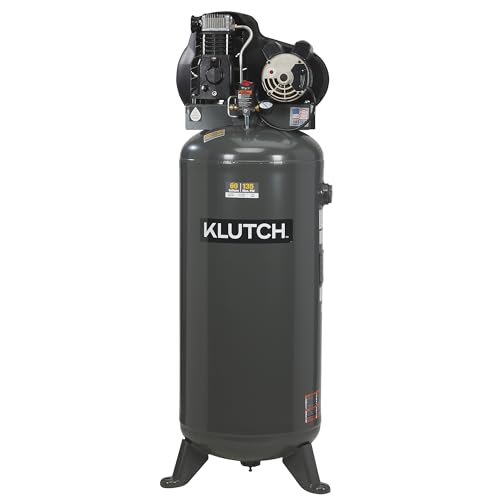
1. Klutch 60-Gallon Vertical Air Compressor — Best overall
The most output per dollar in this set, and the cheapest of the five, which is an unusual pairing.
Best for: a home garage with 230V already run and DIY air tools to feed Skip it if: your only outlets are 120V
Klutch takes the top slot because it is the cheapest of the five and still publishes a real airflow figure. The listing states 9.3 CFM at 90 PSI from a 3.7 HP dual-induction motor, with a 135 PSI ceiling. That is enough for the tools most home garages own, and you pay the least in this group to get it.
The pump description is the part I'd focus on. Klutch says it's a splash oil-lubricated cast iron twin-cylinder unit on a ball bearing-supported crankshaft, which is the construction that separates a compressor you keep from one you replace. The listing also mentions an oil sight gauge and a petcock tank drain, so routine checks don't require dismantling anything.
At 220 lb it's the second-lightest here, which matters more than it sounds when you're getting it through a garage door. The trade-off against the rest of this set is straightforward: single-stage, 135 PSI, and the lowest published airflow of the four machines that state one. It also sells faster than any other pick here, which is worth noting only as a signal of who's buying.
Pros:
- Cheapest of the five picks
- Publishes a clear 9.3 CFM at 90 PSI figure
- Cast iron twin-cylinder pump claimed
- Second-lightest at 220 lb
- Oil sight gauge and petcock drain listed
Cons:
- Lowest published airflow of the four that state one
- 135 PSI ceiling, the lowest here
- Requires 230V, so no standard garage outlet
- No published warranty term
- Only one seller lists it
2. BILT HARD 60 Gallon Air Compressor — Best for heavy use
The highest published airflow in this set, paid for in 357 lb of cast iron.

Best for: long sanding or blasting sessions that starve single-stage pumps Skip it if: you ever need to move it or your floor is suspect
This is the one to buy if the honest answer to "what will I run" is a media blaster or a full day of bodywork. BILT HARD claims 15 SCFM at 90 PSI from a 5 HP single-phase motor, with a 175 PSI maximum. Both figures are the highest stated at a named pressure anywhere in this group.
The reason is the pump. The listing describes a two-stage cast iron design, which compresses air twice and runs cooler at high pressure than the single-stage units here. The tank is described as ASME-certified, matching the California Air Tools and POLAR AIR claims and going beyond what the Klutch and DEWALT listings state.
Then there's the mass. At 357 lb it's 118 lb heavier than the DEWALT and 144 lb heavier than the California Air Tools unit. That's a two-person move at minimum, on a hard floor, and it's the single biggest practical objection to putting this in a home garage rather than a shop. It sits mid-range in price for this set, which is fair for the output, but you're buying a commercial machine and accepting a commercial installation.
Pros:
- Highest stated airflow here at 15 SCFM at 90 PSI
- 175 PSI ceiling, the highest published
- Two-stage cast iron pump claimed
- ASME-certified tank per the listing
- Oil sight glass and accessible drain valve
Cons:
- 357 lb, the heaviest by a wide margin
- No published warranty term
- No published dimensions to plan clearance
- The slowest seller of the five
- Aimed at commercial shops, not garages
3. California Air Tools CAT-60040CAD — Best for families
The only pick here with a published noise figure, and the only oil-free pump.

Best for: an attached garage under living space Skip it if: you want a cast iron oil-lubricated pump
If somebody is sleeping above your garage, this is the pick. California Air Tools states 75 dBA, and it's the only listing in this set that publishes a decibel number at all. The other four say nothing about noise, which means you have no way to compare them on it.
The design behind that claim: twin 2.0 HP motors totalling 4.0 HP, running at 1,680 RPM. Low pump speed is what keeps noise and vibration down. The pump is an oil-free dual piston system, which the listing rates at over 3,000 hours of life, and the EZ-1 automatic drain valve means you don't have to remember to bleed condensate.
It's also the lightest at 213 lb and the shortest at 66 x 21 x 29 in, so it fits under a low ceiling that the DEWALT would not. The catch is the pump material. Oil-free costs you the longevity story that cast iron listings lean on, and 3,000 hours is a fraction of what POLAR AIR claims for its pump. It's the second-most expensive pick here, the warranty runs 1 year, and no airflow figure is published at all.
Pros:
- Only pick with a stated noise figure, 75 dBA
- Lightest here at 213 lb
- Shortest body at 66 x 21 x 29 in
- Automatic drain valve, no manual bleeding
- Oil-free, so no oil changes
Cons:
- No published CFM figure anywhere in the listing
- Pump life claimed at 3,000 hours, the lowest stated
- 1 year warranty, shorter than DEWALT's
- Second-highest price position here
- Listed as portable despite 213 lb
4. DEWALT 60 Gallon Vertical Air Compressor — Best for beginners
The most complete spec sheet in the set, with the longest published warranty.

Best for: a first stationary compressor with a written warranty Skip it if: ceiling clearance is under about 7 feet
For a first big compressor, the thing you want is fewer unknowns, and DEWALT publishes more than anyone here. You get a 2 Year Limited Manufacturer warranty, dimensions of 78 x 24 x 24 in, a 239 lb weight, and a model number of DXCM601.COM. Two of the other four publish neither a warranty nor dimensions.
The performance claims are solid for home work: 3.7 HP, a 155 PSI maximum, and DEWALT states 13.4 SCFM at 40 PSI with an 11-plus figure at higher pressure. That sits between the Klutch and the BILT HARD, and the 155 PSI ceiling is 20 PSI above the Klutch. The pump is oil lubricated, and the listing calls out a 240V supply.
Now the height. At 78 in tall, this needs a genuine 7-foot clearance plus room to work above it, and that rules out plenty of garages with low joists or a door track in the way. It's the second-cheapest of the five, sits in the entry price position, and is the second-slowest seller here. The 24 x 24 in base is a bigger square footprint than the California Air Tools unit too.
Pros:
- 2 Year Limited Manufacturer warranty, longest published
- Full dimensions published at 78 x 24 x 24 in
- 155 PSI ceiling, 20 PSI above the Klutch
- Second-cheapest pick here
- Oil lubricated pump per the listing
Cons:
- 78 in tall, too tall for low-clearance garages
- Airflow at 90 PSI stated only as "11-plus"
- Needs a 240V dedicated circuit
- 239 lb, heavier than three other picks
- Only one seller lists it
5. POLAR AIR Industrial 3-Cylinder Silent Air Compressor — Best premium
A 50,000-hour pump claim and 19 CFM, on the thinnest spec sheet in the set.

Best for: near-continuous shop duty at low pump speed Skip it if: you want published weight and dimensions before you commit
POLAR AIR is the most expensive pick here and it makes the boldest longevity claim: a splash-lubricated cast iron pump rated for 50,000 hours. Set that against the 3,000-hour figure California Air Tools publishes and the gap is enormous, though both are manufacturer numbers rather than anything standardised.
The three-cylinder layout is what separates it. POLAR AIR claims 19 CFM from a 5 HP single-phase motor turning at 1,750 RPM, and low RPM is the same principle that makes the California Air Tools unit quiet. The tank is described as ASME and CRN certified with ETL electrical certification, and the listing says the unit is assembled and tested in the United States.
The problem is what isn't there. No weight, no dimensions, no warranty term, and the 19 CFM figure appears without a stated pressure, which makes it hard to line up against the BILT HARD's 15 SCFM at 90 PSI. For the highest price in this group you get the fewest verifiable numbers, and that's a real cost when you're planning a permanent installation in a fixed space.
Pros:
- 50,000-hour pump life claimed, highest here
- Three-cylinder design, 19 CFM claimed
- 1,750 RPM motor for cooler, quieter running
- ASME, CRN and ETL certifications listed
- Assembled and tested in the USA per the listing
Cons:
- No published weight or dimensions
- 19 CFM stated without a reference pressure
- No published warranty term
- Highest price position in the set
- Needs 230V single-phase power
What running one in a garage really involves
Nobody's listing tells you this part, so here it is.
- The circuit. Three of these five specify 230V or 240V. That's a dedicated breaker and a new run, and it is not a weekend job unless you already do electrical work.
- The floor. At 213 lb to 357 lb, these belong on concrete. A wooden garage floor over a crawlspace needs checking.
- Getting it in. The DEWALT stands 78 in tall and arrives on a pallet. Plan the route before it lands.
- Condensate. Tanks collect water and rust from the inside. Klutch, BILT HARD and DEWALT list manual drains. Only California Air Tools lists an automatic one, and that's the difference between a habit you must keep and one you don't.
- Oil. Four of the five use oil-lubricated pumps, so add oil checks to the routine. The California Air Tools unit is oil-free and skips this entirely.
The maintenance load is genuinely light once the machine is in place. Getting it in place is the hard part, and it's the reason I'd fix your electrical situation before you fix on a model.
Which 60 gallon air compressor wins for your situation?
Four flips, each with a threshold you can check tonight.
- Your thirstiest tool needs more than about 10 CFM at 90 PSI. Buy the BILT HARD. Its 15 SCFM claim is the only one in this set that clears that bar with headroom at a stated pressure.
- There's a bedroom above the garage. Buy the California Air Tools unit. It's the only pick with a published decibel figure, and 75 dBA is a number you can plan around.
- Ceiling clearance is under 7 feet. Rule out the DEWALT at 78 in and look at the California Air Tools unit at 66 in tall.
- You want a warranty term in writing before you spend. The DEWALT publishes 2 years. Three of the five publish nothing.
Absent all four of those conditions, the Klutch is the default. It's the cheapest, it publishes real airflow, and the cast iron pump construction it describes is the same basic recipe the expensive picks use.
The verdict
If you're a DIYer with 230V in the garage and a normal list of air tools, buy the Klutch 60-Gallon Vertical Air Compressor. Its claimed 9.3 CFM at 90 PSI covers most home sanders and impact tools, the cast iron twin-cylinder pump is the right construction for a machine you plan to keep, and it costs the least of these five. At 220 lb it's also among the easier ones to get through a garage door.
If you're running air-hungry tools for hours rather than minutes, buy the BILT HARD. Its 15 SCFM at 90 PSI claim and 175 PSI ceiling are both the highest published here, and its two-stage pump is built for exactly that duty cycle. You accept 357 lb and no published warranty in exchange.
The cutoff between them is roughly 10 CFM at 90 PSI. Below that, the Klutch has all the airflow you need and the price advantage decides it. Above it, the Klutch will cycle constantly and the BILT HARD becomes the only sensible choice in this group.
The California Air Tools unit is the exception that overrides both, and its exact advantage is a published 75 dBA figure that no other listing here can match. If noise is the constraint, that number wins the argument on its own.
FAQ
Is a 60 gallon air compressor worth it for a home garage?
A 60 gallon air compressor is worth it if you run continuous-draw tools like sanders, grinders or spray equipment. For nail guns and tyre inflation, it isn't. The deciding factor is the electrical work: three of these five need a 230V or 240V dedicated circuit, and that cost often exceeds what people budget for.
What does more money buy across these five picks?
More money buys pump architecture, not tank size. All five hold 60 gallons. The cheapest pick, Klutch, is single-stage at 135 PSI. The most expensive, POLAR AIR, claims a three-cylinder pump rated for 50,000 hours. In between you're paying for two-stage compression, ASME certification, or in the California Air Tools case, a 75 dBA noise figure.
How much CFM do I need at 90 PSI for DIY work?
The CFM you need at 90 PSI depends on your thirstiest tool plus roughly 30% headroom. Most DIY dual-action sanders sit in the 6 to 9 CFM range, so the Klutch at 9.3 CFM clears it. Media blasters and production spray guns run higher, which is where the BILT HARD's 15 SCFM claim earns its price.
Klutch or DEWALT: which is the better first compressor?
Between Klutch and DEWALT, the split is price against paperwork. Klutch costs less and publishes 9.3 CFM at 90 PSI. DEWALT publishes a 2 Year Limited Manufacturer warranty, dimensions of 78 x 24 x 24 in and a 155 PSI ceiling. Buy the DEWALT if you want fewer unknowns and have 7 feet of clearance. Otherwise, Klutch.
What mistake do first-time buyers make in this category?
The mistake first-time buyers make is shopping tank size and ignoring everything else. All five picks here hold 60 gallons, so gallons decide nothing. Electrical supply, ceiling height and airflow at 90 PSI decide it. The second mistake is skipping the tank drain, which lets water sit and rust the tank from inside.
Start with your breaker panel, not with a model. Open it, count the free slots, and find out whether a 230V circuit is a quick add or a service upgrade. That single answer eliminates or confirms four of these five picks before you spend anything.
Once the power is sorted, the Klutch is the sensible default for a reason that has nothing to do with being cheapest. It publishes the number that matters, 9.3 CFM at 90 PSI, and it describes the cast iron twin-cylinder pump the expensive machines here also rely on. You're buying the same basic engineering for less, and paying up only if your tools genuinely demand more air than that.