Best 60 Gallon Air Compressor When Garage Space Is Tight
A 60-gallon compressor is a permanent installation, not a purchase. Here's which of six stationary models suits a home garage, how much floor space each needs, and why 230V wiring decides the shortlist before CFM does.
The best 60 gallon air compressor for homeowners is the Klutch 60-Gallon Vertical, which pairs a claimed 9.3 CFM at 90 PSI with a 220 lb frame and the lowest price position of these six. If your ceiling is low and your floor space is long, the VEVOR at 59.1 x 28.3 x 20.9 in lies down where the vertical tanks stand up. Get this wrong and you don't just lose money. You bolt 200-plus pounds of steel to a garage slab, wire a 230V circuit to it, and then discover the pump can't keep up with the sander you bought it for.
Best 60 gallon air compressor for homeowners at a glance
| Pick | Airflow claim | Footprint | Price |
|---|---|---|---|
| Best overall Klutch 60-Gallon Vertical Air Compressor |
9.3 CFM @ 90 PSI claim 135 max PSI |
220 lb vertical |
Check Price |
| Best minimal setup DEWALT 60 Gallon Vertical Air Compressor |
11 SCFM @ 90 PSI claim 155 max PSI |
78 x 24 x 24 in 239 lb |
Check Price |
| Best large-capacity VEVOR 60 Gallons Heavy-Duty Air Compressor |
12 SCFM @ 90 PSI claim 145 max PSI |
59.1 x 28.3 x 20.9 in 235.9 lb |
Check Price |
| Best upgrade BILT HARD 60 Gallon Air Compressor |
15 SCFM @ 90 PSI claim 175 max PSI |
357 lb vertical |
Check Price |
| Best for pros California Air Tools CAT-60040CAD |
75 dBA claim 4.0 HP twin motors |
66 x 21 x 29 in 213 lb |
Check Price |
| Best premium POLAR AIR Industrial 3-Cylinder |
19 CFM claim 5 HP, 1750 RPM |
ASME tank vertical |
Check Price |
How the six were screened and weighted
I weighted three things, in this order.
- Published airflow at 90 PSI, weighted heaviest. This is the only figure that predicts whether a tool runs continuously or stutters. Five of the six publish it.
- Installed footprint and weight, weighted second. A compressor you can't get through the garage door is worth nothing. Four of the six publish dimensions.
- What the listing puts in writing, weighted third. A stated warranty, an ASME tank certification, a model number. Two of the six publish a warranty term.
Why that order? Because the failure modes rank the same way. Undersized airflow is the complaint you live with daily. A footprint mistake is the one that costs you a weekend and a friend with a hand truck. A missing warranty only bites years later, if at all.
Everything here is a stationary or semi-stationary 230V unit in the 60-gallon class, sold as a single unit. Only one seller lists each of the six, so there is no marketplace price competition to shop between. That also means comparing them on published data is the only comparison available, since nobody is undercutting anybody on the same listing.
Two picks are single-stage, one is explicitly two-stage, one is oil-free, and one runs three cylinders. That spread is deliberate. The best 60 gallon air compressor for homeowners looks different depending on which of those four architectures fits your garage and your panel.
1. Klutch 60-Gallon Vertical Air Compressor — Best overall
The Klutch delivers the highest airflow-to-price ratio of the six, and at 220 lb it is the second-lightest thing here you can still bolt down and forget.
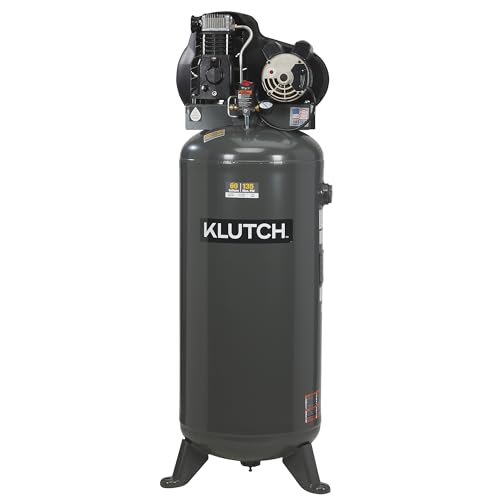
Best for: a home garage running one air tool at a time on a 230V circuit Skip it if: you need two tools running at once
Klutch publishes 9.3 CFM at 90 PSI from a 3.7 HP dual-induction motor, with 135 max PSI. That's the lowest airflow claim of the five that publish one. It's also the cheapest of the six, and 9.3 CFM covers impact wrenches, ratchets, nailers, blow guns and most spray guns comfortably. It does not cover a continuous-duty DA sander.
The pump matters more than the horsepower. Klutch describes a splash oil-lubricated cast iron twin-cylinder pump with a ball bearing-supported crankshaft on a balanced flywheel. Cast iron and splash lubrication is the architecture that lasts in this category, and it's the same basic approach POLAR AIR uses at several times the price position.
At 220 lb it's the lightest of the four picks with a published weight. That matters more than it sounds: a 357 lb unit needs equipment to place, a 220 lb unit needs two people and patience. Maintenance is a manual tank drain, a petcock valve and an oil sight gauge, so you check the oil by looking rather than dipping.
The trade-off is ceiling clearance and airflow headroom. It's a vertical tank with no published dimensions, and 9.3 CFM leaves the least room to grow of anything here.
Pros:
- Cheapest of the six
- Cast iron twin-cylinder splash-lubricated pump
- 220 lb, lightest of the four with published weights
- Oil sight gauge for visual checks
- Sells faster than any other pick here
Cons:
- 9.3 CFM at 90 PSI is the lowest published airflow of the five that state it
- 135 max PSI, the lowest ceiling in the set
- No published dimensions, so clearance is a guess until it arrives
- No stated warranty term
- Single-stage, so no two-stage cooling benefit
2. DEWALT 60 Gallon Vertical Air Compressor — Best minimal setup
The DEWALT is the only pick here that publishes both full dimensions and a warranty term, which makes it the one you can plan an installation around before it ships.

Best for: buyers who want a published warranty and a narrow 24-inch footprint Skip it if: your ceiling is under 7 feet
The numbers you need are all here: 78 x 24 x 24 in, 239 lb, 2 Year Limited Manufacturer warranty, model DXCM601.COM. Nothing else in this set gives you that much before purchase. A 24 x 24 in base is a two-foot square of floor, which is as tidy as a 60-gallon tank gets.
DEWALT claims 11 SCFM at 90 PSI and 13.4 SCFM at 40 PSI from a 3.7 HP motor, with 155 max PSI and an oil-lubricated pump. Note what that means against the Klutch: same stated horsepower, meaningfully more airflow claimed, and 20 more PSI of headroom.
That 78-inch height is the catch. Add clearance to lift the tank upright during installation and you want a garage ceiling closer to eight feet than seven. Measure before you order, because the vertical tanks in this set are the ones that fail on ceiling height rather than floor space.
Against the BILT HARD it gives up airflow and two-stage compression. Against the Klutch it costs more for a warranty and a spec sheet. That's a fair trade if you're installing it yourself and want to know what you're bolting down.
Pros:
- 2 Year Limited Manufacturer warranty, the longest stated here
- Full published dimensions at 78 x 24 x 24 in
- 24-inch square base, narrowest footprint in the set
- 11 SCFM @ 90 PSI claim, mid-pack airflow
- Second-cheapest of the six
Cons:
- 78 in tall, so low garages are out
- Single-stage pump against the BILT HARD's two-stage
- 239 lb, heavier than the Klutch for the same stated 3.7 HP
- Listing colour field reads only "Yellow", with no other finish detail
3. VEVOR 60 Gallons Heavy-Duty Air Compressor — Best large-capacity
The VEVOR is the only pick under 60 inches in its longest dimension, which makes it the answer for a garage with headroom problems.
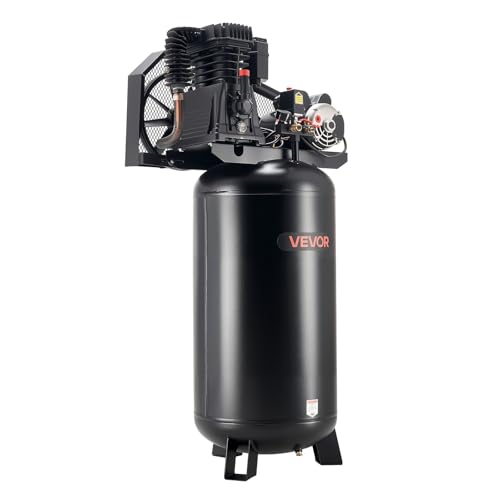
Best for: running two air tools at once from dual outlets Skip it if: you need a published warranty in writing
At 59.1 x 28.3 x 20.9 in and 235.9 lb, this is the geometry outlier. The DEWALT needs 78 inches of vertical clearance. This needs 59.1 inches in its longest direction, roughly two feet less. If your garage has storage shelves, a low door track or a sloped ceiling, that difference decides the purchase on its own.
VEVOR claims 12 SCFM at 90 PSI from a 5 HP motor with 145 max PSI, and a belt-driven pump on a heavy-duty head. The tank is described as 3mm carbon steel with a powder-coated surface. The feature I'd actually use is the dual air outlets: two tools at once, which the Klutch's 9.3 CFM claim can't feed and this one plausibly can.
It's mid-range for this set. The stated 12 SCFM sits above the DEWALT's 11 and below the BILT HARD's 15, and the 145 max PSI splits the difference too.
Two gaps. There's no published warranty term, and unlike the BILT HARD and California Air Tools listings, no ASME tank certification is stated. That's the price of the middle position here.
Pros:
- 59.1 x 28.3 x 20.9 in, shortest longest-dimension in the set
- Dual air outlets for two tools simultaneously
- 12 SCFM @ 90 PSI claim from a 5 HP motor
- 3mm carbon steel tank with powder coating
- Third-cheapest of the six
Cons:
- No stated warranty
- No ASME tank certification in the listing
- 145 max PSI, below the DEWALT, BILT HARD and Klutch ceilings
- Ships with no plug, so wiring is entirely on you
4. BILT HARD 60 Gallon Air Compressor — Best upgrade
The BILT HARD is the only two-stage pump here, and its 15 SCFM at 90 PSI claim is the highest airflow of the four picks that state a figure at that pressure.

Best for: long sessions with a sander or a media blaster Skip it if: you can't move 357 lb into position
Two-stage compression is the real dividing line in this set. BILT HARD describes a cast iron two-stage pump that compresses air twice, which the listing credits with higher efficiency and cooler running. Cooler running is what lets a compressor hold up under a tool that never lets the pump rest.
The claimed numbers back the architecture: 15 SCFM at 90 PSI, 175 max PSI, 5 HP single-phase. That 175 PSI is the highest ceiling of the five picks publishing one, and higher tank pressure means more usable air between pump cycles. The tank is stated as ASME-certified 60-gallon steel, with a user-accessible drain valve and an oil sight glass.
Then there's the weight. 357 lb is 118 lb more than the DEWALT and 137 lb more than the Klutch. This is an appliance delivery, not a two-friends-and-a-hand-truck job, and the listing publishes no dimensions to plan the route with.
It's the slowest seller of the six. Against the Klutch you're paying more and handling far more mass for roughly 60% more claimed airflow. If you're sanding, that's the correct trade. If you're inflating tires and running an impact gun, it isn't.
Pros:
- Only two-stage pump in this set
- 15 SCFM @ 90 PSI claim, highest of those publishing that figure
- 175 max PSI, highest pressure ceiling here
- ASME-certified 60-gallon steel tank
- Oil sight glass and accessible drain valve
Cons:
- 357 lb, heaviest pick by 118 lb
- No published dimensions for planning clearance
- No stated warranty term
- The slowest seller of the six
5. California Air Tools CAT-60040CAD 4.0 HP — Best for pros
This is the only oil-free, noise-rated pick here, and at a claimed 75 dBA it's the one you can run in an attached garage without emptying the house.

Best for: an attached garage where noise matters most Skip it if: you want an oil-lubricated cast iron pump
Noise is the specification nobody else in this set publishes, and California Air Tools builds the whole listing around it. The claim is 75 dBA from twin 2.0 HP motors turning at 1680 RPM, which is roughly conversational-room territory rather than shop-floor territory. Lower RPM also means less wear, which is the same logic POLAR AIR applies at 1750 RPM.
The pump is oil-free dual piston, rated by the manufacturer at over 3000 hours. That number is worth reading against the POLAR AIR claim of 50,000 hours on a cast iron splash-lubricated pump. Oil-free means no oil changes and no sight gauge to watch. It also means a shorter stated service life.
At 213 lb it's the lightest pick here, with dimensions of 66 x 21 x 29 in, so it's a foot shorter than the DEWALT and narrower at 21 inches. The factory-installed EZ-1 automatic drain valve with a preset timer is the feature I'd value most day to day, because manual tank draining is the maintenance step everyone skips.
The warranty is 1 Year Limited, the shortest stated in this set, and no CFM at 90 PSI figure is published.
Pros:
- 75 dBA claim, only noise figure published here
- 213 lb, lightest pick in the set
- Automatic timed drain valve, no manual draining
- 60-gallon ASME steel tank
- 66 x 21 x 29 in, narrower than the vertical tanks
Cons:
- 3000-hour stated pump life, far below POLAR AIR's claim
- 1 Year Limited Warranty, shortest stated here
- No published CFM at 90 PSI to compare
- Second-most expensive pick in the set
6. POLAR AIR Industrial 3-Cylinder Silent Air Compressor — Best premium
POLAR AIR claims 19 CFM and a 50,000-hour pump, the two biggest numbers in this comparison, from the only three-cylinder design here.

Best for: someone buying once and keeping it for decades Skip it if: you want published weight and dimensions before you commit
The headline claims are 19 CFM from a 5 HP single-phase motor and a splash-lubricated cast iron pump rated at 50,000 hours. Set that against California Air Tools' stated 3000 hours and you see the gap between an oil-free pump and a cast iron one. POLAR AIR also runs at 1750 RPM, which it credits with cooler, quieter operation and less vibration.
Certification is where this listing separates itself. The tank is described as 60-gallon ASME/CRN certified vertical, with ETL electrical certification, and POLAR AIR states the units are assembled and tested in the United States. That's the most paperwork any of these six puts on the page.
It's the most expensive pick here, and the specification list is the thinnest. There is no published weight, no dimensions and no warranty term. A three-cylinder 5 HP unit will be heavy and tall, but I won't guess at figures the listing doesn't state, and you shouldn't plan a garage corner around a guess either.
For a homeowner, 19 CFM is more air than most home projects consume. You're buying the pump rating, not the airflow.
Pros:
- 19 CFM claim, highest airflow figure in the set
- 50,000-hour cast iron pump rating claimed
- ASME/CRN tank plus ETL electrical certification
- Only three-cylinder design here
- 1750 RPM low-speed motor for cooler running
Cons:
- No published weight or dimensions at all
- No stated warranty term
- Most expensive pick in this comparison
- Only one seller lists it, with no alternative source
- Airflow far exceeds typical home garage demand
Does a 60 gallon air compressor actually suit a home garage?
Honest answer: sometimes not. Amazon's search returns these six for a homeowner query, but nothing in these listings is specified for residential use, and the modifier isn't something the products themselves address. Every one of these is a 230V machine. Four of the six describe themselves as industrial, commercial or professional equipment.
So judge it for yourself against three things:
- Your electrical panel. These are 230V units, and the VEVOR ships with no plug. If your garage has only 120V outlets, add an electrician's bill to every price you see.
- Your ceiling. The DEWALT stands 78 in tall. Standing a vertical tank upright needs more clearance than its final height.
- Your actual tool list. If your heaviest tool is an impact wrench, a 60-gallon tank is generous. If it's a DA sander, it's the right size.
The best 60 gallon air compressor for homeowners is whichever one your panel and your ceiling permit. Everything else is secondary.
How much floor and ceiling space does each one need?
Four of the six publish dimensions. Here's how they differ, in the terms that matter when you're standing in the garage with a tape measure.
The DEWALT is the tall one: 78 x 24 x 24 in. Two feet square on the floor, six and a half feet in the air. The California Air Tools unit is 66 x 21 x 29 in, so a foot shorter and 21 inches across at its narrowest. The VEVOR is the outlier at 59.1 x 28.3 x 20.9 in, meaning nothing about it exceeds five feet.
The Klutch, BILT HARD and POLAR AIR listings publish no dimensions. All three are described as vertical, which tells you the shape but not the clearance.
Weight is the other half of the problem:
- California Air Tools: 213 lb
- Klutch: 220 lb
- VEVOR: 235.9 lb
- DEWALT: 239 lb
- BILT HARD: 357 lb
- POLAR AIR: not published
Anything above 300 lb needs a pallet jack or an appliance dolly. Below 240 lb, two capable people and a proper hand truck will do it. That 357 lb figure on the BILT HARD is the single biggest logistical difference in this group.
What the CFM number really tells you
Most compressor guides compare horsepower. That's the wrong number. Horsepower ratings in this category are inconsistent across brands, and two units listed at 5 HP here claim different airflow: BILT HARD says 15 SCFM at 90 PSI, VEVOR says 12 SCFM at 90 PSI. Same stated horsepower, 25% difference in air.
CFM at 90 PSI is what decides the purchase, because 90 PSI is where most air tools are rated. Read it against the tool you actually own:
- Under 6 CFM covers nailers, blow guns, tire inflation and staplers. Any of these six clears that easily.
- 6 to 10 CFM covers impact wrenches, ratchets, die grinders and most HVLP spray guns. The Klutch's claimed 9.3 CFM lands here.
- 10 to 14 CFM covers cut-off tools and short sanding sessions. DEWALT at 11 and VEVOR at 12 sit in this band.
- 14 CFM and up covers continuous-duty sanders and small media blasters. BILT HARD's 15 and POLAR AIR's 19 are the picks here.
One warning about the arithmetic. All these airflow numbers are manufacturer claims, not standardised third-party measurements, and California Air Tools publishes no CFM at 90 PSI at all. Buy roughly 30% more airflow than your tool's rating, because a pump running flat-out never gets to cool.
What more money buys across these six
Move up from the cheapest to the most expensive here and you're not buying more gallons. All six hold 60. You're buying three specific things.
At the entry positions, Klutch and DEWALT, you get a single-stage cast iron pump and enough airflow for intermittent tool use. DEWALT adds the 2-year warranty and a published spec sheet for a small step up from the Klutch.
In the middle, VEVOR and BILT HARD, the money goes into airflow and pump architecture. VEVOR adds dual outlets and 12 SCFM. BILT HARD adds a genuine two-stage pump, 175 max PSI and an ASME tank, and takes on 357 lb doing it.
At the top, California Air Tools and POLAR AIR, the money goes into things you can't measure with a pressure gauge. California Air Tools sells quiet: 75 dBA and an automatic drain. POLAR AIR sells longevity and certification: a claimed 50,000-hour pump, an ASME/CRN tank, ETL electrical certification and US assembly.
If you're a homeowner, the honest answer is that the middle tier buys the most useful capability per step up. The premium tier buys attributes that matter more to a shop running eight hours a day than to a garage running eight hours a month.
What the listings do not tell you
Gaps in the published data are worth knowing before you commit.
- No noise figure on five of six. Only California Air Tools publishes one, at a claimed 75 dBA. The others are silent on the subject, and an unrated single-stage compressor in an attached garage is loud enough to end conversations upstairs.
- No warranty stated on four of six. DEWALT lists 2 years, California Air Tools lists 1 year. Klutch, VEVOR, BILT HARD and POLAR AIR publish no term at all.
- No dimensions on three of six. Klutch, BILT HARD and POLAR AIR give you nothing to measure against.
- No duty cycle anywhere. Not one of these six states how long it can run in a given hour.
- Voltage and plug details are thin. DEWALT mentions 240V. VEVOR states 230V 60Hz with no plug. Klutch and POLAR AIR indicate 230V. Confirm your circuit before ordering.
Only one seller lists each of these six, so there's no second listing to cross-check a spec against. What's on the page is what you have.
The verdict
If you run one air tool at a time in a detached garage, buy the Klutch. It's the cheapest of the six, the claimed 9.3 CFM at 90 PSI feeds impact tools and spray guns, and at 220 lb you can actually get it into position. It's also the one buyers choose most often here, which at least suggests the balance lands where homeowners want it.
If your heaviest tool is a sander or a blaster, buy the BILT HARD. Two-stage compression is the real capability gap in this set, and 15 SCFM at 90 PSI with 175 max PSI is what separates a compressor that keeps up from one that gasps. You pay for it in mass: 357 lb, with no published dimensions to plan around.
The cutoff is 12 CFM. Below that demand, the Klutch's price advantage wins and the extra airflow is money spent on air you'll never use. Above it, single-stage pumps run hot and cycle constantly, and the BILT HARD's second compression stage earns its price.
Two conditions override both. If your ceiling can't take 78 inches of vertical tank, the VEVOR at 59.1 x 28.3 x 20.9 in is the only pick here that lies down. If the compressor shares a wall with a bedroom, California Air Tools' claimed 75 dBA is the only noise figure in this set, and that makes it the default regardless of airflow.
FAQ
Is a 60 gallon air compressor worth it for a homeowner?
A 60 gallon air compressor is worth it for a homeowner who owns air tools rated above 5 CFM and has 230V available in the garage. Below that, a smaller portable unit does the same work for less money and less installation. The tank size buys longer run times between pump cycles, which matters for sanding and spraying rather than tire inflation.
Which is the best value 60 gallon air compressor for homeowners here?
The best value 60 gallon air compressor for homeowners in this set is the Klutch. It holds the cheapest price position of the six while claiming 9.3 CFM at 90 PSI from a cast iron twin-cylinder splash-lubricated pump, the same pump architecture POLAR AIR uses at the top of this comparison. You give up 20 PSI of headroom against the DEWALT and any stated warranty.
Do I need 230V wiring for these compressors?
You need 230V wiring for every pick in this comparison. DEWALT lists 240V, VEVOR states 230V 60Hz and ships with no plug, and Klutch and POLAR AIR are 230V units. A standard 120V garage outlet will not run any of them. Budget for an electrician to add a dedicated circuit, and confirm your panel has capacity before ordering.
Klutch or BILT HARD: which should I buy?
Klutch or BILT HARD comes down to your heaviest tool. Klutch claims 9.3 CFM at 90 PSI, weighs 220 lb and costs the least of the six, which suits intermittent impact and spray work. BILT HARD claims 15 SCFM at 90 PSI with a two-stage pump and 175 max PSI, for continuous sanding. It also weighs 357 lb, so plan the delivery.
What's the most common mistake buying a stationary compressor?
The most common mistake buying a stationary compressor is measuring floor space and forgetting ceiling clearance. The DEWALT stands 78 in tall, and standing a vertical tank upright during installation needs more room than its finished height. The second mistake is choosing on horsepower: two 5 HP units here claim 15 and 12 SCFM respectively, so the ratings aren't comparable.
Measure the garage first, check the panel second, and only then compare airflow. That order saves the most grief. For most home garages the Klutch is the right default because it asks the least of your space, your helpers and your wallet while still claiming 9.3 CFM at 90 PSI, which is more air than a typical weekend project consumes. Step up to the BILT HARD only when a tool on your bench needs air continuously rather than in bursts. That single distinction, burst versus continuous, decides this category more cleanly than any other.
Last updated: September 7, 2026. Product availability re-checked.
This page contains affiliate links. As an Amazon Associate we earn from qualifying purchases, at no extra cost to you.