Best Affordable Laser Level: Motovera Leads Five
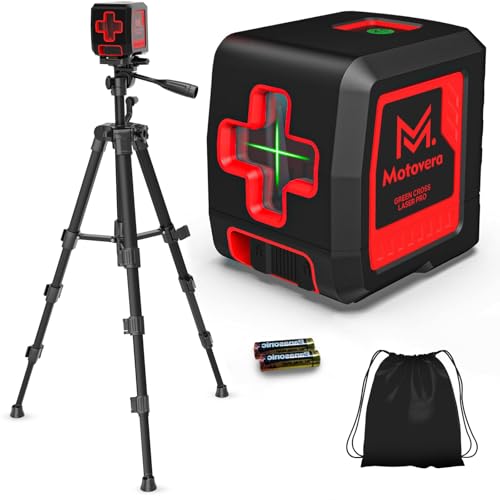
Five affordable laser levels compared on beam colour, range, self-levelling tolerance and kit. Motovera's 100 ft green cross-line leads, with four runners-up for tighter budgets and specific jobs.

By Taylor DavidsonUpdated 14 min read
On this page
- Best affordable laser level at a glance
- How I screened this shortlist
- 1. Motovera Self Leveling Laser Level 100ft — Best overall
- 2. Huepar 9011G Laser Level — Best for pros
- 3. PREXISO Multi Surface Laser Level LED Light Vial — Best minimal setup
- 4. DegLasers Self Leveling Laser Level with Tripod — Best upgrade
- 5. AikTryee Laser Level Line Tool — Best budget pick
- Green beam or red: which one earns the extra spend?
- What the price positions actually buy in this set
- Do you need self-levelling for picture hanging?
- What to check before your first project
- The verdict
- FAQ
The best affordable laser level is the Motovera Self Leveling Laser Level 100ft, a green cross-line kit with self-levelling, IP54 rating and a tripod in the box. If you want tighter accuracy on trim and tile in a single room, the Huepar 9011G is the better pick at a claimed ±1/16 in at 16.4 ft. The 30-second shortlist: Motovera for whole-room jobs, Huepar for close-in precision, and the AikTryee red line for pure picture-hanging duty.
Best affordable laser level at a glance
| Pick | Beam & range | Self-levelling | Price |
|---|---|---|---|
Best overall Motovera Self Leveling Laser Level 100ft |
Green cross-line, 100 ft claim | Yes, with manual lock | Check Price |
Best for pros Huepar 9011G Laser Level |
Green cross-line, 100 ft claim | Yes, ±4° range | Check Price |
Best minimal setup PREXISO Multi Surface Laser Level |
3 lines on surface, 30 ft claim | No, bubble vials + LED | Check Price |
Best upgrade DegLasers Green Cross Line Laser |
Green cross-line, 100 ft claim | Yes, within 3.5° | Check Price |
Best budget pick AikTryee Laser Level Line Tool |
Red line, indoor use | No, three bubble vials | Check Price |


How I screened this shortlist
I compared the five listings on the specifications a shopper can actually use to make a decision: beam colour, claimed range, self-levelling behaviour, weight, dimensions and what ships in the box.
The word "affordable" is doing a lot of work here. Amazon's search returns everything from a pocket bubble-and-laser combo to a full green cross-line kit with a tripod, and the price positions inside this set span the entry to the premium end. So I have not promised a single dollar figure. Instead, I have flagged which pick sits where in the set and what that position appears to buy in extra capability.
Three things I refused to guess at:
- Battery life. No listing here gives a run-time figure.
- Accuracy at range. Only two picks publish a tolerance with units.
- Real-world beam visibility outdoors. Manufacturers claim brightness multiples; that is not the same as a measured lux figure.
Where a listing states a number, I use it. Where it does not, I write around the gap rather than filling it with a plausible-sounding invention.
1. Motovera Self Leveling Laser Level 100ft — Best overall
A self-levelling green cross-line kit with a tripod in the box makes this the most complete affordable laser level for whole-room work.
Best for: one-room renovators who want a self-levelling green cross-line kit that works on and off a tripod Skip it if: you only ever hang the odd picture and never leave one room
The Motovera is the only pick in this set that pairs a green cross-line beam, self-levelling with a manual-lock override, an IP54 rating and a tripod in a single kit. Motovera claims a 100 ft range and lists four brightness modes and a pulse function for use with a detector. The body measures 0.1 x 5.5 x 3.4 in and the model is LL-T2.
That combination is what earns the top slot. Every other green-beam pick here either drops the tripod, drops the IP54 rating, or drops both. The Huepar 9011G matches the beam colour and the 100 ft range claim, but ships without a tripod. The DegLasers matches the beam and adds pulse mode, but its self-levelling window is tighter at 3.5°.
The trade-off is straightforward: this is the most expensive pick here. If you only need a single line to hang a picture, that spend is wasted. If you are tiling a floor or setting a chair rail around a room, the tripod and the self-levelling window earn it back on the first afternoon.
Pros:
- Green cross-line beam with a 100 ft claim
- Tripod, self-levelling and manual lock in one kit
- IP54 rating listed by Motovera
- Pulse mode for outdoor detector use
- Four brightness modes
Cons:
- Most expensive pick in this set
- No published accuracy figure with units
- Only one seller lists it
2. Huepar 9011G Laser Level — Best for pros
The Huepar publishes the tightest accuracy figure in this set, at ±1/16 in at 16.4 ft.

Best for: trim carpenters and tilers who quote tight tolerances and work in one room at a time Skip it if: you want a tripod in the box
Huepar quotes ±1/16 in at 16.4 ft (±1.5 mm at 5 m), a 110° field of view for the cross lines and a 100 ft range for the beam. The pendulum self-levels within ±4° when unlocked and flashes when it is outside that window. The unit itself is small, at 0.1 x 2.9 x 2.8 in, and it sits at the entry end of this set on price.
That price position is the reason it lands here rather than at the top. You get the accuracy figure and the wider self-levelling window of the Motovera, in a smaller body, for less money. What you give up is the tripod, the IP54 rating and the fourth brightness mode. For a pro who already owns a tripod and works indoors, none of that matters. For a first-time buyer building a kit from scratch, the missing tripod means a second purchase.
The 9011G also uses a slide-to-unlock that doubles as the power switch, which is one fewer button to remember on a ladder.
Pros:
- Published accuracy of ±1/16 in at 16.4 ft
- Wider ±4° self-levelling window than the DegLasers
- Compact 2.9 x 2.8 in body
- Entry price position in this set
- 110° cross-line field of view
Cons:
- No tripod included
- No IP rating listed
- Only one seller lists it
3. PREXISO Multi Surface Laser Level LED Light Vial — Best minimal setup
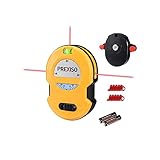
A three-line surface laser with a wall-mount base and LED-lit vials, aimed at renters who own no other tools.
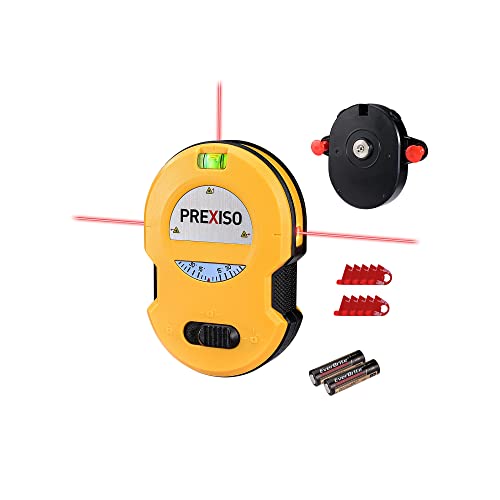
Best for: renters mounting shelves and gallery walls without owning any other tools Skip it if: you need a beam past 30 ft
The PREXISO is the odd pick out here, and deliberately so. It is a surface laser, not a self-levelling cross-line, and PREXISO lists a 30 ft range rather than the 100 ft the green-beam picks claim. What you get instead is a one-switch operation for three lines, an angle dial that adjusts from 15° to 75° with LED lighting, and a wall-mount base with pins, adhesive strips and pin options.
This is the pick I would hand a renter. It sticks to the wall, projects two lines at a true 90° for aligning a shelf or a row of frames, and does not ask you to level a pendulum on a tripod. The body is small at 4.72 x 4.49 in and light at 0.79 lb.
The obvious loss is range. Anything past 30 ft is out of scope, and there is no self-levelling to catch you if the mount slips off level. This one sits in the middle of the set on price, and it is the fastest seller of the five in its category, which suggests the minimal-setup angle finds its buyer.
Pros:
- Wall-mount base with three fixing options
- Angle dial from 15° to 75° with LED lighting
- Compact 4.72 x 4.49 in body at 0.79 lb
- The fastest seller of the five here
- One-switch operation for three lines
Cons:
- 30 ft range only, per PREXISO
- No self-levelling, only bubble vials
- Not a substitute for a cross-line laser on tile
4. DegLasers Self Leveling Laser Level with Tripod — Best upgrade
A green cross-line laser with pulse mode, a dedicated tripod and a published accuracy figure of ±1/9 in at 33 ft.

Best for: flooring and tile jobs where you want pulse mode for a detector outdoors Skip it if: you already own a comparable green line laser
DegLasers publishes ±1/9 in at 33 ft (±1.5 mm at 10 m), an Osram green diode described as 3x brighter than a red laser, three brightness levels and pulse mode for use with a detector. Self-levelling operates within 3.5°, and the kit ships with a dedicated tripod and a 1/4-inch mount thread. The unit weighs 0.6 lb.
Against the Motovera, the DegLasers is the second-cheapest of the three green cross-line kits and adds a published accuracy figure that the Motovera does not. Against the Huepar, it adds the tripod and the pulse mode, but its self-levelling window is narrower at 3.5° versus ±4°.
The catch is the slowest sales rank in this set, which means fewer buyers than the alternatives. Two sellers list it, which is more than any other pick here. There is also no IP rating published, so I would keep this one indoors.
Pros:
- Published accuracy of ±1/9 in at 33 ft
- Pulse mode for detector use
- Dedicated tripod and 1/4-inch mount thread
- Two sellers stock it
- Light body at 0.6 lb
Cons:
- Narrower 3.5° self-levelling window than the Huepar
- No IP rating listed
- Slowest seller of the five here
5. AikTryee Laser Level Line Tool — Best budget pick
The cheapest of the five, with a red beam, three bubble vials, an 8 ft tape and a lifetime warranty.

Best for: first-time DIYers hanging shelves, frames and curtain rods indoors Skip it if: you need a green beam or work beyond a single room
The AikTryee is the cheapest of the six, and it is the only pick here with a stated lifetime warranty. It projects a red line, includes three bubble vials for level, plumb and 45°, and packs an 8 ft tape measure with imperial and metric graduations down to 1/32 in and 1 mm. The whole thing is 3.34 x 1.1 in and weighs 6 oz.
This is a level for hanging things on walls. AikTryee describes it for hanging shelves, cabinets and tiles indoors, and the specifications back that use case. It has no self-levelling and no published range, so I would treat it as a short-run alignment tool rather than a room-scale laser. A green-beam pick will always be easier to see, even indoors under bright lights.
What the AikTryee wins on is the total cost of getting started. There is no tripod to buy, no batteries to worry about beyond what ships, and the built-in tape saves a second reach into the drawer. For someone who has never owned a laser level, that is a low bar to entry.
Pros:
- The cheapest pick in this set
- Lifetime warranty listed
- Built-in 8 ft tape with 1/32 in and 1 mm graduations
- Three bubble vials for 0°, 45° and 90°
- 6 oz body fits a pocket
Cons:
- Red beam, harder to see than green
- No self-levelling
- No published range figure
Green beam or red: which one earns the extra spend?
The single biggest split in this set is beam colour. Four of the five picks use a green diode; one uses red. Motovera claims its green beam is 4x brighter than a standard red laser. Huepar claims 2x. DegLasers claims 3x. The exact multiple is marketing copy, but the direction of travel is real: green sits closer to the peak sensitivity of the human eye, and it reads as more visible under the same room lighting.
That matters most in two situations. First, on a bright day near a window, where a red line washes out. Second, on longer runs, where any beam thins as it travels.
If you work in a windowless bathroom hanging a single shelf, red is fine. If you are setting tile in a sunlit kitchen or running a chair rail across a living room, green is worth the price step. That single decision explains most of the spread in this set, and it is the reason the two entry-priced picks split into a green cross-line (Huepar) and a red bubble-vial tool (AikTryee).
What the price positions actually buy in this set
The five picks sit across three price positions. Reading down the set from cheapest to most expensive, here is what each step adds:
- Entry (AikTryee). Red beam, bubble vials, an 8 ft tape. No self-levelling, no tripod. Indoor short-run work only.
- Entry (Huepar). Green cross-line, ±4° self-levelling, a published ±1/16 in accuracy figure. No tripod, no IP rating.
- Mid (PREXISO). Three surface lines, wall-mount base, angle dial. 30 ft range, no self-levelling.
- Premium (DegLasers). Green cross-line, pulse mode, dedicated tripod, ±1/9 in accuracy figure at 33 ft.
- Premium (Motovera). Green cross-line, IP54 rating, tripod, four brightness modes.
The two steps that buy the most capability are the jump from red to green (AikTryee to Huepar) and the jump from a bare unit to a kit with a tripod (Huepar to DegLasers or Motovera). The step from mid to premium mostly buys weather resistance and the fourth brightness mode.
Do you need self-levelling for picture hanging?
Self-levelling is the feature buyers overpay for when they only hang pictures. A pendulum laser is designed to catch a small tilt in the housing and correct it, so the projected line stays true even when the tripod is on an uneven floor. For a single frame on a nail, three bubble vials do the same job, and the AikTryee has three.
Where self-levelling earns its keep is on jobs where the laser moves. Setting cabinet uppers, running tile across a wall, marking outlet heights along a room. Every time you slide the tool along a rail or a shelf, self-levelling reprojects a true line without a bubble check.
The rule of thumb: if the laser stays put for the whole job, you can skip self-levelling. If it moves, you cannot. That single question is often the honest divider between a budget pick and a mid-range one.
What to check before your first project
Three checks worth doing before you even open the tripod.
- Battery type. None of these listings publishes a run-time figure, so I would buy a fresh set of the specified batteries and a spare pack before your first job.
- Mount thread. The DegLasers lists a 1/4-inch thread. If you already own a camera tripod, that thread matches, and you have a backup mount.
- Pendulum lock. Green cross-line lasers here ship with a manual lock for transport. Locking the pendulum before you move the tool between rooms is what keeps the accuracy figure honest.
The one non-obvious check is line orientation. A cross-line laser projects a horizontal and a vertical line at 90°. If you only need horizontal, some models let you shut the vertical line off, which reduces visual clutter on a busy wall. Look at the mode list on the listing before you buy.
The verdict
If you want one affordable laser level that will handle picture-hanging, shelf-mounting and a small tiling job in a single room, buy the Motovera Self Leveling Laser Level 100ft. It is the only pick in this set that pairs a green cross-line beam, self-levelling with a manual lock, an IP54 rating and a tripod in one kit, and Motovera claims a 100 ft range.
If your work is close-in and you need a published accuracy figure, the Huepar 9011G is the sharper buy at ±1/16 in at 16.4 ft, with a wider ±4° self-levelling window. The cutoff is the tripod: if you already own one, the Huepar wins on both accuracy and price position; if you do not, the Motovera lands in kit form and saves you a second purchase.
The other three picks are conditional. The DegLasers earns the upgrade slot when pulse mode matters. The PREXISO earns the minimal-setup slot for renters. The AikTryee earns the budget slot for anyone who has never owned a laser level and just wants to hang a shelf straight. Do not read those as consolation prizes: each one wins its scenario outright.
FAQ
Is a laser level worth it for occasional DIY?
A laser level is worth it for occasional DIY if you hang more than one frame at a time, mount shelves, or tile any surface. A red-beam picture-hanging tool like the AikTryee costs little and takes minutes to learn. A green cross-line kit like the Motovera is worth the step up if you plan a room refresh where the laser moves along a wall.
What is the difference between a red and a green laser level?
The difference between a red and a green laser level is visibility. Green sits closer to the eye's peak sensitivity, so the line reads as brighter under the same lighting. Manufacturers here claim green beams from 2x to 4x brighter than red. In practice, green is worth the price step for sunlit rooms and long runs; red is fine for a shelf in a hallway.
Do I need self-levelling for hanging pictures?
You do not need self-levelling for hanging pictures. A tool with three bubble vials, like the AikTryee, will hold true for a single frame on a nail. Self-levelling earns its keep on jobs where the laser moves along a rail or shelf, because the pendulum reprojects a true line without a bubble check between marks.
Huepar 9011G or Motovera: which one first?
Huepar 9011G or Motovera comes down to whether you own a tripod. The Huepar publishes a tighter accuracy figure at ±1/16 in at 16.4 ft and sits at the entry price position, but it ships without a tripod. The Motovera is the more expensive pick, and it lands as a complete kit with IP54 and four brightness modes. Own a tripod already? Buy the Huepar first.
What accuracy do I actually need in a laser level?
The accuracy you actually need in a laser level depends on the job. For frames and shelves, anything within ±1/9 in at 33 ft, which DegLasers publishes, is fine. For tile and trim, the ±1/16 in at 16.4 ft the Huepar publishes is tighter and safer. Anything without a published figure with units is a guess, and I would treat it as such.
Buy the tool for the job in front of you, not the job you might do next year. The Motovera earns the top slot because it covers the widest span of realistic jobs in one kit, from picture-hanging to a small tiling run, with a green beam that stays visible in a bright room and a tripod that means you can walk it to the next wall without buying a second accessory. Start there if you are building a kit from scratch. If your work is narrower, one of the four runners-up is very likely a better fit, and this guide names which one and why. Either way, the first thing to do after unboxing is lock the pendulum before it leaves the counter.