Best Attic Insulation Material: AES Foil Leads
Seven attic insulation products compared on coverage, reflectivity claims and where each one actually belongs. Radiant barriers cover the deck; hatch covers seal the one gap most homeowners never treat.

By Taylor DavidsonUpdated 19 min read
On this page
- Best attic insulation material at a glance
- How I screened these attic insulation material picks
- Radiant barrier or bulk insulation: which does what?
- 1. AES US Energy Products Radiant Barrier Insulation 1000 — Best overall
- 2. Houseables Radiant Barrier Insulation — Best premium
- 3. DGSL Attic Door Insulation Cover — Runner-up
- 4. INSULATION MARKETPLACE SmartSHIELD — Best for beginners
- 5. AES NASA TECH 500 sqft Radiant Barrier — Best for heavy use
- 6. Bevel Energy Attic Door Insulation Cover — Best for families
- 7. dojobkinb Reflective Insulation Roll — Best budget pick
- How much roll do you actually need?
- The attic hatch nobody insulates
- What the listings do not tell you
- The verdict
- FAQ
The best attic insulation material in this group is the AES US Energy Products Radiant Barrier Insulation 1000, because one roll spans 1,000 sq ft at 4 ft wide and the listing claims a 99.7% reflective value. If your attic problem is the pull-down hatch rather than the roof deck, the DGSL Attic Door Insulation Cover at 25 x 54 x 11 in is the better buy. Cheap here means a 10 ft patch roll. Mid-range means a sealed hatch cover. Premium means enough foil to line an entire rafter run in a single pass.
Best attic insulation material at a glance
| Pick | Coverage | Reflectivity claim | Price |
|---|---|---|---|
| 1,000 sq ft 250 x 4 ft |
99.7% claim | Check Price | |
Best premium Houseables Radiant Barrier Insulation |
1,000 sq ft 250 x 4 ft |
>97% claim | Check Price |
Runner-up DGSL Attic Door Insulation Cover |
Hatch cover 25 x 54 x 11 in |
97% claim | Check Price |
Best for beginners INSULATION MARKETPLACE SmartSHIELD |
40 sq ft 48 in x 10 ft |
95% claim | Check Price |
Best for heavy use AES NASA TECH 500 sqft Radiant Barrier |
500 sq ft 125 x 4 ft |
None published | Check Price |
Best for families Bevel Energy Attic Door Insulation Cover |
Hatch cover 25 x 54 in |
None published | Check Price |
Best budget pick dojobkinb Reflective Insulation Roll |
About 39 sq ft 47 in x 10 ft |
Not stated | Check Price |




How I screened these attic insulation material picks
I started from the listing data and nothing else. Every product here publishes either a coverage figure, a finished size, or both, and I lined those numbers up side by side before I ranked anything.
Three things got picks cut:
- No usable size. If a listing gives no length, width or finished dimension, you cannot plan a job around it.
- Wrong job entirely. Foam board strips and window film kits show up in the same searches. They do not line a roof deck.
- Duplicate rolls at the same width. Where two listings offered near-identical 48 in foil, I kept the one with the stronger published claim or the wider coverage.
What survived splits cleanly into two families. Four are reflective rolls, ranging from a 10 ft patch up to 1,000 sq ft. Two are hatch covers at the same 25 x 54 in footprint. One, the AES NASA TECH roll, sits in the middle at 500 sq ft.
A note on the search itself. "Material" pulls in accessories alongside sheet goods, and Amazon does not filter for that. So this is a roundup of what the category actually returns, hatch covers included, rather than a pretence that all seven are the same kind of product. That distinction matters more than any single specification, and it drives the whole ranking below.
Radiant barrier or bulk insulation: which does what?
Here's the trick with attic heat. There are two separate transfer paths, and the products in this set only address one of them.
A radiant barrier is a reflective surface. It faces the underside of your roof deck and bounces radiant heat back out rather than letting it soak into the attic air. Bulk insulation, meaning fibreglass batts or blown cellulose, slows conductive heat moving through the ceiling plane below. They are not substitutes. A foil roll stapled to your rafters does not replace batts on the attic floor, and no product in this group claims it does.
Every roll here is a radiant barrier or a foil-faced bubble product. That means:
- They belong on the rafters or the underside of the deck, facing an air gap.
- They do nothing useful when compressed flat against another surface.
- Reflectivity claims (95%, 97%, 99.7%) describe the foil face, not a whole-assembly performance number.
Two of the rolls are perforated. The AES products both describe themselves as perforated and breathable, which lets moisture vapour pass rather than trapping it against the sheathing. The SmartSHIELD and dojobkinb sheets are described as vapour barriers instead. That is the opposite property, and it is the single most consequential difference in this comparison. Trapped moisture in a cold attic is a rot problem, not an energy problem.
Check your climate and your existing vapour control before you pick a side.
1. AES US Energy Products Radiant Barrier Insulation 1000 — Best overall
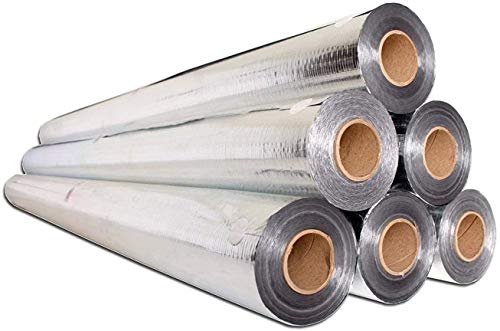
One roll, 1,000 sq ft, and the highest reflectivity claim in the set, which makes it the default for a whole-deck job.
Best for: covering a full rafter run in one roll Skip it if: your attic is small and one roll would be mostly waste
This is the most expensive pick here, and it buys scale. The roll measures 0.04 x 3000 x 48 in, which is 250 ft of 4 ft material, and AES puts the coverage at 1,000 sq ft. Nothing else in this group goes past 500. For a standard attic with rafters at 24 in centres, that is enough to run continuous strips across the entire deck without stopping to order more.
The published claim is a 99.7% reflective value, double-sided, and AES describes the material as perforated and tear-resistant. Perforation is the reason I rank it first. A sealed foil sheet on the underside of a roof deck can trap vapour against the sheathing, and the listing states it meets ASTM breathability standards for building materials alongside fire and smoke requirements.
The trade-off is bluntly commercial. Only one seller lists it, and it is the slowest-moving product in this group by a wide margin. You are also buying a single specification line: dimensions and nothing else. The Houseables roll below publishes size, colour, count and model.
Pros:
- 1,000 sq ft, the largest coverage here
- 99.7% reflective value claim, highest in the set
- Perforated and breathable per the listing
- Stated ASTM fire, smoke and breathability compliance
- Double-sided foil face
Cons:
- The most expensive pick in this comparison
- Only one seller stocks the listing
- A single published specification line
- Overkill for anything smaller than a full deck
2. Houseables Radiant Barrier Insulation — Best premium
The same 1,000 sq ft coverage with a fuller spec sheet and more sellers, at a slightly lower reflectivity claim.

Best for: buyers who want the same coverage from a stocked listing Skip it if: you want the highest published reflectivity figure
Dimensionally this is a twin of the top pick: 0.04 x 3000 x 48 in, 250 ft by 4 ft, 1,000 sq ft of coverage, silver, model RaBa. Where it pulls ahead is availability and documentation. Several sellers stock it, three in total, and it sells faster than the AES roll. It also publishes size, colour, count, dimensions and model, which is the most complete specification list of any roll here.
Houseables states a reflective value above 97% rather than 99.7%. In practice that gap is smaller than it looks on paper, because a foil face either reflects or it doesn't, and the difference between the two claims is under three percentage points on a manufacturer's own number.
The listing adds one claim the AES roll doesn't make: the aluminium material is described as non-toxic, and Houseables says it does not promote fungi or bacteria growth or provide nesting support for rodents or insects. In an attic, rodent nesting is a real concern.
It is the highest-priced product in this set, which is why it lands second rather than first. You pay more than the AES roll for a lower stated reflectivity and identical coverage. The listing also does not state whether the material is perforated.
Pros:
- 1,000 sq ft coverage, tied for largest
- Most complete published specifications of any roll here
- Three sellers stock it
- Stated resistance to fungi, bacteria and rodent nesting
- Named model number, RaBa
Cons:
- Highest price position in the whole group
- Lower reflectivity claim than the cheaper AES roll
- No stated perforation or breathability
- Same coverage as pick one for more money
3. DGSL Attic Door Insulation Cover — Runner-up
The fastest-selling product here by a large margin, and it fixes the leak most attic projects ignore.

Best for: sealing a 25 x 54 in pull-down attic hatch Skip it if: your hatch opening is a different size
This is the one buyers choose most often across the entire set, and the gap is not close. It ranks in the low thousands within ladder accessories while the rolls sit in the tens of thousands or worse. That tells you something about where homeowners actually feel the problem.
The tent measures 25 x 54 x 11 in and drops over a pull-down attic ladder opening. DGSL describes two layers of aluminium with an air bubble layer between them, claims 97% radiant heat reflection, and calls the material fireproof. Access is by zipper, and the set includes tool pliers for installation.
Why it ranks above every small roll: a pull-down hatch is a hole in your insulated ceiling. You can lay a foot of blown cellulose across the rest of the attic floor and the hatch will still bleed conditioned air. Sealing it is a one-evening job with a fixed product size, no cutting and no stapling.
The limitation is that fixed size. At 25 x 54 in it fits one common rough opening and nothing else. Measure before you order. The listing also cuts off mid-sentence on its stated R-value, so you are working from the reflectivity claim alone.
Pros:
- The one buyers choose most often in this set
- Fixed 25 x 54 x 11 in fit, no cutting required
- 97% radiant reflection claim, two aluminium layers
- Zipper access for regular attic entry
- Tool pliers included per the listing
Cons:
- Only fits a 25 x 54 in rough opening
- The published R-value is incomplete on the listing
- Only one seller lists it
- Treats one gap, not the attic deck
4. INSULATION MARKETPLACE SmartSHIELD — Best for beginners
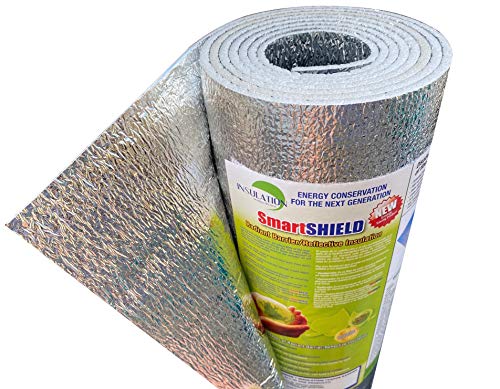
Closed-cell foam core rather than bubble film, in a 10 ft length that's cheap enough to learn on.
Best for: a first small area or a test patch Skip it if: you need to cover more than a few rafter bays
The roll is 48 in x 10 ft, dimensions 0.04 x 120 x 48 in, model SmartSHIELD -3mm. That works out to roughly 40 sq ft, so this is a patch product, not a deck product. It is the second-cheapest pick here and the second-fastest seller, which is a sensible combination for a first attempt.
The construction is what separates it. INSULATION MARKETPLACE describes 3 mm closed-cell polyethylene foam sandwiched between engineered foil on both sides, and the listing explicitly contrasts that with bubble film. Foam core gives you a slightly more rigid sheet that holds a fold and staples cleanly. Reflectivity is claimed at 95%, the lowest stated figure among the products that publish one.
It is also described as a vapour barrier, unaffected by humidity, and the brand adds soundproofing and non-irritating handling claims. Non-irritating matters if your only reference point for attic work is fibreglass.
Two honest drawbacks. Forty square feet buys you a few rafter bays and a hatch surround, nothing more, so buying enough for a real attic gets expensive fast per square foot. And a vapour barrier on a cold roof deck is the wrong choice in some assemblies.
Pros:
- 3 mm closed-cell foam core, not bubble film
- Second-cheapest pick and second-fastest seller
- Non-irritating, non-allergic per the listing
- Claimed soundproofing benefit
- Three sellers stock it
Cons:
- Only about 40 sq ft per roll
- Lowest published reflectivity claim at 95%
- Vapour barrier, not breathable
- Poor value per square foot at attic scale
5. AES NASA TECH 500 sqft Radiant Barrier — Best for heavy use
Half the coverage of the top pick, same perforated construction, for the attic that doesn't need 1,000 sq ft.

Best for: a mid-size attic deck needing half the big roll Skip it if: you want published specifications before you buy
At 4 ft x 125 ft this covers 500 sq ft, which puts it exactly between the patch rolls and the 1,000 sq ft options. For a lot of houses that is the honest number. A 1,200 sq ft footprint with a simple gable roof does not need a full 1,000 sq ft roll once you subtract the areas you cannot reach.
AES describes it as commercial grade, perforated and no-tear, matching the language on the top pick. Perforated means it is designed to let vapour through rather than trap it, which is the safer default for a roof deck in most climates. The 4 ft width is the same as every other roll here, so it runs the same way across rafters at standard centres.
Now the problem, and it is a real one. This listing publishes almost nothing. Two specification lines, count and a dimension set that reads 5 x 48 x 5 in, which describes the packed roll rather than the unrolled material. There are no feature claims at all, so there is no stated reflectivity figure, no stated ASTM compliance, nothing to compare against the other rolls.
It is also the slowest seller in the entire group, and only one seller carries it. That combination is why it sits fifth despite sensible coverage.
Pros:
- 500 sq ft, a realistic mid-size figure
- Perforated and no-tear per the product title
- Same 4 ft width as the other rolls
- Commercial grade description
Cons:
- No published reflectivity or compliance claims
- Slowest-selling product in this set
- Only two specification lines, one describing the packed roll
- Only one seller lists it
6. Bevel Energy Attic Door Insulation Cover — Best for families
A 1.63 lb hatch cover with a low front panel, so a full-size adult isn't wrestling a zip overhead.

Best for: a hatch in a hallway where a low-profile cover matters Skip it if: you want a stated reflectivity number
Same 25 x 54 in footprint as the DGSL cover, 11 in deep, aluminium construction with insulation inside. What separates it is the design detail Bevel Energy leads with: the front is lower, and the zipper sits on that lower face for quicker access. If your attic hatch is the storage route for holiday boxes and suitcases, you will open it more than twice a year, and reach height matters.
It is also the only hatch cover here with a published weight, 1.63 lb. That is light enough to lift with one hand while you balance on a ladder. The listing includes installation instructions and states the cover creates a seal at the attic door to keep dust and pollutants out while improving HVAC efficiency.
The colour is black rather than silver, which is worth noting only because it reads less like a job site product in a finished hallway.
Against the DGSL cover it loses on evidence. Bevel Energy publishes no reflectivity figure, no layer count and no R-value claim of any kind, where DGSL states 97% and two aluminium layers. It also sells far slower and sits at a higher price position. You are paying mid-range money for the same footprint with fewer published claims behind it.
Pros:
- Published weight of 1.63 lb, lightest hatch option
- Lower front panel with zipper for easier access
- Fits a 25 x 54 in doorway
- Instructions included per the listing
- Black finish, less conspicuous indoors
Cons:
- No stated reflectivity or R-value figure
- Costs more than the better-documented DGSL cover
- Only one seller lists it
- Same fixed size limitation as any hatch tent
7. dojobkinb Reflective Insulation Roll — Best budget pick
The cheapest way into reflective foil, at 47 in x 10 ft with a perforated bubble core you can cut to any shape.

Best for: small gaps, hatches and one-off patches Skip it if: you are covering a whole roof deck
This is the cheapest of the seven, and the size tells you why: 47 in x 10 ft, dimensions 0.07 x 120 x 23.6 in, model DRIR. That's roughly 39 sq ft, marginally less than the SmartSHIELD roll and an inch narrower. It is also the thickest sheet here at 0.07 in, thanks to a 2 mm polyethylene air bubble cushion between two layers of aluminium film.
dojobkinb describes a surface round-hole design, which reads as perforation, and the listing says you can cut the sheet to any shape and fix it with double-sided tape, adhesive pads or glue. That flexibility is the actual argument for it. Foil around a hatch frame, a strip behind a knee wall, a patch over a soffit gap: none of those jobs justify a 250 ft roll.
The listing spreads itself thin, naming windows, RVs, garages, attics, sheds, greenhouses and cars. Attic use is one of seven applications rather than the design brief, and the packaging text calls it a garage door insulation kit.
No reflectivity percentage is published anywhere on the listing, which puts it behind every other roll on evidence. It is also the narrowest sheet in the group at 47 in, so it will not sit as cleanly across 24 in rafter centres as a true 48 in roll.
Pros:
- Cheapest pick in the set
- Thickest sheet at 0.07 in with 2 mm bubble core
- Perforated surface design per the listing
- Cuts to any shape, adhesive-mounted
Cons:
- No published reflectivity claim at all
- About 39 sq ft, smallest coverage here
- 47 in width is narrower than standard rafter spacing
- Marketed across seven applications rather than built for attics
How much roll do you actually need?
Measure the roof deck, not the floor. That single mistake is what leaves people with a half-finished attic and a second shipping charge.
Here's the arithmetic. Radiant barrier goes on the underside of the rafters, following the roof slope. A sloped surface is always larger than the footprint beneath it. On a moderate pitch, plan on the deck area running roughly 15 to 25% above the floor area you measured.
Then subtract what you cannot reach. The last two or three feet at the eaves are usually too tight to work in, and you must not block soffit vents.
Matching rolls to jobs:
- Under 50 sq ft, patching a hatch surround or one bay: the dojobkinb roll or SmartSHIELD.
- 300 to 500 sq ft, a small attic or one slope: the AES NASA TECH 500 sqft roll.
- Over 600 sq ft, a full deck on an average house: one of the 1,000 sq ft rolls.
Every roll here is 4 ft wide except the dojobkinb sheet at 47 in. Four feet spans two 24 in rafter bays exactly, which means fewer seams and less stapling. Buy one size up rather than one size down. Offcuts get used on the hatch.
The attic hatch nobody insulates
Most attic insulation material advice stops at the deck and the floor. Then there's a 25 x 54 in hole in the middle of it.
A pull-down attic ladder is a thin plywood panel in a wooden frame, usually with no insulation and no weatherstripping. The panel sits inside your thermal envelope, so warm air rises straight through the gaps around it in winter and hot attic air pours down in summer. It is a small area doing a disproportionate amount of damage.
That is why the DGSL cover outsells every roll in this set several times over. Homeowners feel this leak. It shows up as a cold draught in a hallway or a warm patch on a ceiling.
Both hatch covers here are 25 x 54 in, which is a common rough opening but not the only one. Before you order:
- Measure the rough opening, not the visible panel.
- Check clearance above the frame. Both tents need 11 in of vertical space.
- Confirm the ladder's swing arc clears the tent's zipper face.
- Note which direction you approach from, since the zipper sits on one side.
If the measurements don't match, a cut-to-fit sheet like the dojobkinb roll can be taped to the panel itself. Less elegant, but it addresses the same leak.
What the listings do not tell you
Four gaps run through this whole category, and knowing them changes what you buy.
Reflectivity claims are not R-values. A 97% reflective figure describes the foil surface. It says nothing about the assembly's resistance to conductive heat flow. Only the DGSL listing mentions an R-value at all, and that sentence is truncated on the page.
Perforation is a decision, not a feature. Perforated foil lets water vapour through. Sealed foil stops it. Which one is right depends on your climate, your existing vapour retarder and whether your attic is vented. The AES rolls and the dojobkinb sheet describe perforation. SmartSHIELD explicitly calls itself a vapour barrier. These are opposite behaviours and no listing tells you which your house needs.
Warranty is absent across all seven. Not one product in this set publishes a warranty term. Compare that to how confidently the reflectivity numbers are stated.
Fastenings are your problem. None of the rolls list staples, tape or a foil seaming product. dojobkinb suggests adhesive but doesn't include any. Budget for a staple gun and foil tape alongside whichever roll you pick.
One more thing the data quietly shows. Five of the seven listings have a single seller. That is a category served by small suppliers, so specification depth varies wildly between products doing the same job.
The verdict
The best attic insulation material here is the AES US Energy Products Radiant Barrier Insulation 1000. It publishes the largest coverage in the set at 1,000 sq ft, the highest reflectivity claim at 99.7%, and it is perforated with stated ASTM fire, smoke and breathability compliance. For a full roof deck, that combination of scale and vapour permeability is the safest default.
Two conditions flip it.
First, if your attic problem is the hatch rather than the deck, buy the DGSL Attic Door Insulation Cover instead. A sealed 25 x 54 x 11 in hatch cover fixes a concentrated air leak in one evening, with no cutting and no staple gun. It is the fastest-selling product in this group for exactly that reason, and no amount of foil on the rafters compensates for an uninsulated pull-down panel.
Second, if your deck area is closer to 400 or 500 sq ft, the AES NASA TECH 500 sqft roll is the right size and you will not be storing 500 sq ft of surplus foil.
The Houseables roll is the runner-up on the rolls, and its exact advantage is documentation and supply: full published specifications including a model number, three sellers stocking it, and a stated resistance to rodent nesting that the AES listing doesn't claim. You pay the highest price in the set for that, at a slightly lower stated reflectivity.
FAQ
Is a radiant barrier worth it compared with adding more batts?
A radiant barrier is worth it as an addition, not a replacement. Foil reflects radiant heat off the roof deck. Batts and blown insulation slow conduction through the ceiling plane. They target different heat paths. If your attic floor is thinly insulated, address that first, then add reflective foil to the rafters for summer heat gain.
What is the best attic insulation material for a small patch job?
The best attic insulation material for a small patch is the dojobkinb roll at 47 in x 10 ft, roughly 39 sq ft, or the SmartSHIELD roll at 48 in x 10 ft. Both are the cheapest picks here and both cut to shape. A 250 ft roll makes no sense for a hatch surround or a single rafter bay.
DGSL or Bevel Energy: which attic hatch cover should I buy?
DGSL or Bevel Energy comes down to evidence versus access. Both fit a 25 x 54 in opening at 11 in deep. DGSL publishes a 97% reflection claim and two aluminium layers, and it costs less. Bevel Energy publishes a 1.63 lb weight and a lower zippered front for easier entry, but no reflectivity figure at all.
Will a 4 ft wide roll fit standard rafter spacing?
A 4 ft wide roll fits standard 24 in rafter centres exactly, spanning two bays per pass. Five of the seven picks here are 48 in wide. The dojobkinb sheet is 47 in, an inch short, which means slightly more trimming or overlap. Wider passes mean fewer seams and less time on a ladder.
What mistake do first-time buyers make in this category?
The mistake first-time buyers make is measuring the attic floor and ordering that much foil. Radiant barrier follows the roof slope, so the deck area runs roughly 15 to 25% larger than the footprint below. Then unreachable eaves cut into usable coverage. Measure the slope, add margin, and never block soffit vents.
Start by deciding which surface you are treating. If it's the roof deck, measure the slope, add margin for the eaves you cannot reach, and order the AES US Energy Products roll if that number climbs past 600 sq ft. Its 1,000 sq ft of perforated, 99.7%-claimed foil means one purchase, one delivery, and no seams introduced by a second roll arriving from a different batch. If it's the hatch, the DGSL cover is a shorter project with a faster payoff. Whichever you choose, budget for a staple gun and foil tape. No listing here includes them.