Best Budget Door Lock When You Only Own a Screwdriver

A screwdriver-only install is not the same job as a drill-and-anchor install, and this set splits cleanly along that line. Here's which of six locks fits which door, which tools you actually need, and where the cheapest pick wins outright.

By Taylor DavidsonUpdated 17 min read
On this page
- Best budget door lock for diy enthusiasts at a glance
- How the six picks map to four different buyers
- 1. DESLOC B200 Fingerprint Smart Door Lock — Best overall
- 2. AceMining Door Reinforcement Lock — Best budget pick
- 3. Evanshow Fingerprint Door Lock — Best minimal setup
- 4. Foxgard Smart Fingerprint Door Lock — Runner-up
- 5. PRIME-LINE Door Knob Lock-Out Device — Best upgrade
- 6. MCAVORY Storefront Door Mortise Lock Cylinder & Thumbturn — Best for pros
- What tools does each of these actually need?
- Deadbolt, knob or bar: which does your door take?
- Does budget really mean easy to install?
- What the listings do not tell you
- The verdict
- FAQ
The best budget door lock for diy enthusiasts is the DESLOC B200 Fingerprint Smart Door Lock, a 2.03 lb keyless deadbolt the listing says installs with nothing but a screwdriver. If you cannot touch the existing hardware, the AceMining Door Reinforcement Lock is the pick instead, a 3 x 2.5 x 1.35 in bar that bolts to the door frame. Most shoppers compare unlock methods first: fingerprint counts, code slots, app features. That is not what decides this purchase. What decides it is whether the lock replaces hardware, adds to it, or blocks it.
Best budget door lock for diy enthusiasts at a glance
| Pick | Install method | Unlock methods | Price |
|---|---|---|---|
Best overall DESLOC B200 Fingerprint Smart Door Lock |
Replaces deadbolt, screwdriver | 8 claimed, 50 fingerprints | Check Price |
Best budget pick AceMining Door Reinforcement Lock |
Adds to frame, drill needed | 1, inside thumb latch | Check Price |
Best minimal setup Evanshow Fingerprint Door Lock |
Replaces knob, no drilling claimed | 5, 100 fingerprints | Check Price |
Runner-up Foxgard Smart Fingerprint Door Lock |
Replaces knob, screwdriver | 5, fingerprint to key | Check Price |
Best upgrade PRIME-LINE Door Knob Lock-Out Device |
Clamps over knob, no tools | 1, supplied key | Check Price |
Best for pros MCAVORY Storefront Mortise Cylinder Set |
Swaps cylinder in existing lock | 1, SC1 keys | Check Price |


How the six picks map to four different buyers
I lined up the published specifications side by side and the set sorted itself into four buyer profiles, not one ranked ladder. That matters, because the best budget door lock for diy enthusiasts depends almost entirely on which of these four people you are.
- You want keyless entry on your front door. You are replacing a deadbolt. The DESLOC B200 is the only pick here built for that job, at 3.27 x 7.28 x 6.3 in with an IP54 claim.
- You want the door to survive a kick. You are not replacing anything. You are adding a bar to the frame. That is the AceMining, and it is the cheapest of the six.
- You want a code on an interior door. Bedroom, office, home studio. The Evanshow and the Foxgard both swap a knob, and both list five unlock methods.
- You have an unusual door. A commercial glass storefront takes the MCAVORY cylinder set. A keyed knob you must not modify takes the PRIME-LINE cover.
Notice what the profiles do not share: a common install task. Two of the six touch the frame or the jamb rather than the door. One touches neither. Pick the profile first and the hardware follows.
1. DESLOC B200 Fingerprint Smart Door Lock — Best overall
The only pick in this set designed to replace an exterior deadbolt, and the only one with published weather and grade claims.
Best for: an exterior entry door needing keyless access Skip it if: your door already has hardware you like
Among these six, the B200 is the one that changes how you enter your house rather than how the door resists a shoulder. It weighs 2.03 lb and measures 3.27 x 7.28 x 6.3 in, so it is the bulkiest single unit here. DESLOC lists eight unlock methods: fingerprint, PIN, app, eKeys, key fobs, physical keys, and voice control through Alexa or Google Assistant, with voice needing a G2 gateway sold separately. The listing puts fingerprint capacity at 50 and recognition under 0.3 seconds.
Two spec lines separate it from the rest of the set. DESLOC claims IP54 water resistance and an operating range of -22°F to 158°F, plus BHMA Grade 3 compliance. No other pick here publishes a weather figure or a grade. The company also states a 12-month battery life on 4 AA cells, with USB-C emergency backup, though the batteries are not included.
The trade-off is position and cost. This is the most expensive pick in the set and it demands you remove working hardware. It also sells slower here than the two interior knob locks, and only two sellers list it.
Pros:
- Only pick with a published BHMA Grade 3 claim
- IP54 and -22°F to 158°F range claimed
- 50 fingerprints, recognition under 0.3s claimed
- USB-C backup port for dead batteries
- Screwdriver-only install per the listing
Cons:
- Most expensive pick in this set
- Voice control needs a separate gateway
- 4 AA batteries not included
- Heaviest unit here at 2.03 lb
- Requires removing your existing deadbolt
2. AceMining Door Reinforcement Lock — Best budget pick
The cheapest of the six and the only one that resists force rather than manages access.

Best for: renters and anyone worried about a kicked-in door Skip it if: you need to lock the door from outside
This one solves a different problem than every other pick here. AceMining says the alloy body withstands up to 800 lbs of force, which they describe as 16 times stronger than a normal deadbolt against being kicked in. It is a claim, not a test result I can verify, but it points at the failure mode nobody else in this set addresses: the frame splitting, not the lock picking.
At 3 x 2.5 x 1.35 in it is the smallest footprint of the six. The listing includes eight screws, four long and four short, and says an electric drill gets it mounted in about five minutes. So this is the one pick that genuinely wants a drill rather than a screwdriver. Operation is a two-finger pinch and swing, and AceMining specifically pitches the quick-release spring as an emergency exit feature.
The limitation is fundamental. It only works from inside, so it secures you while you are home and does nothing when you leave. There is no keypad, no key, no published warranty. Treat it as a second layer on top of whatever lock the door already carries.
Pros:
- Cheapest of the six picks
- 800 lb force resistance claimed
- Smallest footprint at 3 x 2.5 x 1.35 in
- Eight screws included, two lengths
- Quick-release spring for fast exit
Cons:
- Only operable from inside the room
- Needs a drill, not just a screwdriver
- No published warranty
- Cannot secure an empty house
- No keyed or coded access at all
3. Evanshow Fingerprint Door Lock — Best minimal setup
The highest fingerprint capacity here at 100, in a knob that Evanshow says needs no drilling or wiring.

Best for: a bedroom or office door, no drilling Skip it if: the door is thicker than 1.97 in
If your project is an interior door and you want it done before lunch, this is the shape to look at. Evanshow lists five unlock methods: fingerprint, password, two mechanical keys, IC card, and Tuya app control. Capacity is the headline figure, 100 fingerprints and 50 passwords, higher on both counts than anything else in this set. It is the one buyers choose most often here alongside the AceMining, and only one seller lists it.
The fit spec is the number that decides whether you can buy it. Evanshow says it suits wooden doors 1.18 in to 1.97 in thick, left or right swing. Measure your door edge before ordering, because a thicker slab ends this project immediately. Physical size is 5.5 x 5.5 x 5.5 in at 1.2 lb, the lightest of the picks with a published weight.
One detail in the listing deserves attention. Evanshow states that until you register an administrator fingerprint, any fingerprint will unlock the door. That is a real setup step, not marketing filler, and skipping it leaves the door effectively open. Against the B200, this pick publishes no weather rating, no grade, and no battery figure.
Pros:
- 100 fingerprints and 50 passwords claimed
- Lightest published weight here at 1.2 lb
- No drilling or wiring per the listing
- Includes two mechanical keys plus IC card
- App access logs and temporary codes claimed
Cons:
- Hard 1.18 in to 1.97 in door thickness limit
- Any fingerprint works until admin is set
- No published battery life or weather rating
- Second-most expensive pick in the set
- Wooden doors only, single seller
4. Foxgard Smart Fingerprint Door Lock — Runner-up
A 2025 knob lock built around guest codes, and the slimmest profile of the three biometric picks.

Best for: a short-term rental room needing timed codes Skip it if: you want published battery or weather ratings
Foxgard also lists five unlock methods, fingerprint, keypad code, app, IC card and mechanical key, so on paper it shadows the Evanshow. The difference is what the company emphasises. The listing highlights one-time, timed and dynamic passcodes, aimed squarely at guests, cleaners and short-let tenants. It also claims an anti-peep code, auto-lock with a delayed-lock option, and a built-in electronic deadlock for indoor privacy.
Dimensions are 2 x 4.8 x 2 in at 1.63 lb, which makes it the narrowest body among the biometric picks. On a door with a slim stile or a nearby frame, that 2 in width is the spec that gets it fitted. The listing gives a release year of 2025, the only pick here with one published, and Foxgard says a screwdriver is all you need, no drilling or wiring.
Where it falls behind the Evanshow is stated capacity. Foxgard names no fingerprint count and no password count, so you are buying without knowing how many people you can enroll. It also sells slowest of the three biometric locks here, sits mid-range on price, and lists no warranty.
Pros:
- Narrowest biometric body at 2 in wide
- One-time, timed and dynamic guest codes claimed
- Anti-peep code and auto-lock claimed
- Electronic deadlock for indoor privacy
- Screwdriver install, no drilling claimed
Cons:
- No fingerprint or password capacity published
- No stated warranty
- No battery life or weather figures
- Slowest seller of the three smart knobs
- Single seller lists it
5. PRIME-LINE Door Knob Lock-Out Device — Best upgrade
The only pick here with a published warranty, and the only one that secures a door without changing its hardware.

Best for: blocking a keyhole without swapping the knob Skip it if: your knob is not round
This is the odd one in the set, and for some readers it is the exact answer. The PRIME-LINE covers the keyhole on a keyed entry doorknob so existing keyholders cannot get in, without you replacing the knob assembly. Prime-Line pitches it at rentals, home sales, evictions, job sites, offices and storage rooms. Turnovers and disputes, in other words.
Fit is dimensional and absolute. The listing says it suits round doorknobs up to 2-7/16 in diameter with a 1-3/16 in circular shaft opening. Measure the outside diameter of the knob before you order. The body is diecast metal, 2.75 x 3.75 x 2.25 in at 1.34 lb, with a removable cylinder held by an O-ring so you can clean it while unlocked. Prime-Line notes the keys may arrive inside the device.
It carries a stated one-year warranty against manufacturing defects, the only warranty published anywhere in this set, and Prime-Line excludes damage from installation or misuse. Against the smart locks it offers no codes, no app, no fingerprint, and it does nothing on a lever handle. It is second-cheapest here and it is a single-purpose tool.
Pros:
- Only pick with a published warranty
- Second-cheapest of the six
- Diecast metal, keyed alike
- Removable cylinder for cleaning
- Needs no change to existing hardware
Cons:
- Round knobs up to 2-7/16 in only
- Useless on lever handles or deadbolts
- No codes, app or fingerprint access
- Warranty voided by installation damage
- Blocks the keyhole rather than adding strength
6. MCAVORY Storefront Door Mortise Lock Cylinder & Thumbturn — Best for pros
A commercial cylinder swap for aluminum glass doors, and the only pick in this set that is not residential.
Best for: aluminum storefront and glass doors Skip it if: you have a residential wood door
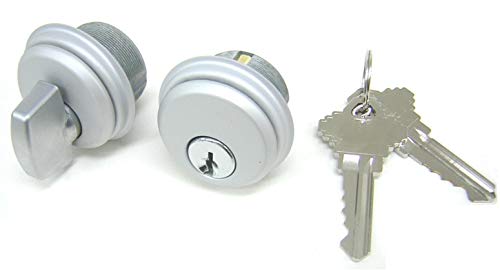
If you manage a shop unit rather than a house, this is the one entry here that fits your door. MCAVORY lists a standard 1 in length and 1-5/32 in diameter mortise cylinder, stated to fit Adams Rite, Kawneer, Vistawall and most other storefront locksets. It uses SC1 keys on a five-pin C keyway with an Adams Rite cam, and the count spec is 2, with the box containing one keyed cylinder, two keys, one thumbturn and two cylinder collars.
The intended application is narrow-frame glass doors running a commercial deadbolt, hook lock or deadlatch. That is a rekey job, not an upgrade. You unscrew the old cylinder, thread the new one to the correct depth, and check the cam clears the lock body. Anyone who has done it once will do it again in ten minutes. Anyone who has not should read the existing lockset's model number first.
Dimensions are 2.7 x 2 x 2 in and no weight is published. It sits mid-range on price and it is by a wide margin the slowest seller of the six, which fits a part aimed at a narrow trade audience. It also lists no warranty and comes from a single seller.
Pros:
- Fits Adams Rite, Kawneer and Vistawall per listing
- Complete set: cylinder, thumbturn, 2 collars, 2 keys
- Standard 1 in length, 1-5/32 in diameter
- SC1 five-pin keyway for easy key duplication
- Mid-range price for a commercial part
Cons:
- No use on residential wood doors
- Requires identifying your existing lockset first
- No published weight or warranty
- Slowest seller of the six
- Keyed access only, no codes or biometrics
What tools does each of these actually need?
The phrase "easy DIY installation" appears across these listings and it does not mean the same thing twice. Here is what each manufacturer actually says about tools, because that is the gap between a Saturday morning and a Saturday.
- DESLOC B200: a screwdriver, no professional tools, fits most standard US doors.
- Evanshow: no drilling and no wiring, installs in minutes, within the 1.18 in to 1.97 in thickness limit.
- Foxgard: a screwdriver, no drilling or wiring.
- PRIME-LINE: no install at all in the mechanical sense. It clamps over the knob and locks with a key.
- AceMining: an electric drill and a choice of four long or four short screws.
- MCAVORY: basic hand tools, plus knowing which lockset you already have.
So five of six need nothing more than a screwdriver or nothing at all, and the cheapest pick is the only one that asks for a drill. That inverts the usual assumption. When people search for the best budget door lock for diy enthusiasts they often expect cheap to mean fiddly, and here cheap means drilling into a steel frame while the expensive picks come apart with a Phillips head.
One thing no listing tells you: whether your existing deadbolt hole is standard bore. Measure it before the box arrives.
Deadbolt, knob or bar: which does your door take?
This is the question that eliminates four of these six picks in about thirty seconds, and it is worth answering before you compare fingerprint counts.
Look at the door first. An exterior entry door in the US usually carries a knob or lever at 36 in from the floor and a separate deadbolt above it. If the deadbolt is the thing you want to modernise, only the DESLOC B200 in this set does that job. Its 3.27 x 7.28 x 6.3 in envelope covers the interior escutcheon.
Interior doors are a different geometry. Bedroom and office doors typically have a single knob with a privacy button, no deadbolt at all. Both the Evanshow and the Foxgard replace that knob outright and add a keypad, and the Foxgard's 2 in body width is the more forgiving of the two on a narrow stile.
A bar is neither. The AceMining mounts to the jamb and swings across the gap, so it does not care what lock the door already carries. That independence is why it works for renters who cannot legally change hardware but can fill four screw holes later.
Commercial glass is its own world. Narrow aluminum frames take mortise cylinders, which is the MCAVORY. And if the door is fine but the wrong people hold keys, the PRIME-LINE covers the keyhole instead of replacing anything.
Does budget really mean easy to install?
Not in this set, and the pattern is worth understanding before you shop. Ranked by price, the cheapest pick here is the one demanding a drill and the two priciest are the two claiming screwdriver-only fitment. Cost tracks electronics, not difficulty.
What more money buys across this group is specification density. The B200, at the top of the range, publishes an IP54 rating, a -22°F to 158°F operating range, BHMA Grade 3 compliance, a 12-month battery estimate and a 50-fingerprint capacity. The Foxgard, sitting mid-range, publishes a release year, a weight and a size, and names no capacity figures at all. The AceMining, at the bottom, publishes one performance number, the 800 lb force claim, and nothing else.
So the honest reading of the best budget door lock for diy enthusiasts is this. Spending less gets you a device that does one thing with fewer published guarantees around it. Spending more gets you numbers you can check against your own door and climate. Neither is a mistake. A jamb bar on a rental is a smart purchase precisely because it is simple.
Where the money is genuinely wasted is buying a smart knob for an exterior door. These knob-format locks are pitched at bedrooms, offices and interior rooms, not at weather.
What the listings do not tell you
Reading six door lock listings back to back exposes the same gaps in each.
Battery type and life, mostly. Only DESLOC names a power source, 4 AA cells and up to 12 months. The Evanshow and Foxgard describe app control and fingerprint scanning without saying what powers either. That is the spec you will care about most in month fourteen.
Warranty coverage. One published warranty across six products, and it belongs to the cheapest-but-one pick, the PRIME-LINE, at one year against manufacturing defects. The rest state nothing, which is not the same as offering nothing but is not a promise either.
Backset and bore compatibility. "Fits most standard US doors" is the closest anyone gets. Nobody publishes a backset range or a bore diameter. If your door is old, non-US, or has been rehung, that ambiguity is your risk.
Finish durability. Four of the six are black or gray. None states a finish standard or coating type, so outdoor fading on an exterior install is unknowable from the page.
App and cloud detail. Evanshow names Tuya. Foxgard names an app without naming the platform. Neither states subscription terms or how long codes persist offline.
The verdict
The DESLOC B200 Fingerprint Smart Door Lock wins because it is the only pick in this set that upgrades an exterior deadbolt while publishing the numbers that matter outdoors: IP54, an operating window of -22°F to 158°F, BHMA Grade 3 compliance and a 12-month battery estimate on 4 AA cells. Fifty fingerprints and eight stated unlock paths cover a family. A screwdriver installs it. That combination is not matched anywhere else here.
Two conditions flip that recommendation. First, if you cannot modify the existing hardware, because you rent or because the door is not yours to change, the AceMining Door Reinforcement Lock takes over. It is the cheapest of the six, it claims 800 lb of force resistance, and it needs only four screws into the jamb. Second, if the door is interior rather than exterior, the Evanshow Fingerprint Door Lock is the smarter spend, with 100 fingerprints and 50 passwords in a knob that Evanshow says needs no drilling at all.
The Evanshow's specific advantage over the winner is capacity and simplicity: double the fingerprint slots, no deadbolt removal, no gateway for extras. What it gives up is every outdoor spec the B200 publishes. Pick by door type first, feature list second.
FAQ
Is the best budget door lock for diy enthusiasts worth buying over a plain deadbolt?
Whether a budget door lock beats a plain deadbolt depends on which failure you are fixing. Keyless entry solves lost keys and shared access, which the DESLOC B200 covers with 50 fingerprints. Frame strength solves forced entry, which the AceMining addresses with its 800 lb claim. A standard deadbolt does neither well. Decide which risk you actually have.
What does a cheaper door lock give up?
A cheaper door lock gives up published specifications more than build quality. The AceMining, cheapest of these six, publishes dimensions and a force claim and little else: no battery figure, no warranty, no grade. The DESLOC B200 at the top of this range publishes IP54, a temperature range and BHMA Grade 3. You are buying documentation as much as hardware.
Will these locks fit a standard interior door thickness?
These locks fit standard interior thicknesses with one hard limit to check. Evanshow states 1.18 in to 1.97 in for wooden doors, left or right swing, which covers most US interior slabs. Foxgard says most standard doors without naming a range. The PRIME-LINE fits round knobs up to 2-7/16 in diameter. Measure with calipers or a ruler before ordering.
Evanshow or Foxgard: which fingerprint knob should I pick?
Between Evanshow and Foxgard, pick Evanshow for capacity and Foxgard for fit. Evanshow publishes 100 fingerprints and 50 passwords; Foxgard names no capacity figures. Foxgard is narrower at 2 x 4.8 x 2 in, useful on a slim stile, and emphasises one-time and timed guest codes. Evanshow costs more here. Both claim screwdriver-only installs on interior doors.
What mistake do first-time door lock buyers make?
The most common door lock mistake is buying for features instead of door type. A fingerprint knob will not upgrade your deadbolt. A jamb bar will not let you in from outside. A storefront mortise cylinder will not touch a wood door. Identify the hardware you are replacing, adding to or blocking, then compare specs within that one group.
Start with the door, not the product page. Walk to it, note whether it carries a deadbolt, a knob, both, or an aluminum frame, then measure the thickness and the knob diameter. Those three numbers eliminate most of this set instantly. For a typical exterior entry door where you want to stop carrying keys, the DESLOC B200 is the sensible default, and the reason is not the fingerprint count. It is that DESLOC publishes an outdoor temperature range and a grade claim while every other pick here stays quiet about weather entirely.