Best Budget Wood Planer for Small Home Shops
A handheld planer, a benchtop thickness planer and a hand plane are three different tools with three different jobs. This guide sorts six picks by what they actually do, using published specs only.

By Taylor DavidsonUpdated 17 min read
On this page
- Best budget wood planer at a glance
- How I screened these six, and what I weighted
- Handheld, benchtop or hand plane: which do you need?
- 1. WEN 6530 6-Amp Electric Hand Planer — Best overall
- 2. JORGENSEN No.101 Mini Wood Planer — Best budget pick
- 3. Amazon Basics Woodworking Hand Planer — Best for pros
- 4. WEN 6528 3.8-Amp Electric Hand Planer — Best upgrade
- 5. WOODERS 13-Inch Benchtop Thickness Planer — Best minimal setup
- 6. DEWALT Thickness Planer — Best premium
- What does more money actually buy in a budget wood planer?
- How much shop space and dust control will you need?
- What the listings do not tell you
- The verdict
- FAQ
The best budget wood planer for most home shops is the WEN 6530, a 6-amp handheld that spins up to 34,000 cuts per minute across a 3-1/4-inch width and carries a 2-year warranty. If you need boards brought to a consistent thickness rather than a surface skimmed flat, the DEWALT DW735X and its 13-inch capacity is the machine to buy instead. Here's the map by tier: entry money buys a hand plane you push yourself, the middle buys a corded handheld, and the top of this set buys a benchtop machine that mills stock to a number.
Best budget wood planer at a glance
| Pick | Type | Key spec | Price |
|---|---|---|---|
Best overall WEN 6530 6-Amp Electric Hand Planer |
Corded handheld | 3-1/4 in width 34,000 CPM claim |
Check Price |
Best budget pick JORGENSEN No.101 Mini Wood Planer |
Mini block plane | 0.55 lb O1 steel blade claim |
Check Price |
Best for pros Amazon Basics Woodworking Hand Planer |
No.4 bench plane | 2 in steel blade 2.66 lb |
Check Price |
Best upgrade WEN 6528 3.8-Amp Electric Hand Planer |
Corded handheld | 2-3/8 in width 4.3 lb |
Check Price |
Best minimal setup WOODERS 13-Inch Benchtop Thickness Planer |
Benchtop thickness | 13 in width 60 lb |
Check Price |
Best premium DEWALT Thickness Planer |
Benchtop thickness | 13 in width 102 lb |
Check Price |



How I screened these six, and what I weighted
I set the criteria before looking at any listing, then weighted them.
- Published depth control, 35%. A planer you can't set to a repeatable depth is a scraper. Numbered stops or a graduated adjuster counts; "adjustable" alone does not.
- Cutting width, 25%. This single figure decides how many passes a board takes and whether the tool can do the job at all.
- Weight and footprint, 20%. A 102 lb machine and a 0.55 lb plane are not competing for the same bench.
- Stated warranty, 10%. Only two of the six list one.
- What's in the box, 10%. Dust bag, fence, spare blades, kickstand.
Depth control got the largest share because it is the difference between removing 1/64 in and gouging a door edge. The WEN 6530 publishes 16 positive stops from 0 to 1/8 in, which is the most granular figure in this set. The WEN 6528 publishes 9 stops from 0 to 1/16 in. The two hand planes use a screw adjuster with no numbered scale, so depth is set by feel and a test shaving.
What got cut: anything with no published cutting width, and anything where the listing gave a motor figure but no depth range. Two of the six here carry no stated warranty at all, and I've flagged that in their sections rather than pretending it doesn't matter.
Handheld, benchtop or hand plane: which do you need?
The single biggest mistake in shopping for the best budget wood planer is treating these three tool types as interchangeable because they share a name. They do completely different jobs.
- A handheld electric planer removes material from a surface. It follows the board. It will not make a board flat or a uniform thickness, because it has no reference surface other than the wood you're standing it on. Use it for doors that stick, twisted stud edges, chamfers and rabbets.
- A benchtop thickness planer feeds a board between a bed and a spinning cutterhead set at a fixed height. Whatever goes in comes out at that thickness, parallel to the reference face. Use it for milling rough lumber and matching board thicknesses.
- A hand plane does what the electric handheld does, more slowly and far more precisely, with no cord and no dust bag. Use it for final smoothing, fitting joints and trimming a hair off a drawer side.
Here's the trick with the category: most people searching for a wood planer describe a thickness-planer job and then buy a handheld because it costs less. That mismatch is the source of nearly every disappointment. If your sentence contains the phrase "make this board an even thickness", nothing in the handheld or hand-plane group will do it, no matter how many amps it draws.
1. WEN 6530 6-Amp Electric Hand Planer — Best overall
The most usable depth control in this set, at a weight and width that suits real door-and-edge work.
Best for: trimming doors and stock edges with real depth control Skip it if: you need boards brought to a uniform thickness
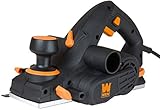
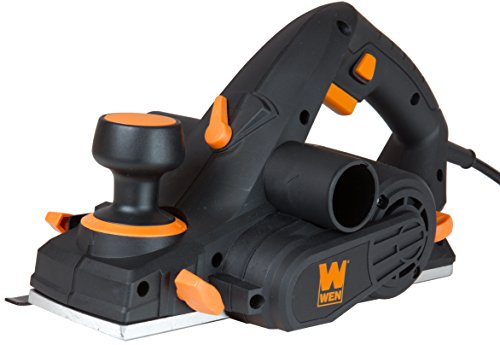
Two things separate the 6530 from everything else here. The first is width: 3-1/4 in across the cutter, wider than the 2-3/8 in of its stablemate the 6528 and wider than the 2 in blade on the Amazon Basics bench plane. On a standard door edge that means one pass instead of two overlapping ones, and overlapping passes are where ridges come from. The second is the depth adjuster. WEN lists 16 positive stops spanning 0 to 1/8 in, so the finest increment is small enough to sneak up on a fit rather than blow past it.
WEN says the 6-amp motor delivers up to 34,000 cuts per minute, and the listing also claims a 5/16 in rabbeting guide that cuts rabbets up to 1 in. The box includes a dust bag, a kickstand and a parallel fence bracket, which is the fullest accessory list among the handhelds here. At 6.5 lb it's the heaviest handheld in this group, and the 2-year warranty is one of only two stated in the set.
The trade-off: it weighs about 50% more than the 6528, and against either thickness planer it cannot deliver a dimensioned board. This is a surfacing tool, not a milling machine.
Pros:
- Widest handheld cut here at 3-1/4 in
- 16 depth stops from 0 to 1/8 in
- Dust bag, kickstand and fence bracket included
- 2-year stated warranty
- Rabbeting guide up to 1 in claimed
Cons:
- Heaviest handheld here at 6.5 lb
- Cannot bring stock to a uniform thickness
- Corded, so an outlet or extension is mandatory
- Only one seller lists it
2. JORGENSEN No.101 Mini Wood Planer — Best budget pick
The cheapest of the six and the only one you can carry in an apron pocket at 0.55 lb.

Best for: small trim work, deburring and fine end-grain cleanup Skip it if: you have more than a few feet of surface to flatten
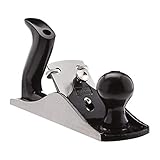
At 1.97 x 3.54 x 1.26 in, this is a No.101-pattern mini block plane, and it is the smallest tool in this roundup by a wide margin. That size is the whole point. A mini block plane is held in one hand and used for the jobs where a full-size plane is clumsy: knocking the arris off a shelf edge, cleaning up a dowel end, easing a drawer runner that binds by a whisker. It's also the pick most likely to become the tool you actually reach for, because there's no cord and no setup.
Jorgensen says the blade is O1 tool steel and the body is ductile iron, drop-tested for durability. The listing also describes a knob-adjusted cutting depth. What it does not publish is a blade width figure, and there's no stated warranty, so I've written around both rather than guessing.
The honest limitation is stroke length. Working across a tabletop with a 3.54 in body means hundreds of passes and a surface that follows the existing hollows rather than flattening them. Against the No.4 bench plane it gives up sole length, and sole length is what makes a plane flatten instead of follow.
Pros:
- Cheapest of the six
- Lightest tool here at 0.55 lb
- Ductile iron body and O1 steel blade claimed
- Knob depth adjustment, no tools needed
- Sells faster than the two thickness planers in this set
Cons:
- 3.54 in body is too short to flatten a surface
- No blade width published
- No stated warranty
- Only one seller lists it
3. Amazon Basics Woodworking Hand Planer — Best for pros
A No.4 bench plane with a 2 in blade and adjustable mouth, for the woodworker who wants the last pass done by hand.

Best for: hand-tool woodworkers smoothing furniture parts Skip it if: you want speed over control
The No.4 is the classic smoothing plane, and the numbers here match the pattern: a 9.8 in long body, 2.66 lb, and a 2 in steel blade. That sole length is what earns the award. It bridges dips instead of dropping into them, so successive passes actually make a board flatter, which is something neither the mini block plane nor any handheld electric can claim. Amazon says the body is cast iron and the mouth and depth gauge are both adjustable, with front and rear handles for two-handed control.
On finish quality, a well-set hand plane leaves a surface no powered tool in this group matches. There's no tear-out from a rotating cutter and no ridge where two passes meet. That's why it sits above the electric handhelds for anyone building furniture rather than fitting trim.
It's also the only pick in this set that several sellers stock, which is a small point in its favour if the first listing is thin.
The trade-offs are real. There's no stated warranty. Bench planes generally arrive needing the blade honed and the sole checked, and this listing publishes no figure for how flat the sole is out of the box. And it's slow: what the 6530 does to a door edge in one pass takes several minutes here.
Pros:
- 9.8 in sole, longest hand-plane reference here
- 2 in steel blade with adjustable mouth and depth
- Cast iron body, front and rear handles claimed
- Second-cheapest of the six
- Several sellers stock it
Cons:
- No stated warranty
- Sole flatness not published
- Expects the user to hone and set the blade
- Far slower than any powered pick here
4. WEN 6528 3.8-Amp Electric Hand Planer — Best upgrade
The lightest corded handheld here at 4.3 lb, for narrow stock and awkward positions.

Best for: narrow stock and one-handed overhead trimming Skip it if: you plane wide boards or want deeper bites
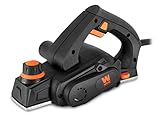
Where the 6530 wins on width, the 6528 wins on handling. It's 4.3 lb against 6.5 lb, and the body measures 6.5 x 9 x 6.25 in, which is noticeably more compact. If you're planing the top edge of a fitted door in place, or working on a ladder, that 2.2 lb difference is the whole argument. WEN puts the motor at 3.8 amps with up to 32,000 cuts per minute, so the cutter speed is close to the 6530's while the current draw is lower.
The cutting width is 2-3/8 in and the depth range runs across 9 positive stops from 0 to 1/16 in. That maximum bite is half the 6530's, which is a genuine constraint if you need to remove 1/8 in from a swollen door in a single pass, and an advantage if your main risk is taking too much. WEN lists a kickstand to protect the workpiece and an onboard slot for the blade wrench, plus a two-year warranty.
Against the 6530 it gives up width, depth capacity, the dust bag and the fence bracket. It's the slowest seller of the two WEN handhelds here, and I'd only choose it over the 6530 when weight genuinely decides the job.
Pros:
- Lightest corded pick at 4.3 lb
- 32,000 cuts per minute claimed
- 9 depth stops, fine 0 to 1/16 in range
- Two-year warranty and onboard wrench storage
- Compact 6.5 x 9 x 6.25 in body
Cons:
- Narrowest powered cut at 2-3/8 in
- Maximum depth is half the 6530's
- No dust bag or fence bracket listed
- Only one seller lists it
5. WOODERS 13-Inch Benchtop Thickness Planer — Best minimal setup
A 13-inch thickness planer at 60 lb, with spare blades in the box so you can start and keep going.

Best for: a first thickness planer with spare blades in the box Skip it if: you want a long service history behind the model
This is the pick for someone who wants dimensioned lumber without dedicating a corner of the garage to a permanent machine. At 60 lb and 17.9 x 22.4 x 14.2 in, it's a little over half the weight of the DEWALT and small enough to lift onto a bench and off again. That's the practical difference between a planer you set up for a project and one that lives on a stand forever.
WOODERS lists a 15-amp, 2000W motor with a 10,000 RPM cutterhead, a 13 in maximum width and a thickness range from 1/4 in to 6.3 in. The listing also describes a four-blade HSS cutterhead with an anti-snipe design, an oversized depth crank with a 0 to 1/8 in indicator, and 2 spare blades packed in a storage box. Those claims are the manufacturer's, and the anti-snipe one in particular is the kind of thing only your own boards will settle.
Two honest marks against it. No warranty is published, which stings on a machine with a motor and a feed mechanism. And it's the slowest seller in this set by a wide margin, so there is less collective owner experience with this model than with the DEWALT, which has been sold for years. For the same reach across a board, the DW735X brings a fan-assisted chip ejection system and a two-speed feed that this one doesn't list.
Pros:
- 13 in width and 1/4 to 6.3 in thickness range
- 60 lb, roughly 40% lighter than the DEWALT
- 2 spare HSS blades included
- 0 to 1/8 in depth indicator with oversized crank
- 2000W, 10,000 RPM cutterhead claimed
Cons:
- No stated warranty
- Slowest seller of the six
- No dust collection or feed speed options listed
- Only one seller lists it
6. DEWALT Thickness Planer — Best premium
The most capable machine here and the most demanding: 102 lb, 13 in wide, two feed speeds.

Best for: milling rough lumber to thickness week after week Skip it if: you can't dedicate a bench and dust collection to it
The DW735X is the most expensive pick here and the only one whose specification list reads like a production tool. DEWALT states a 15-amp, 20,000 RPM motor driving the cutterhead at 10,000 RPM, a three-knife cutter head claimed to give 30% longer knife life, and a two-speed gearbox that switches the feed between 96 and 179 cuts per inch. That second speed is the feature the others don't have: you hog material at 96 CPI, then run a finish pass at 179 CPI and skip a lot of sanding.
DEWALT also lists fan-assisted chip ejection that vacuums chips off the cutterhead and blows them out, and a 19-3/4 in cast aluminium base described as twice as rigid as a standard 10 in base. Rigidity is what keeps thickness consistent from one end of a board to the other.
Then the weight: 102 lb, in a 20.6 x 24.3 in footprint. That is not a tool you move alone, and the chip ejection fan means it wants a hose and a bin or it will bury your shop in shavings. No warranty term is published on this listing, which is worth noting on the priciest pick in the set. It also sells more slowly than the handhelds, which is what you'd expect from a machine at this size.
Pros:
- Two feed speeds, 96 or 179 cuts per inch
- Three-knife cutter head, 30% longer knife life claimed
- Fan-assisted chip ejection off the cutterhead
- 19-3/4 in cast aluminium base for rigidity
- 13 in width for wide boards
Cons:
- Heaviest pick by far at 102 lb
- No warranty term published
- Needs dust collection to be usable indoors
- Highest price position in this set
- Only one seller lists it
What does more money actually buy in a budget wood planer?
Moving up through the tiers here buys capability, not polish. The jump is not smooth.
- Entry tier. The Jorgensen mini and the Amazon Basics No.4 are hand tools. You supply the power. What money buys at this level is blade steel, body material and sole length: 0.55 lb and a 3.54 in body at the bottom, 2.66 lb and a 9.8 in sole a step up.
- Middle tier. The two WEN handhelds add a motor. The 6528 gives you 3.8 amps, 2-3/8 in and 9 depth stops; the 6530 gives you 6 amps, 3-1/4 in, 16 stops, a dust bag and a fence bracket. Both carry a 2-year warranty, which the entry picks do not.
- Top tier. Both thickness planers reach 13 in and mill to a set number. This is the only step in the ladder that changes what jobs you can accept, rather than how fast you do them.
Inside that top tier, the extra money over the WOODERS buys the DEWALT's two-speed feed, its three-knife head, its fan-assisted chip ejection and 42 more pounds of mass. What it doesn't buy is more width, since both are 13 in. Most shoppers miss that the width figure is identical and assume the price gap reflects capacity. It reflects finish quality and duty cycle.
How much shop space and dust control will you need?
Footprint is the constraint that quietly disqualifies picks, so measure before you choose.
The two hand planes need a drawer. The handhelds need a hook and an outlet; the 6530 is 7 x 12 x 7 in and the 6528 is 6.5 x 9 x 6.25 in. The thickness planers are a different conversation. The WOODERS occupies 17.9 x 22.4 in of bench and stands 14.2 in tall, and you need clear space in front and behind equal to the length of the longest board you'll feed. The DEWALT is 20.6 x 24.3 in.
On dust, the split is stark:
- The WEN 6530 lists a dust bag.
- The WEN 6528 does not.
- The DEWALT lists fan-assisted chip ejection, which needs somewhere to send the chips.
- The WOODERS listing mentions dust control in general terms without specifying a port fitting.
- The hand planes produce shavings you sweep up.
In practice, a thickness planer without collection is an outdoor tool. Plan for a shop vac at minimum, and a chip bin if you're feeding rough lumber for an afternoon.
What the listings do not tell you
Three gaps matter enough to name.
Blade replacement cost and availability. Only the WOODERS listing mentions spare blades in the box, with 2 included. Nothing here publishes what a replacement set costs or how long a set lasts, and on a powered planer that's an ongoing expense, not a one-off.
Sole flatness on the hand planes. Both the Jorgensen and the Amazon Basics describe a polished or flat bottom, but neither publishes a tolerance. A bench plane's sole is the reference surface, and a hollow one will not flatten a board no matter how sharp the iron.
Warranty on four of six. The two WEN handhelds each state 2 years. The Jorgensen, the Amazon Basics, the WOODERS and the DEWALT listings state no term. On the two thickness planers, with motors and feed rollers, that silence is worth weighing against the price position.
Snipe. Every thickness planer leaves a slight dip at the leading and trailing ends of a board. The WOODERS listing claims an anti-snipe blade system; the DEWALT relies on its rigid base and folding tables. Neither publishes a figure, so build a few inches of sacrificial length into every board.
The verdict
If you fix doors, chamfer edges and clean up framing lumber, the best budget wood planer here is the WEN 6530. The 3-1/4 in cut, the 16 depth stops from 0 to 1/8 in and the included dust bag and fence bracket make it the most complete handheld in this set, and the 2-year warranty is one of only two stated across all six picks.
If you mill rough lumber to a number, the DEWALT DW735X is the buy, and no handheld substitutes for it at any price. Its exact advantage over the 6530 isn't power, it's reference: the board comes out at the thickness you set, parallel to the face you fed. The two-speed feed at 96 or 179 cuts per inch is the second reason, because the finish pass saves real sanding time.
The cutoff is a sentence. If your job description contains "make this thinner by a set amount", you need a thickness planer, and the choice is between the DEWALT and the lighter 60 lb WOODERS. If it contains "take the high spots off this", you need a handheld, and the 6530 wins. If it contains "make this perfectly smooth", buy the Amazon Basics No.4 and learn to sharpen.
FAQ
Is a budget wood planer worth it, or should you save for a better one?
A budget wood planer is worth it when the job is intermittent. The WEN 6530 at 6.5 lb handles door edges and stud cleanup for years of occasional use. Save up instead if you'll mill lumber weekly, because no handheld produces a uniform thickness. In that case the DEWALT DW735X, with its 96 and 179 CPI feed speeds, is the tool the money should go toward.
What is the best budget wood planer for a beginner?
The best budget wood planer for a beginner is the WEN 6530, mainly because of its 16 positive depth stops. Numbered stops mean you can set a shallow cut, check the result, and repeat it exactly. Beginners get into trouble by removing too much material, and a 1/8 in maximum with 16 increments below it gives you room to work slowly and predictably.
Can a handheld electric planer replace a thickness planer?
A handheld electric planer cannot replace a thickness planer, and this is the most common mistake in the category. A handheld follows the surface it rides on, so it removes high spots without creating a parallel face. A thickness planer references the bed and cutterhead, so a board fed at 3/4 in comes out at 3/4 in across its length. Different tools, different jobs.
WEN 6530 vs WEN 6528: which handheld should I get?
Between the WEN 6530 and WEN 6528, buy the 6530 unless weight decides it. The 6530 cuts 3-1/4 in wide with 16 stops to 1/8 in, plus a dust bag and fence bracket. The 6528 cuts 2-3/8 in with 9 stops to 1/16 in but weighs 4.3 lb against 6.5 lb. Choose the 6528 for overhead or ladder work.
How much space does a benchtop thickness planer need?
A benchtop thickness planer needs more space than its footprint suggests. The WOODERS measures 17.9 x 22.4 x 14.2 in and the DEWALT 20.6 x 24.3 in, but you also need clear infeed and outfeed room equal to your longest board. Add a shop vac or chip bin, since the DEWALT's fan-assisted ejection throws chips with real force.
Start by writing down the last three woodworking jobs that frustrated you. If any of them involved a board that wasn't the right thickness, your money belongs in a thickness planer and the shopping is between two 13-inch machines. If they involved doors, edges or rough framing stock, the WEN 6530 covers all three and does it with the finest depth adjustment in this group. That adjuster is the real reason it leads: a planer's job is to remove exactly what you asked for, and 16 stops across 1/8 in is how you ask precisely.