Best Cheap Headlamp: LHKNL Leads the Pack

A spec-by-spec look at six inexpensive headlamps, from a 1.87 oz two-pack to a 0.71 lb zoomable brick with a power bank port. Which one suits your head, and which one you should walk away from.

By Taylor DavidsonUpdated 16 min read
On this page
- Best cheap headlamp at a glance
- Who should skip a cheap headlamp entirely
- Why three picks were cut before the list
- What actually decides a cheap headlamp?
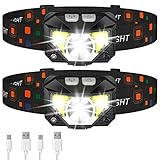
- 1. LHKNL Headlamp Flashlight — Best overall
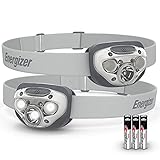
- 2. Energizer LED Headlamp PRO — Most versatile
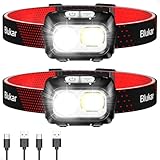
- 3. Blukar LED Headlamp Rechargeable — Best for families
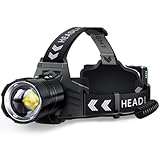
- 4. AKNEAR LED Rechargeable Super Bright Headlamp — Best premium
- 5. FINICO Rechargeable LED Headlamp 99000 High Lumens — Best upgrade
- 6. Staaricc Super Bright Headlamp Rechargeable — Best budget pick
- Are lumen numbers on cheap headlamps real?
- What owning one for a year looks like
- The verdict
- FAQ
The best cheap headlamp here is the LHKNL Headlamp Flashlight, because 1.87 oz on your forehead and a 2-year warranty beat every rival in this set on the two things you notice daily. If you'd rather swap AAA cells than hunt for a charging cable, the Energizer LED Headlamp PRO two-pack is the better buy. This one isn't for you if you need a certified beam distance for search work or caving. Those buyers want a name-brand light with published ANSI FL1 figures and a replaceable 18650 cell, and none of the six here publish that data. Everyone else is choosing between comfort, count and charging port.
Best cheap headlamp at a glance
| Pick | Weight | Power | Price |
|---|---|---|---|
Best overall LHKNL Headlamp Flashlight |
1.87 oz | Rechargeable, 8 modes claimed | Check Price |
Most versatile Energizer LED Headlamp PRO |
Not published | Batteries, 3 modes claimed | Check Price |
Best for families Blukar LED Headlamp Rechargeable |
5.96 oz for 2 | USB-C, 1200mAh claim | Check Price |
Best premium AKNEAR LED Rechargeable Headlamp |
0.71 lb | USB-C, 10500mAh claim | Check Price |
Best upgrade FINICO Rechargeable LED Headlamp |
Not published | USB-C, 12 modes claimed | Check Price |
Best budget pick Staaricc Super Bright Headlamp |
Not published | USB-C, zoom claimed | Check Price |


Who should skip a cheap headlamp entirely
Not every buyer belongs in this category. Be honest about which group you're in before you spend anything.
Skip the whole segment if you need a light your safety depends on. Cave rescue, night mountaineering above treeline, marine work, industrial inspection: those jobs need published ANSI FL1 runtime and beam-distance figures, a user-replaceable cell so you can carry a spare, and a repairable body. None of the six listings here publish an ANSI figure. Five of the six use sealed internal batteries you can't swap in the field.
Skip it too if you already own a good light and you're only shopping because the price looks tempting. A second mediocre headlamp is clutter.
Who should stay:
- Dog walkers and evening runners on lit streets
- Campers who mostly need to find the tent zip
- Anyone working under a sink, in an attic, or behind a dryer
- Households wanting a light in every drawer and glovebox
- Power-outage kits, where two lights beat one good one
If you're in that list, a cheap headlamp is genuinely the right tool, and the differences between these six are real.
Why three picks were cut before the list
I started with the headlamps section of the Lights & Lanterns category and cut hard before comparing anything.
Three disqualifiers did most of the work.
- No published warranty at all. Every pick below states a warranty period or a service promise. Listings with the field blank went out, because in a category built on sealed batteries, the warranty is the only recourse you have.
- Only one seller and no brand identity. A listing with a scrambled brand name and a single seller is a repackaged unit with no continuity. Several here have one seller, but each carries a named brand and a model number I can quote: TG-T069, K9125, ENHDCA32EGA, AK-SR99800-G1, FR-GTK9800-K1.
- No physical dimensions. If a listing won't say how big the housing is, you can't judge whether it'll tip forward on your head. All six survivors publish dimensions, from the FINICO's 1.77 x 1.77 x 1.57 in body to the Staaricc's 4.85 x 3.9 x 3.75 in package.
What survived is a spread rather than six of the same thing. Two are two-packs plus one that ships as a pair, one runs on replaceable batteries, and three are zoomable single units. That spread is deliberate. It means the recommendation can change based on what you're actually doing.
What actually decides a cheap headlamp?
Most guides to the best cheap headlamp rank by claimed lumens. That is the least useful number on the page. Two of these listings claim 99000 lumens, a figure no headlamp of this size produces, and the reason nobody polices it is that the claim carries no test standard behind it.
Here's what decides it instead: weight on your forehead, and how the light gets its power.
Weight is the one thing you feel every minute. The LHKNL publishes 1.87 oz per light. The AKNEAR publishes 0.71 lb, which is 11.36 oz, roughly six times the LHKNL. Both will illuminate a campsite. Only one disappears once you've had it on for twenty minutes. The Blukar's 5.96 oz covers two units, so each sits between the extremes.
Power is the second axis, and it's binary. The Energizer takes batteries. The other five charge over a port. Neither is better in the abstract:
- Sealed rechargeable means no cell hunting, and it means the light is disposable once the battery degrades.
- Replaceable batteries mean you can revive a dead light at any petrol station, and you're buying cells forever.
Decide those two first. Then look at modes, zoom and colour, which are tie-breakers rather than deciders.
1. LHKNL Headlamp Flashlight — Best overall
At 1.87 oz with a 2-year warranty, this is the light you'll actually keep wearing.
Best for: anyone who wants a light they forget they're wearing Skip it if: you need a beam that reaches hundreds of feet
Two figures separate this from the rest of the set. The first is 1.87 oz, the lowest published weight of the six and the only one under two ounces. The second is the 2-year warranty, the longest fixed term here that isn't a vague service promise. The housing measures 2.75 x 4.13 x 3.34 in and the model is TG-T069.
LHKNL says the light offers 8 modes plus a motion sensor and a long-press function, and rates the shell at IPX4. IPX4 covers splashes and rain, not submersion, so treat it as a drizzle light rather than a kayaking one. The listing describes it as a 2 Packs size while giving a count of 1, which is the kind of ambiguity worth reading twice on the live page before you order.
It also sells faster than anything else in this group, which tells you the shape and the fit work for a lot of heads. The trade-off is ambition. Where the AKNEAR and FINICO claim tactical zoom and power-bank output, this is a fixed-beam light that does one job. For a dog walk, an attic, or a tent, that's the right amount of light. For spotting a trail marker at distance, it isn't.
Pros:
- Lightest published weight in this set at 1.87 oz
- Longest fixed warranty term here, 2 years
- IPX4 rating claimed for rain and snow
- Motion sensor and long-press claimed for glove-free use
- The one buyers choose most often here
Cons:
- No zoom, so beam width is fixed
- IPX4 is splash resistance, not submersion
- Listing size and count fields contradict each other
- No published battery capacity to judge runtime
2. Energizer LED Headlamp PRO — Most versatile
The only pick here you can revive with cells from a corner shop.
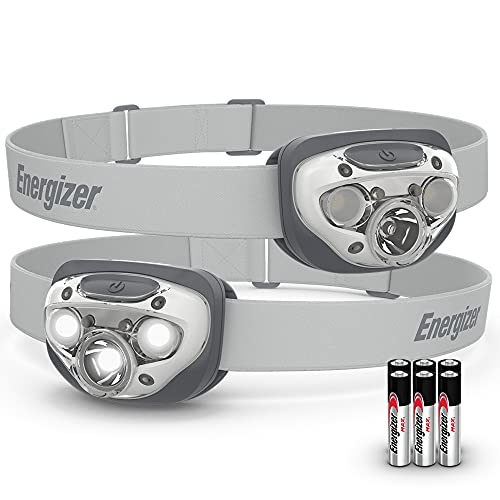
Best for: households that want swappable batteries and two lights Skip it if: you refuse to buy AAA cells ever again
This is the outlier, and that's exactly why it's here. Five of the six picks in this best cheap headlamp lineup have sealed internal batteries. When the cell degrades, the light is rubbish. This one takes batteries, so a dead light is a two-minute fix on a Sunday night.
It ships as a 2-Pack with a count of 2, in stone gray, and measures 2.48 x 4.69 x 3.23 in. The model is ENHDCA32EGA. Energizer states 260 lumens with beam distance up to 80 meters, dimming from 10% to 100%, three modes across high, spot and wide, and an IPX4 rating. Notice that 260 lumens is the most modest brightness claim in the whole set, and it's also the only one paired with a distance figure and a specific percentage range. A conservative number with detail behind it is more useful than a five-digit one without.
The costs are real. There's no published weight, so you can't compare comfort on paper. The warranty field reads only "Parts", which is thinner than the 2-year term on the LHKNL. And you'll be buying cells for the life of the light.
Pros:
- Only pick with field-replaceable batteries
- Ships as two lights in one box
- Specific claims: 260 lumens, 80 m beam, 10 to 100% dimming
- Named brand with a quotable model, ENHDCA32EGA
Cons:
- Ongoing battery cost forever
- No published weight to judge head comfort
- Warranty listed only as parts, with no term
- Three modes, fewer than most rivals claim
3. Blukar LED Headlamp Rechargeable — Best for families
Two USB-C lights with a red mode, at the second-lowest price position here.
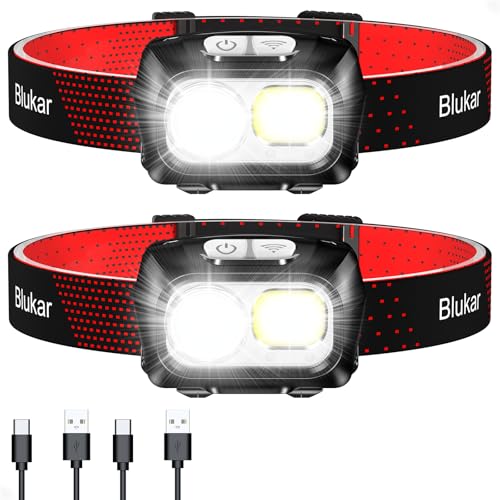
Best for: families needing two USB-C lights with a red mode Skip it if: you want the lightest band on your forehead
Two lights, one charging cable standard, and the second-cheapest position in this group. That combination is why this is the family answer. The listing gives a count of 2 with a combined 5.96 oz and a compact 1.73 x 2.76 x 2.17 in housing, the smallest footprint here after the FINICO. The model is K9125.
The mode list is the interesting part. Blukar claims 8 modes built from a COB strip and an XPG spot, including a red COB output and a red SOS. Red light is the one feature genuinely missing from most cheap headlamps, and it matters if you're moving around a tent with a sleeping child in it, or reading a map without wrecking your night vision. The brand also claims 1200mAh, a 2 to 3 hour charge, stepless dimming, a 45° tilt and IPX5, which is a step up in water resistance from the two IPX4 picks.
The catch is the 1-year warranty, half the LHKNL's term, and a slower sales position than the top two. At 5.96 oz for the pair, each unit is heavier than the LHKNL but nowhere near the AKNEAR.
Pros:
- Two lights with USB-C charging
- Red and red SOS modes claimed, rare at this price
- IPX5 claim, above the IPX4 picks here
- Stepless dimming and 45° tilt claimed
- Second-cheapest of the six
Cons:
- 1-year warranty, half the top pick's term
- 5.96 oz covers both units, so per-light weight is unclear
- Sells far slower than the top two here
- No beam distance published
4. AKNEAR LED Rechargeable Super Bright Headlamp — Best premium
A 10500mAh claim and lifetime service, at 0.71 lb on your head.

Best for: long overnight jobs where runtime beats comfort Skip it if: you'll wear it for hours on a trail run
This is the most expensive pick here, and the pitch is endurance. AKNEAR claims a 10500mAh battery with up to 95 hours of runtime, 12 modes across flood and spot, tactical zoom, USB-C fast charging in 3 to 5 hours, and a USB output port so the light doubles as a power bank. The warranty entry is the strongest in the set on paper: lifetime product service with a 60-day risk-free return.
The number you should weigh against all that is 0.71 lb. That's 11.36 oz, the heaviest published weight of the six and roughly six times the LHKNL. The housing is compact at 1.97 x 3.15 x 1.97 in, which means the mass sits in a dense block on your forehead rather than spread across the band. Model FR-GTK9800-K1.
The 99000 lumens claim is not something I'd build a decision on. Treat it as marketing and buy this for the battery capacity, the zoom and the service promise instead. If you're doing overnight fishing, storm cleanup, or a long shift where a phone top-up would help, the weight is a fair price. If you're jogging, it isn't.
Pros:
- Largest claimed battery capacity here, 10500mAh
- Lifetime service and 60-day return stated
- Power bank output via USB-C claimed
- 12 modes with flood and spot zoom claimed
Cons:
- Heaviest pick at 0.71 lb
- Most expensive here, with no verified brightness advantage
- 99000 lumens claim has no test standard behind it
- Single light only, and one seller lists it
5. FINICO Rechargeable LED Headlamp 99000 High Lumens — Best upgrade
The smallest housing in the set, with a 10-year service promise attached.
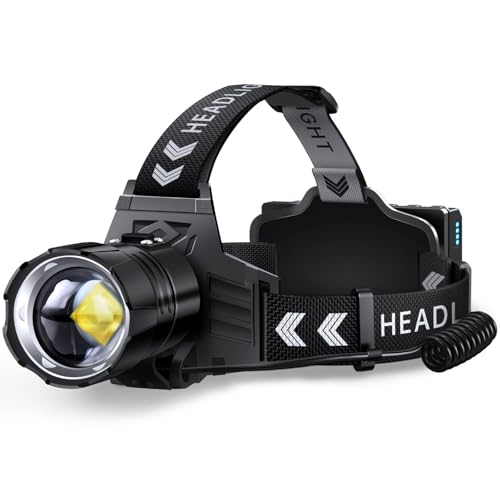
Best for: one person who wants zoom and a 10-year service promise Skip it if: you need more than one light
FINICO's listing reads almost as a sibling of the AKNEAR, and the specifications back that up. Same 12-mode structure across flood and focus, same 95-hour runtime claim, same USB-C fast charge in 3 to 5 hours and the same power-bank framing. Model AK-SR99800-G1. The differences are where it gets interesting.
First, the body: 1.77 x 1.77 x 1.57 in, the smallest published dimensions of the six. That's a genuinely compact block, and FINICO says there's an ergonomic sponge on the forehead pad and 125° of tilt, the widest tilt range claimed here. Second, it sits one step below the AKNEAR in price position while claiming the same feature set. Third, the warranty entry reads 10-year service plus a 60-day risk-free return, which is a fixed term rather than an open-ended promise.
What's missing is a published weight, which is the single figure I most want in a headlamp comparison. Given the AKNEAR's near-identical layout weighs 0.71 lb, assume this isn't a featherweight either. It's also a 1 Pack, so households wanting coverage in two rooms are better served by the Blukar or the Energizer.
Pros:
- Smallest published housing here, 1.77 x 1.77 x 1.57 in
- 125° tilt, the widest claimed in this set
- 10-year service and 60-day return stated
- Zoom between flood and focus claimed
- Cheaper than the AKNEAR with matching claimed features
Cons:
- No published weight at all
- Single unit, unlike three rivals
- 99000 lumens claim is unverifiable marketing
- Slowest-selling but one in this group
6. Staaricc Super Bright Headlamp Rechargeable — Best budget pick
The cheapest of the six, and it still gets you USB-C and adjustable focus.

Best for: spending the least while still getting USB-C and zoom Skip it if: you want a published weight before you buy
This is the cheapest pick in the group, and the notable thing is what it doesn't give up. Staaricc claims adjustable focus between floodlight and spotlight, a Type-C fast-charging connector, 0 to 90° tilt, and an aviation-grade aluminium alloy body for heat dissipation and impact resistance. Metal housing at the bottom of a price ladder is unusual, since plastic is the obvious place to save.
The published package measures 4.85 x 3.9 x 3.75 in, the largest dimensions of the six, though that figure likely covers the retail box rather than the lamp itself. The warranty is one year, matching the Blukar and below the LHKNL. The model reads Headlamp Rechargeable-1, which is a placeholder rather than a real part number, and that's a small signal about how much documentation sits behind the product.
The bigger gap is the missing weight figure. With a metal body and a non-detachable high-capacity cell, I'd expect it to land closer to the AKNEAR end than the LHKNL end. If you already know you're sensitive to front-heavy lights, spend the small step up to the LHKNL. If price is the constraint and you mostly need light in a garage, this covers it.
Pros:
- Cheapest of the six
- Adjustable focus between flood and spot claimed
- Aluminium alloy body claimed for impact resistance
- USB-C charging with a non-detachable cell
Cons:
- No published weight
- Model number is a placeholder, not a real part code
- 1-year warranty, half the LHKNL's term
- Largest published dimensions in this group
- No water-resistance rating stated
Are lumen numbers on cheap headlamps real?
Short answer: mostly not. Two listings here claim 99000 lumens. For scale, a car headlight is in the low thousands. A 99000-lumen emitter of this size would need cooling you could feel through your skull.
The reason the numbers inflate is that nothing forces a test standard. Serious lighting brands publish to ANSI/NEMA FL1, which specifies how output, beam distance and runtime are measured, and how long after switch-on the reading is taken. None of these six listings mention FL1.
So here's how to read brightness claims across the best cheap headlamp shelf:
- A five-digit lumen number is decoration. Ignore it entirely.
- A modest number with a distance attached carries more weight. The Energizer's 260 lumens with an 80 m beam is the most credible claim in this set precisely because it's small and specific.
- A percentage range is a real feature. Energizer's 10% to 100% dimming and Blukar's stepless dimming describe control, which you'll use constantly.
- Runtime claims scale with capacity. A 95-hour figure is almost certainly the lowest mode. A 10500mAh cell is at least a checkable number.
Buy on capacity, weight, warranty and mode count. Not lumens.
What owning one for a year looks like
The listings sell the first night. Here's the rest of it.
Charging becomes a habit or a problem. Five picks charge over USB-C. Once a month, plug them in whether you've used them or not, because a lithium cell left flat in a drawer for a year often won't come back. Only the Energizer sidesteps this.
The band stretches. Elastic loses tension after a season of stretching over hats and hoods. It's the most common failure that isn't electrical, and it's why FINICO's sponge pad and Blukar's stated fixation are worth something.
You'll discover which modes you use. With 8 or 12 claimed modes, you'll settle on two: a low for close work and a high for walking. Every press-through-the-cycle interface eventually annoys you. This is where the LHKNL's long-press claim and Blukar's stepless dimming earn their place.
Water resistance gets tested by accident. IPX4 on the LHKNL and Energizer means splashes. IPX5 on the Blukar means low-pressure jets. Neither means dropping it in a stream.
The warranty is the whole safety net. With a sealed battery, a dead cell in month fourteen is a bin job on the Blukar and Staaricc. It's a claim on the LHKNL, and possibly on the FINICO and AKNEAR service promises.
The verdict
If you'll wear it for hours, buy the LHKNL Headlamp Flashlight. At 1.87 oz it's the only light here under two ounces, it carries the longest fixed warranty at 2 years, and it sells faster than anything else in this group, which usually means the fit works across a lot of head shapes. It's a fixed-beam light, so you're giving up zoom to get that comfort.
If you'll use it for minutes at a time, buy the Energizer LED Headlamp PRO. Two lights, replaceable cells, 260 lumens with an 80 m beam and 10% to 100% dimming. It's the only pick you can bring back from dead with a packet of batteries, which is what you want in a glovebox or a storm kit rather than on a trail.
The cutoff is roughly one hour of continuous wear. Under that, weight barely registers and battery convenience wins. Over it, weight is the only thing you'll think about, and the 0.71 lb AKNEAR or the metal-bodied Staaricc become a chore.
The runner-up's specific advantage over the winner is independence from a charging port. The winner's advantage over everything else is that you'll stop noticing it's there. Families wanting one light each with a red mode should take the Blukar instead.
FAQ
Is a cheap headlamp worth buying at all?
A cheap headlamp is worth buying if your use is casual and intermittent: dog walks, attic trips, campsite tasks, power cuts. The build quality gap between these and a premium light shows up in beam consistency and battery longevity, not in whether you can see. For jobs where failure has consequences, spend more and demand ANSI FL1 figures.
What's the difference between the LHKNL and the Blukar?
The difference between the LHKNL and the Blukar comes down to count and comfort. The LHKNL publishes 1.87 oz and a 2-year warranty, and it's a single unit despite the confusing size field. The Blukar gives you two USB-C lights at 5.96 oz combined, a 1-year warranty, plus red and red SOS modes the LHKNL doesn't claim. Two lights or one light you barely feel.
Does a headlamp need to be waterproof?
A headlamp needs water resistance rather than true waterproofing for most uses. IPX4, claimed by the LHKNL and Energizer, handles rain and splashing. IPX5, claimed by the Blukar, adds low-pressure jets. Neither survives submersion. If you fish, paddle or work in downpours, prioritise the IPX5 claim and keep the charging port cover firmly closed.
How much brightness do I actually need?
The brightness you actually need is far less than these listings advertise. For walking a path or working under a sink, well under 100 lumens is plenty, which is why the Energizer's 260 lumen claim is generous rather than limiting. Beyond that, extra output mostly drains battery and blinds anyone you're talking to. Dimming control matters more than peak output.
Which cheap headlamp lasts longest on one charge?
The longest claimed runtime among these belongs to the AKNEAR, with a 10500mAh battery and up to 95 hours stated, matched on the runtime figure by the FINICO. Read those hours as the lowest mode, not the brightest. The Energizer sidesteps the question entirely with replaceable cells, which means unlimited runtime as long as you're carrying spares.
Start with your wear time, not the brightness claim. If your light spends most of its life on your head rather than in your hand, the LHKNL's 1.87 oz and 2-year warranty make it the sane default, and its fixed beam is a limitation you'll notice far less than eleven ounces pressing on your forehead. Check the LHKNL listing to confirm whether you're getting one unit or two before ordering, since the size and count fields disagree. Then plug it in monthly, whether you've used it or not.