Best Fire Extinguishers When Storage Space Is Tight
Five picks for home fire protection, ranked by what they actually cover and where they fit. The winner weighs 3.9 lb and carries a 6-year warranty.
The best fire extinguishers for a tight home are the Kidde Basic 110 and its FA110G body: 3.9 lb, 15.5 x 4.81 x 3.88 in, and backed by a 6-year warranty. If you need something for a workshop instead of a hallway closet, the First Alert HOME2PRO steps up to a 12-year limited warranty and 9.6 lb of rechargeable canister. The deciding number isn't weight. It's the letter-and-number rating stamped on the label, and only two picks here publish one.
Best fire extinguishers at a glance
| Pick | Fire classes covered | Weight | Price |
|---|---|---|---|
| Best overall Kidde Basic 110 Fire Extinguisher for Home |
1-A:10-B:C rated | 3.9 lb | Check Price |
| Best premium First Alert Fire Extinguisher |
2-A:10-B:C claim | 9.6 lb | Check Price |
| Best budget pick AmzBoom 2-Pack Fire Extinguisher for Home |
A, B, C, K claim | 1 lb | Check Price |
| Runner-up AmzBoom Fire Extinguisher for Home |
A, B, C, K claim | 3.46 lb for 3 | Check Price |
| Best for beginners Prepared Hero Emergency Fire Blanket |
Grease and liquid claim | 39 x 39 in sheet | Check Price |
Why three picks were cut before the list existed
Three things knocked candidates out of this shortlist, and it's worth knowing them because the same three reasons should knock things out of your cart.
- No published rating and no published class coverage. If a listing won't say what kinds of fire the thing fights, it's a red canister and nothing more.
- No stated warranty. Four of the five picks here publish one. A pressurised cylinder you keep for a decade needs a manufacturer standing behind it.
- Dimensions that don't fit anywhere useful. A unit that won't clear the gap beside a fridge or under a sink is a unit you'll leave in the garage, which is the one room it probably wasn't bought for.
What survived is a set that splits cleanly. Two traditional dry-chemical cylinders with published UL-style ratings. Two multi-packs of aerosol spray cans. One fire blanket. That's five very different tools, not five versions of the same tool, and the picks below are ranked on how much of a real home they actually cover.
What actually decides which fire extinguisher you need?
Most guides to the best fire extinguishers compare weight, and weight is the wrong lead. What decides it is the rating.
Here's how to read one. In 1-A:10-B:C, the letters name the fuel and the numbers name the capacity. A is ordinary combustibles: paper, wood, fabric, trash. B is flammable liquids: gasoline, cooking oil, solvents. C means the agent is safe on live electrical equipment. The number in front of A is a rough measure of how much Class A fire the unit can knock down, and the number in front of B is the square footage of liquid fire.
So the Kidde's 1-A:10-B:C and the First Alert's claimed 2-A:10-B:C differ in one place: the First Alert claims twice the Class A capacity. Same liquid-fire figure. That single digit is the whole gap between the two cylinders, and it's why the heavier one belongs in a workshop where there's more wood and more paper on the floor.
The aerosol picks publish letters but no numbers. They claim A, B, C and K coverage, K being commercial cooking oils. Letters without numbers tell you what the agent works on, not how much of it the can can handle. Treat those as spot tools.
1. Kidde Basic 110 Fire Extinguisher for Home — Best overall
A published 1-A:10-B:C rating in a 3.9 lb body is the most protection per inch of shelf space in this set.

Best for: one whole-house unit in an apartment or small home Skip it if: you need commercial-grade coverage in a workshop
The FA110G is the only pick here whose fire rating appears in the product name rather than buried in a marketing bullet: 1-A:10-B:C. That covers trash, wood, paper, liquids, gases and electrical equipment, and it's the minimum most residential guidance points at for a general-purpose home unit.
The numbers that matter for placement are 15.5 x 4.81 x 3.88 in and 3.9 lb. That's under four inches wide, so it clears the gap between a fridge and a cabinet, and light enough to aim one-handed while you're moving toward a door. Compare that to the 9.6 lb First Alert and you understand the trade: less agent, far more places it can live.
Kidde lists all-metal aluminium construction, an easy-pull safety pin and a colour-coded pressure gauge that reads charged when the needle sits in the green. The 6-year warranty is half the First Alert's term. This is also the one buyers choose most often across this set by a wide margin, and it's the second-cheapest of the five.
The trade-off: 1-A is the lower Class A figure of the two rated cylinders, and only one seller lists it.
Pros:
- Published 1-A:10-B:C rating, not a marketing claim
- Only 3.88 in deep, fits narrow gaps
- 3.9 lb, manageable one-handed
- Pressure gauge shows charge at a glance
- The one buyers choose most often here
Cons:
- 1-A is half the Class A capacity the First Alert claims
- 6-year warranty against the First Alert's 12
- No wall hook listed with it
- Single seller only
2. First Alert Fire Extinguisher — Best premium
Twice the claimed Class A capacity and a 12-year limited warranty, at the cost of 9.6 lb and 6 in of depth.
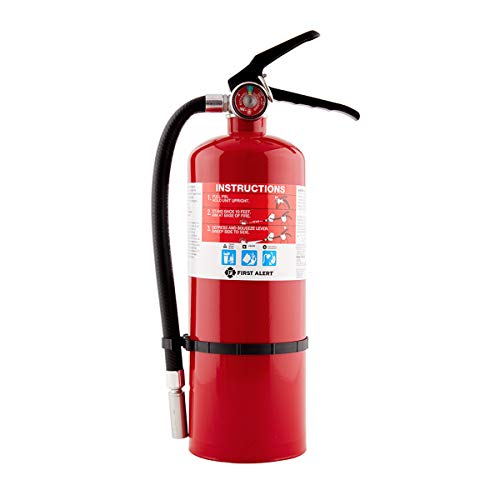
Best for: garages, workshops and anyone who wants a rechargeable body Skip it if: 9.6 lb is too much to lift one-handed
This is the heavyweight of the set. First Alert says the HOME2PRO is UL rated 2-A:10-B:C, which is double the Kidde's Class A figure at the same liquid-fire number, and the listing states it meets minimum 2-A:10-B:C code requirements. Worth checking against your own local code before you buy on that basis.
The build is where the extra goes. First Alert lists all-metal construction with a commercial-grade metal valve, mono ammonium phosphate as the agent, and rechargeability by certified professionals after use. That last point matters more than it sounds. A rechargeable body is a one-time purchase you service instead of replace, which is the reasoning behind the 12-year limited warranty, the longest published term in this group.
At 17 x 5.75 x 6 in and 9.6 lb, it's nearly two and a half times the Kidde's weight and 6 in deep. That rules out most kitchen cabinets. A wall hook is included, which is the honest signal about how this one is meant to live: mounted, not stashed. It's also the most expensive pick here and the slowest seller of the five.
Pros:
- Claimed 2-A:10-B:C, the highest Class A figure here
- 12-year limited warranty, longest in this set
- Rechargeable after use by certified pros
- Commercial-grade metal valve, wall hook included
Cons:
- 9.6 lb, heavy for one-handed use
- 6 in deep, won't fit narrow gaps
- Most expensive pick here
- Rating is a listing claim, not printed in the product name
3. AmzBoom 2-Pack Fire Extinguisher for Home — Best budget pick
Two 1 lb aerosol cans and two mounting brackets, cheapest in the set, for the places a real cylinder won't go.

Best for: the car and the kitchen drawer, on a tight budget Skip it if: you need one unit rated to cover a whole floor
At 1 lb and 10.5 x 2.65 in per can, this is the smallest thing here by a distance. That size is the entire argument for it. A glovebox, a boat locker, a kitchen drawer, the shelf above a grill. Places where the 6 in First Alert is a non-starter and even the Kidde is awkward.
AmzBoom claims A, B, C and K coverage, calls it 8-in-1 protection, and specifically names lithium-ion battery fires in phones and laptops among the fuels it handles. The agent is described as a non-toxic, water-based formula, which is why the listing says it's safe around people and the environment and prevents reignition. Read all of that as the manufacturer's claim. There's no published UL-style number in front of any of those letters.
Two brackets ship with the two cans, so both can be mounted rather than rattling loose. The 6-year manufacturer warranty matches the Kidde's term. This one is the cheapest of the five and outsells the 3-pack version.
The honest limitation: two 1 lb spray cans are not a substitute for a rated cylinder. Buy this alongside the Kidde, not instead of it.
Pros:
- Cheapest pick in this set
- 1 lb and 2.65 in across, fits a glovebox
- Two mounting brackets included
- 6-year manufacturer warranty
- Claimed K coverage for cooking oils
Cons:
- No published capacity number behind the A, B, C, K letters
- 1 lb of agent per can, spot use only
- Class coverage is a listing claim, not a printed rating
- Single-use spray, not rechargeable
4. AmzBoom Fire Extinguisher for Home — Runner-up
Three cans instead of two, so one lands in the kitchen, one in the car and one in the garage.

Best for: covering three rooms or vehicles at once Skip it if: you'd rather have one larger canister than three small ones
Same MSWJ-500C model as the 2-pack, same 6-year manufacturer warranty, one more can. Total shipping weight is 3.46 lb and each can measures roughly 10 x 2.6 x 2.6 in. It sits mid-range for price in this group, above the 2-pack and below the Kidde.
Coverage is the reason to pick this over its smaller sibling. Three units and three brackets means three separate rooms get something within arm's reach, and proximity is most of what makes a small extinguisher useful. A can in a drawer twelve feet from the stove beats a cylinder in the basement every time.
AmzBoom lists the same broad claims: kitchen grease, wood, gasoline and lithium-ion battery fires, a water-based non-toxic solution, and residue-free cleanup that's safe around children and pets. Again, no capacity figure accompanies those letters.
It's the slowest seller among the two AmzBoom listings and it costs more than the 2-pack for a third can of the same agent. If you only need coverage in two spots, the 2-pack is the better value. If you're spreading protection across a house, a car and a shop bench, the third can earns its keep.
Pros:
- Three cans and three brackets, three rooms covered
- 6-year manufacturer warranty
- 10 x 2.6 x 2.6 in per can, drawer-friendly
- Residue-free water-based agent, per the listing
Cons:
- Costs more than the 2-pack for the same agent
- No published capacity rating
- Slowest-selling AmzBoom listing here
- Single-use cans, no recharge option
5. Prepared Hero Emergency Fire Blanket — Best for beginners
No pin, no gauge, no pressure. Two 39 x 39 in sheets you throw over a pan fire and walk away from.

Best for: stovetop grease fires and anyone nervous about a pressurised cylinder Skip it if: the fire is anywhere you can't reach over it safely
This is the outlier and it belongs on the list. The blanket has no discharge, no expiry gauge and nothing to aim. You pull it out, drop it over the flames and the fire loses its air supply. For a pan of oil on a stovetop, that's a faster and cleaner answer than a chemical cylinder, which can spatter burning oil if you hit it with a jet at close range.
Prepared Hero lists 100% flame-retardant material conforming to CE safety standard EN 1896:1997, and says the blanket works on liquid and grease fires as well as other types, and doubles as a thermal or heat shield. Each sheet is 39 x 39 in, two per pack. That's genuinely the best pick here for someone who has never handled an extinguisher, because there's nothing to get wrong under pressure.
It's also the most limited. No fire class rating, no Class C claim for live electrical equipment, and it only works on a fire small enough that you can get directly over it. The listing publishes no warranty, the only pick here without one, and it sits in the highest price position alongside the First Alert.
Pros:
- Nothing to operate, no pin or gauge
- 39 x 39 in per sheet, two in the pack
- Conforms to CE EN 1896:1997, per the listing
- No residue and no chemical cleanup
- Sells faster here than three of the four extinguishers
Cons:
- No fire class rating published at all
- Requires reaching directly over the flames
- No warranty listed, the only pick without one
- Premium price position with the fewest published specs
Where do you put a fire extinguisher in a small home?
Placement decides whether any of this works, and it's the part most buyers get wrong. Depth is the number that matters, because that's what determines whether a unit lives on a wall or in a gap.
- Kitchen, near the exit not the stove. You want to reach the extinguisher while moving away from the fire, never past it. The Kidde's 3.88 in depth fits beside most fridges.
- Kitchen drawer or the shelf above a grill. One AmzBoom can, 2.65 in across.
- Garage or workshop, wall-mounted. The First Alert's 6 in depth and 9.6 lb want a hook, and one ships with it.
- Vehicle glovebox or boat locker. A 1 lb aerosol can and nothing bigger.
- Beside the stovetop. The fire blanket, folded, in a drawer within arm's length.
One unit per floor is the usual minimum, plus one in the kitchen and one in any garage. That's why the multi-packs matter more than they look on paper: the best fire extinguishers are the ones close enough to reach in under ten seconds.
Rechargeable, disposable or single-use spray?
Three service models sit in this set, and they cost different amounts over a decade.
Rechargeable is the First Alert. Discharge it, a certified professional refills it, the same body serves for years. The 12-year limited warranty exists because the cylinder is designed to outlive several fills.
Disposable but gauged is the Kidde. There's a pressure indicator you check periodically, and when the needle drops out of the green or the unit is used, it gets replaced. The 6-year warranty covers the body over that span.
Single-use spray is both AmzBoom packs. One incident per can. The upside is that the 6-year manufacturer warranty applies to sealed cans, and buying in twos or threes means using one doesn't leave you with nothing.
If you want a single purchase that keeps working after an incident, the First Alert is the only pick here that does it. If you'd rather spread cheap coverage across five rooms, the aerosols make more sense. Neither answer is wrong, and plenty of homes want both.
What the listings do not tell you about ratings
Here's the gap in the data. Only two of these five publish a numbered fire rating: the Kidde at 1-A:10-B:C and the First Alert at a claimed 2-A:10-B:C. The other three publish letters, or in the blanket's case nothing at all.
That is not the same as saying they don't work. It means you can't compare their capacity to anything. A rated cylinder has been discharged against a measured test fire; a claimed A, B, C, K spray has been described by whoever wrote the listing. When the AmzBoom cans name lithium-ion battery fires, that's a claim worth reading carefully, because battery fires reignite and no published number here tells you how much of one a 1 lb can handles.
Two more things the listings stay quiet about. None of them state a service interval, so you'll want to check pressure gauges yourself on a schedule. And the blanket's EN 1896:1997 reference is a European standard, which the listing cites without any US equivalent alongside it.
Buy the rated units for coverage. Buy the unrated ones for reach. Don't confuse the two.
The verdict
The Kidde Basic 110 is the right default for the best fire extinguishers in a home, and the reason is the combination of a published 1-A:10-B:C rating with a 3.88 in depth. It's the only pick that puts a genuine general-purpose rating into a body slim enough to live in a hallway or beside a fridge, and it's the second-cheapest of the five. That's why it's also the one buyers here reach for most.
Two conditions flip it. First, a garage or workshop with wood, solvents and a bench: the First Alert's claimed 2-A:10-B:C doubles the Class A figure and its rechargeable body plus 12-year limited warranty make it the cheaper unit across a decade, if you can live with 9.6 lb and 6 in of depth. Second, a stovetop as the main worry: the Prepared Hero blanket smothers a grease fire without spattering oil, and there's no pin to pull under pressure.
The AmzBoom packs aren't primary protection. They're reach. Two or three 1 lb cans in a car, a drawer and a boat locker cover the places a cylinder can't go, and buying one alongside the Kidde is a better plan than buying either alone.
FAQ
Are the best fire extinguishers worth buying for a small apartment?
The best fire extinguishers are worth buying at any square footage, because fire size at discovery matters more than home size. A 3.9 lb Kidde at 15.5 x 4.81 x 3.88 in fits a coat closet or the gap beside a fridge in a studio. One rated unit near the kitchen exit covers the most likely ignition point in an apartment.
What does 1-A:10-B:C actually mean on a fire extinguisher?
1-A:10-B:C means the unit is rated for three fire classes at stated capacities. A covers ordinary combustibles like paper and wood, B covers flammable liquids, and C means the agent is safe on live electrical gear. The 1 and the 10 are capacity figures. The Kidde publishes 1-A:10-B:C; First Alert claims 2-A:10-B:C.
Kidde Basic 110 or First Alert HOME2PRO: which should I buy?
Kidde Basic 110 or First Alert comes down to where it lives. The Kidde is 3.9 lb and 3.88 in deep, so it fits indoor gaps and lifts easily. The First Alert is 9.6 lb and 6 in deep, claims double the Class A capacity, is rechargeable, and carries a 12-year limited warranty. Garage: First Alert. Hallway: Kidde.
Do fire blankets replace a fire extinguisher in the kitchen?
Fire blankets do not replace an extinguisher, they complement one. The Prepared Hero sheets measure 39 x 39 in and smother grease or liquid fires without spraying, which suits stovetop pans. But no fire class rating is published for them, and they require reaching over the flames. Keep a rated cylinder near the exit too.
What is the most common mistake when buying a fire extinguisher?
The most common mistake is buying on canister size instead of on the published rating and the mounting depth. A 9.6 lb unit that ends up in a basement because it's 6 in deep protects nothing. Check the rating, then measure the spot you'll actually mount it, then buy the largest unit that fits there.
Measure the gap you intend to use before you order anything. Depth is the specification that quietly decides this purchase, because a unit that doesn't fit near the kitchen exit ends up somewhere you'll never reach it in time. The Kidde Basic 110 wins here on exactly that logic: a published 1-A:10-B:C rating in a body 3.88 in deep, with a gauge you can check in a second and a 6-year warranty behind it. Add a two-pack of aerosol cans for the car and the drawer, and one modest order covers the three places a home fire usually starts.
Last updated: September 7, 2026. Product availability re-checked.
This page contains affiliate links. As an Amazon Associate we earn from qualifying purchases, at no extra cost to you.