Best Green Laser Levels by Line Count and Runtime
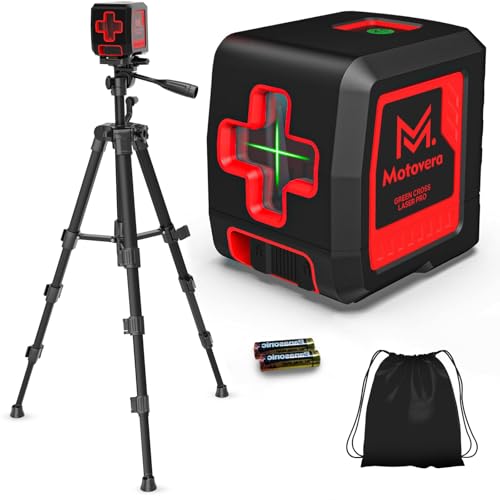
Six green laser levels ranked by what actually decides the job: line count, runtime, mount type and how far the beam has to reach on a real wall.

By Taylor DavidsonUpdated 16 min read
On this page
- Best green laser level at a glance
- How I narrowed six green laser levels from the shortlist
- 1. Motovera Self Leveling Laser Level 100ft — Best overall
- 2. Huepar Laser Level 360 Self Leveling HM03CG — Runner-up
- 3. Huepar Laser Level 9011G — Best budget pick
- 4. Alloyman Laser Level with Tripod T16 — Best for beginners
- 5. Fanttik D2 Pocket Green Laser Level — Best for small spaces
- 6. Takamine 16 Line Green Laser Level Pro GM160 — Best premium
- Line count is what actually decides this
- Cross-line or 360°: which one do you need?
- How long will one charge actually last?
- What the listings do not tell you about outdoor use
- The verdict
- FAQ
The best green laser level for most jobs is the Motovera LL-T2, a self-levelling cross-line tool with a green diode the listing rates at four times the brightness of a red beam, an IP54 body and a tripod in the box. If you need lines running the full way around a room, the Huepar HM03CG is the better buy, projecting 3x360° planes with an 8-hour rechargeable runtime and a 5-year warranty. Green wins over red indoors because your eye reads green as brighter at the same power, and the six tools here split neatly by how much of the room they light.
Best green laser level at a glance
| Pick | Line coverage | Runtime / power | Price |
|---|---|---|---|
Best overall Motovera LL-T2 |
Green cross-line 4 brightness modes |
Battery, not stated IP54 body |
Check Price |
Runner-up Huepar HM03CG |
3x360° (1H + 2V) 1.32 lb |
8 hr rechargeable claim 5-yr warranty |
Check Price |
Best budget pick Huepar 9011G |
Green cross-line 110° field claim |
Battery, not stated ±1/16 in at 16.4 ft claim |
Check Price |
Best for beginners Alloyman T16 |
4x360°, 16 lines 37.5-in tripod included |
Battery, not stated Class II green |
Check Price |
Best for small spaces Fanttik D2 |
Green cross-line 0.9 lb, 3.03 x 2.95 in |
10 hr rechargeable claim 2200 mAh cell |
Check Price |
Best premium Takamine GM160 |
4x360°, 16 lines Remote + Type-C |
Battery, not stated IP54 body |
Check Price |




How I narrowed six green laser levels from the shortlist
I set three cut criteria before I looked at any listing, and I weighted them in this order.
- Green beam only. Red-diode tools were out. The whole point of a green laser level is visibility, and mixing colours in a comparison hides that.
- A stated self-levelling mechanism. Every pick had to show a pendulum or equivalent with a defined lock and a manual mode. Tools relying on the user to eyeball level were cut.
- A useful mount. A 1/4"-20 thread, a magnetic bracket or an included tripod. Anything you had to prop against a book was cut.
That left the six here. Two are 360° tools that light a whole room, two are pocket cross-line units for a single wall, and two sit in between with a cross-line beam and a tripod in the box. I then ranked within that spread using published specifications: line count, runtime, weight, warranty and ingress rating.
What I did not do: plug them in, tape them to a wall or measure the beam. I compared the published specifications side by side, and I flag every manufacturer claim as a claim. Anything a listing did not state, I did not assume.
1. Motovera Self Leveling Laser Level 100ft — Best overall
A palm-sized green cross-line laser with four brightness modes, IP54 sealing and a tripod in the box, at a middle price for the set.
Best for: DIYers hanging pictures, tiling a backsplash or squaring a small room. Skip it if: you need lines wrapping a full room.
The LL-T2 is the pick I would hand to somebody who does not yet know how often they will use a green laser level. It projects a green cross-line, and Motovera says the diode runs four times as bright as a standard red laser, which matches the physics: your eye peaks near green even at the same output. The 5.5 by 3.4 in footprint sits easily on a shelf edge, and the included aluminium tripod is what stops most first-time buyers from having to spend again a week later.
Four brightness modes and a pulse function are the two features that push this ahead of the Huepar 9011G at a similar spec level. Pulse mode lets a detector pick the beam up outdoors, and the extra brightness steps buy you a fighting chance in a bright kitchen without a receiver. IP54 rating covers dust and splashes, which is more than the pocket units here promise.
The trade-off is line coverage: a cross-line tool lights one wall at a time. If you are laying out a whole room, this is not the pick.
Pros:
- Green cross-line with pulse and four brightness modes
- IP54 sealing on a mid-priced body
- Aluminium tripod included in the kit
- Sells faster than most of this set
- Compact 5.5 by 3.4 in footprint
Cons:
- No stated runtime or battery capacity
- Cross-line only, not 360°
- No published warranty length
2. Huepar Laser Level 360 Self Leveling HM03CG — Runner-up
A rechargeable 3x360° green laser that wraps one horizontal and two vertical planes around a whole room, with the only 5-year warranty in the set.

Best for: framers and tilers who need one horizontal and two vertical planes around a room. Skip it if: you only ever work on a single wall.
If the Motovera lights one wall, the Huepar HM03CG lights the room. Huepar says it projects one 360° horizontal plane and two 360° verticals, which is what you want for squaring walls to a floor, dropping tile courses that meet in a corner, or hanging cabinet runs. At 1.32 lb the head is heavier than a pocket cross-line unit, but that mass buys you a magnetic bracket mount and a 1/4"-20 thread that pairs with any camera tripod.
The rechargeable pack is where this pick earns its runner-up spot. Huepar claims 8 hours of continuous runtime, which is a full trades day without a swap. Add the 5-year warranty, the only published warranty across all six picks, and this becomes the best green laser level for anyone whose job depends on the tool being alive at 3 p.m. on a Friday.
It costs more than the Motovera, and the listing warns against use near reflective surfaces, which matters in a bathroom mid-tile. The premium is real, and so is the reason for it.
Pros:
- 3x360° coverage in green
- Rechargeable with an 8-hour runtime claim
- 5-year warranty, the only one in this set
- Magnetic bracket and 1/4"-20 thread
- Sells faster than the rest of this set
Cons:
- Premium price position for the six here
- Manufacturer warns against reflective surfaces
- Heavier than the pocket cross-line picks at 1.32 lb
3. Huepar Laser Level 9011G — Best budget pick
A compact green cross-line tool with a 110° field claim and a stated indoor accuracy of ±1/16 in at 16.4 ft, at the cheapest price position here.

Best for: occasional picture-hanging and shelf jobs indoors. Skip it if: you work outdoors or beyond a small room.
The 9011G is the cheapest of the six and the one to buy if the tool will spend most of its life in a drawer between weekend jobs. Huepar publishes a stated accuracy of ±1/16 in at 16.4 ft, a 110° field for the cross beam, and a self-levelling range of ±4° with an out-of-range flash. Those are the numbers a first-time buyer actually needs, printed on the listing.
Physically it is the smallest tool of the six alongside the Fanttik, at 2.9 by 2.8 in. It runs on batteries rather than a rechargeable pack, which is a plus if you dislike hunting for a USB cable and a minus if you dislike hunting for AAs. Huepar claims the green diode is twice as bright as a comparable red, a more modest number than the Motovera's four-times claim and closer to what most cross-line tools deliver.
Two things it does not do: pulse mode for a receiver, and any kind of 360° coverage. It is an indoor cross-line laser and it is honest about that.
Pros:
- Cheapest of the six
- Stated ±1/16 in at 16.4 ft accuracy claim
- 110° field for the cross beam
- Small 2.9 by 2.8 in footprint
- Self-levelling with an out-of-range warning
Cons:
- No pulse mode for outdoor use with a receiver
- Cross-line only
- Battery-powered rather than rechargeable
4. Alloyman Laser Level with Tripod T16 — Best for beginners
A 4x360° 16-line green laser that ships with a 37.5-inch tripod and magnetic mount, aimed at buyers who want one box that covers everything.

Best for: first-time buyers who want a tripod and mount in one box. Skip it if: you prefer a compact tool that fits a jacket pocket.
Beginners overspend on the tool and underspend on the mount, which is what makes the T16 an easy first buy. It ships with a 37.5-inch tripod and a magnetic mount together, and it is one of only two 4x360° picks here. Alloyman describes 16 green laser lines split across four 360° planes, plus an outdoor pulse mode using Class II green diodes.
The reason it sits below the Huepar HM03CG in the ranking is what the listing does not print. There is no stated runtime, no stated warranty length and no published leaving-level accuracy figure. The pendulum has self-levelling and manual modes with an audible alarm, and the mode switch is a long press. Those are useful behaviours, but they are behaviours, not numbers.
Set against the Takamine GM160, which is also 4x360° and 16 lines, the T16 gives up the remote control and Type-C charging speed. Set against the Motovera, it wins on line count and loses on how quickly it slips into a drawer.
Pros:
- 4x360° with 16 green lines
- 37.5-inch tripod and magnetic mount both included
- Outdoor pulse mode with Class II green
- Self-levelling and manual modes with alarm
- Mid-price position for the set
Cons:
- No stated runtime or warranty
- No published leaving-level accuracy
- Slowest seller of the six
- Bulkier package than the pocket picks
5. Fanttik D2 Pocket Green Laser Level — Best for small spaces
A 0.9 lb pocket green cross-line laser with a claimed 10-hour rechargeable runtime and a 2200 mAh cell.

Best for: renters, apartment DIY and picture walls where the tool must disappear. Skip it if: you need 360° lines around a whole room.
The D2 is the tool for people whose "workshop" is a kitchen table. At 3.03 by 2.95 in and 0.9 lb it is the smallest published footprint of the six alongside the 9011G, and Fanttik says the 2200 mAh cell drives ten hours of continuous work per charge. That is the longest stated runtime in the set, and it is on the only pick paired with more than one seller on the listing.
Fanttik lists a pulse mode with a claimed 164 ft range when used with a separately-sold receiver, and 360° head rotation on the base so you can spin the cross without unsticking the mount. Self-levelling and manual modes work off the pendulum, with the usual flashing warning outside the levelling range.
The obvious limit is coverage. This is a cross-line laser, not a 360° laser. If you are laying tile around a corner or aligning cabinets across three walls, you will move it and re-level between each. For picture-hanging, floating shelves, curtain rods and a TV mount, it does the job and vanishes into a drawer.
Pros:
- Pocket size at 3.03 by 2.95 in and 0.9 lb
- Claimed 10-hour rechargeable runtime
- 360° base rotation for quick repositioning
- Pulse mode with a 164 ft claim in a receiver setup
- Two sellers list it, unusually for this set
Cons:
- Cross-line only, no 360° planes
- Receiver not included
- No published warranty length
6. Takamine 16 Line Green Laser Level Pro GM160 — Best premium
A 4x360° 16-line green laser with a remote control, Type-C charging and an IP54 body, the most expensive pick here.

Best for: pros who want a remote, Type-C charging and four 360° planes. Skip it if: you rarely leave one room per job.
The GM160 is the most expensive pick here and the one with the deepest feature list. Takamine describes four 360° green planes and 16 lines, an IP54 body for dust and splashes, and a Japanese SHARP green laser unit, plus a remote control and Type-C charging that the brand claims is 60% faster than a standard USB port. The 1/4" mounting thread pairs with any tripod or pole.
What you are paying for over the Alloyman T16, the other 4x360° pick, is the remote and the charging system. The remote matters when the tool is on a pole above head height and you need to switch a plane off without climbing. Type-C matters when you have twenty other Type-C cables in the van and no old micro-USB left.
Two caveats. This is the slowest seller of the six, which means less crowd-sourced knowledge if something goes wrong. And the listing does not publish a warranty length, which is a real gap at the premium price position when the Huepar HM03CG publishes five years at a lower price.
Pros:
- 4x360° with 16 lines
- Remote control included
- Type-C charging with a 60% faster claim
- IP54 body
- SHARP green laser unit per the listing
Cons:
- Most expensive pick here
- No published warranty length
- Slowest seller of the six
Line count is what actually decides this
Most green laser level guides compare beam brightness. That is not what decides the buy. Every green diode here is bright enough for indoor work, because that is why the category exists. What actually decides it is how many planes the tool projects and whether they wrap 360° around a room.
Here is the split across the six picks:
- Cross-line, one wall at a time: Motovera LL-T2, Huepar 9011G, Fanttik D2.
- 3x360°, one horizontal and two vertical planes: Huepar HM03CG.
- 4x360°, sixteen lines around and above: Alloyman T16, Takamine GM160.
The rule is simple. If your work is a single wall at a time, a cross-line tool is enough and a 360° tool is money and weight you do not need. If your work turns a corner, a 360° tool pays for itself before the second room. The cutoff is honest: how many walls does one job involve? One wall, cross-line. Two or more, 360°.
Cross-line or 360°: which one do you need?
The honest test is the number of walls your beam needs to hit without you moving the tool. A cross-line laser projects a vertical line and a horizontal line on whichever wall it faces. A 360° laser projects a full plane, so the horizontal circles the whole room at the same height, and each vertical wraps floor-to-wall-to-ceiling-to-opposite-wall.
- Picture-hanging, one shelf, a curtain rod: cross-line. The Motovera LL-T2 or the Fanttik D2 covers it, and both cost less than any 360° pick.
- Wainscoting or a tile splashback that turns a corner: 3x360°. The Huepar HM03CG is designed for this.
- A whole-room tile floor, cabinet runs on three walls, a drop ceiling grid: 4x360°. The Alloyman T16 or the Takamine GM160.
Green beats red for one reason and it matters here: the human eye reads green as brighter than red at the same power, so a 360° green line stays visible on the far wall where a red line fades. That is why every pick on this list is green.
How long will one charge actually last?
Runtime is where the listings get patchy, and where the price bands separate.
Only two picks publish a runtime figure. The Huepar HM03CG claims 8 hours on its rechargeable pack, and the Fanttik D2 claims 10 hours on a 2200 mAh cell. Both are enough for a full DIY day, and the Fanttik's ten hours is the longest stated runtime in the set.
The Motovera LL-T2, Huepar 9011G, Alloyman T16 and Takamine GM160 do not publish runtime numbers on their listings. Two of those are battery-powered rather than rechargeable, which shifts the question from hours-per-charge to spare-AA-in-the-drawer. That is a fair trade for a picture-hanging tool that lives in a kitchen cupboard. It is a worse trade for a jobsite tool.
If uninterrupted runtime is the criterion that decides your buy, the Fanttik D2 for pocket work and the Huepar HM03CG for room-scale work are the two picks with published numbers to point at. The rest are quieter about it, and quiet listings mean quiet expectations.
What the listings do not tell you about outdoor use
Every pick here is a green laser marketed with "outdoor" or "pulse mode" language somewhere on the listing. Read the small print. Green beams that look bright indoors get washed out by direct sunlight, and pulse mode is not a workaround by itself.
Here is the trick most shoppers miss. Pulse mode turns the beam into a fast on-off signal that a laser detector can pick up on a rod, well past the point where your eye loses the line. That means outdoor pulse mode is only useful if you have, or buy, a compatible receiver. The Fanttik listing states this plainly and says the 164 ft range applies with a receiver that is not supplied. The others hint at it.
If your work is outdoors on a deck, a fence line or a foundation, budget for a receiver on top of the tool and check compatibility before you buy. If your work is indoors under normal lighting, ignore pulse mode entirely and pick on line count and mount instead. The "outdoor" language on the box is not a promise you can leave the receiver at home.
The verdict
The best green laser level for most buyers is the Motovera LL-T2. It is green, it self-levels with a manual mode, it has four brightness steps and pulse, it is IP54 rated, and it comes with the aluminium tripod that first-time buyers usually forget to budget for. It sits mid-price in the six here, which is where the cost-to-capability curve is flattest.
If your work turns a corner, buy the Huepar HM03CG instead. Its 3x360° coverage, 8-hour rechargeable runtime claim and 5-year warranty are the pro-grade combination the Motovera does not offer, and the warranty length alone is the strongest published spec across the whole set. It is the runner-up because most buyers do not need what it does, not because it is a worse tool.
For pocket-sized apartment DIY, the Fanttik D2 wins on runtime and weight. For a beginner who wants a tripod and 4x360° in one box, the Alloyman T16 is the value pick against the Takamine GM160. For pros who want a remote and Type-C fast charging, the Takamine GM160 is the pick and the price reflects it.
FAQ
Is a green laser level worth it over a red one?
Green laser level beams look brighter than red beams at the same power, because the human eye peaks in sensitivity near green wavelengths. In practice that means green lines stay readable at longer distances indoors and in ambient light where red lines fade. Every pick here uses a green diode. For anything past a small dim room, green is worth the small price premium over an equivalent red tool.
How accurate is a self-levelling green laser level for tile work?
Accurate green laser levels for tile publish a stated tolerance at a stated distance. The Huepar 9011G lists ±1/16 in at 16.4 ft in its self-levelling range of ±4°. That is enough for a residential floor or splashback, provided the tool sits on a stable surface. If the pendulum flashes, the surface is out of range and the reading is not level. Re-seat the tool on the tripod before you cut a tile.
Motovera LL-T2 or Huepar HM03CG: which should I buy?
Motovera LL-T2 or Huepar HM03CG comes down to how much of the room you need lit at once. The LL-T2 is a green cross-line tool with a tripod, IP54 sealing and four brightness modes, and it lights one wall at a time. The HM03CG is a 3x360° rechargeable tool with an 8-hour runtime claim and a 5-year warranty. Single wall, LL-T2. Whole room, HM03CG.
Can I use a green laser level outdoors in bright sun?
Green laser level use outdoors in bright sun almost always needs a receiver, not just pulse mode. Pulse mode turns the beam into a signal a detector can read past the point where your eye loses it. Every pick here mentions pulse mode; the Fanttik D2 listing states the 164 ft claim is with a receiver not included. Budget for a compatible detector before you order, or plan to work in shade.
What mount does the best green laser level need?
The best green laser level for a mixed job needs a 1/4"-20 tripod thread and either a magnetic bracket or an included tripod. The Motovera LL-T2 and Alloyman T16 bundle a tripod. The Huepar HM03CG pairs a magnetic bracket with a 1/4"-20 thread for a camera tripod. Without one of those, you end up propping the tool on a book, which defeats the point of a self-levelling laser entirely.
Green laser levels split cleanly into three groups: pocket cross-line tools for one wall, mid-size cross-line kits with tripods for a room's worth of DIY, and 360° tools for anyone whose beam has to turn a corner. Match the tool to the number of walls, not to the marketing on the box, and you will spend once. The Motovera LL-T2 covers the middle case, which is where most buyers actually live, with a tripod already in the kit and a green beam bright enough to read across a normal kitchen. Start there unless your next job wraps a room, and you will not need to upgrade for a long time.