Best Headlamp for Night Running: Who Should Buy What

Seven lights compared for after-dark miles, with a 1.87 oz head-mounted winner, a 400-lumen premium pick, and clear rules on when a chest light beats a headlamp.

By Taylor DavidsonUpdated 18 min read
On this page
- Who this shortlist is not for
- Best headlamp for night running at a glance
- How I cut the field down to seven
- Head-mounted or chest-mounted: which wins for running?
- 1. LHKNL Headlamp Flashlight — Best overall
- 2. Nitecore NU25 MCT UL 400 Lumens Ultra Lightweight Headlamp — Best premium
- 3. MOLAER LED Headlamp Rechargeable Flashlight — Runner-up
- 4. Viccux 500LM High-Visibility Running Lights for Runners — Best for pros
- 5. Viccux 500LM & 360° Visibility Running Lights with Waist Pack — Best for heavy use
- 6. Avanto Lifestyle AVANTO SOLX1 Pro Chest Light — Best for beginners
- 7. Faxins Clip on Flashlight — Best budget pick
- How bright do you actually need on a dark road?
- What the listings do not tell you about night runs
- How do I stop the light from bouncing?
- The verdict
- FAQ
The best headlamp for night running is the LHKNL Headlamp Flashlight, a 1.87 oz head-mounted unit with a motion sensor, eight modes and an IPX4 rating that covers everything a road or light-trail runner needs. If you want a warmer beam, three colour temperatures and a two-year warranty on a 1.6 oz body, the Nitecore NU25 MCT UL is the better buy.
Who this shortlist is not for
Before the picks, a caveat. The primary keyword is a headlamp query, but the shortlist includes three chest-mounted lights and one clip-on. Amazon's own results for the best headlamp for night running mix these categories together because runners buy across all three. If you specifically want a strapped-to-the-forehead light and nothing else, look at picks one, two, three and six only. If you are open to a chest beam, keep reading.
A few groups should not buy anything on this page:
- Trail racers running technical singletrack past midnight. Nothing here publishes a lumen figure above 500, and long ultra distances usually demand a dedicated running lamp with a spare battery pack.
- Runners logging miles on fully lit urban routes. A reflective band and a rear blinker do more for you than a front beam.
- Anyone who needs a specific beam distance in metres for a race requirement. The listings here mix stated lumen figures with a couple of stated distances, and the two are not interchangeable.
Everyone else, this is a workable shortlist. Seven products, three formats, one clear winner for typical after-dark road running.
Best headlamp for night running at a glance
| Pick | Weight | Beam or lumens | Price |
|---|---|---|---|
Best overall LHKNL Headlamp Flashlight |
1.87 oz | 8 modes motion sensor |
Check Price |
Best premium Nitecore NU25 MCT UL |
1.6 oz | 400 lm claim 3 colour temps |
Check Price |
Runner-up MOLAER LED Headlamp |
2.6 oz | 350 lm claim 230° wide beam |
Check Price |
Best for pros Viccux 500LM Vest |
0.51 lb | 500 lm claim chest mount |
Check Price |
Best for heavy use Viccux 500LM Waist Pack |
not listed | 500 lm claim 8 modes |
Check Price |
Best for beginners AVANTO SOLX1 Pro |
not listed | 500 lm claim 90° adjustable |
Check Price |
Best budget pick Faxins Clip on Flashlight |
17 g | 450 lm claim clip mount |
Check Price |


How I cut the field down to seven
Three named reasons picks were cut before this seven survived.
First, anything with no stated waterproof rating went. A headlamp for night running is a headlamp for wet night running, and IPX4 is the minimum the listings here publish. Second, anything sold as a work light or camping light with no running use case in the listing was cut, since the beam pattern and headband tension for a construction lamp is wrong for a runner. Third, anything without a rechargeable battery. Swapping AAAs by torchlight at a trailhead in November is a bad way to spend five minutes.
That left the seven above, and they split cleanly by mount format:
- Head-mounted lamps: LHKNL, MOLAER and Nitecore NU25 MCT UL.
- Chest-mounted lights on a reflective vest or harness: the two Viccux models and the AVANTO SOLX1 Pro.
- A clip-on that fits a cap brim or vest strap: the Faxins CL-01.
I ranked the head lamps against each other on weight, publicly stated features and warranty. The chest lights I judged on beam adjustability, reflective coverage and the extras stitched into the vest.
Head-mounted or chest-mounted: which wins for running?
This is the real decision, and it is not the one most guides address. The obvious specification, lumens, misleads because a 500-lumen chest beam and a 400-lumen head beam behave very differently on the same road. The deciding factor is where the light sits.
A head-mounted light points where you look, which is fine for reading a trail sign and awkward for a runner talking to a partner on a shared path. A chest-mounted light points where you go, throws shadows across ground detail from a low angle, and never blinds an oncoming driver at eye level. That is why Avanto's listing pitches the SOLX1 as safer around traffic.
Rule of thumb from the specification data:
- Under 2.5 oz on the forehead is fine for most runners. The LHKNL at 1.87 oz and the Nitecore at 1.6 oz sit well within that.
- A chest light is worth the extra bulk if you run in traffic, share paths with other runners, or want the vest's reflective coverage as well as the beam.
- A clip-on is a supplementary light, not a primary one. The Faxins at 17 g is a rear blinker or hydration-vest add-on.
1. LHKNL Headlamp Flashlight — Best overall
A 1.87 oz head lamp with a motion sensor, eight modes and a two-year warranty at an entry price position, which is a rare combination in this set.
Best for: runners who want a light head-mounted rig for road and light-trail miles Skip it if: you want a chest-mounted beam and a full reflective vest
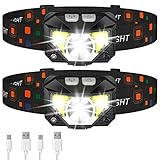
The LHKNL wins on the numbers the other head lamps also publish. It is 1.87 oz, second only to the Nitecore's 1.6 oz, and it ships as a two-pack, which matters if you run with a partner or want a spare in a race bag. LHKNL says the unit has eight modes and a long-press function that toggles between them, plus a hand-wave motion sensor for when you are fiddling with a hydration pack strap. The IPX4 rating covers rain and sweat, and the 2-year warranty is longer than most of the head-mounted competition publishes.
Against the Nitecore, it gives up multi-colour temperature and the 400-lumen figure Nitecore states. Against the MOLAER, it gives up the 230-degree wide beam, though it wins on weight. Against every chest light in this set, it gives up the reflective vest. Nothing published, though, shows a weakness that would keep a road runner off it, and the price position sits in the entry band, which is the LHKNL's second sharp edge.
Pros:
- Second-lightest head lamp in this set at 1.87 oz
- Eight modes and a hand-wave motion sensor
- 2-year warranty, the longest published here
- Ships as a two-pack for shared gear
- IPX4 rating covers rain and sweat
Cons:
- No stated lumen figure in the specification data
- Single colour temperature, unlike the Nitecore
- No reflective vest, unlike the chest-mounted picks
2. Nitecore NU25 MCT UL 400 Lumens Ultra Lightweight Headlamp — Best premium
The lightest head lamp in this shortlist at 1.6 oz, with a stated 400-lumen output, three colour temperatures and a 2-year manufacturer warranty.

Best for: runners who log serious weekly miles and want warm-light options for fog and rain Skip it if: you only run once or twice a week on lit streets
Nitecore's pitch here is quantitative in a way the other head lamps are not. The listing states 400 lumens, a beam distance of 144 yards, up to 45 hours of runtime on the lower outputs and about an hour to recharge over USB-C. The unit weighs 1.6 oz, the lowest in this set, and Nitecore rates it IP66, which is a step above the IPX4 rating that covers the LHKNL and the Viccux vests.
The three colour temperatures are the interesting extra. Nitecore says the warm setting cuts through fog and rain better than a cool white, which is a genuine advantage on a wet autumn morning. The auxiliary red light also matters if you are running with someone whose night vision you would rather not wreck.
The catch is the premium price position, the highest of the seven, and the fact that everything above is a manufacturer's stated figure rather than an independently verified one. If you run three or four times a week year-round, the outlay makes sense. If you run twice a week in summer, the LHKNL covers the same job.
Pros:
- Lightest head lamp in the set at 1.6 oz
- 400 lm and 45-hour runtime claims from Nitecore
- Three colour temperatures including a warm white
- IP66 waterproof rating, the highest published here
- USB-C charging with power status indicator
Cons:
- Highest price position of the seven picks
- Colour-temperature claims not independently verified
- Single unit only, no two-pack option
3. MOLAER LED Headlamp Rechargeable Flashlight — Runner-up
A two-pack head lamp with a stated 230-degree wide beam and a 350-lumen claim, useful when you want to share gear across two people.

Best for: a household sharing gear across two runners, or a runner and a walker Skip it if: you want the lightest possible head unit
MOLAER sits between the LHKNL and the Nitecore on the specification sheet. It weighs 2.6 oz, heavier than either, and its dimensions run 2.1 x 3.1 x 4.7 inches, so it has more mass over the brow. MOLAER says the wide beam covers 230 degrees at up to 350 lumens, with a soft silicone body and an adjustable elastic band. Charging is USB-C off a 1500 mAh cell.
Two features push this into runner-up rather than an also-ran. First, the wide beam pattern, which the LHKNL does not publish. If you run on trail with roots and rocks either side of the line, the 230-degree spread is genuinely useful. Second, the pack of two, which no other head lamp except the LHKNL offers, at an entry-band price position that undercuts the Nitecore.
The trade-off is the missing published warranty and the higher weight. Nothing in the specification data shows a warranty period at all, which is the reason it sits third rather than second. If you are the runner in the household, take the LHKNL. If you both run, MOLAER earns its place.
Pros:
- Two-pack, one of two in the set
- 230-degree wide beam claim
- Entry-band price position
- USB-C charging with 1500 mAh cell
- Soft silicone body and adjustable band
Cons:
- 2.6 oz is heavier than the two lighter head lamps
- No warranty period published in the listing
- No stated waterproof rating in the specification data
4. Viccux 500LM High-Visibility Running Lights for Runners — Best for pros
A 0.51 lb chest-mounted 500-lumen beam built into a 360-degree reflective vest with seven lighting modes.

Best for: runners who prefer a chest beam and a full 360-degree reflective vest Skip it if: you want a compact light you can slip into a jacket pocket
This is the pick for a runner who has already decided they want a vest and a chest beam rather than a headlamp. Viccux publishes a 500-lumen figure, a 70 m beam reach, seven lighting modes and an adjustable 45-degree beam angle. The harness fits chest sizes from 31 to 51 inches, shoulder widths from 12 to 23 inches, and weighs 0.51 lb total. That is heavier than any head lamp here, but the mass sits on your shoulders and torso, not your forehead, which is why runners who dislike bounce on the head end up with a rig like this.
The reflective vest is the point. On a road with driver traffic, being visible from behind matters as much as seeing the ground in front. A head lamp gives you the second and nothing of the first.
Against the Viccux waist-pack model below, this one has a longer runtime range in the listing, from 3.5 to 20 hours. Against the AVANTO SOLX1 Pro, it costs less and stakes its case on the reflective coverage rather than on beam adjustability alone.
Pros:
- 360-degree reflective vest coverage
- 500 lm and 70 m beam-reach claims
- Seven lighting modes across colours and patterns
- Fits chest sizes 31 to 51 inches
- 3.5 to 20 hour runtime range claim
Cons:
- 0.51 lb is heavier than any head lamp here
- One-year warranty, shorter than the head-lamp picks
- Vest sizing can feel bulky under a jacket
5. Viccux 500LM & 360° Visibility Running Lights with Waist Pack — Best for heavy use
A chest-and-waist rig that adds a zippered waist pack to the 500-lumen chest beam, sized for keys, phone and gels on longer runs.

Best for: long runners who want a waist pack for keys, phone and gels Skip it if: you want a stated warranty period longer than a year
Viccux's second entry is the same 500-lumen chest beam, this time bolted to a waist pack rather than the pure vest. The waist pack measures 11.8 x 5 inches according to the listing and holds the essentials a runner over an hour usually carries. The beam is 45-degree adjustable, there are eight modes on this model rather than seven, and Viccux states a 1100 mAh cell with 4 to 35 hours of runtime depending on output.
The reason this pick exists as a separate recommendation, rather than as a variant of the Best for pros, is the runner it fits. If you head out for a two-hour Sunday run, you probably need somewhere to put a phone and a gel or two. Stuffing them into a jacket pocket makes them bounce. This rig solves both problems in one purchase: light, reflectivity and storage.
The trade-off is the premium price position, which is one of the two highest in the shortlist, and a warranty of just one year. The head-lamp picks give you the same one to two years for less money. You are paying for the waist pack and the integrated design.
Pros:
- Integrated waist pack for phone, keys and gels
- 500 lm claim with 8 lighting modes
- 45-degree adjustable beam angle
- Wide dual-shoulder straps reduce bounce
- USB-C charging on a 1100 mAh cell
Cons:
- Premium price position without a longer warranty
- No weight figure published in the specification data
- One-year warranty, shorter than the head-lamp winners
6. Avanto Lifestyle AVANTO SOLX1 Pro Chest Light — Best for beginners
A 500-lumen chest light with a 90-degree adjustable beam and a reflective harness, pitched at runners nervous about traffic.

Best for: new night runners nervous about traffic on unlit stretches Skip it if: you already run with a reflective vest and want a head-mounted light
The AVANTO SOLX1 Pro is the beginner pick because its listing is written for someone new to running in the dark. Avanto states a 500-lumen output and a 90-degree adjustable beam, positioned low on the chest so it throws shadows across the ground and does not blind oncoming drivers or walkers. Avanto also says the design means you do not need a separate reflective harness, which simplifies a first purchase.
Compared to the Viccux vest, the beam angle here is wider at 90 degrees against 45, so the light spread on a nearby pavement is broader but the reach shorter. Compared to a headlamp, the biggest gain is the same as with either Viccux model: the light travels with your torso, not your head, so scanning left before a road crossing does not swing the beam off the ground.
The catch is the price. This is the premium band, and the specification data does not publish a lumen-hour figure or a weight, so you are buying largely on Avanto's descriptive claims and the one-year warranty. As an entry into night running, though, it is a defensible starting kit.
Pros:
- 500 lm claim from Avanto
- 90-degree adjustable beam for wide near coverage
- Reflective harness built into the design
- Low mount angle avoids blinding others
- USB-C charging
Cons:
- Premium price position
- No weight figure in the specification data
- One-year warranty and highest sales-rank number in the set
7. Faxins Clip on Flashlight — Best budget pick
A 17 g clip-on light with a 450-lumen claim and IPX6 waterproofing, sized to sit on a cap brim or a hydration-vest strap.
Best for: runners who want to clip a light to a cap brim or hydration vest Skip it if: you need a wide beam that lights the full width of a trail
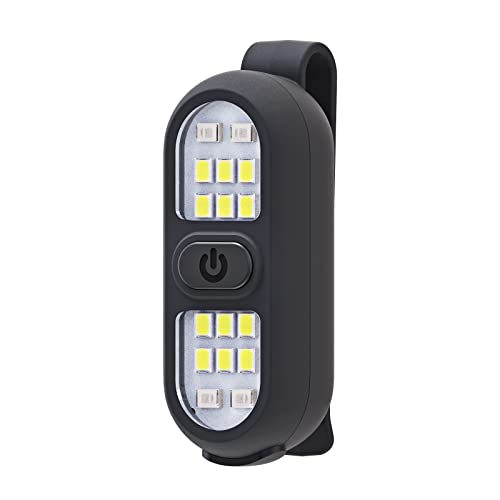
The Faxins is the cheapest pick in the set and the smallest. It weighs 17 g, measures 0.9 x 2.2 x 0.9 inches and clips onto anything with an edge: a cap brim, a hydration strap, a collar. Faxins says it puts out 450 lumens on high and 300 mAh of battery gives 2.5 hours on high flood mode or 7.5 hours on low flood mode. The IPX6 rating is technically the highest number of any product in this shortlist for water ingress protection.
Take the caveats seriously. This is a spot-beam clip light, not a wide-throw headlamp. It is best used as a supplementary marker on a cap or as a rear light clipped to a vest, and it works less well as your only source of forward light on a dark trail. That is why it earns Best budget pick rather than a higher slot: the format itself is niche.
Against the head-lamp picks, it gives up head-strap stability and beam width. Against the chest lights, it gives up the reflective vest entirely. What it wins on is versatility, weight and the cheapest price position of the seven.
Pros:
- 17 g, the lightest pick in the set
- IPX6 rating for full water spray protection
- 450 lm claim on high output
- Clips to caps, straps and vests
- Cheapest price position of the seven
Cons:
- Spot-beam pattern rather than wide throw
- 2.5-hour high-mode runtime is short for long runs
- No warranty period published in the listing
How bright do you actually need on a dark road?
Bright enough to see the surface ten metres ahead, dim enough not to burn out your night vision on the next glance up. The specification numbers on this shortlist run from a 350-lumen claim to a 500-lumen claim, and for road running that entire range is more than adequate.
The mistake most first-time buyers make is chasing the biggest number. A 500-lumen chest beam on a suburban pavement is genuinely too bright, and the reflected glare off wet tarmac makes it harder to read the road, not easier. Every pick in this set except the Faxins publishes multiple modes for a reason: you want low most of the time and high in reserve.
Sensible defaults, based on the mode counts and features the listings state:
- On lit streets, use low or medium mode. Save the battery.
- On unlit road with driver traffic, use medium and add a rear blinker.
- On unlit trail, use high and consider a chest mount to throw shadows.
- In rain or fog, prefer a warm colour temperature if your light offers one. The Nitecore is the only pick in this set that publishes that option.
What the listings do not tell you about night runs
Two things you will not read on any of these product pages, that experience with the specification data still makes clear.
First, waterproof ratings are not weather ratings. IPX4 means the light will shrug off rain and sweat. It does not mean you can submerge it in a puddle or leave it in a soaked jacket pocket overnight. The Faxins IPX6 rating is a step up because it protects against powerful water jets from any angle, and the Nitecore IP66 also covers dust. Everything else here sits at IPX4 or does not publish a rating at all.
Second, USB-C is now the default. Six of the seven picks charge over USB-C. That matters because a runner with three or four devices in a gear drawer wants one cable, not four, and it means you can top the light up off a portable battery pack mid-race.
The one thing worth checking before you leave the house is whether the battery indicator on your chosen unit is visible while you are running. Nitecore mentions a power status indicator explicitly. The other listings do not. A light that dies at the two-mile mark of a five-mile loop is the failure mode you want to avoid.
How do I stop the light from bouncing?
Bounce is the biggest complaint people have with a head lamp for running, and it is fixable without buying a chest rig. Three quick tests before you write off any of the head-mounted picks.
- Tighten the headband one notch past what feels comfortable at rest. Running loosens straps.
- Position the lamp low on the forehead, just above the brow ridge, rather than up on the crown.
- Angle the beam down until you can see about three metres ahead when standing still.
If you have done all three and the light still bounces, the issue is usually mass, not fit. That is why weight matters so much in the head-mounted category. The LHKNL at 1.87 oz and the Nitecore at 1.6 oz bounce noticeably less than the MOLAER at 2.6 oz, which is the entire reason those two lead the head-lamp ranking. If you have tried a light rig and hated it, that is the moment to move to a chest-mounted picks like the Viccux vest or the AVANTO SOLX1.
The verdict
For most runners heading out after dark, the best headlamp for night running is the LHKNL Headlamp Flashlight. It weighs 1.87 oz, ships as a two-pack, publishes eight modes and a motion sensor, and is backed by a two-year warranty at an entry price position. Nothing else in this set gives you that combination.
If you run four or five times a week year-round, the Nitecore NU25 MCT UL is the better long-term buy. The 1.6 oz weight, the 400-lumen claim, the three colour temperatures and the IP66 rating together justify the premium price for a serious weekly runner. The warm-light option alone earns its place in a British autumn.
If you are running in traffic, or you have tried a head lamp and hated the bounce, switch categories entirely. The Viccux 500LM vest with 360-degree reflective coverage is the strongest chest-mounted pick, and the waist-pack model above it earns its place only if you need the storage. Beginners nervous about traffic should look at the AVANTO SOLX1 Pro. Budget buyers who want a supplementary light on a cap or vest strap should take the Faxins. Whichever way you go, the LHKNL is the default that fits the most runners without a specific reason to pick something else.
FAQ
Is a headlamp or a chest light better for night running?
A headlamp is better if you value low weight and simplicity, and a chest light is better if you run in traffic or dislike beam bounce with head movement. The head-mounted LHKNL and Nitecore weigh under 2 oz and put the beam where you look. The Viccux and AVANTO chest lights weigh more but keep the beam pointed forward when you turn your head to check for cars.
How many lumens do I need for night running?
For lumens on a night run, the practical range is 300 to 500 for road and light trail, and every pick in this shortlist publishes a stated figure inside or just below that band. More lumens is not always better because a very bright cool-white beam creates glare on wet tarmac and burns out your night vision when you glance back up at the road. Use the lowest mode that lets you read the surface.
Is the Nitecore NU25 MCT UL worth the premium price?
The Nitecore NU25 MCT UL is worth the premium if you run at least three times a week year-round and want a warm colour temperature for fog and rain. It is 1.6 oz, publishes a 400-lumen figure and a 45-hour maximum runtime, and adds a red auxiliary light. If you run twice a week on lit streets in summer, the LHKNL covers the same job at an entry price position with a similar 2-year warranty.
LHKNL vs MOLAER: which two-pack headlamp should I choose?
Between the LHKNL and MOLAER two-packs, choose the LHKNL for weight and warranty and the MOLAER for beam spread. The LHKNL is 1.87 oz per unit with a two-year warranty and a motion sensor. The MOLAER is 2.6 oz but publishes a 230-degree wide beam and a 350-lumen figure that the LHKNL does not state. On a technical trail with obstacles either side of the line, the wider beam is genuinely useful.
What is the biggest mistake first-time night runners make with lighting?
The biggest mistake first-time night runners make is buying one very bright light and calling it done. A single 500-lumen beam pointed forward tells drivers nothing about the shape or direction of a runner from behind. Pair any of the head-mounted or clip-on picks here with a reflective vest or a rear blinker, or choose one of the Viccux vests, which already integrates the reflective coverage into the light.
Whatever you end up buying, the fastest route to a working setup is to start with the LHKNL, run three or four loops of your normal route, and only then decide whether you need to move to a chest-mounted rig. Most runners find the head-mounted lamp does the job for months before they hit a use case it does not cover. If you already know you will be running in traffic, or if you have tried a head lamp and disliked the bounce, skip that middle step and take the Viccux vest instead. Either way, the deciding factor is the road you actually run, not the specification sheet.