Best Headlamp Trail Running by Lumens and Weight

A ranked comparison of six trail running headlamps by lumens, weight, beam distance and waterproof rating, with the profile each pick actually suits.

By Taylor DavidsonUpdated 16 min read
On this page
- Best headlamp trail running at a glance
- Who this guide is not for
- How I screened the six picks
- 1. Nitecore NU25 MCT UL — Best overall
- 2. Fenix HM65R-T V2.0 — Best premium
- 3. Fenix HL18R-T V2.0 — Best warranty
- 4. Nitecore UT27 MCT Pro — Best upgrade
- 5. Black Diamond Storm 500-R — Best minimal setup
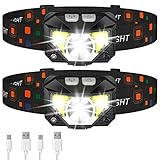
- 6. LHKNL Headlamp Flashlight — Best budget pick
- What actually decides a trail running headlamp?
- Lumens, throw and runtime: reading the numbers
- How waterproof is waterproof enough?
- What the listings do not tell you
- The verdict
- FAQ
The best headlamp for trail running is the Nitecore NU25 MCT UL, a 1.6 oz USB-C rechargeable lamp that pushes 400 lumens and 144 yards of throw on a body barely bigger than a matchbox. If you run technical descents where beam distance and a submersible housing matter more than grams, the Fenix HM65R-T V2.0 climbs to 1600 lumens with an IP68 rating and takes over as the better buy.
Best headlamp trail running at a glance
| Pick | Lumens | Weight | Price |
|---|---|---|---|
Best overall Nitecore NU25 MCT UL |
400 claim | 1.6 oz | Check Price |
Best premium Fenix HM65R-T V2.0 |
1600 claim | 4.96 oz | Check Price |
Best warranty Fenix HL18R-T V2.0 |
800 claim | 4 oz | Check Price |
Best upgrade Nitecore UT27 MCT Pro |
800 claim | 2.61 oz | Check Price |
Best minimal setup Black Diamond Storm 500-R |
500 claim | 3.2 oz | Check Price |
Best budget pick LHKNL Headlamp Flashlight |
not listed | 1.87 oz | Check Price |


Who this guide is not for
Two of the six here are described by their sellers as trail running headlamps by name. The other four are lighting products that fit the use case on the numbers, but were not marketed with that keyword. That matters, because Amazon's search returned this mixed set, so the "trail running" label in the search box does not guarantee a dedicated running fit or a running-specific strap.
If you need a beam engineered around a runner's cadence, with a bounce-tuned strap and a rear battery counterweight, look at the two Fenix models here. If you plan to use the lamp for camp chores, dog walking and the odd trail session, the Nitecore and Black Diamond picks will serve you just as well without any real compromise. The LHKNL two-pack is a general-purpose light. Run in it if you're staying on smooth path and finishing before it's fully dark. Push it into cold rain and technical singletrack at your own risk, because the IPX4 rating in the listing is the lowest in this set.
How I screened the six picks
I compared the published specifications side by side. Weight, lumens, beam throw, waterproof rating, warranty and power source went into a grid, and the picks were ranked against the profile each one serves best.
Three criteria did the cutting:
- Weight on the head. A trail runner tolerates about 3.5 oz before neck fatigue on a two-hour effort, so lamps over that weight had to justify the extra grams with beam distance or runtime.
- Beam throw in yards. Below 100 yards, a lamp struggles on fast descents. Every pick that clears that bar earns a place.
- A stated waterproof rating. IP66 is the floor for a lamp that will see cold rain and river spray. IP68 is submersible. IPX4 is splash only, and it is called out where it applies.
What was cut: unbranded lamps with no stated waterproof rating, lamps without USB-C or an equivalent rechargeable path, and any lamp whose listing gave no weight figure. Six survived. Every one of them has a role in the ranking, and every one has a real weakness against at least one of the others.
1. Nitecore NU25 MCT UL — Best overall
The lightest USB-C rechargeable lamp in this set at 1.6 oz, with three colour temperatures and a stated 45-hour runtime.
Best for: runners logging short-to-medium night sessions who want almost nothing on their forehead Skip it if: you run technical descents that need a longer beam throw
The NU25 MCT UL wins the best headlamp trail running slot on weight discipline. At 1.6 oz it is the lightest pick here, roughly a third the mass of the Fenix HM65R-T V2.0 and less than half the Black Diamond Storm 500-R. Nitecore rates the beam at 400 lumens and 144 yards, which is not the longest throw in this set, but it clears the 100-yard bar and does so on a body measuring 1.3 x 2.36 x 1.01 in.
The listing describes three white colour temperatures plus an auxiliary red mode. Warm white for fog and rain, neutral white for everyday use, cool white for maximum brightness. Nitecore claims up to 45 hours of runtime on a full charge and just over an hour to recharge via USB-C. IP66 waterproofing and 1-meter impact resistance sit at the category norm.
Against the Fenix picks, it gives up beam distance and half the warranty duration. It also lacks a AAA backup option, so on multi-day fastpacks you are tied to a power bank.
Pros:
- Lightest pick in this set at 1.6 oz
- Three white colour temperatures plus red
- USB-C rechargeable with power status indicator
- Stated 45-hour runtime on a full charge
- IP66 waterproof and 1-meter impact resistant
Cons:
- Shorter beam throw than the two Fenix picks
- 2-year warranty, half of the Fenix cover
- No AAA fallback for multi-day trips
2. Fenix HM65R-T V2.0 — Best premium
The brightest and best-sealed lamp here, with a magnesium alloy frame, 185 yards of throw and an IP68 rating.

Best for: ultra runners on rough ground who need a long beam and a submersible housing Skip it if: you want the lightest possible headlamp for a fast-and-light kit
The HM65R-T V2.0 is the most expensive pick here, and it earns the position on numbers. Fenix rates it at 1600 lumens with a throw of 185 yards, both figures the highest in this set. The housing is a magnesium alloy frame that Fenix says is 30% lighter than aluminium, and the IP68 rating means it is submersible rather than merely splash-resistant. Impact resistance is stated at 2 meters, twice the norm for the other five.
Weight lands at 4.96 oz, the heaviest here, and that is the trade-off you accept for the beam and the sealing. The listing describes a two-way SPORT fit fastener that adjusts with a single hand, a dual white and warm white beam, and USB-C charging with a runtime indicator. Fenix claims over 600 hours on a full charge at low output, which is a lot of margin for a long overnight effort.
The 5-year manufacturer warranty is the longest in this set, matching the HL18R-T V2.0.
Pros:
- 1600 lumens, the highest claim in this set
- 185 yards of stated throw
- IP68 submersible rating
- Magnesium alloy frame with 2-meter impact resistance
- 5-year manufacturer warranty
Cons:
- Heaviest pick here at 4.96 oz
- The most expensive pick in this set
- No AAA fallback option
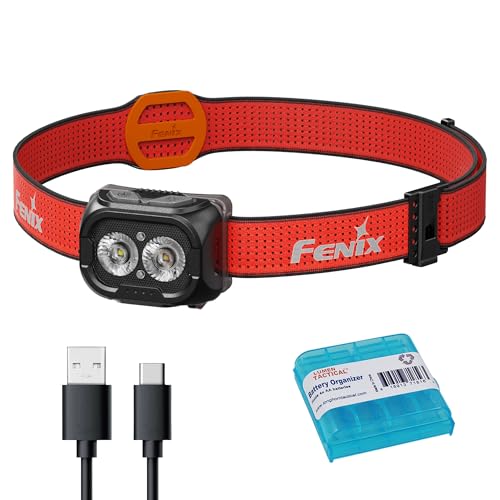
3. Fenix HL18R-T V2.0 — Best warranty
A trail-marketed headlamp with dual USB-C and AAA power, 800 lumens and a 5-year warranty.
Best for: runners who keep gear for years and want AAA backup on long routes Skip it if: you count grams and never use disposable batteries
The HL18R-T V2.0 is one of the two lamps in this set marketed by name for trail running. Fenix rates it at 800 lumens and 136 yards of beam throw, with white and warm white modes for visibility and eye strain respectively, plus two red modes for signalling and night vision. It weighs 4 oz on the published spec sheet, and Fenix claims a 3-hour full charge over USB-C.
The reason it stands out is the dual fuel setup. You can charge the built-in battery over USB-C or drop in three AAA cells, which turns any convenience store into a resupply. That flexibility is worth real weight on a 50-mile night effort where a dead battery ends the run. IP66 waterproofing and 1-meter impact resistance match the category norm.
The 5-year manufacturer warranty is the longest in this set, matching the HM65R-T V2.0. Against the premium Fenix, it gives up 800 lumens, 49 yards of throw and the IP68 sealing, but it also sheds nearly an ounce and costs less.
Pros:
- 5-year manufacturer warranty, the longest here
- Dual USB-C and 3x AAA power
- 800 lumens and 136 yards of throw
- Dedicated white, warm white and red modes
- Marketed by name for trail running
Cons:
- Heavier than the Nitecore and LHKNL picks
- IP66 rather than IP68 sealing
- Shorter throw than the HM65R-T V2.0 or UT27 Pro
4. Nitecore UT27 MCT Pro — Best upgrade
Two USB-C battery packs included, 800 lumens, 183 yards of throw and three colour temperatures on 2.61 oz.

Best for: runners who swap between mixed weather and want a spare battery pack included Skip it if: you want the longest warranty in this set
The UT27 MCT Pro is the second dedicated running lamp here, and it slots between the two Fenix models on both weight and beam. Nitecore claims 800 lumens and 183 yards of throw, almost matching the HM65R-T V2.0 on distance while weighing under half as much at 2.61 oz. The dimensions are 1.26 x 2.2 x 1.83 in, so the body sits close to the forehead.
Three colour temperatures are called out in the listing: 3000K warm for rain, fog and snow, 4500K neutral for rough terrain, and 6500K cool for maximum brightness. A red mode is included with steady and flashing options. Power is dual: a USB-C rechargeable HLB1500 battery pack, and Nitecore says two of them ship in this Pro edition, plus 3x AAA compatibility.
The warranty is the shortest in this set at 18 months, which is the note against buying it if longevity is your top criterion. IP66 waterproofing and 1-meter impact resistance match the rest of the field aside from the HM65R-T V2.0.
Pros:
- 183 yards of throw on 2.61 oz
- Two USB-C battery packs included
- 3x AAA fallback for resupply
- Three colour temperatures plus red
- Reflective strap called out in the listing
Cons:
- Shortest warranty in this set at 18 months
- IP66 rather than IP68 sealing
- Bulkier body than the Nitecore NU25 MCT UL
5. Black Diamond Storm 500-R — Best minimal setup
A compact 500-lumen rechargeable lamp with a dimming ring, red night-vision mode and Black Diamond's fit heritage.

Best for: runners who want a simple, dimmable beam and a proven Black Diamond fit Skip it if: you need USB-C charging or triple-digit beam throw
The Storm 500-R is the odd one out on charging. Black Diamond specifies micro-USB rather than USB-C, and if you have already standardised on USB-C for a phone and a watch, that is a real inconvenience. On everything else, it holds its own. The listing states 500 lumens, a 2400 mAh built-in lithium-ion battery, full-strength and dimming modes, a strobe and a red night-vision mode. The housing measures 1.18 x 0.74 x 1.57 in, the most compact footprint in this set.
Weight is 3.2 oz, sitting between the Nitecore UT27 Pro and the Fenix HL18R-T V2.0. Black Diamond calls out heavy-rain and snow tolerance but does not publish an IP rating in the fields supplied, so the sealing detail is thinner than the two Fenix listings offer. The 3-year warranty is above the Nitecore and LHKNL cover, below the Fenix pair.
Where it earns its place: brand familiarity, a genuinely simple interface, and the dimming ring that lets you tune output without cycling through modes. For a runner who wants a lamp that just works and doesn't want to relearn a menu, this is the pick.
Pros:
- Compact 1.18 x 0.74 x 1.57 in housing
- Full-strength, dim, strobe and red modes
- 2400 mAh built-in lithium-ion battery
- 3-year manufacturer warranty
- Two sellers listed, the widest availability here
Cons:
- Micro-USB rather than USB-C charging
- No IP rating in the supplied fields
- Shorter beam distance than the 800+ lumen picks
6. LHKNL Headlamp Flashlight — Best budget pick
A 1.87 oz rechargeable two-pack with a motion sensor and 8 modes, aimed at casual outdoor use.

Best for: occasional dusk runners and casual hikers who want two lamps at once Skip it if: you run in heavy rain or need a submersible IP rating
The LHKNL is the cheapest of the six and the only pick that ships as a 2-pack, so the per-lamp value is stronger than the price position suggests. The listing describes a motion sensor for hands-free on-off, a long-press function, 8 modes, and USB rechargeable operation. Weight is 1.87 oz per lamp, the second-lightest in this set.
The listing does not state a lumen figure or a beam distance, which is the honest reason it sits at the bottom of the ranking. On the numbers you can compare, it also gives up sealing: IPX4 is splash-only, so heavy rain and cold-weather condensation are outside the rated envelope. That is a real limitation for trail running in shoulder-season weather.
If your night use runs to camp chores, evening dog walks, dusk finishes on smooth path, and the occasional emergency backup in a running vest, two of these at this price is a defensible buy. It is not, on the published specifications, the lamp to take onto a wet ridge in November. Treat it as the second lamp in the drawer, not the one you plan a night ultra around.
Pros:
- The cheapest pick in this set
- Ships as a 2-pack
- 1.87 oz per lamp
- Motion sensor for hands-free on-off
- 2-year warranty
Cons:
- IPX4 splash-only rating, the lowest here
- No lumen or beam distance in the listing
- Not marketed for running or wet-weather use
What actually decides a trail running headlamp?
Most best headlamp trail running guides lead with lumens. That is not what decides it. Two lamps at the same lumen output can feel completely different on your head because beam shape, weight, strap tension and colour temperature do more than raw brightness ever will.
Here is the trick with lumens: a wide flood beam of 400 lumens will feel brighter and more useful on a technical descent than a narrow spot at 800 lumens, because your feet need context, not a single hot dot 200 yards ahead. That is why the Nitecore NU25 MCT UL at 400 lumens can win overall in this set. Its low weight and warm-temperature option matter more than the headline number.
The three specifications that actually decide the buy, in order:
- Weight, in ounces. Below 3 oz, you forget it is on. Above 4 oz, you feel it on the second hour.
- Beam throw, in yards. Below 100 yards, a fast descent outruns the light.
- Waterproof rating. IP66 or better for real weather. IPX4 for dry evenings only.
Colour temperature is the fourth criterion, and it decides how much you strain your eyes in fog. Warm white cuts through mist. Cool white looks brighter on dry pavement.
Lumens, throw and runtime: reading the numbers
Three numbers govern how a lamp behaves at night. Read them together, not one at a time.
Lumens measure total light output. The picks here span 400 lumens to 1600 lumens on the manufacturer claims. More is not always better, because most trail lamps run their highest output for only a few minutes before stepping down to protect the battery. What you actually run on is the medium setting, and that figure is rarely in the listing.
Beam throw, measured in yards, tells you how far the useful light reaches. In this set the range is 136 yards on the Fenix HL18R-T V2.0 up to 185 yards on the HM65R-T V2.0. Below 100 yards, you outrun the light on a fast descent. Above 150 yards, you have real margin.
Runtime is the one manufacturers stretch hardest. The 45-hour figure Nitecore quotes for the NU25 MCT UL is the low setting, not the 400-lumen mode. The 600-hour claim on the HM65R-T V2.0 is even lower output. Halve the headline figure to get a working estimate for a run you'd actually use the lamp on.
How waterproof is waterproof enough?
Waterproof ratings look interchangeable in listings, but the gap between IPX4 and IP68 is enormous.
- IPX4, on the LHKNL, means splash-resistant. Rain from any direction is not guaranteed.
- IP66, on the Nitecore NU25, Fenix HL18R-T V2.0 and Nitecore UT27 MCT Pro, means dust-tight and rated against powerful water jets. It is the practical floor for trail use in wet weather.
- IP68, on the Fenix HM65R-T V2.0, means submersible. A river crossing, a dropped lamp in a puddle, a full immersion, all rated.
For a trail runner who trains through winter, IP66 is enough. If you race in mountain weather or you know you'll cross water, the IP68 rating on the HM65R-T V2.0 is a real reason to pay more. Black Diamond doesn't publish an IP figure in the supplied fields for the Storm 500-R, so treat its rain tolerance as unknown by that specific standard, even though the listing describes heavy rain and snow use.
What the listings do not tell you
Listings do a good job on lumens and weight. They are quieter on the details that decide whether a lamp actually stays put on a run.
- Strap bounce. The Fenix HL18R-T V2.0 and HM65R-T V2.0 mention a SPORT fit system. The others describe a generic adjustable band. On a downhill, bounce is what separates a running strap from a camping strap.
- Rear counterweight. A lamp with the battery split to the rear of the strap balances better than one with the whole weight over the brow. None of the six listings here make this split explicit, so assume brow-mounted unless the images show otherwise.
- Button feel with gloves. Every lamp here has multiple modes, and switching in the cold is fiddlier than it looks in daylight.
- Regulated output. A regulated lamp holds its brightness until the battery is nearly empty. An unregulated one dims gradually. The listings don't call this out.
- Charge port cover integrity. USB-C ports need a rubber flap that stays sealed in the wet. This detail is never in the spec sheet.
Three things worth testing at home before your first night run: strap position, button reach with gloves on, and how long it takes to switch to red mode.
The verdict
The Nitecore NU25 MCT UL is the best headlamp for trail running for most runners, most of the time, because 1.6 oz on the head and 400 lumens with a 45-hour claimed runtime covers the honest majority of night trail sessions. It charges over USB-C, offers three white colour temperatures, and hits IP66 waterproofing. On the numbers, nothing else here comes as close to invisible on the head.
The Fenix HM65R-T V2.0 is the runner-up, and it wins on two specific conditions. If your runs cross water, the IP68 submersible rating is worth the extra weight. If your descents demand a beam past 150 yards, the 185-yard throw and 1600-lumen ceiling take over from the NU25. It is the heaviest pick here at 4.96 oz, and the most expensive, so those two constraints have to actually apply for the upgrade to pay off.
For the runner who wants AAA backup on ultra-distance efforts, the Fenix HL18R-T V2.0 splits the difference with a 5-year warranty and dual power. For anyone who wants the cheapest way into two lamps at once for light-duty use, the LHKNL two-pack is defensible on price alone.
FAQ
How many lumens do I actually need for trail running?
How many lumens you actually need depends on pace and terrain. For hiking or easy jog pace on well-marked trail, 200 to 400 lumens covers it, which puts the Nitecore NU25 MCT UL at 400 lumens comfortably in range. For technical descents above jog pace, 800 lumens or more gives real margin. The Fenix HM65R-T V2.0 at 1600 lumens is overkill for most, essential for some.
Is the best headlamp trail running pick worth the extra cost?
Is the best headlamp trail running pick worth paying for over a budget lamp? For anyone running in wet weather or after 9pm regularly, yes. The Nitecore NU25 MCT UL is not the cheapest here, but at 1.6 oz with a 45-hour claimed runtime, USB-C charging and IP66 sealing, it earns the position. The LHKNL two-pack costs less, but the IPX4 rating and unlisted lumen figure limit it to dry conditions.
Nitecore NU25 MCT UL or Fenix HM65R-T V2.0: which for ultras?
Nitecore NU25 MCT UL or the HM65R-T V2.0 comes down to weight versus beam. The NU25 weighs 1.6 oz and reaches 144 yards. The HM65R-T V2.0 weighs 4.96 oz and reaches 185 yards on 1600 lumens with IP68 sealing. For a fast 50k on smooth trail, take the Nitecore. For a 100-miler with river crossings and technical descents, the Fenix earns its extra 3.36 oz.
Do I need USB-C charging on a running headlamp?
Do I need USB-C on a headlamp? Not strictly, but it makes life easier. Four of the six picks here use USB-C, including both Nitecore lamps and both Fenix lamps. The Black Diamond Storm 500-R uses micro-USB, which means a second cable in your kit. Two Fenix lamps also accept AAA batteries, which is the real backup on multi-day fastpacks where power banks run out.
What waterproof rating do I need for wet-weather trail running?
What waterproof rating you need depends on where you run. IP66, on four of the six picks here, is the practical floor: dust-tight and rated against powerful water jets. IP68, on the Fenix HM65R-T V2.0, adds submersibility, which matters if you cross rivers. IPX4, on the LHKNL, is splash-only and not enough for a serious rain training session or a wet race.
Pick the Nitecore NU25 MCT UL first, unless you already know that beam distance or river crossings are going to shape your night running this year. If they are, jump straight to the Fenix HM65R-T V2.0 and accept the weight. Everything else in this ranking exists for specific reasons: the HL18R-T V2.0 for AAA resupply, the UT27 Pro for a spare battery pack out of the box, the Storm 500-R for a simple dimming interface, the LHKNL two-pack for a dry-weather backup. The winner is the winner because 1.6 oz on the head and a 45-hour claimed runtime removes the two objections runners actually raise: it feels heavy, and it dies mid-run.