Best Handheld Wood Planers by Cut Width and Depth
Seven handheld planers compared on the two numbers that actually matter: cutting width and maximum depth per pass. Includes a 4-3/8 in. option for framing lumber and a hand plane for fine tuning.
The best heavy duty handheld wood planer is the WEN 6530, a 6.5 lb corded planer with a 3-1/4 in. cut, 16 positive depth stops from 0 to 1/8 in., and a 2-year warranty. If you regularly dress 2x4s and 4x4s, the WEN 6534 and its 4-3/8 in. cutting width covers the full board in one pass instead of two. Pick wrong here and you'll spend an afternoon chasing a ridge down the middle of every board, because your planer was narrower than the stock.
Best heavy duty handheld wood planer at a glance
| Pick | Cut width | Max depth | Price |
|---|---|---|---|
| Best overall WEN 6530 6-Amp Electric Hand Planer |
3-1/4 in. | 1/8 in. 16 stops |
Check Price |
| Best for pros WEN 6534 8-Amp Electric Hand Planer |
4-3/8 in. | 1/8 in. 16 stops |
Check Price |
| Best premium DEWALT 20V MAX Planer |
Not stated | 5/64 in. (2 mm) | Check Price |
| Best for heavy use TengXcel Electric Hand Planer |
3-1/4 in. (82 mm) | 5/64 in. (2 mm) | Check Price |
| Runner-up MtiolHig Cordless Planer |
3-1/4 in. (82 mm) | 2 mm claim | Check Price |
| Best for beginners Masitke 3-1/4 Inch Electric Hand Planer |
3-1/4 in. | 2 mm claim | Check Price |
| Best budget pick Dreyoo No.4 Adjustable Hand Planer |
2 in. blade | Manual screw | Check Price |
How I screened this field down to seven
I started from the handheld planer listings and worked outward, comparing only what the manufacturers actually publish: cutting width, maximum depth of cut, weight, dimensions, warranty term, and what ships in the box. Every claim below traces back to one of those.
Three things shaped the shortlist:
- Published cut width. A planer that doesn't state its width in the listing is a planer you can't match to your stock. Five of the seven publish it.
- Published maximum depth. Two figures dominate this field: 1/8 in. on both WEN units, and 2 mm (5/64 in.) on the cordless bodies and the DEWALT.
- Documented weight. Only four of the seven publish a weight, which matters more than it sounds when you're planing a door edge at shoulder height.
What got cut was anything I couldn't describe without guessing. Two picks here, the MtiolHig and the Masitke, have thin specification sheets, and I've flagged that in their sections rather than filling the gaps.
One honest note on the search itself. "Heavy duty" is not a specification any of these listings publish, so the phrase describes a class of work rather than a certified rating. Judge it yourself from the numbers: width, depth per pass, weight, and whether the body is corded or running off a battery.
Which spec actually decides a heavy duty handheld wood planer?
Most guides lead with amps or RPM. That's the wrong first number.
Cutting width decides it. A 3-1/4 in. planer laid across a nominal 2x4 (3-1/2 in. of actual face) leaves a quarter-inch strip untouched. You then take a second overlapping pass, and the seam between passes is where ridges live. The WEN 6534's 4-3/8 in. width clears that face in one stroke. That single number changes the job more than any motor figure in this set.
Maximum depth per pass is the second number. Both WEN planers offer 16 positive stops from 0 to 1/8 in. The DEWALT DCP580B and both battery-powered bodies cap at 5/64 in., which is 2 mm. That difference is real: a 1/8 in. bite removes material noticeably faster on rough stock.
Cuts per minute is the number that misleads. The WEN 6530 lists 34,000 cuts per minute, the DEWALT lists 30,000, and the WEN 6534 lists 32,000 with the biggest motor of the three. Higher cuts per minute correlates with finish quality, not removal rate. Removal rate is width times depth times how fast you walk the tool.
So the order to compare in:
- Width first, against the widest board you own
- Depth per pass second
- Weight third, if the work is vertical or overhead
- Motor figures last
1. WEN 6530 6-Amp Electric Hand Planer — Best overall
A 6.5 lb corded planer with the deepest published bite in this group and a stated 2-year warranty, which makes it the sane default.
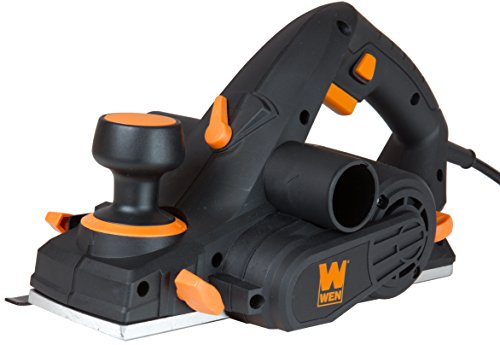
Best for: door edges, trim and general shop work Skip it if: you plane framing lumber wider than 3-1/4 in.
The 6530 wins on the combination, not on any single figure. Its 16 positive stops run from 0 to 1/8 in., matching the deepest published depth in this set, and the corded 6-amp motor is rated at 34,000 cuts per minute, the highest figure published here. At 6.5 lb it sits in the middle of the four picks that publish a weight, light enough to hold square on a door edge without your forearm shaking by the third pass.
It's also the one buyers choose most often in this group, and the second-cheapest of the seven. WEN publishes a 2-year warranty, one of only three picks here with a stated term.
The kit matters too. WEN lists a dust bag, a kickstand, a parallel fence bracket and a 5/16 in. rabbeting guide capable of rabbets up to 1 in. The kickstand is the underrated part: it holds the spinning drum off your workpiece when you set the tool down mid-job.
The trade-off is width. At 3-1/4 in. you're taking two passes across a 2x4 face, where the 6534 takes one. And the cord means an extension reel on any job away from an outlet.
Pros:
- Deepest published depth here, 0 to 1/8 in.
- 16 positive stops for repeatable settings
- 34,000 cuts per minute, highest figure in this set
- 2-year warranty published
- Dust bag, kickstand and fence bracket included
Cons:
- 3-1/4 in. width needs two passes on a 2x4 face
- Corded, so an outlet or reel is mandatory
- Only one seller lists it
- Heavier than the 5.73 lb TengXcel
2. WEN 6534 8-Amp Electric Hand Planer — Best for pros
The only pick here that clears a 2x4 face in a single pass, thanks to a 4-3/8 in. cutting width.
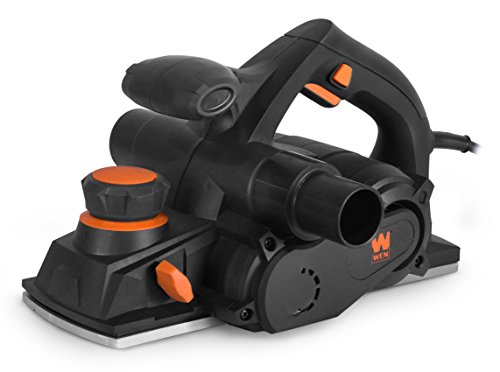
Best for: planing 2x4s and 4x4s in one pass Skip it if: you need a light tool for overhead or ladder work
Width is the whole argument. WEN states a 4-3/8 in. cutting capacity and says it suits planing 2x4s and 4x4s, and the arithmetic backs that up: a nominal 2x4 measures about 3-1/2 in. across the face, so the drum covers it with room to spare. No overlapping passes, no ridge down the centreline.
The 8-amp motor is the largest here, listed at 32,000 cuts per minute, and the depth range matches the 6530 at 0 to 1/8 in. across 16 positive stops. WEN also lists a two-way dust port that ejects shavings left or right, two reversible HSS blades, two V-shaped chamfer grooves, a rabbeting guide at 1/3 in., a parallel fence bracket and an automatic kickstand.
The cost is mass. At 9.5 lb this is the heaviest pick in the set, nearly 4 lb more than the TengXcel, and its 8.25 x 12 x 9.75 in. body is the bulkiest of the corded pair. That weight helps on a bench and hurts on a ladder.
It's also the third-cheapest here, which is a genuinely odd position for the widest planer in the group.
Pros:
- 4-3/8 in. width, widest published cut here
- 8-amp motor, largest in this set
- 16 positive stops to 1/8 in.
- Two-way dust port ejects left or right
- Two reversible HSS blades included
Cons:
- 9.5 lb, the heaviest pick in the group
- Bulkiest corded body at 8.25 x 9.75 in.
- No warranty term in the specification list
- Sells noticeably slower than the 6530
3. DEWALT 20V MAX Planer — Best premium
The best-documented cordless body here: brushless, 7.4 lb, and depth adjustment calibrated to 1/256 in.

Best for: site work on an existing 20V battery platform Skip it if: you don't already own the battery and charger
The DCP580B is the most expensive pick here and the one with the tightest published tolerances. DEWALT lists 30,000 cuts per minute from a brushless motor, a maximum depth of 5/64 in. (2 mm), and a depth adjustment knob calibrated to 1/256 in., roughly 0.01 mm. It also states precision-machined front and back aluminium shoes to keep the cut parallel, which is the specification that separates a planer that tracks flat from one that scoops.
Three years is the longest warranty term published in this group. The 3 mm gap between it and the WEN pair on warranty is 12 months, and on a tool with a brushless motor and no brushes to replace, that matters.
It ships as a bare tool. No battery, no charger. If you already run 20V MAX packs, that's a saving. If you don't, add both to the real cost of ownership, and the arithmetic changes fast.
The other catch: the listing publishes no cutting width. Everything else in its specification sheet is precise, but the number that decides the category isn't there. At 7.4 lb and 16 x 8 x 6.94 in., it's also longer than any other pick here.
Pros:
- 3-year limited warranty, longest term in this set
- Brushless motor with 30,000 cuts per minute
- Depth adjustment calibrated to 1/256 in.
- Machined aluminium front and rear shoes
- Cordless, no extension reel needed
Cons:
- Bare tool, so battery and charger cost extra
- Most expensive pick in the group
- No cutting width published in the listing
- 5/64 in. depth is shallower than either WEN
4. TengXcel Electric Hand Planer — Best for heavy use
The lightest pick with a published weight, at 5.73 lb, and it runs on DeWalt 20V packs.
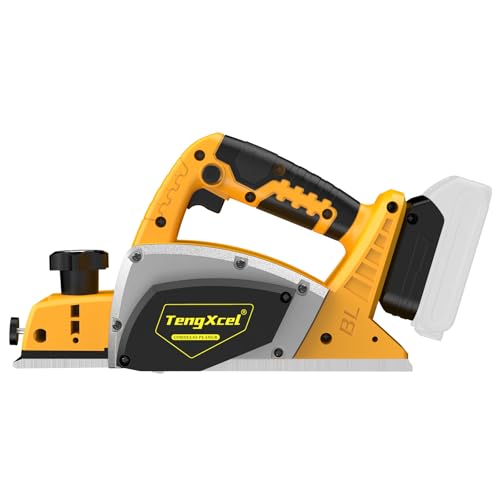
Best for: long cordless sessions where weight matters most Skip it if: you want a published warranty term
Weight is why this one earns its place. At 5.73 lb it's the lightest of the four picks that state a weight, almost 4 lb under the WEN 6534. Add a battery and it climbs, but the bare body advantage still shows up in your shoulders after twenty door edges.
The published numbers are clean. TengXcel lists an 82 mm (3-1/4 in.) cutting width, a 2 mm (5/64 in.) maximum depth, and a brushless motor rated at 30,000 CPM, matching the DEWALT's figure. The brand also states that the front and rear shoes are precision-matched to hold a level surface, and that the front shoe carries a V-notch for squaring board edges quickly.
It's the second most expensive pick here, and like the DEWALT it takes DeWalt 20V batteries without including one. That combination is a harder sell than the DEWALT's, because the specification sheet is thinner: no warranty term, no dimensions.
Treat the shoe-alignment and speed lines as the manufacturer's claims rather than verified measurements. The width and depth figures are the parts you can plan work around.
Pros:
- 5.73 lb, lightest published weight in this set
- 82 mm (3-1/4 in.) cutting width stated
- Brushless motor listed at 30,000 CPM
- V-notch front shoe for edge squaring
- Runs on DeWalt 20V packs
Cons:
- No warranty term published
- No dimensions in the specification list
- Battery and charger not included
- Second-highest price position in the group
5. MtiolHig Cordless Planer Compatible with DeWalt 20V — Runner-up
A cheaper route into a DeWalt 20V planer, with a thinner specification sheet as the price.

Best for: a cheaper cordless body for a DeWalt 20V kit Skip it if: you want a documented weight and warranty
If you own DeWalt 20V batteries and want a planer on that platform without paying the DEWALT price, this sits between the two. MtiolHig publishes a 3-1/4 in. (82 mm) planing width, a 0 to 2 mm depth range with 0.01 mm accuracy, and a brushless motor at 15,000 RPM no-load. Note that 15,000 RPM is a spindle speed, not a cuts-per-minute figure, so it isn't directly comparable to the 30,000 CPM numbers elsewhere in this table.
Three sellers list it, more than any other pick here, which at least means you're not tied to a single source.
The gaps are the problem. There's no published weight, no warranty term, and the dimensions (12.2 x 6.5 x 7.09 in.) are the only physical figure on the sheet. Compared with the TengXcel, which states 5.73 lb, you're buying a tool whose heft you can't estimate before it arrives.
It's also the slowest-moving pick in this set apart from the Masitke, which is worth knowing when you're weighing an unfamiliar brand against DEWALT's 3-year warranty.
Pros:
- 82 mm cutting width published
- Depth range 0 to 2 mm with 0.01 mm increments claimed
- Brushless motor
- Cheaper than the DEWALT and TengXcel
- Three sellers stock it
Cons:
- No published weight
- No warranty term stated
- 15,000 RPM figure isn't comparable to CPM ratings
- Battery not included
6. Masitke 3-1/4 Inch Electric Hand Planer — Best for beginners
A corded planer that ships with the guides a first-timer needs, at a mid-range price for this set.

Best for: a first corded planer with guides in the box Skip it if: you need published weight or warranty figures
Masitke's pitch is the kit. The listing describes an edge guide for straight uniform cuts, an integrated V-groove for chamfering, spare carbon brushes, a glove and a dust chute. For someone buying a first planer, having a guide in the box is the difference between straight edges and a hand-eye experiment.
The published figures are a 3-1/4 in. width, a scale-adjustable knob covering 0 to 2 mm of depth, and a 16,000 RPM motor. Like the MtiolHig, that 16,000 RPM is a spindle figure and shouldn't be read against the 30,000-plus cuts-per-minute claims from WEN and DEWALT. Masitke also mentions a safety lock button to prevent accidental startup and a rubber anti-slip handle, both attributed claims rather than measured behaviour.
This is the thinnest specification sheet of the seven. No weight, no dimensions, no warranty term, just colour, count and model number. That's a real cost when you're comparing against a WEN 6530 that publishes 6.5 lb, 7 x 12 x 7 in. and 2 years.
Roughly mid-range in price for this group, and the slowest-selling pick here. Buy it for the included guides, not the paperwork.
Pros:
- Edge guide and V-groove included
- Carbon brushes supplied as spares
- Corded, so no battery purchase
- 0 to 2 mm scale-adjustable depth knob
- Safety lock button claimed
Cons:
- No published weight or dimensions
- No warranty term listed
- 16,000 RPM not comparable to CPM figures
- Slowest-selling pick in this set
7. Dreyoo No.4 Adjustable Hand Planer — Best budget pick
A manual No.4 smoothing plane and the cheapest pick here, for the jobs a powered drum overshoots.

Best for: fine-tuning a sticking door by hand Skip it if: you have more than a few feet of stock to remove
This is the odd one out and deliberately so. The Dreyoo is a No.4 bench plane, not a power tool, and it's the cheapest of the seven by a clear margin. Dreyoo lists a 9.25 in. body, a 2 in. blade with a spare 2 in. manganese steel blade included, a carbon steel body with red epoxy coating for rust resistance, and a barbell-shaped depth adjuster.
Why it belongs in a guide about powered planers: control. A 3-1/4 in. drum spinning at 30,000 cuts per minute removes material faster than you can react. When a door catches on the jamb by a hair, or a joint needs two shavings taken off one corner, a hand plane does it without gouging. The 9.25 in. flat sole also bridges dips rather than following them, which is exactly what a short-shoed power planer won't do.
The limits are obvious. No motor, no dust collection, a 2 in. blade against 3-1/4 in. and 4-3/8 in. powered widths, and no warranty term published. It sits in a different category from the rest, smoothing planes rather than handheld power planers.
Buy it alongside a powered pick, not instead of one.
Pros:
- Cheapest pick in this set by a wide margin
- Spare 2 in. manganese steel blade included
- 9.25 in. flat sole bridges surface dips
- Carbon steel body with rust-resistant coating
- Nothing to charge or plug in
Cons:
- Manual, so slow on any real volume
- 2 in. blade is the narrowest here
- No warranty term published
- Not a substitute for a powered planer
Cordless or corded: which should you buy?
Four of these seven are corded, three are cordless, and the split is cleaner than it looks.
Corded wins on depth of cut. Both WEN units reach 1/8 in. per pass. Every cordless body here caps at 2 mm, which is 5/64 in., so you're taking roughly 60% of the bite. On rough stock that means more passes.
Cordless wins on where you can work. No reel, no trip hazard, no hunting for an outlet on a half-finished framing job. It also wins on weight if you compare the TengXcel's 5.73 lb bare body against the WEN 6534's 9.5 lb, though a battery narrows that gap.
The hidden cost is the platform. Both the DEWALT DCP580B and the TengXcel and MtiolHig bodies ship without a battery. Three ways that plays out:
- You already own DeWalt 20V packs: cordless is genuinely cheaper than it looks
- You own another brand's batteries: none of these three work for you
- You own no cordless tools: a corded WEN costs less all-in and cuts deeper
My default for a first planer is corded, for the depth and the price. Cordless earns its keep as a second tool once the battery is already in the van.
How wide a cut do you actually need?
Measure your stock before you shop. The nominal size on the lumber rack isn't the size of the board.
- Door edges and trim: 3-1/4 in. covers almost everything. A standard interior door edge is about 1-3/8 in. thick, so any pick here clears it in one pass.
- Nominal 2x4: actual face is roughly 3-1/2 in. A 3-1/4 in. planer misses a strip. The WEN 6534 at 4-3/8 in. does not.
- Nominal 4x4: actual face is roughly 3-1/2 in. too, so the same rule applies.
- Wide boards and tabletops: no handheld planer here does these in one pass. You're taking overlapping passes and finishing with a sander or the Dreyoo hand plane.
The tell that you've undersized the tool: a faint ridge running the length of every board, right where two passes met. It sands out, but sanding out a ridge on twenty boards is an hour you didn't budget.
Set against that, the 6534's 9.5 lb is the honest cost of extra width. If most of your work is trim and doors, the lighter 6530 is the better tool and the ridge never comes up.
What the listings do not tell you
Three of these seven publish no warranty term at all: the WEN 6534, the TengXcel and the Masitke. The Dreyoo doesn't either. Only the WEN 6530 (2 years) and the DEWALT (3 years) state one. That's a genuine differentiator, and it's the strongest single argument for the DEWALT if you plan on daily use.
Weight is the other blank. The MtiolHig and Masitke listings don't publish one, which is awkward for a tool you hold at arm's length. When a spec sheet skips weight, assume nothing and plan on handling it before you commit to a long session.
Blade replacements are the running cost nobody lists. The WEN 6534 states two fully reversible HSS blades, and the Dreyoo includes a spare 2 in. blade. The other five listings don't say what's in the box, so budget for a replacement set separately.
Dust handling varies too. The 6530 lists a dust bag, the 6534 a two-way port and dust adapter, the Masitke a dust chute. The DEWALT, TengXcel and MtiolHig listings don't specify a bag. Planing indoors without one is a mistake you make once.
The verdict
The WEN 6530 is the best heavy duty handheld wood planer for most people, and the reason is the combination rather than any single number. It publishes the deepest cut in this set at 1/8 in. across 16 positive stops, the highest cuts-per-minute figure at 34,000, a 2-year warranty, and a kit that includes a dust bag, kickstand and fence bracket. At 6.5 lb it's manageable on a door edge. It's also the second-cheapest pick here, which makes the value obvious.
Two conditions flip that. First, board width: if your regular work is 2x4s and 4x4s, the WEN 6534's 4-3/8 in. cutting capacity clears the face in one pass and eliminates the ridge you'd otherwise sand out, and you accept 9.5 lb in exchange. Second, the outlet: if you're working where there isn't one and you already own DeWalt 20V batteries, the DEWALT DCP580B is the better buy on a 3-year warranty, a brushless motor and a depth knob calibrated to 1/256 in.
The DEWALT's exact advantage over the 6530 is precision and portability, not power. Its 5/64 in. maximum depth is shallower. You trade bite for cordless reach and the longest warranty here.
FAQ
Is a heavy duty handheld wood planer worth buying over a bench planer?
A heavy duty handheld wood planer is worth buying when the wood can't come to the shop. Door edges hung in a jamb, deck joists, framing already nailed in place. A bench planer needs the board loose and both hands free. Handheld tools with 3-1/4 in. to 4-3/8 in. cutting widths handle in-place work no stationary machine reaches.
Which offers better value, the WEN 6530 or the WEN 6534?
Better value between the WEN 6530 and 6534 depends entirely on board width. Both publish 16 positive stops to 1/8 in. and both sit in the lower price positions here. The 6530 is cheaper and lighter at 6.5 lb. The 6534 costs a little more, weighs 9.5 lb, and covers a 2x4 face in one pass with its 4-3/8 in. width.
What cutting depth does a heavy duty handheld wood planer need?
The cutting depth a heavy duty handheld wood planer needs depends on your stock. For rough lumber, the 1/8 in. maximum on both WEN units removes material fastest. For finish work and fitting, the 5/64 in. (2 mm) ceiling on the DEWALT and cordless bodies is plenty, and the DEWALT's 1/256 in. adjustment increments give you finer control than any depth-stop system here.
Will the DEWALT DCP580B work with batteries I already own?
The DEWALT DCP580B works with DeWalt 20V MAX packs and nothing else. It ships as a bare tool, so no battery or charger is included. The TengXcel EPT698S and MtiolHig body also state compatibility with DeWalt 20V batteries. If you run a different brand's cordless platform, choose one of the four corded picks instead.
What mistake do first-time planer buyers make most often?
The mistake first-time planer buyers make most often is taking too deep a cut on the first pass. A 1/8 in. bite on a narrow edge tears grain and leaves snipe at the board end. Start at the shallowest stop, take two light passes instead of one heavy one, and keep pressure on the front shoe until the rear shoe lands.
Start by measuring the widest board you plan to plane, then match it to the cut width column above. That single measurement rules out more of this field than any motor comparison will. For most workshops the WEN 6530 is the right default because it gives you the deepest bite here and a published 2-year warranty at the second-lowest price position, which is an unusual combination. Add the Dreyoo hand plane alongside it for the fitting work where a powered drum takes off more than you meant. Two tools, two jobs, no ridges to sand out afterwards.
Last updated: September 7, 2026. Product availability re-checked.
This page contains affiliate links. As an Amazon Associate we earn from qualifying purchases, at no extra cost to you.