Best Insulation for Pole Barn Walls in Cold Climates

A faced fiberglass condensation blanket beats bare radiant foil for most pole barn walls. Here's when each pick wins, and the moisture trap that ruins a metal building from the inside out.

By Taylor DavidsonUpdated 13 min read
On this page
- How I screened these five picks
- Best insulation for pole barn walls at a glance
- Why the vapor barrier decides this, not the R-value
- 1. Generic 2" PSK Faced Fiberglass Insulation — Best overall
- 2. Generic 6" R-19 PSK Faced Fiberglass Insulation — Best premium
- 3. INSULATION MARKETPLACE SmartSHIELD -3mm — Most versatile
- 4. INSULATION MARKETPLACE SmartSHIELD -1.5mm — Best for families
- 5. Houseables Insulation Roll, Radiant Barrier — Best budget pick
- How much wall does one roll cover?
- When does a radiant barrier beat fiberglass?
- What the listings do not tell you
- The verdict
- FAQ
The best insulation for pole barn walls is the Generic 2" PSK Faced Fiberglass Insulation, a 48-inch-wide condensation blanket with a built-in vapor barrier facing that fights the moisture problem metal buildings actually have. If you heat the space through a cold winter, the 6" R-19 version of the same blanket is the better buy. Here's the fast shortlist: fiberglass for real thermal control, thin foil rolls for a radiant layer, and a budget foam roll if you just want reflectivity.
How I screened these five picks
I lined up the published specifications for every roll here and sorted them by what a pole barn wall actually needs. Two things separated the field: whether the product carries a vapor barrier facing, and whether it publishes a real thermal rating.
Here's what shaped the list.
- Only one pick states an R-value. The 6" fiberglass blanket lists R-19. Nothing else here publishes a rated number, so I treated the foil rolls as radiant layers, not thermal insulation.
- Two picks are purpose-built for this. The faced fiberglass blankets are described as condensation blankets made for pole barns and metal buildings.
- Three are reflective foil-foam rolls. These reflect radiant heat but add little to a cavity's R-value.
I kept the range wide on purpose. The cheapest roll here and the most expensive both earn a spot, because they answer different questions. What I cut in my head were any products with no facing and no reflectivity claim at all, which leaves nothing to defend in a humid metal building.
Best insulation for pole barn walls at a glance
| Pick | Type | Thickness / Coverage | Price |
|---|---|---|---|
Best overall Generic 2" PSK Faced Fiberglass |
Faced fiberglass | 2" thick 48" x 52.5' |
Check Price |
Best premium Generic 6" R-19 PSK Faced Fiberglass |
Faced fiberglass | 6" thick, R-19 48" x 39.3' |
Check Price |
Most versatile SmartSHIELD -3mm Foil |
Foam-core radiant | 3mm 48" x 100' |
Check Price |
Best for families SmartSHIELD -1.5mm Foil |
Foam-core radiant | 1.5mm 48" x 200' |
Check Price |
Best budget pick Houseables Radiant Barrier |
Foam-core radiant | 3mm 48" x 50' |
Check Price |



Why the vapor barrier decides this, not the R-value
Most guides to the best insulation for pole barn walls lead with R-value. In a metal building, that ranking misleads you. A pole barn wall is a cold surface with warm, moist interior air on the other side. When that air touches cold metal, it condenses. Water drips down the inside of your wall. Over time it rots framing and rusts fasteners.
That is why the two fiberglass blankets carry a PSK facing. The listings describe it as a polypropylene scrim kraft vapor barrier that stops warm, moist air from reaching the cold metal. Fix the moisture first. The R-value is the second job.
The three foil rolls also claim vapor resistance. The SmartSHIELD listings say the foam core is unaffected by humidity and moisture and prevents condensation. That is a real advantage, but a thin foil sheet does not fill a wall cavity or slow conductive heat the way a 2-inch or 6-inch batt does.
- Faced fiberglass: moisture control plus thickness for conductive resistance.
- Foil-foam: radiant reflection plus a moisture-resistant core, but minimal cavity fill.
1. Generic 2" PSK Faced Fiberglass Insulation — Best overall
A 2-inch faced blanket that fixes the condensation problem first and adds real thermal resistance second.
Best for: an insulated shop or garage in a mixed climate Skip it if: you have deep wall cavities to fill
This is the pick I'd start with for most pole barn walls. It is built for the exact job, and it does the two things that matter in a metal building at once. The roll runs 48 inches wide by 52.5 feet, so a single roll covers a meaningful wall run before you reach for a second.
The listing describes a 2-inch fiberglass blanket with a PSK facing that the maker calls an effective vapor barrier against condensation. That facing is the whole point. It sits toward the warm interior and keeps moist air off the cold panel. The 2-inch thickness gives you conductive resistance on top of that, which the thin foil rolls here cannot match.
It sits mid-pack on price in this group, cheaper than the 6-inch version and the wider foil roll. The trade-off is depth. If your framing gives you a deep cavity to fill in a hard-freeze climate, 2 inches leaves R-value on the table, and the 6-inch blanket is the smarter spend. Only one seller lists it, so stock can be thin.
Pros:
- Purpose-built condensation blanket for metal buildings
- PSK vapor facing controls moisture at the source
- 48" x 52.5' covers a long wall run per roll
- Mid-range price for a faced fiberglass product
Cons:
- No published R-value figure
- Only 2 inches thick for cold climates
- Just one seller lists it
2. Generic 6" R-19 PSK Faced Fiberglass Insulation — Best premium
The same vapor-faced blanket built three times thicker, and the only pick here with a rated R-19.
Best for: a heated pole barn in a cold region Skip it if: your framing cannot take a 6-inch blanket
If you actually heat the building through winter, this is the one. It shares the PSK vapor facing of the 2-inch blanket, so it handles the same condensation problem. The difference is depth and a number. At 6 inches thick and rated R-19, it is the only product in this roundup that publishes a real thermal value.
The roll measures 48 inches wide by 39.3 feet. That is a shorter run than the 2-inch blanket, which makes sense given the extra loft packed into each foot. You cover less wall per roll and pay more for it. This sits at the top of the price range here.
The catch is fit. A 6-inch blanket needs framing deep enough to hold it without crushing the loft, and crushed fiberglass loses R-value fast. Check your girt spacing and depth before you buy. For an uninsulated storage barn you rarely heat, this is more insulation than the job needs, and the 2-inch version saves money. For a shop you want warm in January, the R-19 rating is worth the premium.
Pros:
- Only pick here with a published R-19 rating
- 6-inch loft for cold-climate performance
- Same PSK vapor facing as the overall winner
- Purpose-built for pole barns and metal buildings
Cons:
- Highest price position in this set
- Shorter 39.3' roll covers less wall
- Needs deep framing to avoid crushing the loft
- Single seller listing
3. INSULATION MARKETPLACE SmartSHIELD -3mm — Most versatile
A thin foil-foam roll that reflects radiant heat and cuts easily, useful as a layer rather than the whole system.

Best for: a detached workshop where you want a thin radiant layer Skip it if: you need a rated thermal R-value
This is the pick that goes almost anywhere, which is why it earns most versatile. It is a 3mm closed-cell polyethylene foam core sandwiched between engineered foil on both faces, in a 48-inch by 100-foot roll. The listing claims it reflects 95% of radiant energy and stays unaffected by humidity and moisture.
It sells faster than anything else here, and it is priced near the bottom of the group. That combination makes it easy to reach for. The foil handles radiant heat well, especially under a roofline where summer heat gain is the problem. It is light, cuts with a knife, and the maker says it will not irritate skin or throat the way loose fiberglass can.
Set your expectations, though. A 3mm sheet is a radiant barrier, not a cavity-filling insulator. It publishes no R-value, and it will not hold heat in a wall the way the fiberglass blankets do. Use it as a reflective layer, or where wall depth is too tight for a batt. On its own, in a cold climate, it will disappoint anyone expecting a warm shop.
Pros:
- Claimed 95% radiant heat reflection
- Long 48" x 100' roll for the price
- Sells faster than the rest of this set
- Cuts easily and non-irritating to skin
Cons:
- No published R-value
- 3mm is a radiant layer, not cavity fill
- Weak on conductive heat loss in cold weather
4. INSULATION MARKETPLACE SmartSHIELD -1.5mm — Best for families
The longest roll in the group, built for covering large wall areas in one continuous run.
Best for: a large building with long uninterrupted wall runs Skip it if: you only have one bay to cover
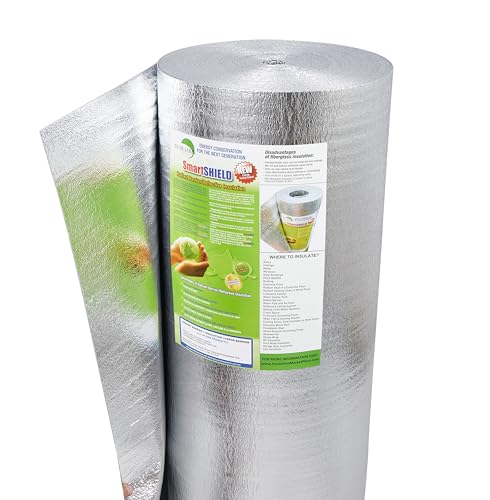
For a big building, roll length matters as much as the material. This SmartSHIELD comes in a 48-inch by 200-foot roll covering 800 square feet, the most coverage per roll of anything here. Fewer roll ends means fewer seams to tape and less overlap waste on long walls.
Like its 3mm sibling, it is a foam core between reflective foil, claimed at 95% radiant reflection and marketed as a moisture-resistant vapor barrier. The core here is thinner at 1.5mm, so it is a pure radiant barrier with even less insulating body than the 3mm version. Two sellers list it, which gives you a little more sourcing flexibility.
It sits in the upper price range for this set, which reflects the sheer length rather than any spec advantage. That thin core is the honest weakness. Against the 3mm roll it gives up foam thickness, and against the fiberglass blankets it gives up thermal resistance entirely. If you have one small bay, the shorter budget roll costs less and wastes less. This one pays off only when you have a lot of wall to wrap.
Pros:
- 800 sq ft covers large buildings in fewer runs
- Longest roll in this set at 200 ft
- Claimed 95% radiant reflection
- Moisture-resistant foam core
Cons:
- Thinnest foam core here at 1.5mm
- Upper price range for a radiant-only layer
- No published R-value
- Overkill for a single small bay
5. Houseables Insulation Roll, Radiant Barrier — Best budget pick
The cheapest way into a reflective layer here, in a manageable 50-foot roll.

Best for: a hobby barn where cost matters more than R-value Skip it if: you expect the foil alone to keep the space warm
When budget leads the decision, this is the entry point. It is the cheapest pick in the group and comes in a 48-inch by 50-foot roll weighing 5.8 lb, with a silver foil face and a white face. The listing calls out a 3mm foam core and a claimed 95% reflective capability.
The white side is the practical wrinkle worth knowing. A finished-looking white interior face can be handy if the barrier will show, which the all-foil rolls do not offer. Houseables markets it for walls, ceilings, roofs and floors, with the foil side facing out in warm climates to block radiant heat.
The short 50-foot roll is both its charm and its limit. For a small hobby barn or a single wall, you buy only what you need. For a large building, you will buy several rolls and tape a lot of seams, at which point the 200-foot roll makes more sense. Like every foil here, it lists no R-value, so treat it as a reflective layer and pair it with something thicker if you want the space genuinely warm. Three sellers list it.
Pros:
- Cheapest pick in this set
- White finished face plus reflective foil face
- Light 5.8 lb roll, easy to handle solo
- Claimed 95% radiant reflection
Cons:
- Short 50' roll needs many rolls for big walls
- No published R-value
- Radiant only, weak on conductive heat loss
How much wall does one roll cover?
Roll length quietly drives your total cost, because you buy by the roll, not the square foot. All five picks are 48 inches wide, so length is the variable to watch. Here they are ordered longest to shortest.
- SmartSHIELD -1.5mm: 200 ft, 800 sq ft. Fewest seams on big walls.
- SmartSHIELD -3mm: 100 ft. A solid middle for a two- or three-bay building.
- Generic 2" fiberglass: 52.5 ft. Long for a faced blanket.
- Houseables: 50 ft. Sized for a small barn or single wall.
- Generic 6" R-19 fiberglass: 39.3 ft. Shortest, because the loft is thickest.
The lesson is simple. A short roll is not worse, it is scoped for a smaller job. Match roll length to your wall area before you compare anything else, or you will either run short mid-wall or pay for coverage you never install.
When does a radiant barrier beat fiberglass?
A radiant barrier is not a weaker fiberglass. It solves a different problem. It reflects radiant heat rather than slowing conductive heat, so the two shine in different situations. Here is how I'd flip the recommendation.
- If summer heat gain is your main complaint, a foil roll under the roofline reflects it well. The SmartSHIELD listings claim 95% radiant reflection.
- If you heat the building in winter, conductive loss dominates, and a rated blanket wins. The 6" R-19 fiberglass is the only pick with a published number.
- If wall depth is too tight for a batt, a thin foil layer fits where 2 or 6 inches will not.
- If you want one product to do everything, you will be disappointed. The best builds pair a reflective layer with a thicker insulating one.
The mistake is expecting a 1.5mm or 3mm foil to keep a shop warm in January. It reflects heat, it does not store it.
What the listings do not tell you
A few gaps are worth flagging before you commit, because the product pages here leave them open.
The foil rolls publish no R-value. That is not a defect, it is the nature of a radiant barrier, but it means you cannot compare them head-to-head with the fiberglass on thermal numbers. Only the 6-inch blanket gives you R-19 to work with.
Facing orientation matters and is easy to get backward. A vapor facing belongs toward the warm interior in most climates, and a reflective foil needs an air gap to reflect into. Installed flat against a surface with no gap, foil loses much of its benefit.
Finally, none of these listings states fire ratings, local code compliance, or how the product behaves behind interior sheeting. Pole barn insulation is often governed by local building code, so confirm what your jurisdiction requires. The keyword's "pole barn walls" framing points you at the right products, but only your wall depth, climate, and code tell you which of these five is right.
The verdict
The best insulation for pole barn walls is the Generic 2" PSK Faced Fiberglass Insulation, because it fixes the moisture problem that actually damages metal buildings while adding genuine conductive resistance the thin foils cannot. Its PSK vapor facing stops warm interior air from condensing on cold panels, and the 48-inch by 52.5-foot roll covers real ground per purchase.
Two conditions flip that pick. If you heat the space through a cold winter, step up to the 6" R-19 version of the same blanket. It is the only product here with a published thermal rating, and the extra loft earns its higher price when the thermometer drops. And if your problem is summer radiant heat or your wall cavities are too shallow for a batt, a SmartSHIELD foil roll reflects heat where a fiberglass blanket would not fit.
The runner-up's exact advantage over the winner is that R-19 number and 6 inches of loft. The winner's advantage over it is coverage per roll, a lower price, and a thickness that fits ordinary framing without crushing. For most builds, the 2-inch blanket is the right default.
FAQ
What is the best insulation for pole barn walls?
The best insulation for pole barn walls, for most builds, is a faced fiberglass condensation blanket like the Generic 2" PSK roll. Its vapor facing stops warm interior air from condensing on cold metal, which is the failure that rots framing. It adds conductive resistance too, unlike a thin reflective foil that only bounces radiant heat.
Is a 6-inch R-19 blanket worth the extra cost?
Whether the extra cost is worth it depends on heating. If you heat the building through winter, the 6" R-19 fiberglass is worth it, since it is the only pick here with a published thermal rating and three times the loft of the 2-inch blanket. For an unheated storage barn, the cheaper 2-inch version does the moisture job for less money.
What R-value do the foil radiant barriers have?
The R-value of the foil radiant barriers is not published on any of these listings. Foil-foam rolls like SmartSHIELD reflect radiant heat rather than resisting conductive heat, so they are rated by reflectivity, claimed at 95%, not by R-value. Treat them as a radiant layer, and pair them with a rated blanket if you need measured thermal performance.
SmartSHIELD 3mm or the Houseables roll: which should I pick?
Between the SmartSHIELD 3mm and the Houseables roll, choose by wall area and finish. The SmartSHIELD gives you 100 feet per roll, double the Houseables 50 feet, so it suits larger walls with fewer seams. The Houseables costs less and adds a white finished face, which helps on a small barn or single wall where the barrier will show.
What mistake ruins pole barn wall insulation?
The mistake that ruins pole barn wall insulation is ignoring condensation. Warm, moist interior air hits cold metal and drips inside the wall, rusting fasteners and rotting framing. Chasing R-value while skipping a vapor facing invites that damage. The faced fiberglass blankets here put a PSK vapor barrier between the moist air and the cold panel to prevent it.
Measure your wall depth and decide whether you heat the space before you order anything. Those two answers point you to a pick faster than any spec sheet. For a shop or garage you use year-round in a mixed climate, start with the 2" PSK faced fiberglass blanket. It handles the condensation that quietly destroys metal buildings, adds real thermal body, and fits ordinary framing without a struggle. Add a foil radiant layer later if summer heat gain becomes the next thing you want to fix.