Best Lightweight Laser Level for Home DIY Projects

Five pocket-sized line lasers, ranked by the specs that actually matter: weight, beam colour, mounting hardware and how long the battery lasts before you reach for a charger.

By Taylor DavidsonUpdated 16 min read
On this page
- Best lightweight laser level for DIY enthusiasts at a glance
- How I cut the field down to five
- Green or red: which beam do you actually need?
- 1. Fanttik D2 Pocket Green Laser Level — Best overall
- 2. Huepar 9011G Cross Line Laser — Best for heavy use
- 3. PREXISO Multi Surface Laser Level — Most versatile
- 4. AikTryee Laser Level Line Tool — Best budget pick
- 5. Motovera LL-T2 Self-Leveling Laser — Best for families
- Why weight matters less than mounting
- What the listings do not tell you
- Which lightweight laser level suits your project?
- The verdict
- FAQ
The best lightweight laser level for DIY enthusiasts is the Fanttik D2, a 0.9 lb pocket unit with a green beam and a 2200 mAh battery Fanttik rates at 10 hours per charge. If you want a published accuracy figure to hold the tool to, the Huepar 9011G is the better buy at ±1/16 in at 16.4 ft. Most shoppers compare beam distance first. That number is the least useful thing on the page, because almost every failure in this category comes from the tool sliding, not the beam fading.
Best lightweight laser level for DIY enthusiasts at a glance
| Pick | Beam | Weight | Price |
|---|---|---|---|
Best overall Fanttik D2 Pocket Green Laser Level |
Green | 0.9 lb | Check Price |
Best for heavy use Huepar 9011G Cross Line Laser |
Green | Not listed, body is 2.9 x 2.8 in | Check Price |
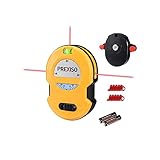
Most versatile PREXISO Multi Surface Laser Level |
3 lines, 30 ft claim | 0.79 lb | Check Price |
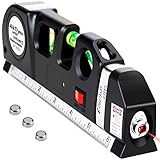
Best budget pick AikTryee Laser Level Line Tool |
Red | 6 oz | Check Price |
Best for families Motovera LL-T2 Self-Leveling Laser |
Green | 7.05 oz | Check Price |



How I cut the field down to five
Three things got listings cut before I compared anything else.
The first was weight. Anything over a pound left the shortlist, because a lightweight laser level is only useful if it sits on a shelf bracket or a magnet without pulling itself off. Four of these five publish a weight, and the heaviest is 0.9 lb.
The second was mounting hardware. A laser projecting a perfect line onto a wall is worthless if you have to hold it. I kept listings that describe a bracket, a magnet, an adhesive base or a tripod thread, and dropped the ones that mention nothing.
The third was mode control. A self-levelling pendulum is the point of the tool, but you need to lock it too. Every pick here that claims self-levelling also claims a manual mode, which is what you use for a 45-degree stair stringer or an angled shelf.
What survived is five line lasers from the same two Amazon categories, spread across every price position from the cheapest to the most expensive. The Huepar and the Motovera both claim a 100 ft working range. The PREXISO claims 30 ft. That gap matters less than it looks, and the next section explains why.
Green or red: which beam do you actually need?
Beam colour is the specification that most changes what the tool feels like to use, and it is the one buyers skim past.
Three of these five project green: the Fanttik D2, the Huepar 9011G and the Motovera LL-T2. Huepar's listing claims up to twice the brightness of a traditional red laser. That is the manufacturer's figure, not a measurement, but the direction is right for the physics involved. Green sits closer to the middle of what the human eye picks up easily.
The AikTryee is the only red-beam pick here. In a dim garage that is fine. On a bright wall near a window, a red line washes out sooner.
Here's the trick with green, though. It costs you power. The Fanttik carries a 2200 mAh rechargeable pack rated at 10 hours precisely because a green diode draws more. The AikTryee has no battery figure published at all, and at 6 oz it does not need much of one.
When to pick red anyway:
- You work indoors only, in controlled light.
- You want the lightest possible tool in a drawer.
- You want a spirit vial as a cross-check, which the AikTryee has in three positions.
When green earns the money:
- Bright rooms, or anywhere near a window.
- Long horizontal runs where you're squinting at the far end.
- Outdoor work, where the Fanttik and Motovera both claim a pulse mode for use with a detector.
1. Fanttik D2 Pocket Green Laser Level — Best overall
The Fanttik D2 pairs a green beam with a stated 10-hour rechargeable runtime, which is the combination that makes a whole afternoon of hanging possible without a battery hunt.
Best for: picture walls and gallery hangs over a long afternoon Skip it if: you need a magnetic bracket in the box
This is the pick I'd hand to someone doing a whole room. At 0.9 lb and 3.03 x 2.95 in, it disappears into a pocket. Fanttik's listing describes an integrated 2200 mAh cell rated at up to 10 hours of continuous work per charge, which is the only published runtime figure in this group. No AA hunt halfway through a wall.
The rest is standard for the category and executed cleanly. Fanttik describes 360-degree rotation, a self-levelling pendulum that you unlock by sliding, and a manual mode for angled lines. There's a Class II rating listed at under 1 mW output, which is the ordinary consumer class for this kind of tool.
The pulse mode claim comes with a caveat worth reading. Fanttik says pulse reaches up to 164 ft with a receiver, and then states the receiver is not supplied. Treat the 164 ft as an upgrade path, not a feature you own.
Against the others, the trade-off is money and hardware. It sits in the most expensive position here, and only two sellers list it, which is the thinnest supply of any pick. It also doesn't publish an accuracy tolerance the way the Huepar does.
Pros:
- Only pick with a published runtime, 10 hours claimed
- Rechargeable 2200 mAh cell, no loose batteries
- Green beam for brighter rooms
- 0.9 lb and 3.03 x 2.95 in, genuinely pocketable
- Self-levelling plus manual lock for angles
Cons:
- Most expensive pick in this set
- Receiver for the 164 ft pulse claim is not included
- No accuracy tolerance published
- Only two sellers list it
2. Huepar 9011G Cross Line Laser — Best for heavy use
The Huepar is the only pick here that publishes an accuracy tolerance, and ±1/16 in at 16.4 ft is the number to hold a tiling job to.

Best for: tiling and cabinet runs needing a stated accuracy figure Skip it if: you'd rather not buy batteries
If you're setting tile or hanging a cabinet run, a stated tolerance is worth more than any brightness claim. Huepar lists ±1/16 in at 16.4 ft, or ±1.5 mm at 5 m, on the 9011G. Nothing else in this group commits to a figure.
Coverage is the second reason it's here. Huepar describes a 110-degree field for the cross lines, which is how you get a horizontal line to wrap far enough into a corner to be useful. The body is 2.9 x 2.8 in, the smallest footprint of the five, and the working range is listed at 100 ft.
The mode behaviour is well documented on the listing, which I appreciate. Slide the pendulum to unlock and it self-levels within ±4 degrees, flashing when you've gone past that. Press the button with the pendulum locked and you get manual mode for angled lines. That flashing alert is a feature, not a fault, and it's the thing new owners misread most often.
The trade-offs are real. Huepar publishes no weight for this unit, so I can't put it in the weight ranking. It runs on removable batteries rather than a built-in pack, and only one seller lists it.
Pros:
- Only pick with a stated tolerance, ±1/16 in at 16.4 ft
- 110-degree field of view for wide corner coverage
- Smallest body footprint here at 2.9 x 2.8 in
- Green beam, claimed 2x red brightness
- Clear self-levelling and manual mode switching
Cons:
- No published weight in the listing
- No rechargeable pack, so batteries are ongoing
- Only one seller lists it
- No stated water or dust rating
3. PREXISO Multi Surface Laser Level — Most versatile
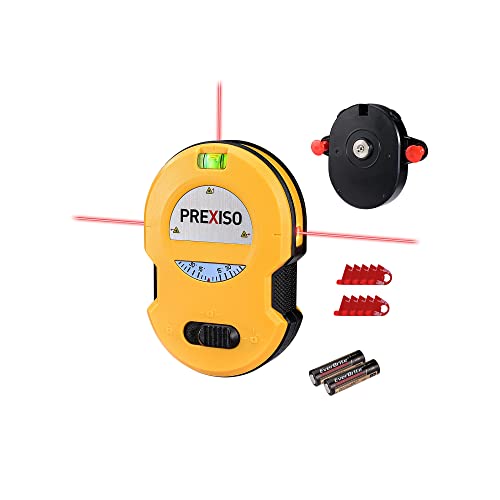
Three lines and an adjustable angle dial from 15 to 75 degrees make this the pick for work that isn't purely level and plumb.
Best for: angled work and floor layout at 90 degrees Skip it if: you're working past 30 ft
Every other pick here gives you level and plumb. The PREXISO gives you three lines and a dial. Its listing describes an angle reference adjustable from 15 to 75 degrees, with the dial and bubble vial both lit by LEDs so you can read them in a dark corner. That is the detail that makes it the choice for stair stringers, sloped ceilings and diagonal tile.
It's also the pick that thinks hardest about the floor. PREXISO describes two lines projected onto floor, wall or other surfaces at an exact 90-degree angle, which is the layout job that ordinary cross-line lasers handle badly. A bonus wall mount base is listed with three fixing methods: two pins for rough surfaces, ten adhesive strips for smooth ones, and a pin option. That's the widest mounting kit here.
At 0.79 lb it's the second-lightest of the picks that publish a weight, in a 4.72 x 4.49 in body. One switch runs all three lines.
The catch is reach. PREXISO lists the surface lines at up to 30 ft, well short of the 100 ft that Huepar and Motovera claim. For a room, fine. For a hallway or a fence line, no. It also sits in the more expensive half of this set and publishes no accuracy tolerance.
Pros:
- Angle dial adjustable across 15 to 75 degrees
- Three laser lines from one switch
- LED-lit dial and bubble vial for dark corners
- Wall mount base with three fixing methods
- 0.79 lb in a 4.72 x 4.49 in body
Cons:
- 30 ft claimed reach, shortest in this group
- Higher price position without a stated tolerance
- No published battery type or runtime
- Largest footprint of the five
4. AikTryee Laser Level Line Tool — Best budget pick
Six ounces, a lifetime warranty and a built-in 8 ft tape make this the cheapest sensible way into the category.

Best for: shelves, frames and short indoor runs Skip it if: you need a bright beam in daylight
This is the cheapest of the five and the lightest, at 6 oz in a 3.34 x 1.1 in body. It's also the only pick in the group with a published warranty, and AikTryee lists it as a lifetime warranty. Read that as the strongest paperwork here, coming from the entry price position.
The design leans on mechanical backup rather than electronics. AikTryee describes three bubble vials, at 0 degrees for level, 90 degrees for plumb and one at 45 degrees, so you can check the tool against itself before you drill. There's an 8 ft tape built in, graduated in both imperial down to 1/32 in and metric down to 1 mm. One front slider selects the mode. That's it.
For shelf brackets, curtain poles and a row of frames, this covers the job. It's the pick that sells fastest of the five, which tells you it's answering an ordinary question well.
Two honest limits. The beam is red, so it fades sooner in bright light than the three green picks. And the listing describes it as designed for indoor use, with no self-levelling pendulum, no pulse mode and no stated waterproof rating. You are levelling it by eye with the vials, which is slower than sliding a pendulum and letting it settle.
Pros:
- Cheapest of the five and lightest at 6 oz
- Only pick with a published warranty, listed as lifetime
- Built-in 8 ft tape, 1/32 in and 1 mm graduations
- Three bubble vials at 0, 45 and 90 degrees
- Single front slider, nothing to learn
Cons:
- Red beam washes out in bright rooms
- No self-levelling pendulum, so you level by eye
- Listed for indoor use only, no pulse mode
- No accuracy tolerance or battery figure published
5. Motovera LL-T2 Self-Leveling Laser — Best for families
A magnetic bracket, an IP54 rating and a carrying bag make this the pick that survives a shared tool drawer.

Best for: shared tool drawers and occasional outdoor jobs Skip it if: storage space is tight
The Motovera is the pick I'd choose for a household where more than one person borrows the tools. Two things drive that. It's the only pick listing an ingress rating, and Motovera states IP54 for water and dust plus a drop-resistant design. It's also the only one describing a 360-degree rotatable magnetic bracket with a mounting thread and a separate iron plate, so you can stick it to a stud bracket or a door frame and walk away.
The specs support light use well. It weighs 7.05 oz, the second-lightest here, and Motovera lists four brightness modes on the green cross line, plus self-levelling and manual modes and a pulse mode for outdoor work with a detector. A carrying bag is included, which matters more than it sounds when the tool lives in a drawer with screwdrivers.
Two things pull it down the order. The listed dimensions are 16.8 x 8.03 in, by far the largest package of the five, which is presumably the bag and bracket rather than the laser body. And it's the slowest seller in this group by a wide margin, which is why it isn't higher despite good hardware.
Against the Fanttik, you get the magnet and the weather rating but lose the published runtime.
Pros:
- Only pick with a stated IP54 water and dust rating
- 360-degree magnetic bracket, thread and iron plate included
- Four brightness modes on a green beam
- 7.05 oz, second-lightest published weight
- Carrying bag in the box
Cons:
- Largest listed package at 16.8 x 8.03 in
- Slowest seller of the five by a wide gap
- No published accuracy tolerance
- No battery type or runtime stated
Why weight matters less than mounting
Here's what I'd tell anyone shopping for a lightweight laser level for DIY enthusiasts: the weight number is a gate, not a decision. Once a tool is under a pound, another few ounces changes nothing. What changes everything is how it stays where you put it.
Look at the spread in this set. The Motovera lists a 360-degree magnetic bracket with a threaded mount and an iron plate. The PREXISO lists a wall base with pins for rough surfaces and ten adhesive strips for smooth ones. The Fanttik describes 360-degree rotation. The AikTryee and Huepar listings describe no dedicated bracket at all.
That difference decides your afternoon:
- Drywall, no stud handy. Adhesive strips win. The PREXISO base is built for it.
- Steel stud, door frame or metal shelf standard. A magnet wins outright. Motovera.
- Tripod already in the cupboard. You need a thread. Motovera lists one.
- Setting the tool on a level shelf or floor. Any of the five works.
Skip the mounting question and you end up holding a self-levelling laser in your hand, which is exactly the state that makes the pendulum flash its out-of-range alert. Huepar's own listing calls that out as the most common reason people think the tool is broken.
What the listings do not tell you
Three gaps run across this whole category, and knowing them saves you a return.
Accuracy is usually absent. Only Huepar publishes a tolerance, at ±1/16 in at 16.4 ft. Four of five say nothing. If you're setting a tile course where an error compounds across the wall, buy the one that commits to a number.
"100 ft" is not a promise about your room. The Huepar and Motovera both list 100 ft, and Fanttik lists 164 ft in pulse mode. Those long figures usually assume a detector, and Fanttik states plainly that the receiver is not supplied. Indoors, on a wall, in daylight, treat the visible line as much shorter.
Battery information is thin. Only Fanttik publishes a capacity, 2200 mAh, and a runtime, 10 hours. The other four listings give neither. Assume removable cells and buy a pack alongside the tool.
One more thing worth flagging. The keyword for this whole category is "for DIY enthusiasts", and that phrase does not map to any specification on any of these listings. No manufacturer here certifies a tool as suitable for home use versus trade use. What you can check is the published evidence: weight, beam colour, mounting hardware, ingress rating, warranty. Judge suitability from those, not from a phrase in a product name.
Which lightweight laser level suits your project?
The best lightweight laser level for DIY enthusiasts changes with the job in front of you. Here's the flip chart.
- Hanging a gallery wall over an afternoon. Fanttik D2. The 10-hour claim on a 2200 mAh pack means no interruption.
- Tiling a bathroom or hanging cabinets. Huepar 9011G, for the ±1/16 in at 16.4 ft figure and the 110-degree field.
- Stair stringers, sloped ceilings, diagonal tile. PREXISO, for the 15 to 75 degree angle dial.
- Squaring a floor layout at 90 degrees. PREXISO again, for the two floor lines.
- Three shelf brackets on a Saturday, nothing more. AikTryee. 6 oz, a lifetime warranty, an 8 ft tape.
- Fence posts or a deck rail outdoors. Motovera, for the IP54 rating and the pulse mode.
- A tool five people in the house will borrow. Motovera, for the bag, the magnet and the drop-resistant claim.
The cutoff I'd draw is 30 ft. Working shorter than that indoors, the PREXISO's extra lines and angle dial buy you more than any reach figure. Working longer, or anywhere near daylight, go green and take the Fanttik or the Huepar.
The verdict
Sorted by what you're willing to spend, this set falls into three clean tiers.
At the entry end, the AikTryee is the cheapest pick here and it is not a compromise for small indoor jobs. Six ounces, three bubble vials, an 8 ft tape graduated to 1/32 in, and the only published warranty in the group. The Motovera sits just above it and is the better entry buy the moment you need a magnet, a bag or an IP54 rating for outdoor work.
In the middle, the Huepar 9011G is the tool to buy if a number matters. ±1/16 in at 16.4 ft is the only accuracy tolerance published across these five listings, and the 110-degree field means the line reaches into corners on a wide wall.
At the top, the Fanttik D2 takes the overall win and the PREXISO takes the specialist slot. Fanttik earns it with the one thing nobody else publishes: a 2200 mAh rechargeable pack rated for 10 hours, in a 0.9 lb green-beam body that fits a pocket. Battery anxiety is what ends DIY afternoons, and this removes it.
The PREXISO's exact advantage is angles. A dial spanning 15 to 75 degrees, LED-lit vials and three lines make it the pick when the work isn't level and plumb. Its 30 ft claimed reach is the price of that flexibility.
FAQ
Is a lightweight laser level worth it for occasional DIY?
A lightweight laser level is worth it the moment you hang more than two things in a row. A spirit level checks one span at a time. A projected line holds a reference across a whole wall while you mark. The AikTryee makes that upgrade cheap at 6 oz with a lifetime warranty, so the entry cost of finding out is low.
What's the difference between the Fanttik D2 and the Huepar 9011G?
The difference between the Fanttik D2 and the Huepar 9011G is what each publishes. Fanttik commits to power: a 2200 mAh rechargeable cell rated at 10 hours. Huepar commits to precision: ±1/16 in at 16.4 ft with a 110-degree field. Pick Fanttik for long sessions and no loose batteries, Huepar for tile courses and cabinet runs where the tolerance matters.
Do I need a green beam, or will red do?
Whether you need a green beam depends on your light. Green sits nearer the eye's peak sensitivity, and Huepar claims up to twice the visibility of a traditional red laser. Three picks here are green: Fanttik, Huepar and Motovera. The red AikTryee is fine in a dim garage or hallway. Near a bright window, it fades sooner.
Can a lightweight laser level be used outdoors?
A lightweight laser level can be used outdoors, but only two here are built for it. Motovera lists an IP54 water and dust rating with a drop-resistant design and a pulse mode. Fanttik lists a pulse mode reaching 164 ft, though the required receiver is not supplied. The AikTryee listing describes indoor use only.
What is the most common mistake buyers make in this category?
The most common mistake buyers make is chasing the longest range number and ignoring how the tool mounts. A 100 ft rating means nothing if you're holding the laser by hand, which triggers the out-of-range flash on self-levelling models. Check for a magnet, an adhesive base or a tripod thread before you check the distance figure.
Start with the job, not the spec sheet. Count the surfaces you actually drill into, decide whether you need a magnet or adhesive pads to hold the tool there, then pick the beam colour that suits your light. That order gets you to the right tool in about a minute. The Fanttik D2 is the sensible default because it removes the one variable that ruins a productive afternoon: at 0.9 lb with a rated 10 hours on a charge, it's still projecting a clean green line when you finish the last frame on the wall.