Best Quiet Generator When Job Site Noise Is Capped

Six inverter generators ranked on published output, weight and manufacturer noise claims, with the Oxseryn 2800-Watts leading on the balance a one-van crew actually needs.

By Taylor DavidsonUpdated 18 min read
On this page
- Best quiet generator for professionals at a glance
- How six listings survived the cut
- What actually decides a quiet generator purchase?
- Do these listings really support professional use?
- 1. Oxseryn 2800-Watts Portable Inverter Generator — Best overall
- 2. Westinghouse 5000 Peak Watt Super Quiet Portable Inverter — Best premium
- 3. Oxseryn 4400-Watts Inverter Generator — Best upgrade
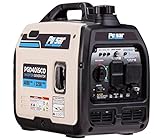
- 4. Pulsar PGD40ISCO Ultra Light Quiet 4000W — Best warranty
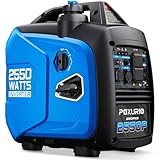
- 5. POXURIO 2550-Watt Portable Inverter Generator — Best minimal setup
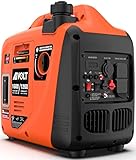
- 6. AIVOLT 1600W Super Quiet Inverter Generator — Best budget pick
- Watts, weight and the trade you can't avoid
- How loud is 58 dBA on a real job site?
- When a different pick wins
- The verdict
- FAQ
The best quiet generator for professionals is the Oxseryn 2800-Watts Portable Inverter Generator, which pairs 2000 running watts with a 40 lb body and a manufacturer claim of under 58 dBA at 23 ft. If your loads include a 30A RV feed or a rooftop air conditioner, the Westinghouse iGen5000 is the better buy at 3900 rated watts and 52 dBA claimed. This guide is not for anyone wiring a whole-house standby unit. Those are permanent installs on a transfer switch, and none of these six qualify. Everything here is a portable inverter you carry to the work.
Best quiet generator for professionals at a glance
| Pick | Output (peak / running) | Noise claim | Price |
|---|---|---|---|
Best overall Oxseryn 2800-Watts Portable Inverter Generator |
2800 W / 2000 W | Under 58 dBA claim | Check Price |
| 5000 W / 3900 W | 52 dBA claim | Check Price | |
Best upgrade Oxseryn 4400-Watts Inverter Generator |
4400 W / 3400 W | None published | Check Price |
Best warranty Pulsar PGD40ISCO Ultra Light Quiet 4000W |
4000 W / 3200 W | 59 dB claim | Check Price |
Best minimal setup POXURIO 2550-Watt Portable Inverter Generator |
2550 W start | 59 dB claim | Check Price |
Best budget pick AIVOLT 1600W Super Quiet Inverter Generator |
1600 W | 57 dBA claim | Check Price |


How six listings survived the cut
Three disqualifications did most of the work here.
First, anything without inverter electronics was out. A conventional open-frame generator with a fixed-speed engine cannot throttle down when the load drops, so it runs loud all day and its waveform is dirty. Every pick in this set is an inverter, and four of the six publish a total harmonic distortion figure under 3%.
Second, anything that couldn't be carried by one person was out. That capped the field near 105 lb, which is where the Westinghouse iGen5000 sits at 104.7 lb with a wheel and handle kit. Above that, you are dealing with a two-person lift or a tailgate ramp, and the buyer looking for the best quiet generator for professionals is usually loading solo before sunrise.
Third, anything with a bare specification sheet was out. Every survivor lists at least a model number, a warranty term and a published output. The Oxseryn 4400-Watts and the POXURIO both have gaps, and I've flagged those in their sections rather than papering over them.
What survived is a spread from 1600 W to 5000 W peak, from 28 lb to 104.7 lb, and across warranty terms of one to three years. That spread is deliberate. A drywall crew and a mobile detailer are not shopping for the same machine.
What actually decides a quiet generator purchase?
Most guides rank on decibels. That is the wrong lead, and here is why.
Every noise figure in this set is a manufacturer claim measured at 23 ft, and the range across all six is just 52 dBA to 59 dBA. Seven decibels is audible, but it is not the difference between getting a complaint and not getting one. Distance matters far more: the same unit at 46 ft reads roughly six decibels lower than at 23 ft, which swamps the entire spread of this field. Where you set the generator down decides more than which one you bought.
What actually decides it is surge headroom against your single largest tool. A quiet generator for professionals fails the moment a circular saw's startup draw trips the overload protection, and no decibel rating saves you from that. Run the arithmetic on your worst-case starting watts first, then pick from what clears it.
Three published figures deserve your attention in this order:
- Running watts, not peak. Peak is a fraction of a second. Running watts is what holds a compressor cycling all afternoon.
- Fuel tank against shift length. The Westinghouse holds 3.4 gal and claims up to 18 hours; the Pulsar holds 1 gal and claims 4 hours at half load.
- Weight against how you load it. 40 lb is a one-hand carry. 104.7 lb is a wheeled roll and a careful lift.
Decibels are the tiebreaker, not the criterion.
Do these listings really support professional use?
Here is the honest position: not one of these six listings is written for the trades. Read the marketing copy and you get camping, RV nights, tailgating and emergency home backup. The POXURIO listing mentions commercial use in a single clause. Nothing else in the set claims a duty cycle, a job-site rating, or an OSHA-relevant noise certification.
So the word "professionals" is doing work the product data does not fully back up. Treat it as a filter you apply yourself, not a promise these manufacturers make.
What that means in practice:
- Check your own noise cap. Municipal ordinances and site rules are written in dBA at a property line or at a set distance. A 23 ft manufacturer claim is not the same measurement, and you cannot substitute one for the other.
- Check duty expectations. None of these listings states a continuous-duty rating. If you need eight hours at 80% load, five days a week, verify that directly with the brand before you commit.
- Check the warranty term against your usage. Commercial use voids or shortens coverage on plenty of consumer power equipment. The listings here publish terms of one to three years but say nothing about commercial exclusions.
I'd still buy from this set for light and medium trade work: lights, chargers, laptops, small compressors, single-tool operation. For anything heavier, verify first.
1. Oxseryn 2800-Watts Portable Inverter Generator — Best overall
The best quiet generator for professionals here is the Oxseryn 2800-Watts, because 2000 running watts in a 40 lb frame is the only combination in this set that solves both the load problem and the carry problem.
Best for: a one-van trade carrying the unit solo every morning Skip it if: you need a 30A RV outlet or more than 2000 running watts
Look at the middle of this field and the Oxseryn 2800 is the pick that refuses to compromise in either direction. It runs 2000 watts continuously from a 79.8cc four-stroke OHV engine, which covers a job-site light tower, a laptop, a battery charger bank and one moderate power tool at a time. It weighs 40 lb, which is genuinely a single-handed lift out of a truck bed.
Oxseryn claims under 58 dBA from 23 ft and less than 3% THD, and the listing describes an Eco mode that throttles the engine back at low load. The port layout is the most varied in the set for small electronics: two 120V AC outlets, a 12V DC port, one USB and one USB-C. That matters more than it sounds when four people need phones charged and you'd rather not run a power strip.
Footprint is 19.2 x 18.6 x 11.2 in, so it slots into a van shelf rather than eating floor space. The trade-off is real: the 1.1 gal tank is small, the warranty runs 1 year against the three-year terms on two rivals, and there is no RV-style 30A outlet at all.
Pros:
- 2000 running watts from a 79.8cc four-stroke OHV engine
- Only 40 lb, a realistic one-person carry
- Four port types including USB and USB-C
- Under 58 dBA claim at 23 ft
- Compact 19.2 x 18.6 x 11.2 in footprint
Cons:
- 1.1 gal tank is the second-smallest here
- 1 Year Manufacturer warranty, weakest in the set alongside two others
- No 30A outlet, so no direct RV or high-amp feed
- Only one seller lists it
2. Westinghouse 5000 Peak Watt Super Quiet Portable Inverter — Best premium
The Westinghouse iGen5000 is the highest-output and quietest-claimed unit in this set, and the only one that publishes a run-time display alongside a 3.4 gal tank.

Best for: crews running compressors or a 13,500 BTU air conditioner Skip it if: you lift the generator in and out of a truck bed alone
This is the most expensive pick here and the specification sheet explains why. 5000 peak watts and 3900 rated watts at under 3% THD is 1900 more running watts than the Oxseryn 2800, and Westinghouse claims as low as 52 dBA, the lowest figure any listing in this set publishes. Up to 18 hours of run time from a 3.4 gal tank in Economy mode covers a full shift plus overtime without a fuel run.
The convenience features are the real separator. Remote start with an included key fob, electric start, and recoil as a backup. A rotating LED display showing fuel level, power output, remaining run time, voltage and lifetime hours, which is the only diagnostic panel described anywhere in this group. Outlets cover a 5–20R 120V duplex, a TT-30R 30 amp RV connection and two USB ports. A telescoping handle and wheel kit ship with it.
The cost is mass. At 104.7 lb it is two and a half times the winner's weight, and 20 x 24.5 x 17.5 in is a substantial box. You roll this one to the work. The 3 Year Limited Warranty is the longest term here, tied with the Pulsar.
Pros:
- 3900 rated watts, the highest running output in this set
- 52 dBA claim, the lowest published figure here
- 3.4 gal tank with an up-to-18-hour run-time claim
- Remote key fob, electric and recoil start
- LED data centre showing fuel, output and lifetime hours
Cons:
- 104.7 lb, by far the heaviest pick in this comparison
- Largest footprint at 20 x 24.5 x 17.5 in
- The most expensive option here by a clear margin
- Slower-selling than four of the other five picks
3. Oxseryn 4400-Watts Inverter Generator — Best upgrade
The Oxseryn 4400 delivers 3400 running watts and a 30A RV outlet at the second-cheapest position in this set, which is the sharpest output-for-money case here.

Best for: buyers who want 3400 running watts without the premium price position Skip it if: you need a published noise figure before you buy
Set this beside the Westinghouse and the gap narrows fast. 4400 peak and 3400 running watts against 5000 and 3900 is a 500-watt difference in continuous output, and the Oxseryn 4400 also carries a 30A RV port, two 120V AC outlets and a 12V DC port. It sells faster than the other five picks in this comparison, which tells you buyers are reaching the same conclusion about where the value sits.
Weight lands at 57 lb, roughly half the Westinghouse. Dimensions are 19.2 x 19.4 x 15.2 in, so it is taller than the winner but not much wider. Oxseryn lists a 2 gallon fuel tank with a 14-hour claim at 25% load, plus inverter electronics, ECO mode, overload protection, low oil shutdown and cold start.
Now the honest problem. This is an open-frame design and the listing publishes no decibel figure at all. Every other pick here states a number. Open frames typically run louder than enclosed cases because there is no acoustic housing between the engine and you. In a guide about the best quiet generator for professionals, that omission is the reason this sits third rather than second. The listing also notes a possible fuel smell on arrival from factory testing.
Pros:
- 3400 running watts, second-highest here
- 30A RV outlet plus two 120V AC and 12V DC
- 2 gallon tank with a 14-hour claim at 25% load
- 57 lb, a little over half the Westinghouse weight
- Sells faster than any other pick in this set
Cons:
- No published noise rating anywhere on the listing
- Open frame offers no acoustic housing
- 1 Year Manufacturer warranty
- Listing warns of a possible gasoline smell out of the box
4. Pulsar PGD40ISCO Ultra Light Quiet 4000W — Best warranty
The Pulsar PGD40ISCO backs 3200 running watts with a 3 year limited warranty at only 47.3 lb, the best power-to-weight ratio in the set.

Best for: someone who values a 3 year limited warranty on a mid-weight frame Skip it if: you run long shifts without a fuel can nearby
Do the arithmetic and the Pulsar looks unusual. 3200 rated watts at 47.3 lb works out to roughly 68 watts per pound, better than the Oxseryn 4400 at about 60 and far ahead of the Westinghouse at about 37. It is only 7.3 lb heavier than the winner while delivering 1200 more running watts. Dimensions of 17.3 x 18.9 x 11.4 in make it the second-smallest box here.
Pulsar rates it at 59 dB and states it handles air conditioning units up to 13,500 BTU, along with sensitive electronics and emergency power. The 3 year limited warranty ties the Westinghouse for the longest coverage in this comparison, and it comes attached to a much lighter machine.
The fuel tank is where this falls down. One gallon, and Pulsar's own figure is 4 hours of run time at half load. That is not a shift. It is a morning. Plan on a jerry can and a mid-day top-up, or accept that a light load stretches it further. The 59 dB claim is also the joint-highest here, seven decibels above the Westinghouse figure, and the listing describes no USB ports or DC output. This is the slowest-selling pick of the six.
Pros:
- 3200 rated watts at just 47.3 lb
- 3 year limited warranty, joint-longest here
- Compact 17.3 x 18.9 x 11.4 in body
- Rated for air conditioners up to 13,500 BTU
Cons:
- 1 gallon tank, only 4 hours at half load per the listing
- 59 dB claim, joint-highest in this set
- No USB or 12V DC output described
- Slowest seller of the six
5. POXURIO 2550-Watt Portable Inverter Generator — Best minimal setup
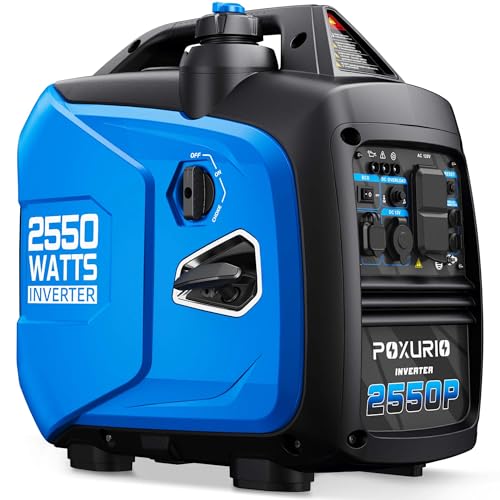
The POXURIO 2550 pairs a 2550 W start figure with a 10-hour claim at 25% load, making it the long-day option for light tool loads.
Best for: light tool loads and long low-draw days Skip it if: you need to know the shipping weight before you commit
The case for the POXURIO is endurance at low draw. POXURIO lists a 4L tank, described elsewhere on the listing as 1.06 gallon, and claims up to 10 hours at 25% load. Compare that against the Pulsar's 4 hours at half load and you can see the intended use: a steady, modest draw across a full working day rather than heavy intermittent tool starts.
Starting power is 2550 W. The listing describes sound reduction technology with a 59 decibel operating figure and mentions commercial use directly, which is more than most of these listings offer. Output is 120V. Dimensions of 12.6 x 21.3 x 20.1 in give it the narrowest profile in the set at 12.6 in across, useful if your van shelving is tight.
Two gaps hold it back. The listing publishes no weight, which is a genuine problem when you are deciding whether one person can load it. And it states a starting figure without a separate rated running number, so you cannot compare its continuous output against the rest of this field on equal terms. The warranty reads as 1 year with a 30 day return. Buy this one when the low-draw endurance case is what you actually need.
Pros:
- Up to 10 hours at 25% load per the listing
- 4L (1.06 gallon) tank on a compact frame
- 59 decibel operating figure claimed
- Narrowest dimension in the set at 12.6 in
- Listing names commercial use directly
Cons:
- No published weight anywhere on the listing
- 2550 W is a starting figure with no separate running number
- 1 year warranty with a 30 day return window
- No THD figure published, unlike four other picks
6. AIVOLT 1600W Super Quiet Inverter Generator — Best budget pick
At 28 lb with a 57 dBA claim and a 2-year manufacturer warranty, the AIVOLT is the cheapest and lightest way into this category.
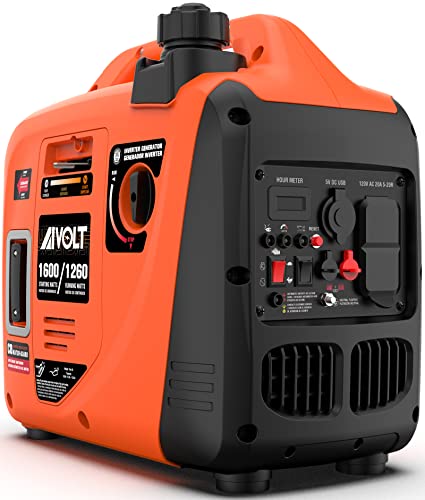
Best for: a second unit for lights, laptops and battery chargers Skip it if: any tool on your van draws more than 1600 starting watts
This is the cheapest of the six and the lightest by 12 lb. At 28 lb and 15.8 x 16.9 x 9.92 in, it is the only pick you'd genuinely carry a few hundred feet without thinking about it. AIVOLT claims 57 dBA at 23 ft, second-lowest here, and describes it as quieter than a normal conversation.
Two features punch above the price position. The 2-year manufacturer warranty beats the 1-year terms on three pricier picks. And this is the only listing in the set describing built-in CO alert technology with automatic shutdown at unsafe carbon monoxide levels, which matters if you ever work near an open garage door or a partially enclosed space. Under 3% THD, a 60cc four-stroke OHV engine with copper windings, two 120V outlets, two USB ports including Type-C, and parallel capability round it out. AIVOLT lists 8 hours at 25% load and 2 hours at full load.
The limit is obvious. 1600 W will not start a compressor or a table saw, full stop. Treat it as a charger and lighting unit, or as the second machine you pair with a bigger one. That two-hour full-load figure is also the shortest heavy-draw runtime in this comparison.
Pros:
- Cheapest of the six and lightest at 28 lb
- 2-year manufacturer warranty beats three pricier picks
- Only pick describing built-in CO alert auto-shutdown
- 57 dBA claim, second-lowest here
- Parallel capable, plus two USB ports
Cons:
- 1600 W will not start most heavy power tools
- Only 2 hours at full load per the listing
- No 12V DC or 30A outlet
- Smallest output in this comparison by a wide margin
Watts, weight and the trade you can't avoid
Line these six up by output and weight and a pattern appears immediately: more running watts costs you pounds, but not at a fixed rate.
- 1600 W at 28 lb — AIVOLT, roughly 57 watts per pound
- 2000 W at 40 lb — Oxseryn 2800, roughly 50 watts per pound
- 3200 W at 47.3 lb — Pulsar, roughly 68 watts per pound
- 3400 W at 57 lb — Oxseryn 4400, roughly 60 watts per pound
- 3900 W at 104.7 lb — Westinghouse, roughly 37 watts per pound
The Pulsar wins that ratio outright, and it does so because of a 1 gallon tank. Fuel is heavy. Cut the tank and you cut the weight, then pay for it in refills every four hours at half load. The Westinghouse sits at the opposite pole: 3.4 gal, a wheel kit, and an 18-hour claim.
So the trade is not really watts against weight. It's watts against weight plus refuelling frequency, and you choose which side of it your day can absorb. A finish carpenter parked next to a driveway all day should take the Westinghouse and roll it. A window installer moving between four addresses should take the lighter frame and carry a fuel can.
How loud is 58 dBA on a real job site?
Fifty-eight dBA at 23 ft is roughly the level of ordinary conversation. That is quiet for a combustion engine, and it is the sort of figure that keeps neighbours calm on a residential remodel.
But three things distort it on an actual site.
Reflective surfaces raise it. A generator set against a brick wall or inside a garage bay bounces sound back at you and adds several decibels compared with the same unit on open ground. Put it on grass or gravel, away from hard vertical faces.
Load raises it. Every noise claim in this set is measured at a low load with Eco mode engaged, which lets the engine idle down. Push the same machine to 80% capacity and the engine climbs to full speed. Expect noticeably more than the published figure whenever you are working near the unit's ceiling.
Distance lowers it fast. Doubling the distance from 23 ft to 46 ft cuts roughly six decibels, which is close to the entire 52-to-59 dBA spread of this whole field. That is why placement beats specification. Run a longer extension cord and you gain more quiet than any purchase decision in this article can give you.
When a different pick wins
Three thresholds flip the recommendation away from the winner.
Above 2000 running watts, the winner is out. If your largest tool plus your baseline load exceeds 2000 W continuous, the Oxseryn 2800 cannot serve you regardless of how quiet or portable it is. Move to the Oxseryn 4400 at 3400 W or the Westinghouse at 3900 W.
Above roughly six continuous hours of moderate draw, tank size decides. The Pulsar's 1 gallon runs 4 hours at half load and the Oxseryn 2800 carries 1.1 gal. For a full unattended shift, the Westinghouse 3.4 gal tank or the POXURIO 10-hour quarter-load claim are the only picks that address it.
If you lift alone with no ramp, 60 lb is your ceiling. That eliminates the Westinghouse at 104.7 lb outright. The Pulsar at 47.3 lb is then the highest-output pick you can realistically handle, and its 3 year limited warranty comes along for free.
One more flip worth naming: if a published decibel figure is a hard requirement for a site permit or a client conversation, the Oxseryn 4400 drops out entirely. It publishes no noise number at all, and you cannot cite a figure that doesn't exist.
The verdict
The Oxseryn 2800-Watts Portable Inverter Generator is the best quiet generator for professionals in this set, and the reason is balance rather than any single leading figure. 2000 running watts covers a light tower, chargers and one power tool. 40 lb means one person loads it. Under 58 dBA claimed and under 3% THD means you can stand near it and plug a laptop into it. Four port types, including USB-C, cover the small stuff that eats the day.
Two conditions flip that. The first is output: if your continuous draw crosses 2000 W, the Westinghouse iGen5000 takes over with 3900 rated watts, a 52 dBA claim, remote key fob start and a 3.4 gal tank rated up to 18 hours. Its exact advantage over the winner is 1900 additional running watts and a tank three times the size, paid for in 64.7 lb of extra weight and the highest price position here.
The second is budget. If you only need lights, laptops and battery chargers, the AIVOLT 1600W does it at 28 lb, the cheapest position in this comparison, with a 2-year warranty and CO shutdown the winner lacks. Buy the Oxseryn 2800 as the default. Size up or down from there.
FAQ
Is a quiet generator worth it for professional job sites?
A quiet generator is worth it for professional job sites mainly for two reasons beyond noise. Inverter models throttle their engine down at low load, which cuts fuel burn across a long day. They also deliver under 3% THD on four of these six picks, which protects laptops, chargers and tool electronics. The lower decibel figure is a bonus that keeps clients and neighbours off your back.
What size quiet generator for professionals do I actually need?
The size quiet generator you actually need is set by your largest tool's starting draw plus everything running at the same time. Add those figures, then choose a unit whose rated running watts clears the total with margin. For lights and chargers, 1600 W suffices. For a compressor or a 13,500 BTU air conditioner, look at 3200 W and above.
Oxseryn 2800 or Westinghouse iGen5000: which should I buy?
Choosing between the Oxseryn 2800 and the Westinghouse iGen5000 comes down to load and lifting. The Oxseryn gives 2000 running watts at 40 lb, easy to carry solo. The Westinghouse gives 3900 rated watts, a 52 dBA claim, a 30A RV outlet and up to 18 hours from 3.4 gal, but weighs 104.7 lb and needs its wheel kit.
Can these generators run a 30 amp RV outlet?
Two picks here publish a 30 amp outlet. The Westinghouse iGen5000 lists an RV-ready TT-30R connection alongside its 5–20R duplex, and the Oxseryn 4400-Watts lists a 30A RV port with two 120V AC outlets. The Oxseryn 2800, AIVOLT, Pulsar and POXURIO listings describe no 30 amp connection, so plan on standard 120V outlets with those four.
What is the biggest mistake when buying a quiet generator?
The biggest mistake when buying a quiet generator is treating the decibel claim as the deciding number. Every figure in this set is a manufacturer claim at 23 ft under light load, and the whole field spans just 52 dBA to 59 dBA. Undersizing the running watts causes far more grief, because an overload shutdown stops your work entirely.
Start by writing down the starting watts of your single heaviest tool, then add your steady loads. That one number eliminates most of this field before decibels ever enter the conversation. For a one-van trade that lands under 2000 W, the Oxseryn 2800-Watts is the sensible default: it's the only pick here that stays genuinely portable at 40 lb without dropping below a useful output, and its four port types mean you rarely need a power strip. Then set it on grass, twice as far from the work as feels necessary, and you'll gain more quiet than any spec sheet promises.