Best Random Orbital Sander for Concrete by Spec
A shortlist of five random orbit sanders judged against concrete work, with the deciding specs, honest weaknesses, and the buyer profile each one actually fits.
The best random orbital sander for concrete in this set is the DEWALT DWE6423, because its 8,000–12,000 OPM variable speed and 3.4 lb body give you the control a hard, dusty surface demands. If you want the longest published warranty of the group, the DEWALT DWE6421K kit runs 3 years against the DWE6423's specification sheet and lands as the premium pick instead.
Before the picks, an honest note. Random orbit sanders are built for wood, metal and filler, not for grinding down cured slabs. The best random orbital sander for concrete work is the one that handles light concrete tasks, thin skim coats, feathering patches, cleaning efflorescence, polishing decorative surfaces, without wrecking itself. For heavy stock removal on a slab, you want a concrete grinder, not any tool on this list.
Best random orbital sander for concrete at a glance
| Pick | Speed (OPM/RPM) | Weight | Price |
|---|---|---|---|
| Best overall DEWALT DWE6423 |
8,000–12,000 OPM variable |
3.4 lb | Check Price |
| Best for families SKIL SR211601 |
13,000 OPM variable |
3.44 lb | Check Price |
| Best premium DEWALT DWE6421K |
12,000 OPM fixed |
4 lb | Check Price |
| Most versatile DEKOPRO DKOS30A125Y |
14,000 RPM claim 6 speeds |
3.62 lb | Check Price |
| Best budget pick HYCHIKA FL117 |
13,000 RPM claim 6 speeds |
not listed | Check Price |
Can a random orbital sander actually handle concrete?
The keyword sends a lot of shoppers here, so it is worth answering flat: a random orbit sander is not a concrete grinder, and none of the five listings above claims otherwise. Their feature bullets describe woodworking, finishing and polishing. What a random orbit sander can do on concrete is narrow and specific.
- Feathering the edges of a patch or skim coat before a topcoat.
- Cleaning light efflorescence, paint speckles or glue residue off a smooth slab.
- Buffing decorative or countertop concrete with a soft interface pad and diamond-backed discs.
- Prep sanding a floor patch so it blends into surrounding finish.
What it cannot do is remove cured stock, level a rough pour, or grind down a trip hazard. Try, and you will glaze paper in seconds, load the dust collector with abrasive fines that eat bearings, and cook the motor. For that job, rent a variable-speed concrete grinder with a dust shroud.
Two conditions decide whether these tools will survive concrete work. First, variable speed: you want to drop the pad below 10,000 OPM for diamond discs. Second, sealed dust handling: concrete dust is far more abrasive than sawdust, and the sander that lasts is the one whose switch and bearings the manufacturer has closed off.
1. DEWALT DWE6423 — Best overall
The DWE6423 is the best random orbital sander for concrete work here because it combines a low 3.4 lb body, variable 8,000–12,000 OPM, and a dust-sealed switch DEWALT calls out by name.

Best for: long sanding sessions where vibration and dust control matter most. Skip it if: you want a kit with case and paper in the box.
The case for this one is set against the other four. It is the lightest of the group at 3.4 lb, only a shade under the SKIL, and comfortably below the 4 lb DWE6421K. The 3-amp motor runs the pad from 8,000 to 12,000 OPM, so you can dial it down for diamond-backed discs on concrete without stalling. DEWALT lists a dust-sealed switch and a counterweight design that reduces vibration, both of which matter more on abrasive dust than on sawdust. The dust port is spec'd to fit DEWALT's DWV010 and DWV012 collectors directly, which is the kind of clean vac connection you want when the fines are silica-laden.
Against the SKIL, the DWE6423 gives up the cyclonic dust box in exchange for a proper hose port. Against its DWE6421K sibling, it loses the kit case and two years of warranty but drops half a pound. On this shortlist, it is the tool best suited to the awkward second-cousin role a random orbit sander plays on concrete.
Pros:
- Lightest of the five at 3.4 lb
- Variable 8,000–12,000 OPM for slow-speed work
- Dust-sealed switch called out by DEWALT
- Direct port fit to DWV010 or DWV012
- Sells faster than every pick here except the SKIL
Cons:
- No case, no starter paper, no warranty listed
- Sits in the premium price position of the set
- Only two sellers list it
2. SKIL SR211601 — Best for families
The SKIL is the pick when nobody in the house wants to think about a shop vac, because its cyclonic dust box is self-contained and empties in seconds.

Best for: occasional users who want a self-contained cyclonic dust box. Skip it if: you plan to hook up to a shop vac full-time.
At 3.44 lb and 5.51 x 7.87 x 4.8 in, this is the most compact tool in the set on two of three dimensions. SKIL rates the 2.8-amp motor at 13,000 OPM with variable speed control, which gives you enough range to drop below 10,000 OPM for diamond pads or a fine-grit polish on a countertop. The headline feature is the X-flow cyclonic dust box in a transparent container, which is a genuine advantage for households where hauling out the shop vac is the reason nothing ever gets sanded. It is also the pick with a published 1-year limited warranty, more than the DWE6423 and DEKOPRO offer on paper.
The trade-off is exactly the dust box that makes it convenient. For heavy or abrasive dust, a sealed cyclonic canister fills fast and does not equal a hose to a vac. On concrete fines, you will empty it constantly. Sells faster than three of the four others here, which suggests the size-and-simplicity story lands.
Pros:
- Cyclonic transparent dust box, no vac required
- 1-year limited warranty, one of only two in the set
- Compact 5.51 x 7.87 x 4.8 in footprint
- Variable speed for slow-pad work
- Second-cheapest of the five
Cons:
- No shop-vac port match called out
- 2.8-amp motor is the smallest here
- Dust box fills quickly on abrasive work
3. DEWALT DWE6421K — Best premium
The DWE6421K kit is the tool to buy when you want the longest published warranty in this set and a case to keep it in.
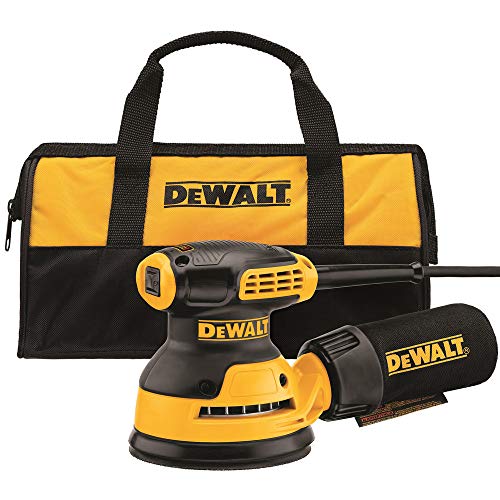
Best for: buyers who want the longest published warranty in the set. Skip it if: weight or a lower price position is your priority.
DEWALT lists this one with a 3.0-amp motor at 12,000 OPM, rubber over-mold on the critical areas, a dust-sealed switch, and a 3-year limited warranty. That warranty is the longest of any pick here by a factor of three, and it is the specification most worth paying attention to when the tool will see abrasive concrete fines. Concrete dust is the single fastest way to kill a sander's switch and bearings, and a manufacturer standing behind the tool for 36 months is a meaningful hedge.
The compromises against the DWE6423 are real. At 4 lb, this is the heaviest tool of the five, and it runs a fixed 12,000 OPM rather than a variable range, so you cannot slow the pad down for diamond discs the way you can on the DWE6423 or the SKIL. It sits at the top of the price positions here, and it is the slowest seller of the five, so if speed of shipping matters to you the DWE6423 is a safer bet.
Pros:
- 3-year limited warranty, longest in the set
- Rubber overmold on critical areas
- Dust-sealed switch called out by DEWALT
- Ships in a kit with case
- 3.0-amp motor at 12,000 OPM
Cons:
- Heaviest of the five at 4 lb
- Fixed speed only, no variable range
- Highest price position in this shortlist
4. DEKOPRO DKOS30A125Y — Most versatile
The DEKOPRO is the pick when you want a sander that ships ready to use, with sixteen sanding discs and a six-speed dial for very different materials.

Best for: a first sander that ships with a starter pack of paper. Skip it if: you need a published warranty or a full spec sheet.
DEKOPRO lists a 2.5-amp motor with a 14,000 RPM claim, six variable speeds, and a bundle of sixteen sanding discs from 60 to 1000 grit. That grit range is the versatility argument: you can move from a coarse feather on a patched slab to a 1000-grit polish on a decorative concrete piece without another paper order. The dust bag is detachable, and the hook-and-loop pad accepts fast disc changes, which matters when concrete work chews through paper.
The evidence against it is what the listing does not say. No weight rating in the standard spec block. No warranty published. The dimensions are given as 0.79 x 0.79 x 0.79 in, which is clearly the shipping label rather than the tool, so you are buying without a real size. The 14,000 RPM figure is a manufacturer claim, and the price position is entry-level for a reason: it is the second-cheapest here, with less spec transparency than the DEWALTs or the SKIL. Fine for a starter or an occasional-use tool, less obviously the right choice when a slab is waiting.
Pros:
- 16 sanding discs, 60 to 1000 grit
- 6 variable speeds
- Detachable dust bag
- Hook-and-loop fast disc change
- Second-cheapest price position
Cons:
- No warranty published
- No verified weight in the spec block
- Dimensions listed appear to be the shipping carton
- 14,000 RPM is an unattributed manufacturer claim
5. HYCHIKA FL117 — Best budget pick
The HYCHIKA is the cheapest of the five and a reasonable second sander when the main tool is already in use, provided you are not counting on it for heavy work.
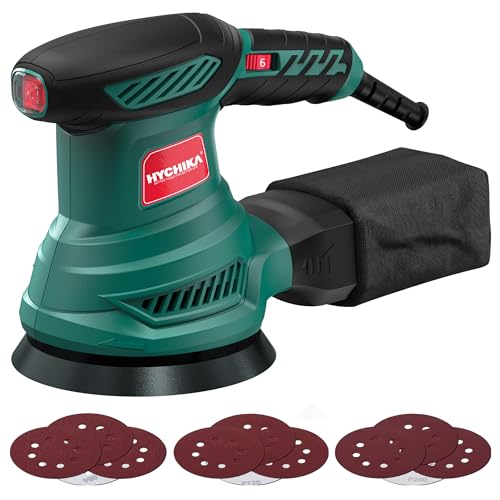
Best for: a light-duty second sander you will not use every week. Skip it if: you want fast turnover of orders and stock.
HYCHIKA lists a 300W motor with a 13,000 RPM claim, six speed settings, an eight-hole vacuum dust collector, and twelve sanding sheets in the box. On paper, the speed range is comparable to the SKIL and the DEKOPRO. The hook-and-loop pad is standard. As a first sander for occasional work, or as a backup you keep on hand for a specific grit, it is the lowest cost of entry here.
The reasons it lands last are structural. It is the slowest seller of the five by a wide margin, so it turns over less often on Amazon. The weight is not published in the standard spec block. There is no warranty listed. The RPM number is an unattributed manufacturer figure, not an OPM rating you can compare directly against the DEWALTs. On concrete work specifically, where abrasive fines punish a tool with sealed switches and rubber overmold in the right places, the HYCHIKA does not call any of that out. Buy it for what it is, which is the entry-tier pick with a starter pack of paper.
Pros:
- Cheapest of the five
- Six variable speeds
- Twelve sanding sheets in the box
- Eight-hole vacuum dust pattern
- Hook-and-loop quick change
Cons:
- Slowest seller in this shortlist
- No warranty published
- No weight listed
- 13,000 RPM is a manufacturer claim
How I screened the shortlist
The picks map to five buyer profiles rather than a single "best" tool, because random orbit sanders are bought for very different reasons even inside one keyword. Concrete work is a minority use case for every listing above, so I sorted the picks around three profiles that decide the purchase in practice.
- The user who will pair the sander with a shop vac and wants dust handling to be serious. That is the DWE6423.
- The user who wants the tool to look after its own dust and refuses to buy a vac. That is the SKIL.
- The user who cares most about warranty length because concrete fines will eventually damage something. That is the DWE6421K.
The DEKOPRO and HYCHIKA cover the entry price positions for a first sander or a second-string tool. What was cut: any sander without variable speed, since you cannot safely run diamond-backed discs at 12,000 OPM; any sander whose listing did not call out dust handling; and anything from a brand with no other spec beyond a wattage figure.
What separates the five: the specs that matter
Speed range is the one specification I would prioritise for concrete work. Diamond discs and polishing pads want a slower pad than wood does, and only three of the five here give you a real variable range: the DEWALT DWE6423 at 8,000–12,000 OPM, the SKIL at up to 13,000 OPM with variable control, and the DEKOPRO with six discrete speeds. The DWE6421K is fixed at 12,000 OPM. The HYCHIKA has six speeds by its own claim but does not publish the range.
Weight matters more than usual on concrete. You are often working overhead on a wall patch, or feathering a horizontal patch with the tool at arm's length. Lighter is better, and the DWE6423 wins here at 3.4 lb, with the SKIL a hair behind at 3.44 lb.
Warranty is the third spec I would weight heavily, because concrete dust is what kills sanders. Only two listings publish one: the DWE6421K at 3 years and the SKIL at 1 year. Everyone else is silent, and silence is not a spec.
The verdict
The best random orbital sander for concrete in this set is the DEWALT DWE6423, and the reasoning fits on a napkin. It is the lightest tool of the five at 3.4 lb, which matters when you are working a wall patch overhead. It has a real variable OPM range of 8,000 to 12,000, which lets you drop the pad speed for diamond-backed discs. Its dust-sealed switch and direct DWV010 or DWV012 hose fit are the two features that decide whether abrasive fines wreck the tool in six months or six years.
Two conditions flip the pick. If a published warranty is what you trust more than a spec sheet, the DEWALT DWE6421K's 3-year limited warranty is triple anything else here, and worth the extra half pound and the fixed 12,000 OPM. If you refuse to run a shop vac and want the sander to handle its own dust, the SKIL SR211601's cyclonic transparent box is the reason to pick it over either DEWALT. The DEKOPRO and HYCHIKA are the right calls only when the price position matters more than the spec transparency, which on concrete work is a hard trade.
What to look for beyond this list
If none of these five is quite right, the specifications below are the ones that separate a sander that survives concrete from one that does not. Read them off the listing before you order.
- Variable OPM with a stated range, not just a top figure. You want to run diamond discs at 6,000 to 9,000 OPM, and a top-only spec of "up to 13,000 OPM" does not confirm you can go slow.
- Sealed switch and sealed bearings, called out by name in the manufacturer's copy. Silica dust migrates through anything that is not sealed.
- Direct hose port to a named shop vac model, ideally a common one you already own or can source paper for.
- Rubber overmold in the palm and grip areas, because vibration on hard surfaces climbs fast.
- Hook-and-loop pad with common 5-inch discs, so you can source diamond and polishing pads without a proprietary size.
- A published warranty in years, not months. If the listing does not state one, assume there is none.
Dust, discs and the accessories the listings gloss over
Random orbit sanders on concrete are only as good as the paper and the dust setup you put behind them. None of the five listings above ships with diamond discs, and standard aluminium-oxide sandpaper will glaze inside a minute on cured concrete. Plan the accessory order at the same time as the tool.
For light concrete work, you want 5-inch hook-and-loop diamond sanding discs in three grits, roughly 60, 120 and 220 for shaping and feathering, plus 400 and 800 if you are working a decorative surface. A soft interface pad between the sander and the diamond disc is almost mandatory. It absorbs the flex the pad cannot, and it stops the disc chattering across an uneven patch.
Dust is the other buy. A shop vac with a HEPA filter and a cyclone separator between the sander and the vac will keep silica out of the filter and keep the vac motor alive. The DWE6423's DWV010 or DWV012 hose fit is the cleanest connection here. The SKIL's cyclonic box works standalone but fills fast. Everyone else uses a bag, which is fine for a garage but not fine for indoor work.
Which pick fits which job?
Rather than one recommendation, three concrete scenarios and the sander I would buy for each.
- Feathering a floor patch before a topcoat, an hour or two of work with the sander held low to the ground. The DWE6423 wins on weight and OPM range. Pair with a shop vac.
- Buffing a decorative concrete countertop or hearth with fine-grit diamond pads. The SKIL wins because its cyclonic box means no vac hose tangling across the piece, and variable speed lets you drop the pad below 10,000 OPM.
- Occasional light concrete cleanup around DIY projects where the sander will spend 90% of its life on wood. The DWE6421K wins because the 3-year warranty covers the abuse, and the kit case keeps concrete grit off the tool between jobs.
If your concrete work is heavier than any of these, buy or rent a proper concrete grinder. A random orbit sander is a finish tool.
FAQ
Can a random orbital sander really sand concrete?
A random orbital sander can handle concrete only in specific, light-duty scenarios: feathering patches, cleaning surfaces, and polishing decorative work with diamond-backed discs. For heavy stock removal on a slab, you need a concrete grinder instead. None of the five listings in this guide claims concrete grinding as an intended use, and their feature bullets describe woodworking and finishing.
Is the DEWALT DWE6423 worth it over the SKIL SR211601?
The DEWALT DWE6423 is worth it over the SKIL when you plan to pair the sander with a shop vac full-time. Its dust port is designed to fit DEWALT's DWV010 or DWV012 collectors directly, and its variable 8,000–12,000 OPM range gives you slower speeds than the SKIL's top figure. The SKIL wins if you refuse to use a shop vac.
What speed should a sander run for concrete work?
The speed a sander should run at for concrete work is below 10,000 OPM for diamond-backed discs and polishing pads, higher only for coarse feathering with aggressive paper. Three picks here offer that low-end range: the DWE6423 at 8,000–12,000 OPM, the SKIL with variable control up to 13,000, and the DEKOPRO with six discrete speeds.
Which pick has the longest warranty?
The pick with the longest warranty is the DEWALT DWE6421K at 3 years limited. That is triple the SKIL SR211601's 1-year limited warranty, and none of the DWE6423, DEKOPRO or HYCHIKA listings publishes one at all. On abrasive concrete work, warranty length is worth weighting heavily, because silica dust is the fastest way to kill sealed switches and bearings.
What is the mistake most buyers make with a sander for concrete?
The mistake most buyers make is treating a random orbit sander as a substitute for a concrete grinder. It is not. Use aluminium-oxide sandpaper on cured concrete and it glazes in a minute. Buy diamond-backed hook-and-loop discs in the right grit range, run the pad slow, and pair the sander with a HEPA vac to handle silica fines safely.
If concrete is a real part of your workload, order the DEWALT DWE6423 along with a set of 5-inch diamond discs, a soft interface pad and a HEPA shop vac in the same cart. That combination costs more attention up front than picking a tool alone, and it is the reason your first patch actually blends into the surrounding slab instead of leaving a scorched halo. The sander itself is the smallest part of the answer. It is light, its OPM range drops low enough, and its dust port fits a proper vac. Everything else you add around it is what makes the tool suitable for a job it was never marketed to do.
Last updated: September 7, 2026. Product availability re-checked.
This page contains affiliate links. As an Amazon Associate we earn from qualifying purchases, at no extra cost to you.