Best Rotary Laser Level by Range and Accuracy
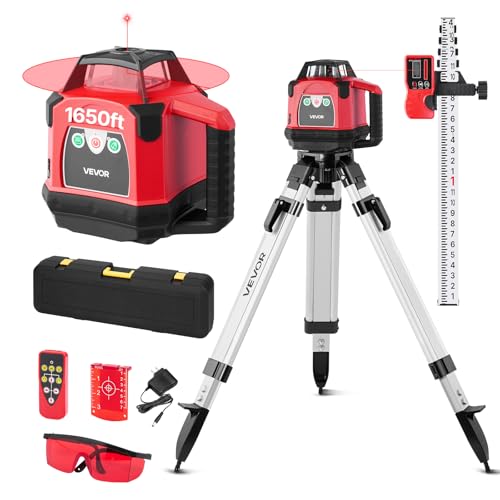
Seven rotary lasers compared by working range, self-leveling accuracy, weatherproof rating and kit contents, with a named winner and the conditions that flip it.

By Taylor DavidsonUpdated 17 min read
On this page
- Best rotary laser level at a glance
- How I screened the field down to seven
- The specification that actually decides this
- 1. VEVOR Rotary Laser Level Kit — Best overall
- 2. Klein Tools 93RLS — Best premium
- 3. Topcon RL-H5A Self-Leveling Construction Laser w/LS-80 — Best lightweight
- 4. LotaTools Self-Leveling Rotary Laser — Best upgrade
- 5. Lipril 206HR Rotary Laser Level Kit — Best warranty
- 6. Johnson Level & Tool 40-6517 — Most versatile
- 7. VEVOR Rotary Laser Level 2000 ft — Best budget pick
- What the working-range numbers really mean
- How do IP54 and IP66 ratings differ on a jobsite?
- What does a full rotary laser kit need to include?
- Red beam or green beam: which should you buy?
- The verdict
- FAQ
The best rotary laser level for most jobsites is the VEVOR LRE205 kit, a red-beam self-leveling head that reaches 1650 ft with a receiver and holds ±0.06 in per 100 ft with an IP54 housing. If your work is indoor drywall, ceiling grid and layout, the Klein Tools 93RLS is the better call because its green Class 3R beam and integrated plumb spot cover horizontal, vertical and ceiling alignment in one head. Seven picks below, each tied to a specific job.
Best rotary laser level at a glance
| Pick | Working range | Accuracy | Price |
|---|---|---|---|
Best overall VEVOR LRE205 Kit |
1650 ft with receiver | 0.06 in / 100 ft claim | Check Price |
Best premium Klein Tools 93RLS |
1150 ft with detector | H, V and plumb spot | Check Price |
Best lightweight Topcon RL-H5A w/LS-80 |
2600 ft diameter claim | 1/16 in claim | Check Price |
Best upgrade LotaTools 2000 ft Kit |
2000 ft diameter claim | ±1/8 in at 100 ft claim | Check Price |
Best warranty Lipril 206HR Kit |
not published | ±1/16 in at 100 ft claim | Check Price |
Most versatile Johnson 40-6517 |
horizontal + vertical rotary | Class IIIa, ≤5 mW | Check Price |
Best budget pick VEVOR 203HG Green |
2000 ft claim | 360° cross line, green | Check Price |


How I screened the field down to seven
I started with the current listings in the rotary laser category and cut on three grounds. First, anything sold as a line laser without a rotating head came out, with one exception noted below. Second, kits that arrived without a receiver were dropped, because a rotary laser without a detector caps you at whatever your eye can see, which is a fraction of the published range. Third, listings without a stated working range or self-leveling behavior in the feature bullets were set aside, because a rotary laser is bought on those two numbers before anything else.
Klein's 93RLS sits in the line-laser branch of the category rather than the rotary branch, but it rotates 360 degrees on both axes and ships with a detector, so it earned a place in the set on capability rather than on the category tag. That is the one exception.
Seven picks made the cut. Two are entry-priced VEVOR kits, one red and one green. One is a mid-priced LotaTools bundle. Three sit in the premium band: Topcon, Klein and Lipril. Johnson's 40-6517 rounds out the entry tier with a stated three-year warranty, which none of the VEVORs publish.
The specification that actually decides this
Most rotary laser guides lead on working range. That is not what decides it. Accuracy at 100 ft is the number that matters, because working range is the distance at which the receiver still beeps, not the distance at which the beam is still true.
A laser that drifts ±1/8 in per 100 ft is fine for framing a garden shed and unusable for pouring a slab. A laser that holds ±1/16 in per 100 ft is a different tool. The VEVOR LRE205 publishes 0.06 in per 100 ft, which is roughly ±1/16 in. Topcon's RL-H5A publishes 1/16 in. Lipril's 206HR publishes ±1/16 in at 100 ft. LotaTools publishes ±1/8 in at 100 ft. Johnson and the two VEVOR kits' second sibling do not publish the number in the same form.
Working range still matters when you are laying out a foundation across a lot, but only once accuracy clears the bar for the work. Buy on accuracy first, then filter by range.
1. VEVOR Rotary Laser Level Kit — Best overall
A red-beam self-leveling rotary that pairs the tightest published accuracy in this set with a full jobsite kit at the second-cheapest position.
Best for: small crews doing foundations, footings and site leveling out to a quarter mile Skip it if: you need a green beam for indoor visibility
VEVOR lists the LRE205 at 0.06 in per 100 ft, which is the tightest published accuracy figure in this set alongside the Topcon and the Lipril. Working range is quoted at 1650 ft with the receiver. The head is red, self-leveling to ±5° with a manual mode, and the housing is rated IP54 against dust and splashes. Weight is 22.3 lb for the whole kit, which is heavy in the hand and normal for a rotary laser with the tripod, receiver and hard case in the box.
Two things separate this from the cheaper VEVOR sibling below. The published accuracy figure is stated in a form you can hold the tool to. And the remote works out to 65 ft, which is enough to bump the tilt from the far end of a footing without walking back.
The trade-off against the Klein and the Topcon is the beam color. Red is harder to see indoors on light drywall than green, and this kit has no vertical mode or plumb spot. Outdoors with the receiver, none of that matters.
Pros:
- Tightest published accuracy of the red-beam kits here
- 1650 ft range with the supplied receiver
- 8 to 12 hour rechargeable NiMH runtime claim
- Remote reaches 65 ft
- Standard 5/8 in mount fits common tripods
Cons:
- Red beam is hard to see indoors on light surfaces
- No vertical mode or plumb spot
- IP54 is the lowest weather rating in the set
- No published warranty
2. Klein Tools 93RLS — Best premium
The only pick here that rotates 360° on horizontal and vertical axes and adds a plumb spot, wrapped in a green Class 3R beam for indoor visibility.

Best for: interior finishers who need horizontal, vertical and plumb in one head Skip it if: your work is outdoor grading at long range
Klein publishes 1150 ft of range with the included detector, which is shorter than the two VEVORs and the LotaTools. Everything else is the reason it sits in the premium slot. The green Class 3R diode is easier to see indoors than any red beam here. The head throws horizontal and vertical planes and adds a plumb spot for ceiling grid, so one tool handles slab, wall and ceiling layout. Klein lists 24 hours of continuous runtime on the rechargeable pack, which is the longest in the set outside Topcon's alkaline claim. Impact sensing pauses the head if the tripod is bumped.
The whole kit weighs 4.36 lb on Amazon's listing. That is the lightest published body weight here by a wide margin, though the shipped carton is 8.75 x 32 x 16 in with the tripod and grade rod inside.
The trade-off against the winner is range and price position. Klein is the most expensive pick in this set, and it gives up around 500 ft of receiver range against the LRE205. For interior work that gap does not matter. For a large lot, it does.
Pros:
- Green Class 3R beam for indoor visibility
- Horizontal, vertical and plumb spot in one head
- 24 hour rechargeable runtime claim
- Impact sensing pauses the head if bumped
- Includes detector, tripod and 9 ft grade rod
Cons:
- Shortest published receiver range in the premium tier
- Highest price position of the seven
- Warranty listed only as "call vendor"
- Sits in the line-laser branch of the category
3. Topcon RL-H5A Self-Leveling Construction Laser w/LS-80 — Best lightweight
A Japanese-built grading laser with the longest working-diameter claim in the set and an IP66 rating that shrugs off a downpour.

Best for: excavators and graders working long shifts on open sites Skip it if: you want a green beam or a vertical mode
Topcon quotes a 2600 ft (800 m) diameter working envelope with the LS-80 receiver and an accuracy of 1/16 in. That is the longest range claim in this comparison. The listed weight on Amazon is 2.4 oz, which is a listing weight for one part rather than the whole kit, so treat it as a data point rather than the shipped mass. The kit includes the RL-H5A head, the LS-80 receiver, a sensor holder, a hard case and an EDEN field book. Runtime is quoted at up to 100 hours, which is an alkaline number rather than a rechargeable pack claim.
IP66 is the top weather rating in this set, alongside the LotaTools, the Lipril and the second VEVOR. The listing describes the housing as built to take dust, a sudden shower and torrential rainfall.
The trade-off against the winner is what it does not do. This is a horizontal-only grading laser with a red-adjacent yellow-cased body. No vertical mode, no plumb, no green beam. If your day is dirt and concrete, that is the right specialization. If your day is drywall, it is the wrong tool.
Pros:
- Longest working-diameter claim here at 2600 ft
- 1/16 in accuracy claim
- IP66 housing for outdoor abuse
- Up to 100 hour runtime claim
- Includes LS-80 receiver and hard case
Cons:
- Highest price band, alongside Klein and Lipril
- Horizontal only, no vertical or plumb
- Listed weight is for one component, not the kit
- No published warranty term
4. LotaTools Self-Leveling Rotary Laser — Best upgrade
A mid-priced red-beam kit with the second-longest range claim in the set and the most complete accessory bundle out of the box.

Best for: landscapers who want a full kit with grade rod and glasses in one box Skip it if: you need tighter than eighth-inch accuracy at 100 ft
LotaTools publishes ±1/8 in at 100 ft and a 2000 ft working range with the included receiver. The listing describes ±5° self-leveling and IP66 protection. The kit count is 10, and the bullets describe a bundle that pairs the rotary head with a receiver and clamp, remote control, target plate, laser glasses, an aluminum tripod and a grade rod. That is the fullest accessory list of any pick here.
Sitting in the middle price band, this is the kit that fills the gap between the entry VEVORs and the premium Topcon and Klein. You get a longer range claim than either VEVOR and the same IP66 body as Topcon, without paying the Topcon or Klein price.
The trade-off is accuracy. ±1/8 in at 100 ft is fine for grading a drive, laying out a fence line or leveling landscape terraces. It is loose for finish concrete or interior layout where the tighter ±1/16 in class holds the tolerance. Also, several listing fields are thin: no published weight, no published warranty, and the model is listed simply as "RL."
Pros:
- 2000 ft range claim with receiver
- IP66 housing
- Ten-piece kit with grade rod and glasses
- Mid price band rather than premium
- Remote control included
Cons:
- Eighth-inch accuracy is looser than the ±1/16 in class
- No published weight or warranty
- Model field listed only as "RL"
- Red beam, harder to see indoors
5. Lipril 206HR Rotary Laser Level Kit — Best warranty
A premium-priced kit with a stated three-year warranty, tight published accuracy and a user-replaceable battery pack.
Best for: owner-operators who want a three-year backstop and a replaceable battery Skip it if: you need a published working range before you buy
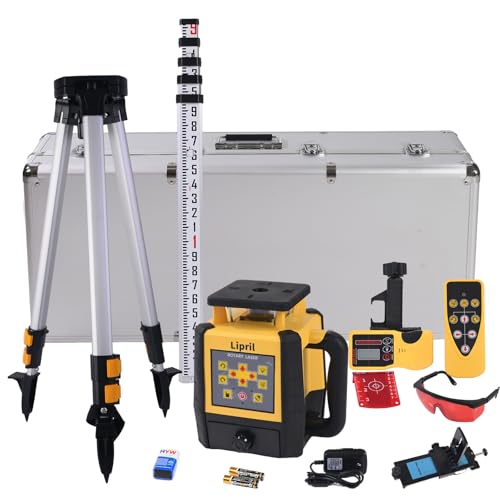
Lipril lists ±1/16 in at 100 ft, which puts this in the tight-accuracy tier alongside the Topcon and the VEVOR LRE205. The housing is IP66. The battery is a 4000 mAh Ni-MH pack that the user can remove and swap, with a stated 12 hours of continuous use per charge. The listing describes an 11-piece kit in a hard case, with the rotary head, receiver and an RF remote among the components.
Two things stand out. The published three-year warranty is the only clear multi-year term in this set, matching Johnson's three years. And field-replaceable batteries are unusual at this price. Most rotary lasers in this comparison use an internal pack you cannot swap on site.
The trade-off is that the listing does not publish a working range in feet the way the other kits do. You can infer capability from the accuracy figure and the IP66 rating, but a buyer who needs to confirm range against a specific site distance has less to work with. The price position is also premium, alongside Klein and Topcon.
Pros:
- Three-year stated warranty
- ±1/16 in at 100 ft accuracy claim
- IP66 housing
- User-replaceable 4000 mAh Ni-MH battery
- 11-piece hard-case kit
Cons:
- Working range not published in feet
- Premium price band
- Weight not listed
- Newer listing with limited spec disclosure
6. Johnson Level & Tool 40-6517 — Most versatile
The only pick here that publishes both horizontal and vertical rotary modes at entry-tier pricing, with a stated three-year warranty.

Best for: shops that switch between horizontal slab work and vertical layout Skip it if: you want a green beam or a modern rechargeable pack
Johnson lists the 40-6517 as a horizontal and vertical rotary laser, Class IIIa with a maximum power output of ≤5 mW. That dual-axis capability is the reason it sits here rather than as a straight budget alternative. Klein does horizontal, vertical and plumb too, but at the top of the price ladder. Johnson does horizontal and vertical at the entry price band.
The published warranty is three years against defects in materials and workmanship, with repair or replacement at the company's option. That matches Lipril and beats every other pick in the set, all of which either publish no warranty or list only a "call vendor" note. Weight is 19 lb for the kit, which is lighter than the VEVOR LRE205 by about three pounds.
The trade-off is disclosure. The feature bullets on this listing are thin. Working range and accuracy in feet or inches are not published in the same form as the other kits, and there is no rechargeable-battery claim. If you need those numbers before you commit, one of the VEVOR kits or the LotaTools gives you more to work with. For a shop that already knows what a rotary laser does and wants dual-axis coverage with a real warranty, the case is straightforward.
Pros:
- Horizontal and vertical rotary in one head
- Three-year stated warranty
- Entry price band despite dual-axis
- Lighter than the VEVOR LRE205
- Established brand in the category
Cons:
- Working range not published in the listing
- Accuracy not stated in inches per 100 ft
- Red beam, harder to see indoors
- Feature bullets are sparse
7. VEVOR Rotary Laser Level 2000 ft — Best budget pick
The cheapest of the seven, and the only green-beam entry-tier option, aimed at indoor remodels where visibility beats jobsite hardness.

Best for: DIY remodels and light framing where the laser lives indoors Skip it if: you need self-leveling on a full 360-degree rotating head
This is the cheapest pick here and the only entry-tier green-beam kit. VEVOR quotes a 2000 ft working range and describes the tool as a 360° cross-line rotary with self-leveling. The housing is IP66, which matches Topcon and beats the LRE205's IP54. Weight is 9.48 lb, less than half of the LRE205 kit. A remote is included.
The green beam is the reason to pick this over the LRE205 if your work is indoors. On light drywall in daylight, a green line reads several times brighter than red at the same power. That advantage disappears outside, where a receiver is doing the work anyway.
The trade-off is what the listing does not say. The accuracy figure is not published in the same ±X in per 100 ft form the LRE205, Topcon and Lipril use, so you cannot line it up on the same scale. And "cross line" rotary is a different beast from a continuous rotating plane at high rpm: fine for indoor layout, less useful for long-run outdoor grading with a receiver. Treat this as an indoor budget tool, not a shrunken outdoor laser.
Pros:
- Cheapest of the seven
- Green beam for indoor visibility
- IP66 housing
- 9.48 lb, light for a rotary kit
- Remote included
Cons:
- Accuracy figure not published in inches per 100 ft
- Cross-line style, not a high-rpm continuous plane
- No published warranty
- Slowest seller of the seven
What the working-range numbers really mean
Every rotary laser in this comparison quotes a working range in feet, and every one of those numbers assumes you are using the receiver. The beam does not stay visible to the naked eye anywhere near that far. In bright sun, the useful eyeball range on a red rotary laser is often under 50 ft. On a green rotary laser it is a bit further, still nowhere near four figures.
The receiver is what unlocks the published range. It clamps to a grade rod, listens for the sweep of the beam, and beeps when it crosses the plane. That is why the four kits with the longest range claims all include a receiver in the box.
Two practical notes. First, a receiver's usable range is capped by its own sensitivity, not by the head. Pairing a strong head with a weak detector wastes the head. Second, the range figure is a diameter in some listings and a radius in others. Topcon states 2600 ft diameter, which is 1300 ft in each direction from the tripod. VEVOR states 1650 ft as a working distance. Read the phrasing before you compare.
How do IP54 and IP66 ratings differ on a jobsite?
How do IP54 and IP66 ratings differ in practice? The first digit is dust, the second is water. IP54 means dust-protected and splash-resistant. IP66 means dust-tight and rated against powerful water jets. On a jobsite, IP54 survives a light shower and a dusty ride in a truck. IP66 survives being left out in a hard rain and hosed off. Five of the seven picks here publish IP66. The LRE205 is IP54.
What does a full rotary laser kit need to include?
A rotary laser is only as useful as what ships with it. The kits worth buying include, at minimum:
- The rotating head itself, with self-leveling to at least ±5°.
- A laser receiver, with a clamp for a grade rod.
- A tripod with a 5/8 in mount, which is the standard thread the heads here use.
- A grade rod, for setting the receiver against.
- A remote, so you are not walking back to the tripod to tilt an axis.
- A hard case, because a rotary laser in a soft bag will not survive a summer of tailgate rides.
The LotaTools and Lipril bundles ship the most complete kits. Klein adds a 9 ft grade rod. Johnson's 40-6517 and the VEVOR LRE205 include the head, receiver and case. Topcon adds the LS-80 receiver and a field book. Confirm the tripod is in the specific listing you land on: some retailers strip it out at lower prices.
Red beam or green beam: which should you buy?
- Red beam. The default for outdoor work with a receiver. Cheaper diode, longer battery life, and the receiver does not care about beam color anyway. Five of the seven picks here use red.
- Green beam. Roughly four times more visible to the human eye than red at the same power. Buy green if your work is indoors, if the room is bright, or if you rely on seeing the line rather than hearing the receiver. Two picks here run green: the Klein 93RLS and the VEVOR 203HG.
The trap is buying green for outdoor grading. Green diodes drain the battery faster, and in bright sun you cannot see either color at range: the receiver is doing the work in both cases.
The verdict
The VEVOR LRE205 is the best rotary laser level for the widest slice of buyers. It publishes the tightest accuracy figure in the red-beam field at 0.06 in per 100 ft, reaches 1650 ft with the included receiver, and sits at the second-cheapest position of the seven. For foundations, footings, deck posts and site leveling out to a quarter mile, that combination is hard to beat.
Two conditions flip the pick. If your work lives indoors on drywall, ceiling grid and layout, the Klein 93RLS is the answer. Its green Class 3R beam is easier to see than any red option here, and the plumb spot plus vertical mode do the ceiling work the LRE205 cannot. If your work is grading dirt and concrete on open sites, the Topcon RL-H5A earns the premium. Its 2600 ft diameter claim is the longest here, and IP66 shrugs off weather that would stop the LRE205.
For a middle path with the fullest accessory bundle, LotaTools is the upgrade over the VEVOR at a mid-tier price. For a three-year warranty and a replaceable battery, Lipril's 206HR. For dual-axis coverage on an entry budget, Johnson's 40-6517. For an indoor remodel on a tight budget, the green VEVOR 203HG.
FAQ
What accuracy do I actually need in a rotary laser level?
What accuracy you actually need depends on the work. For deck posts, fence lines, landscape grading and rough framing, ±1/8 in at 100 ft is fine, which is what the LotaTools kit publishes. For concrete slabs, tile substrates, drop ceilings and interior finish layout, ±1/16 in at 100 ft is the target. The VEVOR LRE205, Topcon RL-H5A and Lipril 206HR all publish figures in that tighter class.
Is a rotary laser level worth it over a line laser?
Is a rotary laser worth the extra spend? Yes, if you work outdoors or across long spans. A rotary head throws a continuous 360° plane a receiver can catch at 1000 ft or more, which no line laser matches. If your work is one room at a time and you only need visible lines on the wall, a good line laser is enough. Once the job goes outside or across a lot, a rotary earns back its price fast.
How does the VEVOR LRE205 compare to the Topcon RL-H5A?
How does the LRE205 compare to the RL-H5A? Both are horizontal red-beam rotary lasers built for outdoor work. The LRE205 publishes 1650 ft with its receiver and 0.06 in per 100 ft accuracy at an entry price. The RL-H5A publishes a 2600 ft diameter with its LS-80 receiver, 1/16 in accuracy and IP66. Buy the VEVOR to save budget on smaller sites. Buy the Topcon if you need the longer range and the tougher housing.
Do I need a green beam for indoor work?
Do I need a green beam for indoor work? Yes, in most cases. Green rotary laser lines read several times brighter than red at the same power because the human eye is more sensitive to green wavelengths. On drywall in daylight, a red line can disappear and a green line stays visible. Two picks here run green: the Klein 93RLS at the premium end, and the VEVOR 203HG at the budget end.
What is the biggest mistake buyers make with rotary lasers?
The biggest mistake buyers make is chasing the range figure and ignoring accuracy. A laser rated at 2000 ft with the receiver but ±1/8 in per 100 ft is fine for grading and wrong for concrete. A laser at 1150 ft with ±1/16 in is the opposite trade. Match the accuracy class to the work first, then filter by range. Also, confirm the receiver, tripod and grade rod are in the listing you are buying, not stripped for a cheaper price.
Pick the beam color for where the laser will live, then buy on accuracy class, then filter on range. For most buyers, that route leads straight to the VEVOR LRE205: a red-beam self-leveling head with the tightest published accuracy of the entry tier, a 1650 ft range with its receiver, and the full outdoor kit in the case. Set it on a tripod, walk out with the receiver on a grade rod, and you have every stake and footing on the same plane in an hour. The green Klein and the long-range Topcon are the two conditions that flip the recommendation, and the other four picks each earn a specific job you now know how to name.