Best Small Portable Power Station for Biking by Weight

Seven small power stations compared on the numbers that matter when you're carrying one on a bike: weight, published dimensions, capacity and how fast each one refills at a cafe stop.

By Taylor DavidsonUpdated 17 min read
On this page
- Best small portable power station for biking at a glance
- Why three picks were cut before I started ranking
- Does a power station belong on a bike at all?
- What actually decides it: watt-hours per pound
- 1. VTOMAN FlashSpeed 300 Portable Power Station — Best overall
- 2. powkey 200W Portable Power Station — Runner-up
- 3. HOWEASY Portable Power Station — Best budget pick
- 4. Daran Portable Power Station 89.6Wh — Best for beginners
- 5. ZeroKor Portable Power Station 300W — Best for heavy use
- 6. EnginStar Portable Power Station 300W — Most versatile
- 7. ALLWEI Portable Power Station 300W — Best for families
- How does each pick refill at a cafe stop?
- What more money buys across this set
- The verdict
- FAQ
The best small portable power station for biking is the VTOMAN FlashSpeed 300, because 230Wh and a 100W USB-C input give you two nights of phone, light and GPS charging from a 7 lb box you can refill over lunch. If you're weight-obsessed, the HOWEASY H120 at 2.3 lb is the better call. Where you land depends almost entirely on how many watt-hours you're willing to carry, and this set spans 89.6Wh to 296Wh.
Best small portable power station for biking at a glance
| Pick | Capacity | Weight | Price |
|---|---|---|---|
Best overall VTOMAN FlashSpeed 300 |
230Wh, 300W out | 7 lb | Check Price |
Runner-up powkey 200W Portable Power Station |
192Wh, 200W out | 4.7 lb | Check Price |
Best budget pick HOWEASY Portable Power Station |
88Wh, 120W out | 2.3 lb | Check Price |
Best for beginners Daran Portable Power Station |
89.6Wh, 100W out | 2.54 lb | Check Price |
Best for heavy use ZeroKor Portable Power Station 300W |
280Wh, 300W out | 5.08 lb | Check Price |
Most versatile EnginStar Portable Power Station 300W |
296Wh, 300W out | 6 lb claim | Check Price |
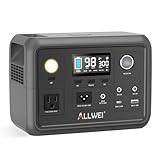
Best for families ALLWEI Portable Power Station 300W |
256Wh, 300W out | 6.4 lb | Check Price |


Why three picks were cut before I started ranking
I started with a much longer list of small generators in the same category and cut on three grounds.
- No published dimensions. If a listing doesn't state how big the box is, you can't tell whether it fits a pannier. Every pick here gives measurements, and the tightest is the HOWEASY at 4 x 6.6 x 3 in.
- Over 8 lb. Once a unit passes that, it's a car item. The heaviest survivor is the VTOMAN FlashSpeed 300 at 7 lb.
- No stated warranty. Six of the seven publish a term, from the powkey's one-year cover to two years on both the ALLWEI and the HOWEASY. Only the VTOMAN lists nothing more specific than "Manufacturer Warranty", which is the one place the winner gives ground.
What survived is a spread rather than a cluster. Capacity runs from 88Wh to 296Wh, weight from 2.3 lb to 7 lb, and output from 120W to 300W. That spread is the useful part, because the right small portable power station for biking is entirely a function of how far you're going and what you're carrying it in. Two picks are pocketable. Three are pannier items. None of them is a backpack afterthought.
Does a power station belong on a bike at all?
Be honest about this before you spend anything. None of these seven listings is designed, marketed or specified for cycling. They're camping and emergency units. Not one publishes a mounting system, a waterproof rating, or a vibration spec, so any claim that a given model is "made for bikes" would be invention.
What the data does tell you is which ones are physically plausible to carry.
- Under 3 lb and pocket-sized: the HOWEASY H120 at 2.3 lb and 4 x 6.6 x 3 in, and the Daran at 2.54 lb and 4 x 3.3 x 6.5 in. Both fit a frame bag or a jersey pocket at a stretch.
- Around 5 lb: the powkey at 4.7 lb in a 5 x 7 x 5 in cube, and the ZeroKor at 5.08 lb. Pannier or handlebar-bag territory.
- Above 6 lb: the ALLWEI at 6.4 lb and the VTOMAN at 7 lb. Rack or trailer only.
Two practical points the listings don't cover. Mass on a bike wants to sit low and central, so a rear pannier beats a backpack every time for a 7 lb block. And none of these has a stated ingress rating, which means a dry bag is not optional if you ride in weather. Treat that as your own judgment call, not a promise from any of these products.
What actually decides it: watt-hours per pound
Most guides to the best small portable power station for biking compare AC wattage. That's the wrong number. Output wattage tells you what you can plug in; it says nothing about how long it runs. Four of these seven claim 300W output, which makes the figure almost useless for separating them.
Watt-hours per pound is the number that matters when you're the engine.
- ZeroKor: 280Wh at 5.08 lb, roughly 55Wh per pound. Best ratio in the set.
- powkey: 192Wh at 4.7 lb, about 41Wh per pound.
- ALLWEI: 256Wh at 6.4 lb, about 40Wh per pound.
- HOWEASY: 88Wh at 2.3 lb, about 38Wh per pound.
- Daran: 89.6Wh at 2.54 lb, about 35Wh per pound.
- VTOMAN: 230Wh at 7 lb, about 33Wh per pound.
The EnginStar can't be placed here. Its listing gives dimensions of 7 x 9.1 x 5 in but no weight in the specifications, so the ratio isn't calculable from published data.
Notice that the winner has the worst ratio in the group. That's deliberate. Above a certain point, refill speed beats density, and a 100W USB-C input changes what a rest stop is worth. Ratio decides which unit to carry. Input speed decides whether you ever run out.
1. VTOMAN FlashSpeed 300 Portable Power Station — Best overall
The 100W USB-C input is what wins it: this is the only pick here that refills fast enough to make a lunch stop count as a real charge.
Best for: multi-day trips where 230Wh and a 100W USB-C input matter more than a couple of pounds Skip it if: you're counting every ounce on a road bike
At 7 lb this is the heaviest thing here, and it still takes the top spot. The reason is input, not output. VTOMAN says the 100W Power Delivery input brings it to 80% in about two hours, and the listing describes four recharging methods. Nothing else in this set claims a 100W input. That single figure reframes the trip: instead of budgeting 230Wh for three days, you top up wherever there's a socket.
Capacity is 230Wh with 300W of output, and VTOMAN lists seven outlets: two AC, one 100W USB-C, three USB-A and one DC. Seven ports is the joint highest count here alongside the Daran. The body measures 7.87 x 10.2 x 4.72 in, which is a pannier or a rack load rather than a frame bag. There's a three-mode LED with steady, strobe and SOS.
The trade-off is blunt. You're carrying 2.3 lb more than the ZeroKor for 50Wh less capacity, and the warranty entry says only "Manufacturer Warranty" where two rivals publish two years. Buy it for the refill speed or don't buy it.
Pros:
- 100W USB-C input, the fastest claimed here
- VTOMAN claims 80% in about two hours
- Seven output ports, joint most in this set
- 230Wh with 300W output and two AC sockets
- Three-mode LED including strobe and SOS
Cons:
- Heaviest pick at 7 lb
- Worst capacity-to-weight ratio of the six with published weights
- Warranty term not stated on the listing
- Largest footprint at 7.87 x 10.2 x 4.72 in
2. powkey 200W Portable Power Station — Runner-up
192Wh in a 5 x 7 x 5 in cube at 4.7 lb is the tidiest balance of capacity and carry weight in the group.

Best for: riders who want a real AC outlet at 4.7 lb Skip it if: you need USB-C charging faster than 9V 2A
This is the pick I'd hand to someone who wants an AC outlet without a rack-mounted brick. It's 4.7 lb, and the near-cube 5 x 7 x 5 in shape packs into a pannier corner better than the flatter, wider bodies here. powkey lists a foldable handle, which matters more than it sounds when you're strapping something to a bike.
The port list is six: one 120V 200W AC outlet, two USB-A rated 5V 3.1A total, one USB-C at 5V 3A or 9V 2A, and two 12V 10A DC outputs. Those twin DC outputs are worth noting for anyone running 12V lights or a compressor. Recharging works three ways per the listing, from wall, car or a solar panel that isn't included. There's a dual-white-light LED that doubles as a lantern.
Two limits. The USB-C tops out at 9V 2A, so laptop charging is off the table, and 200W output is the second-lowest here. It also sells faster than most of this set, which tells you buyers keep landing on the same balance point I did.
Pros:
- 192Wh at only 4.7 lb
- Compact 5 x 7 x 5 in cube shape
- Two 12V 10A DC outputs for lights and pumps
- Foldable handle per the listing
- One-year warranty stated
Cons:
- USB-C limited to 9V 2A, no laptop charging
- 200W output, second-lowest in the set
- Only one AC socket
- Solar panel not included
3. HOWEASY Portable Power Station — Best budget pick
At 2.3 lb and 4 x 6.6 x 3 in, this is the only pick light enough that you'll actually bring it on a day ride.

Best for: overnighters where 2.3 lb and eight ports beat raw capacity Skip it if: you need to run anything above 120W
The lightest and cheapest pick here, and for a lot of riders that combination ends the argument. 2.3 lb is roughly a third of the VTOMAN. The 4 x 6.6 x 3 in body genuinely fits a handlebar bag, and it's the smallest footprint in the group by volume.
Port count is the surprise: HOWEASY lists eight. Two AC sockets at 110V 120W with a 240W peak, one 18W USB-C, two QC 3.0 USB ports and more USB-A. Two AC outlets on a sub-3 lb unit is unusual. Capacity is 88Wh, the second-smallest here, and three recharging modes are listed. The LED has steady, flash and SOS modes.
The maths is what to watch. 88Wh is a handful of phone charges plus a light, not a laptop weekend. 120W of continuous output rules out most kettles, fans and camera chargers with a real draw. Two sellers list it, the only pick here besides the EnginStar with more than one. The two-year warranty is the joint longest in the set, which is a genuinely odd thing to find on the cheapest pick.
Pros:
- Lightest here at 2.3 lb
- Smallest footprint at 4 x 6.6 x 3 in
- Eight output ports, most in this set
- Two-year warranty, joint longest
- Cheapest of the seven
Cons:
- 88Wh, second-smallest capacity
- 120W continuous output limits what you can plug in
- USB-C capped at 18W
- No lithium iron phosphate claim on the listing
4. Daran Portable Power Station 89.6Wh — Best for beginners
Seven ports on a 2.54 lb body the size of a phone, with a 1.5-hour claimed refill: the easiest first buy here.

Best for: first-time buyers who want a phone-sized unit with AC outlets Skip it if: 89.6Wh won't cover your second day
Daran describes this as about the size of a smartphone at 6.5 x 3.3 x 4 in, and the specifications give 4 x 3.3 x 6.5 in and 2.54 lb. Either way, it's the narrowest body here, which is the shape that slides into a frame bag rather than fighting it. There's an ergonomic soft handle.
Where it earns "best for beginners" is the spec sheet clarity. 89.6Wh of lithium iron phosphate, explicitly not NCM per the listing, with a claimed 3,500-plus life cycles. Seven output ports including two 100W AC sockets and two USB-C. Daran claims 0 to 80% in 1.5 hours, the fastest stated refill in the group. Operation is described as fanless and silent, with a four-level LED flashlight carrying steady and SOS modes.
The ceiling is low. 89.6Wh is the smallest capacity here, and 100W output is the lowest too, so this covers phones, lights, a GPS head unit and a camera battery. Not a laptop weekend, not a 12V fridge. It's also the fastest-selling pick in this set, which suggests plenty of buyers want exactly that ceiling and nothing more.
Pros:
- 2.54 lb in the narrowest body here
- Seven ports including two USB-C
- Claimed 0 to 80% in 1.5 hours
- LiFePO4 cells with 3,500-plus cycles claimed
- Fanless, silent operation per the listing
Cons:
- Smallest capacity at 89.6Wh
- Lowest output at 100W continuous
- One-year warranty, shorter than two rivals here
- Only one seller lists it
5. ZeroKor Portable Power Station 300W — Best for heavy use
280Wh at 5.08 lb is the best capacity-to-weight ratio in this set, at roughly 55Wh per pound.

Best for: riders with a lot of USB devices and a rack to carry 5.08 lb Skip it if: you want lithium iron phosphate cells confirmed on the listing
Run the numbers and this is the efficiency winner. 280Wh for 5.08 lb beats every other pick with a published weight, and it does it while matching the 300W output of units two pounds heavier. If you're carrying capacity per gram, start here.
The port list leans USB-heavy: two AC outlets at 300W max, one DC rated 9V to 12.6V at 10A, three 5V 3A USB ports and one QC USB doing 5V 3A or 9V 2A. That's four USB sockets, useful when three people want phones charged at once. Three recharging routes are listed, including DC5521 solar panels between 13V and 23V, with a built-in controller. ZeroKor lists a BMS covering short circuit, over-current, over-voltage and overload protection, plus a 12-month warranty. The body is 4.1 x 8.5 x 6.7 in.
Two gaps. The listing doesn't state a battery chemistry, so unlike the Daran, ALLWEI and VTOMAN you can't confirm LiFePO4 cells. And the fastest USB port here is a QC socket, not high-wattage USB-C, so the refill and laptop story is weaker than the VTOMAN's.
Pros:
- Best ratio here, 280Wh at 5.08 lb
- Four USB sockets including one QC port
- 300W output from a 5 lb body
- Solar input controller built in per the listing
- 12-month warranty stated
Cons:
- Battery chemistry not stated on the listing
- No high-wattage USB-C port
- Bulkier at 8.5 in wide than the powkey cube
- Solar panel not included
6. EnginStar Portable Power Station 300W — Most versatile
296Wh is the largest capacity here, with two pure sine wave AC outlets and ETL certification on the listing.

Best for: mixed bike-and-car trips needing two pure sine wave outlets Skip it if: you need a published weight before you commit
296Wh tops the group, edging the ALLWEI's 256Wh and the ZeroKor's 280Wh. That's why it takes "most versatile": more stored energy covers more device types before you need a socket. EnginStar specifies two 110V pure sine wave AC outlets, which the listing links to quieter, more stable operation for sensitive electronics. Only this and the ALLWEI describe pure sine wave output.
The listing also carries ETL certification and a battery management system with voltage and temperature control. Three charging routes are described, including any compatible 12V to 25V solar panel with a built-in controller to speed up the recharge. The box includes a home charger, a car charger cable and a manual. Dimensions are 7 x 9.1 x 5 in, and the model is the R300.
Here's the problem, and it's specific to the use case in this guide. The specifications carry no weight figure. The feature text starts to say "weights only 6." and stops mid-number, so the only honest position is that the weight isn't published. For a car camping buy, shrug. For a bike, weight is the deciding number and you shouldn't have to guess it. The 12-month warranty is also shorter than the ALLWEI's two years despite a similar price position.
Pros:
- Largest capacity here at 296Wh
- Two pure sine wave 110V AC outlets
- ETL certification stated on the listing
- Home and car charger cables included
- Solar input accepts 12V to 25V panels
Cons:
- No weight published in the specifications
- 12-month warranty against two years on cheaper picks
- 7 x 9.1 x 5 in body needs a pannier or rack
- Port count not fully detailed on the listing
7. ALLWEI Portable Power Station 300W — Best for families
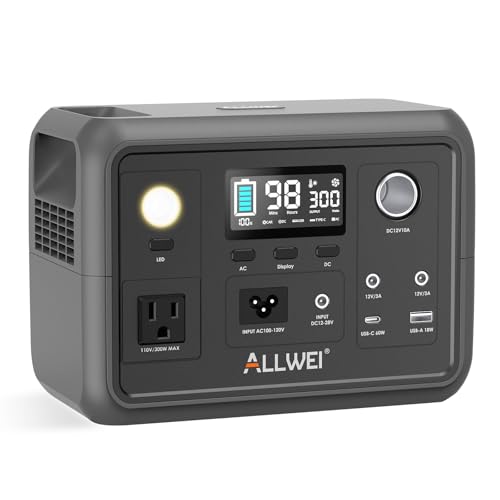
A 60W USB-C port, 256Wh of LiFePO4 and a 2-year warranty make this the pick for shared use at camp.
Best for: shared use at camp with a 2-year warranty and 60W USB-C Skip it if: you only have one AC device and want the lightest option
This is the group-trip unit. 256Wh with 300W continuous and a claimed 600W peak surge on pure sine wave, from a 6.4 lb body measuring 7.8 x 9 x 4.7 in. ALLWEI states LiFePO4 cells with 3,000 charge-discharge cycles and describes that as ten-year performance. The two-year warranty is joint longest here with the HOWEASY.
The port mix is what suits a group rather than a solo rider: one AC outlet, two DC5521 ports, a car cigarette lighter socket, an 18W USB-A fast charge port and a 60W USB-C PD port. That 60W USB-C is second only to the VTOMAN's 100W and is enough for most laptops. The car socket is the only one of its kind in this set, which matters if you're running a 12V pump or cooler at camp. ALLWEI lists AC wall charging at 3.5 to 4 hours full, plus 12V car charging and solar as a third route.
Its weakness is the single AC outlet. Five other picks here give you two. At 6.4 lb it's also the second-heaviest, and you're carrying that for 24Wh less than the ZeroKor's 280Wh in a 5.08 lb body. Fine on a rack, awkward anywhere else.
Pros:
- 60W USB-C PD, second-fastest here
- Two-year warranty, joint longest
- Car cigarette lighter socket, unique in this set
- LiFePO4 with 3,000 cycles claimed
- Pure sine wave with 600W peak claimed
Cons:
- Only one AC outlet, fewest here
- Second-heaviest at 6.4 lb
- Less capacity than the lighter ZeroKor
- Solar panel sold separately
How does each pick refill at a cafe stop?
This is the question that separates a usable small portable power station for biking from dead weight on day three. A 90-minute stop is realistic. What can you get back?
- VTOMAN FlashSpeed 300: 100W USB-C input, with 80% claimed in about two hours. The clear leader.
- Daran: 0 to 80% in 1.5 hours claimed, the fastest stated figure in the set, though from a smaller 89.6Wh tank.
- ALLWEI: 3.5 to 4 hours to full from a wall socket per the listing. One long stop won't do it.
- powkey, ZeroKor, EnginStar, HOWEASY: three charging routes each, with no refill time published.
Two things follow. First, capacity and refill speed are substitutes: the Daran's 89.6Wh matters less when it refills in 90 minutes. Second, a fast input only helps if you'll find sockets, so a remote bikepacking route inverts the logic and pushes you toward the ZeroKor's 280Wh.
Every pick here supports solar, and no pick here includes a panel. Budget for one separately if you're going off-grid, and check the input voltage window first: the ZeroKor wants 13V to 23V, the EnginStar accepts 12V to 25V.
What more money buys across this set
The spread here is instructive, because the cheapest pick isn't the worst and the priciest isn't the biggest.
At the entry end, the HOWEASY, Daran and powkey. What you get is low weight, 88Wh to 192Wh, and outputs of 120W, 100W and 200W. What you give up is capacity headroom. Notably you do not give up warranty: the HOWEASY publishes two years, matching the most expensive pick in this comparison.
In the middle, the ZeroKor. 280Wh, 300W, 5.08 lb, four USB sockets. This is where capacity per pound peaks, and it's the single most efficient pick in the set.
At the premium end, the EnginStar, ALLWEI and VTOMAN. Here the money buys specific capability rather than raw size. The VTOMAN buys the 100W input and seven ports. The ALLWEI buys 60W USB-C, a car socket and two years of cover. The EnginStar buys 296Wh and ETL certification.
The pattern worth acting on: paying more in this group buys faster charging, better port quality and stated certifications, not more watt-hours per pound. If capacity per pound is your metric, you'll find the sweet spot in the middle.
The verdict
If you're doing multi-day rides with occasional access to sockets, the VTOMAN FlashSpeed 300 is the buy. The 100W USB-C input and the claimed two-hour path to 80% mean 230Wh behaves like far more, and seven ports cover a whole group. You pay for that with 7 lb and the worst capacity-to-weight ratio here, so it wants a rack or a rear pannier.
If you're riding remote with no reliable sockets, take the ZeroKor Portable Power Station 300W instead. 280Wh at 5.08 lb is roughly 55Wh per pound, the best in this set, and four USB sockets plus a solar controller cover a long weekend without mains. Its exact advantage over the winner is simple: more stored energy in a lighter, smaller box.
The cutoff is socket access. Access to mains every day or two, buy the VTOMAN. Three days or more off-grid, buy the ZeroKor.
Two other lines are worth knowing. Under 3 lb, the HOWEASY H120 is the only pick that disappears into a handlebar bag, and eight ports plus two years of warranty at the lowest price is a strong package if 88Wh is enough. And if you want a laptop charged without carrying the VTOMAN, the ALLWEI's 60W USB-C does it at 6.4 lb.
FAQ
Is a small portable power station for biking worth it?
A small portable power station for biking is worth it if you're out more than one night and running a GPS unit, lights, a phone and a camera. Below 88Wh you're better served by a plain USB power bank. Above that, the AC outlets and DC ports on these picks cover devices a power bank can't touch.
How much capacity do I need for a weekend ride?
Capacity you need for a weekend depends on device count more than trip length. Two phones, a head unit and a light for two nights sits comfortably inside the Daran's 89.6Wh or the HOWEASY's 88Wh. Add a laptop, a drone or a group of four, and you want the ZeroKor's 280Wh or the EnginStar's 296Wh instead.
VTOMAN FlashSpeed 300 or ZeroKor 300W: which should I carry?
VTOMAN FlashSpeed 300 or ZeroKor comes down to sockets. The VTOMAN has a 100W USB-C input and claims 80% in about two hours, so it suits routes with cafes and campsites. The ZeroKor gives 280Wh at 5.08 lb, nearly two pounds lighter, which wins when you won't see mains power for three days.
Do any of these come with a solar panel?
None of these come with a solar panel. All seven listings describe solar input, and all seven state or imply the panel is sold separately. Check the accepted voltage before buying: the ZeroKor specifies 13V to 23V through a DC5521 connector, and the EnginStar accepts any compatible 12V to 25V panel with its built-in controller.
What's the biggest mistake buyers make in this category?
The biggest mistake buyers make is shopping on output wattage. Four picks here claim 300W, so it separates nothing. Watt-hours decide runtime and weight decides whether you carry it. Compare 88Wh at 2.3 lb against 280Wh at 5.08 lb, then check the charging input speed, and the shortlist narrows fast.
Start by weighing your loaded pannier or frame bag before you order anything. That number, not the spec sheet, decides which half of this list you're shopping from. Under 3 lb of headroom points at the HOWEASY H120 or the Daran. Three to five pounds spare and the ZeroKor is the efficiency pick. A rear rack changes everything, and that's where the VTOMAN FlashSpeed 300 earns its top spot: the 100W USB-C input turns every coffee stop into a meaningful recharge, which is the difference between rationing power and forgetting about it.