Best Small Portable Power Station When Bag Space Is Tight
Six compact power stations lined up by published weight, watt-hours and port count, with a clear winner for anyone who has to carry it all day and honest reasons to size up instead.
The best small portable power station for teens is the Daran 89.6Wh LiFePO4 unit, because 2.54 lb with two AC sockets is the lightest way to get a wall plug into a backpack. If you need to run a laptop charger for two days rather than one evening, the Jackery Explorer 300 and its 292Wh pack is the better buy at 7.1 lb. Both are LiFePO4. The gap between them is almost entirely weight against watt-hours.
Think of this field in three tiers. The entry tier gets you a pocketable battery, a couple of low-wattage sockets and a flashlight. The middle tier roughly doubles the capacity and adds a car port. The top tier buys published cycle-life figures, longer warranties and enough headroom to forget you are on battery.
Best small portable power station for teens at a glance
| Pick | Capacity | Weight | Price |
|---|---|---|---|
| Best overall Daran Portable Power Station 89.6Wh |
89.6Wh 100W AC |
2.54 lb | Check Price |
| Best budget pick VRURC Portable Charger |
10000mAh claim USB only |
0.57 lb | Check Price |
| Best upgrade ZeroKor Portable Power Station 300W |
280Wh claim 300W max |
5.08 lb | Check Price |
| Best minimal setup powkey 200W Portable Power Station |
192Wh 200W AC |
4.7 lb | Check Price |
| Best for pros ALLWEI Portable Power Station 300W |
256Wh 300W AC |
6.4 lb | Check Price |
| Best premium Jackery Explorer 300 |
292Wh 2 AC outlets |
7.1 lb | Check Price |
How I screened this category down to six
I started from the published specifications and nothing else. Weight, dimensions, watt-hours, port count, battery chemistry, warranty. Those are the figures a shopper can actually compare across brands without trusting the marketing copy.
Three screens did most of the work:
- Under 8 lb. Anything heavier stops being a bag item. The heaviest pick here is 7.1 lb.
- A published capacity figure. Watt-hours or a milliamp-hour claim, stated in the listing.
- A stated warranty. All six publish one, which is rarer in this category than you'd expect.
What got cut: units with no capacity number anywhere in the listing, and anything whose stated dimensions put it past a laptop-sleeve footprint. I also cut duplicates of the same shell sold under different brands, keeping whichever listing published more specifications.
One thing worth naming. The word "teens" in this search does not map to any specification these listings publish. There is no age rating on a battery. So I treated it as a proxy for what a younger user's kit actually needs: light enough to carry, simple enough to use without a manual, and safe chemistry. That is a judgment call, not a spec match, and you should make it yourself.
How many watt-hours do you actually need?
Watt-hours is the number that decides this purchase, and it's the one most listings bury under a peak-wattage headline. The best small portable power station for teens is whichever one clears your real daily draw without a pound of margin you'll carry for nothing.
Here's the spread across these six:
- 89.6Wh (Daran) — phones, earbuds, a tablet, a handheld console for an evening.
- 192Wh (powkey) — the same list, plus one laptop top-up.
- 256Wh (ALLWEI) — a laptop through a full day of use.
- 280Wh claim (ZeroKor) — similar, with a car port added.
- 292Wh (Jackery) — a weekend if you're careful.
The VRURC sits outside this scale entirely. It publishes a 10000mAh claim, no AC outlet, and 0.57 lb. That's a phone battery with cables attached, not a power station.
Notice the jump. Going from 89.6Wh to 292Wh triples the capacity and multiplies the weight by nearly three. Most shoppers miss that the middle of that curve is where the value sits: the powkey doubles the Daran's watt-hours for 2.16 lb more.
1. Daran Portable Power Station 89.6Wh LiFePO4 Battery 100W — Best overall
The lightest way in this set to put a real AC socket in a backpack, at 2.54 lb.

Best for: carrying power all day in a backpack Skip it if: you need to run anything over 100W
Nothing else here comes close on weight-to-capability. At 2.54 lb and 4 x 3.3 x 6.5 in, the Daran is under half the weight of the next-lightest AC unit in this set, the powkey at 4.7 lb. Daran says the footprint is roughly smartphone-sized and puts a soft ergonomic handle on it.
The capacity is 89.6Wh in LiFePO4 chemistry, and Daran claims 3500-plus life cycles from it. That matters more than the raw watt-hours if this thing gets charged every single night for two years. The listing counts seven output ports, including two AC sockets rated at 100W and two USB-C. Daran also claims a 0 to 80% recharge in 1.5 hours and fanless, silent operation, plus a four-level LED flashlight with steady and SOS modes.
The trade-off is ceiling. 100W of AC and 200W peak runs a laptop charger and a monitor, not a hair dryer or a kettle. Against the ZeroKor and Jackery, you're giving up roughly two-thirds of the stored energy. You get it back every time you pick the bag up.
Pros:
- Lightest AC-equipped pick here at 2.54 lb
- LiFePO4 chemistry with a 3500-cycle claim
- Seven output ports including two USB-C
- Fanless operation, per the listing
- 1-year manufacturer warranty stated
Cons:
- 100W continuous limits it to small electronics
- Lowest capacity of the five AC picks at 89.6Wh
- Only one seller lists it
- Warranty is half the length of the Jackery and ALLWEI
2. VRURC Portable Charger — Best budget pick
At 0.57 lb with four cables built in, this is the one you carry every day rather than on trips.

Best for: phone-and-earbuds charging with no cables to lose Skip it if: you need an AC outlet
This is the cheapest of the six and the one buyers choose most often across this set. It's also the odd one out. There's no AC socket anywhere on it, so it isn't a power station in the same sense as the other five. It's a 0.73 x 5.7 x 2.7 in slab that slides into a pocket.
What earns it a place is the cable problem. VRURC builds in four cables: Micro USB, USB-C, an older iPhone connector, and a USB-A lead, plus a separate USB-C port. The listing claims five devices charge at once and that the USB-C port handles 2.4A in both directions. For anyone who loses cables faster than they lose socks, that's the whole pitch. There's a built-in lanyard for hands-free carry.
The published capacity claim is 10000mAh, which is a couple of phone charges, not a laptop. And 2.4A input means recharging it takes a while compared with the AC-charged units here. Set against the Daran, you're trading every socket and 89.6Wh of LiFePO4 for 1.97 lb of savings and a much lower price position.
Pros:
- Lightest pick in the set at 0.57 lb
- Four cable types built into the body
- 24-month after-sales service stated
- Cheapest of the six
- Slim 0.73 in profile for a pocket
Cons:
- No AC outlet at all
- Capacity is a milliamp-hour claim, not a watt-hour figure
- Battery chemistry is not published
- 2.4A input means slow self-recharging
3. ZeroKor Portable Power Station 300W — Best upgrade
A 280Wh claim and 300W max output for 5.08 lb, which is the best capacity-per-pound ratio here.

Best for: weekend trips where a laptop has to survive two days Skip it if: you want a long published cycle-life figure
Run the arithmetic and the ZeroKor wins on efficiency. A 280Wh claim at 5.08 lb beats the Jackery's 292Wh at 7.1 lb, and it beats the ALLWEI's 256Wh at 6.4 lb. The body measures 4.1 x 8.5 x 6.7 in, so it's narrower than either premium pick.
Port count is generous. ZeroKor lists two AC outlets rated at 300W max, one DC output at 9V to 12.6V and 10A max, three USB ports at 5V/3A max, and a QC USB port. Two AC sockets at this weight is unusual: the powkey and ALLWEI each publish only one. Recharging works three ways per the listing, including a DC5521 solar input accepting 13V to 23V panels, sold separately. The listing also describes a built-in battery management system covering short circuit, over-current, over-voltage and overload.
What's missing is chemistry. The listing doesn't state LiFePO4 or a cycle count, where the Daran, Jackery, powkey and ALLWEI all do. ZeroKor also warns in the listing that leaving it uncharged for long periods can cause problems, which tells you this one wants a monthly top-up. The stated warranty is 12 months, the shortest tier here alongside the Daran and powkey.
Pros:
- Best watt-hour-per-pound figure of the six
- Two AC outlets rated at 300W max
- Six-plus output ports including QC USB
- Solar, AC and car recharging per the listing
- Narrow 4.1 in width
Cons:
- Battery chemistry and cycle life not published
- Listing warns against leaving it long-term uncharged
- 12-month warranty against 2 years on two rivals
- Capacity is stated as a claim, not a certified figure
4. powkey 200W Portable Power Station — Best minimal setup
192Wh of LiFePO4 in a 5 x 7 x 5 in cube, for people who only ever plug in one AC device.

Best for: one AC device and a stack of USB gadgets Skip it if: you need two AC outlets at once
The powkey is the most compact of the mid-capacity picks. At 5 x 7 x 5 in it's near-cubic, which packs better in a rucksack than the flatter Jackery and ALLWEI shells. Weight is 4.7 lb, the lightest of anything here above 100Wh.
Ports are where you have to be honest about the compromise. There's one AC outlet at 120V and 200W, two USB ports sharing 5V and 3.1A total, one USB-C at 5V/3A or 9V/2A, and two DC outputs at 12V/10A. That single AC socket is the constraint. If your laptop brick and a desk lamp both need mains, you're picking one. powkey also builds in a dual-white-light LED flashlight that doubles as a camping lantern, and the handle folds flat.
The battery is LiFePO4 at 192Wh, so you get the safer chemistry without the ZeroKor's silence on the subject. Three recharge routes are listed: solar panel (not included), wall outlet, and car. Against the ZeroKor, you're accepting less capacity and one fewer AC socket to save 0.38 lb. That trade only makes sense if the cube shape genuinely suits your bag. This is also the slowest seller of the six.
Pros:
- LiFePO4 chemistry at 192Wh
- Lightest pick above 100Wh at 4.7 lb
- Near-cubic 5 x 7 x 5 in footprint
- Foldable handle and built-in lantern
- Six output ports listed
Cons:
- Only one AC outlet
- USB-A ports share 3.1A between them
- Slowest seller in this set
- One-year warranty, half the Jackery's
5. ALLWEI Portable Power Station 300W — Best for pros
A 60W USB-C PD port and a 3000-cycle LiFePO4 claim make this the one for laptop work away from a desk.
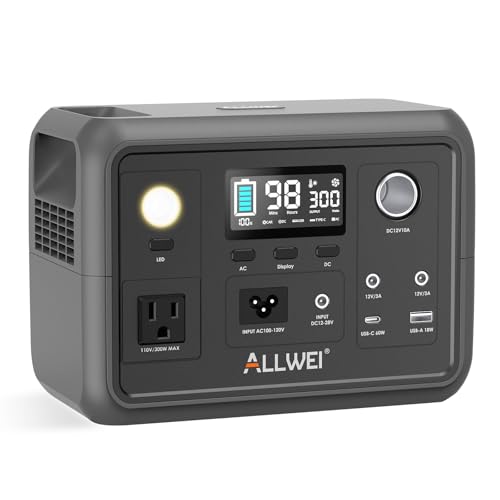
Best for: 60W USB-C laptop charging away from a wall Skip it if: you want more than one AC socket
The ALLWEI is built around a specific job. Its USB-C PD port is rated at 60W, which means a modern laptop charges directly over USB-C with no AC brick in the bag at all. That's a real weight saving on top of the unit's own 6.4 lb.
Capacity is 256Wh, and ALLWEI states 300W continuous with a 600W peak surge on a pure sine wave inverter. Pure sine wave is the specification to look for if you're powering anything with a motor or sensitive electronics. The chemistry is LiFePO4 and ALLWEI claims 3000 charge-discharge cycles, framed in the listing as ten years of performance. Six output ports are listed: one AC outlet, two DC5521, a car cigarette lighter port, an 18W USB-A fast charge port and the 60W USB-C. AC wall charging is claimed at 3.5 to 4 hours for a full charge. The box includes an AC cable, a DC car cable and a manual.
The single AC outlet is the catch, and it stings more here than on the powkey because the ALLWEI sits in the top price tier alongside the Jackery, which publishes two. Dimensions are 7.8 x 9 x 4.7 in, so it's the flattest of the larger units.
Pros:
- 60W USB-C PD charges laptops directly
- Pure sine wave inverter at 300W continuous
- LiFePO4 with a 3000-cycle claim
- 2-year manufacturer warranty
- Cables and car lead included per the listing
Cons:
- Only one AC outlet at a premium price position
- 256Wh is less than the Jackery and ZeroKor
- Heavier than the ZeroKor for less stated capacity
- Only one seller lists it
6. Jackery Explorer 300 Portable Power Station — Best premium
The most capacity here at 292Wh, with a 100W USB-C port and six device outputs.

Best for: multi-day trips with six devices to keep alive Skip it if: 7.1 lb is more than you want to carry
The Explorer 300 is the most expensive pick here and the one that stops you rationing power. 292Wh is the highest published figure in this set, and it feeds two AC outlets, a 100W USB-C PD port, two USB-A ports and a 120W car port. Jackery says six devices run at once.
That 100W USB-C port is the standout. It's the highest USB-C rating of any pick here, 40W above the ALLWEI's, which means faster laptop charging and headroom for a bigger machine. Chemistry is LiFePO4, and Jackery claims over 4000 charge cycles before capacity drops to 70%, the longest cycle claim in this set. The warranty is 2 years. Jackery also claims 80% solar charge in roughly two hours with its own panels, and the listing notes deliveries need a physical address rather than a PO Box only.
Weight is the price of all that. At 7.1 lb and 7.8 x 9.1 x 5.2 in, this is the heaviest and bulkiest pick, nearly triple the Daran. The ZeroKor gets within 12Wh of it for 2.02 lb less. Buy the Jackery for the 100W USB-C port, the 4000-cycle claim and the two-year cover, not for the raw watt-hours.
Pros:
- Highest published capacity at 292Wh
- 100W USB-C PD, the fastest here
- 4000-cycle LiFePO4 claim
- Two AC outlets plus a 120W car port
- 2-year manufacturer warranty
Cons:
- Heaviest pick at 7.1 lb
- Most expensive of the six
- Bulkiest footprint at 7.8 x 9.1 x 5.2 in
- ZeroKor nearly matches its capacity for 2 lb less
Is a power station right for a teenager?
Worth pausing on, because the listings give you nothing here. None of these six publishes an age rating, a recommendation or a safety certification aimed at younger users. Amazon's search returns them for this query anyway, so you're judging it yourself.
Three things I'd weigh:
- Chemistry. Four of the six state LiFePO4: the Daran, Jackery, powkey and ALLWEI. LiFePO4 is a lithium chemistry known for thermal stability compared with the alternatives, which is why it's worth naming. The ZeroKor and VRURC don't publish theirs.
- Simplicity. The VRURC has cables attached and nothing to configure. The Daran has a soft handle and fanless operation. Both are the sort of thing you hand over without a tutorial.
- What's actually being charged. A phone and earbuds need a power bank. A camping trip with a laptop needs watt-hours. Buying 292Wh for a phone is carrying 7.1 lb for no reason.
If safety oversight matters to you, the four LiFePO4 picks are the shortlist. That's the most the published data supports, and I'd rather say that than pretend a specification exists.
Weight, size and what fits in a backpack
Weight is the specification people underestimate. The best small portable power station for teens has to survive the walk, not just the spec sheet.
Lined up lightest to heaviest:
| Pick | Weight | Dimensions |
|---|---|---|
| VRURC | 0.57 lb | 0.73 x 5.7 x 2.7 in |
| Daran | 2.54 lb | 4 x 3.3 x 6.5 in |
| powkey | 4.7 lb | 5 x 7 x 5 in |
| ZeroKor | 5.08 lb | 4.1 x 8.5 x 6.7 in |
| ALLWEI | 6.4 lb | 7.8 x 9 x 4.7 in |
| Jackery | 7.1 lb | 7.8 x 9.1 x 5.2 in |
Shape matters as much as the number. The VRURC's 0.73 in thickness means it disappears into a jacket pocket. The Daran's 4 x 3.3 x 6.5 in footprint fits a side water-bottle pouch. The powkey's cube tucks into a corner. The ALLWEI and Jackery both need dedicated space at roughly 8 by 9 inches.
In practice, the cutoff is around 5 lb. Below that, you forget it's in the bag. Above it, you notice on every hill.
What more money buys across these six
Moving up the price positions in this set buys three specific things, and it's worth knowing which you're paying for.
Watt-hours. The two cheapest picks store the least: 89.6Wh on the Daran and a 10000mAh claim on the VRURC. The most expensive, the Jackery, stores 292Wh.
Warranty length. The Jackery and ALLWEI, the two premium picks, both publish 2 years. The Daran, ZeroKor and powkey publish 12 months. VRURC states 24 months of after-sales service.
Cycle-life claims. Jackery claims over 4000 cycles, ALLWEI 3000, Daran 3500-plus. ZeroKor and VRURC publish no figure at all, which is the clearest thing money buys here: a number you can hold the brand to.
What more money does not reliably buy is port count. The ZeroKor sits mid-range and publishes two AC outlets plus a QC USB port. The ALLWEI sits in the premium tier with one AC outlet. Skip the assumption that the priciest listing has the most sockets. Read the port list.
The verdict
If you're carrying it every day, buy the Daran. 2.54 lb with two AC sockets, seven ports and a 3500-cycle LiFePO4 claim is a combination nothing else here matches, and the 89.6Wh capacity covers phones, tablets, earbuds and a handheld console through an evening without complaint.
If you're powering a laptop for more than one day, buy the Jackery Explorer 300. Its exact advantage is the 100W USB-C PD port, 40W above the next-best in this set, paired with 292Wh and a 4000-cycle claim under a 2-year warranty. That's the fastest direct laptop charging available here.
The cutoff is 150Wh. Below it, weight wins and the Daran is the answer. Above it, you're already committed to a bag with a dedicated slot, so take the capacity and the ports.
Two honourable mentions. The ZeroKor is the efficiency pick, with a 280Wh claim at 5.08 lb and two AC outlets, though it publishes no battery chemistry. And the VRURC is the one to buy alongside any of these: 0.57 lb with four cables built in solves a different problem entirely, at the lowest price position of the six.
FAQ
What size is the best small portable power station for teens?
What size works best depends on where it travels. For daily backpack use, the Daran's 4 x 3.3 x 6.5 in footprint at 2.54 lb is the sweet spot in this set. For trips, the powkey's 5 x 7 x 5 in cube packs well at 4.7 lb. Anything above 5 lb needs its own space in the bag.
Is a portable power station worth it over a regular power bank?
A portable power station is worth it only if you need an AC outlet. Five of these six have one; the VRURC does not. If you're charging a phone and earbuds, a 0.57 lb power bank does the job for less weight and less money. If a laptop brick, a lamp or a fan has to run, you need watt-hours and a socket.
How many watt-hours do I need for a laptop?
Watt-hours needed for a laptop start around 192Wh for a single full charge with USB gadgets alongside, which is the powkey. For two days, look at 256Wh to 292Wh: the ALLWEI, ZeroKor or Jackery. The Daran's 89.6Wh handles a partial top-up, not a full cycle. Direct USB-C charging stretches all of these further than an AC brick does.
Daran or Jackery: which small portable power station should I buy?
Daran or Jackery comes down to weight against capacity. The Daran is 2.54 lb with 89.6Wh and two 100W AC sockets, so it's the everyday carry. The Jackery is 7.1 lb with 292Wh, a 100W USB-C PD port and a 2-year warranty, so it's the trip unit. Nearly triple the weight for roughly triple the stored energy.
What mistake do first-time buyers make with these?
The mistake first-time buyers make is reading the peak wattage headline instead of the watt-hour figure. A "300W" label describes how much it can push at once, not how long it lasts. The ZeroKor's 300W max and 280Wh claim are two separate numbers. Check both, and check the AC outlet count while you're there.
Start with your real daily draw, then pick the lightest unit that clears it. That single step rules out four of these six before you compare anything else. The Daran earns the default recommendation because 2.54 lb is the point where a power station stops being a decision you have to make each morning: it just lives in the bag, and the two AC sockets are there when a laptop needs them. Everything above it in this list is a deliberate trade of shoulder comfort for watt-hours, and that trade is worth making only when you know the number you need.
Last updated: September 7, 2026. Product availability re-checked.
This page contains affiliate links. As an Amazon Associate we earn from qualifying purchases, at no extra cost to you.