Best Brushless Nail Gun for a First-Time Owner
Five brushless cordless nailers, sorted by the fastener they shoot rather than the brand on the housing. Which gauge suits baseboard, which suits picture frames, and where the DeWalt roofing model stops making sense for a house.
The best brushless nail gun for homeowners is the WORX WX838L.9, an 18-gauge cordless brad nailer that WORX says drives fasteners up to 2-1/8 in. into hardwood. If you want a warranty on paper instead, the RYOBI P322 carries a stated 3 year term and ships with two non-marring pads. Between them sit three specialists: a 23-gauge pin nailer, a 2-in-1 nailer and stapler, and a coil roofing nailer built for one job only.
This category is not for everyone. If you hang one picture a year, a hammer and a nail set will beat any of these five, and you'll keep the cash. Cordless brad nailers earn their place once you're running baseboard down a hallway, building shop shelves, or trimming out a room where holding a nail with two fingers stops being safe.
Best brushless nail gun for homeowners at a glance
| Pick | Gauge and fastener | Included | Price |
|---|---|---|---|
| Best overall WORX Cordless Brad Nailer |
18 GA brads to 2-1/8 in. claim |
Bare tool (WX838L.9) |
Check Price |
| Best for beginners RYOBI P322 ONE+ HP 18V Brushless |
18 GA brads | Bare tool + 2 non-marring pads |
Check Price |
| Best for heavy use DEWALT ATOMIC 20V MAX 23 Ga. Pin Nailer |
23 GA pins 5/8 in. to 1-1/2 in. |
Kit (DCN623D1) | Check Price |
| Best budget pick Hlrmsat 18 Gauge Cordless Brad Nailer |
18 GA brads 5/8-1-1/4 in. + staples to 1 in. |
Kit, 2 batteries claim | Check Price |
| Best premium DeWalt 20V MAX 15 Degree Coil Roofing Nailer |
Coil roofing nails | Bare tool (DCN45RNB) |
Check Price |
How I ranked these five nailers
Three criteria decided the order, weighted in this sequence.
- Fastener range, weighted heaviest. A nailer is only as useful as the fasteners it accepts. An 18-gauge brad nailer covers the widest band of household jobs, so the two dedicated 18-gauge tools rank above the specialists.
- Published specification depth, weighted second. I lined up every figure each listing publishes. The RYOBI names a 3 year warranty. The DeWalt pin nailer publishes dimensions of 9.7 x 12.4 x 4.84 in. and a 2017 release. One listing publishes a model number and nothing else.
- How narrow the job is, weighted third. A coil roofing nailer does one task extremely well and everything else not at all, which drops it despite the price position.
Why that order? Because fastener compatibility is the thing you cannot fix later. You can buy a battery, you can live without a warranty, but you cannot make a 23-gauge tool hold a stair skirt. Everything that got cut failed on the first criterion: brushed motors, pneumatic-only tools needing a compressor, and framing nailers that no homeowner buys for trim.
Which gauge do you actually need?
Gauge is the number that decides your purchase, and it runs backwards. A higher gauge number means a thinner nail. This is where most first-time buyers of the best brushless nail gun for homeowners go wrong, because they shop by brand and battery instead.
- 18 gauge (brads). The household default. Baseboard, door casing, shoe moulding, shop jigs, cabinet backs. The WORX, RYOBI and Hlrmsat picks all sit here.
- 23 gauge (pins). Nearly invisible holes, almost no holding power. Built for delicate moulding you're also gluing. The DEWALT DCN623D1 covers 5/8 in. to 1-1/2 in. pins.
- Coil roofing nails. Shingles. That is the list. The DCN45RNB does nothing else.
Three of the five picks share the 18-gauge standard, and that is not an accident of this set. It is the gauge that splits the difference between a hole you have to fill and a nail that actually holds. Buy 23-gauge as a second tool, never as a first one. And note the word "homeowners" is not a specification any of these listings publish, so judge fit by the fastener, not by how a product is marketed.
1. WORX Cordless Brad Nailer — Best overall
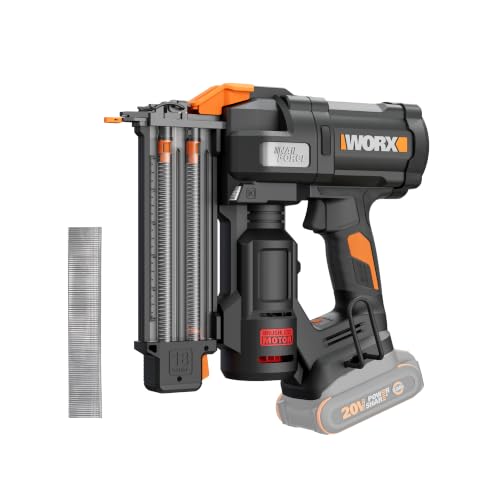
The WX838L.9 is the pick I'd hand a homeowner buying one nailer for the whole house, because 18-gauge brads and a claimed 2-1/8 in. drive depth cover almost everything you'll shoot.
Best for: trim and baseboard work around the house Skip it if: you already own a different battery platform
What separates this one inside the set is reach. WORX claims Air Impact Technology drives nails up to 2-1/8 in. into hardwood, which is the longest fastener length any of the three 18-gauge picks here publishes. That matters on jamb extensions and thicker stock where a 1-1/4 in. brad simply stops short of the stud.
The body measures 11.3 x 3.3 x 10 in., making it the narrowest of the five at 3.3 in. across. Narrow helps when you're nailing inside a cabinet carcass or against a wall return. WORX also lists a triple LED light and describes the housing as lightweight, though no weight figure appears on the listing, so I can't tell you how it compares to the 6.7 lb DeWalt roofing tool.
The PowerShare angle is the real argument. WORX says its 20V batteries run any WORX tool across the 20V, 40V and 80V range, so a homeowner already holding one WORX pack is starting from a lower total outlay. It's the second-cheapest of the five. The trade-off: this is the model designation WX838L.9, the bare-tool suffix, and no battery is listed as included. Only one seller stocks it, and unlike the RYOBI, no warranty term is published.
Pros:
- Longest published brad length in this set at 2-1/8 in.
- Narrowest body here at 3.3 in. wide
- Second-cheapest of the five picks
- Triple LED light for dark cabinet interiors
- Shares batteries across the WORX 20V, 40V and 80V range
Cons:
- No battery or charger listed as included
- No warranty term published on the listing
- No weight figure given, unlike two other picks
- Only one seller lists it
2. RYOBI P322 ONE+ HP 18V 18-Gauge Brushless Cordless — Best for beginners
The P322 is the safest first purchase in this group because it publishes a 3 year warranty and includes the two non-marring pads that stop a first-timer bruising fresh paint.

Best for: first-time nailer buyers who want a long warranty Skip it if: you need the battery and charger included
Here's the trick with a first nailer: the mistakes are cosmetic, not mechanical. You press the nose too hard against a painted casing and leave a dimple. RYOBI ships two non-marring pads in the box, and it's the only pick in this set that names that accessory. Small inclusion, but it addresses the exact error a beginner makes in the first ten minutes.
The 3 year warranty is the other reason it earns the beginners label. It's the only stated warranty across all five picks, which is a genuine gap in the rest of the field rather than a small edge. When you're spending on your first battery tool, a published term on paper is worth more than a feature bullet.
At 3.86 x 12.2 x 10 in. it's the longest of the two flagship 18-gauge tools, 0.9 in. more nose-to-tail than the WORX, and 0.56 in. wider. In a tight corner that difference is real. Roughly mid-range in price for this set, it sits above the WORX with no published drive-depth figure to justify the gap, which is the honest cost of choosing it. The listing confirms it as tool-only: the P322, two pads, an operator's manual. Bring your own ONE+ battery.
Pros:
- Only pick here with a published warranty, at 3 years
- Two non-marring pads included in the box
- Runs on the widely stocked RYOBI ONE+ 18V platform
- Contents fully itemised on the listing
Cons:
- No battery or charger included
- No maximum brad length published
- Longer and wider body than the WORX pick
- Costs more than the WORX with no extra published capability
3. DEWALT ATOMIC Compact Series 20V MAX Brushless Cordless 23 Ga. Pin Nailer Kit — Best for heavy use
The DCN623D1 is the one to buy when the fastener hole matters more than the holding power, and DeWalt claims 2,000 nails per charge for long sessions.

Best for: delicate trim, moulding and cabinet work Skip it if: you need holding power in structural pine
A 23-gauge pin leaves a hole you often don't bother filling. That's the whole case for this tool. DeWalt lists compatibility with pins from 5/8 in. up to 1-1/2 in., so it handles thin returns, mitred corners and glue-up clamping where a brad would split the stock.
It's the only kit in this set from a major brand where DeWalt publishes a shots-per-charge figure: 2,000 nails on average per charge, by the company's own claim. That's the number behind the heavy-use label. The listing also names a tool-free jam release, tool-free depth adjustment, and a low-nail lockout with an LED indicator that tells you to reload before you start firing blanks into trim.
Dimensions run 9.7 x 12.4 x 4.84 in., the second-longest here. The weight field on the listing reads 0.28 g, which is obviously a data error rather than a real figure, so treat the tool's mass as unpublished. The 2017 release date makes this the oldest design in the group. And the honest limitation is the gauge itself: a 23-gauge pin will not hold a baseboard to a wall on its own. Buy it as your second nailer, after an 18-gauge. It's the second most expensive pick here.
Pros:
- Pin range spans 5/8 in. to 1-1/2 in.
- Claimed 2,000 nails per charge
- Tool-free jam release and depth adjust
- Low-nail lockout with LED reload indicator
- Sold as a kit rather than bare tool
Cons:
- 23-gauge pins offer minimal holding power alone
- Weight listed as 0.28 g, clearly unusable data
- Oldest design in the set, released 2017
- Second-highest price position here
- No warranty term published
4. Hlrmsat 18 Gauge Cordless Brad Nailer — Best budget pick
The HL-PBN18 is the cheapest of the five and the only one that shoots staples as well as brads, which is a lot of function for the least money.

Best for: occasional light nailing and stapling in one tool Skip it if: you want published specs before you buy
Two tools for one price is the pitch, and it's genuine within this group. Hlrmsat says the HL-PBN18 drives 18-gauge straight brads from 5/8 in. to 1-1/4 in. and narrow-crown staples from 2/5 in. to 1 in. Nobody else here fires both. For upholstery tacking, cabinet backs, screen repair and light trim, that combination covers real weekend work.
The listing also claims two 21V 4.0Ah batteries and a fast charger in the box. If that holds, it's the only pick here arriving battery-ready, which changes the maths considerably against two bare tools. Hlrmsat further describes dual firing modes and a dual safety mechanism of switch plus contact tip.
Now the caveats, and they're the reason it sits fourth rather than first. The listing publishes exactly one specification: the model number HL-PBN18. No weight, no dimensions, no warranty, no colour. Every claim above is the manufacturer's own sentence, not a standardised figure. Its maximum brad length of 1-1/4 in. is well short of the 2-1/8 in. WORX claims, so thicker jamb work is out. It's also the slowest seller of the five by a wide margin, and only one seller lists it.
Pros:
- Cheapest of the five picks
- Only pick here firing both brads and staples
- Two batteries and fast charger claimed in the box
- Two firing modes for different work
Cons:
- Only one published specification: the model number
- Maximum brad length of 1-1/4 in. limits thicker stock
- No weight, dimensions or warranty listed
- Slowest seller of the five
- Only one seller lists it
5. DeWalt 20V MAX 15 Degree Coil Battery Powered Roofing Nailer — Best premium
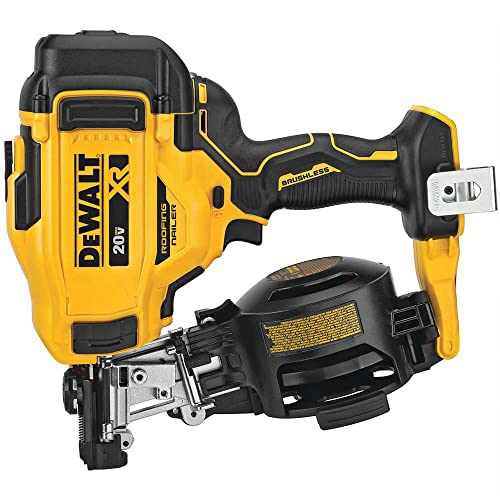
The DCN45RNB is the most expensive pick here and the only one that removes a compressor and hose from a roof, which is exactly one job well done.
Best for: a full roof tear-off and re-shingle Skip it if: you are nailing anything other than roofing
Dragging a compressor hose across shingles is the part of roofing nobody talks about. It snags, it pulls the gun off line, and it's a trip hazard on a pitch. This tool exists to delete it. DeWalt lists a bump mode for continuous nailing and a tool-free nail tray that adjusts across the full range of roofing nails, so you're not carrying a wrench up the ladder.
At 6.7 lb it's the heaviest pick in this set, and the 6 x 15 x 14 in. footprint is the bulkiest by a wide margin. On a roof, weight in the hand is the metric that matters after two hours, so go in knowing that number. DeWalt also names the brushless motor as the source of the runtime and durability gain.
Here's the honest verdict for a homeowner: this is a specialist. Coil roofing nails do not trim a door, build a shelf or fix a cabinet. Buy this only if you're genuinely re-shingling, and even then compare it against a rental. It's the most expensive pick here for the narrowest possible use. Two sellers list it, and the listing notes that international units may differ in fit, labelling and instructions, which is worth reading before you commit. No warranty term is published either.
Pros:
- Cordless roofing removes hose and compressor entirely
- Bump mode for continuous shingle nailing
- Tool-free nail tray fits the full roofing nail range
- Published weight of 6.7 lb, unlike three other picks
- Two sellers stock it
Cons:
- Coil roofing nails only, useless for trim work
- Heaviest pick here at 6.7 lb
- Bulkiest footprint at 6 x 15 x 14 in.
- Most expensive pick in the set
- International-unit differences flagged on the listing
Bare tool or kit: what is in the box?
This is where a comparison of the best brushless nail gun for homeowners gets expensive in ways the headline hides. Three of these five are bare tools.
- WORX WX838L.9 — the .9 suffix marks it bare. No battery listed.
- RYOBI P322 — tool, two non-marring pads, operator's manual. No battery listed.
- DeWalt DCN45RNB — the NB suffix marks it bare. No battery listed.
- DEWALT DCN623D1 — sold as a kit.
- Hlrmsat HL-PBN18 — claims two 21V 4.0Ah batteries and a fast charger.
If you own nothing yet, a bare tool is not the cheaper choice. It's the deferred one. Read the model suffix before anything else on the page, because it changes what you actually receive more than any feature bullet does.
What the listings do not tell you
Four things you'll want and won't find published across this set.
Weight, mostly. Only the roofing nailer gives a usable figure, 6.7 lb. The DEWALT pin nailer's field reads 0.28 g, which is broken data. The WORX and RYOBI publish none, and neither does the Hlrmsat.
Warranty, mostly. The RYOBI's 3 year term is the only one stated. That's one out of five, and it's the strongest single argument in its favour.
Nails per charge, mostly. DeWalt claims 2,000 per charge for the pin nailer. Nobody else quantifies runtime, so cross-brand comparison on that point is guesswork.
Depth adjustment. Named only on the DEWALT pin nailer as tool-free. Assume nothing about the others until you have the manual.
When a specification is absent, the fix isn't to guess. It's to buy the tool whose published numbers cover the job you actually have.
When a different pick wins
Three thresholds flip my recommendation.
- You already own a battery platform. If there are RYOBI ONE+ packs on your shelf, buy the P322 and ignore the rest. Platform lock-in beats every spec here, because a second charger and a second battery family cost more than the difference between any two of these tools.
- Your longest fastener needs to exceed 1-1/4 in. That rules the Hlrmsat out immediately. The WORX claims 2-1/8 in. into hardwood, so it's the pick for jamb extensions and thicker trim.
- The nail hole must be invisible. Below the 18-gauge threshold, go 23-gauge. The DCN623D1 handles pins from 5/8 in. to 1-1/2 in. and leaves a mark you can often ignore entirely.
One more: if the job is a roof and only a roof, the DCN45RNB is the only tool here that does it, and rental is still worth pricing first.
The verdict
Split this by budget tier and the answer gets simple.
Entry tier. The Hlrmsat HL-PBN18 is the cheapest way in and the only 2-in-1 nailer and stapler here, with claimed batteries included. You're paying with information: one published specification, no weight, no warranty. Fine for light occasional work, wrong if you want figures before you commit.
Middle tier. This is where the best brushless nail gun for homeowners actually lives. The WORX WX838L.9 wins it and wins the whole set, on the longest published brad length at 2-1/8 in. and the narrowest body at 3.3 in. wide, at the second-lowest price. The RYOBI P322 is the runner-up, and its exact advantage is documentation: a stated 3 year warranty, the only one across all five, plus two non-marring pads. If a warranty on paper decides your purchases, pay the difference and buy the P322 instead.
Premium tier. Both DeWalt tools are specialists, not upgrades. The DCN623D1 pin nailer earns its place as a second nailer for delicate 23-gauge work with a claimed 2,000 nails per charge. The DCN45RNB roofing nailer earns it only if you're re-shingling, and at 6.7 lb you'll feel every one of those hours.
FAQ
Is a brushless nail gun worth it for a homeowner?
A brushless nail gun is worth it for a homeowner running trim, baseboard or shop projects, mainly because there's no compressor, no hose and no gas cartridge to manage in a garage. Manufacturers here credit brushless motors with lower heat and longer runtime. For one picture hook a year, a hammer still wins. For a room of casing, cordless changes the job.
Which is better, the WORX WX838L.9 or the RYOBI P322?
Better depends on which gap bothers you. The WORX WX838L.9 claims brads to 2-1/8 in. into hardwood, measures just 3.3 in. wide, and costs less than the RYOBI. The RYOBI P322 answers with the only published warranty in this comparison, 3 years, plus two non-marring pads. Longer fasteners and a narrower nose, or paperwork and included pads.
What does 18 gauge mean on a nail gun?
18 gauge on a nail gun describes the thickness of the brad, and the number runs inverse to size. An 18-gauge brad is thicker and holds better than a 23-gauge pin, while leaving a hole small enough to fill with putty. Three picks here shoot 18-gauge. It's the standard for baseboard, casing, shoe moulding and cabinet backs.
Do these nail guns come with a battery included?
Battery included is the exception, not the rule. The DEWALT DCN623D1 ships as a kit, and Hlrmsat claims two 21V 4.0Ah batteries plus a fast charger with the HL-PBN18. The WORX WX838L.9, the RYOBI P322 and the DeWalt DCN45RNB list no battery. Check the model suffix: .9 and NB both signal a bare tool.
What is the most common mistake buying a first nail gun?
The most common mistake buying a first nailer is choosing gauge by brand loyalty instead of by fastener. A 23-gauge pin nailer looks premium and will not hold your baseboard. Start with 18 gauge, confirm the maximum brad length covers your thickest stock, then add a pin nailer later for delicate moulding you're also gluing.
Start with the fastener, not the housing. Write down the thickest piece of trim in your house, add the depth you need to reach solid wood behind it, and buy the tool whose published brad length clears that number. For most homeowners that lands on the WORX WX838L.9, which claims 2-1/8 in. into hardwood and squeezes into cabinet corners at 3.3 in. across, for the second-lowest cost in this group. If you'd rather own a warranty than a spec sheet, the RYOBI P322 and its 3 year term is the honest alternative.
Last updated: September 7, 2026. Product availability re-checked.
This page contains affiliate links. As an Amazon Associate we earn from qualifying purchases, at no extra cost to you.