Best Compact Framing Nail Gun: MAX SuperFramer Wins

A framing nailer's weight gets all the attention, but the number that decides whether you can drive a nail between 16-inch studs is body height. Six picks compared on the figures their listings actually publish.

By Taylor DavidsonUpdated 16 min read
On this page
- Best compact framing nail gun at a glance
- How the six picks map to six different framers
- Which number actually decides a compact framing nail gun?
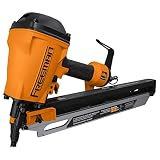
- 1. MAX USA CORP SuperFramer CN890F3 — Best overall
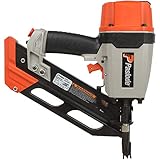
- 2. Paslode Pneumatic Framing Nailer F325R — Runner-up
- 3. Metabo HPT NR90AES1 — Best for beginners
- 4. Freeman Compact Lightweight G22183CLW — Best for heavy use
- 5. DEWALT DCN930B 20V 30° — Best for small spaces
- 6. DOTOOL 21 Degree Framing Nailer — Best budget pick
- Coil or stick: which magazine suits your work?
- What the listings do not tell you
- When a different pick wins
- The verdict
- FAQ
The best compact framing nail gun is the MAX SuperFramer CN890F3, because MAX publishes the one figure that actually matters in a tight stud bay: a 13-1/2 in body height, at 8.4 lbs. If you're remodelling rather than framing new walls, the Paslode F325R is the better buy at a listed 4.17 lb. What splits this field is not horsepower. It's the length of the nail the tool will accept, and the height of the tool that has to fit above it. Two of these six stop at 3-1/4 in, and that single specification rules them out of some plans before you've pulled a trigger.
Best compact framing nail gun at a glance
| Pick | Nail range | Height / weight | Price |
|---|---|---|---|
Best overall MAX USA CORP SuperFramer CN890F3 |
2" to 3-1/2" 15° coil |
13-1/2 in 8.4 lb |
Check Price |
| 2" to 3-1/4" 30° stick |
14 in listed 4.17 lb |
Check Price | |
Best for beginners Metabo HPT NR90AES1 |
2" to 3.5" 21° stick |
15 in listed 7.5 lb |
Check Price |
Best for heavy use Freeman Compact Lightweight G22183CLW |
2" to 3-1/4" 21° stick |
19.9 in listed 6.6 lb |
Check Price |
Best for small spaces DEWALT DCN930B 20V 30° |
Not listed 30° stick |
13.9 in listed 9.92 lb |
Check Price |
Best budget pick DOTOOL 21 Degree Framing Nailer |
2" to 3-1/2" 21° stick |
Not listed 8.9 lb |
Check Price |




How the six picks map to six different framers
I lined up the published specifications for all six and sorted them by who'd actually reach for each one. That mapping matters more than a ranked list here, because a framing nailer is bought for a job, not for a shelf.
- The production framer. Wants long reload runs and a short nose. That's the MAX, with a 300-nail magazine and a published 13-1/2 in height.
- The remodeller. Cuts into existing walls, works overhead, moves partitions. Weight rules. Paslode lists 4.17 lb.
- The first-timer. Wants a common nail, a warranty, and nothing exotic. Metabo HPT publishes a 5 year warranty.
- The long-day user. Ten hours of sheathing. Freeman lists 6.6 lb and a 7 year professional warranty.
- The cordless convert. No hose, no compressor, punch-list work. DEWALT's DCN930B runs on 20V.
- The occasional builder. One deck, one shed. DOTOOL is the cheapest of the six and still covers 2 in to 3-1/2 in.
Notice the split: only three of the six accept a nail up to 3-1/2 in. That's the MAX, the Metabo HPT and the DOTOOL. Two cap out at 3-1/4 in. One doesn't publish a nail range at all.
Which number actually decides a compact framing nail gun?
Most guides comparing a compact framing nail gun lead with weight. Weight is real, but it's the wrong headline. Here's why.
A 16-inch-on-centre stud bay gives you about 14-1/2 in of clear space between studs. To toe-nail a stud to a plate inside that bay, the tool's nose has to sit low and the body has to clear the adjacent stud. Overall body height is what decides that. Weight decides how your shoulder feels at 4pm.
So the number I sort on first is height. MAX publishes 13-1/2 in outright and calls it a low-height design. DEWALT's listed dimensions include 13.9 in. Metabo HPT's listing shows 15 in on one axis, Paslode 14 in, Freeman 19.9 in. Read those with care: the shipping dimensions in a listing are not always the tool's standing height, and only MAX states a body height directly. That's a genuine advantage. It's a published number instead of an inference.
The second number is nail length. If your plans call for 3-1/2 in nails in structural connections, a 3-1/4 in tool is not a compromise, it's a different tool. Check the plan before you check the price.
1. MAX USA CORP SuperFramer CN890F3 — Best overall
The only pick here that publishes an actual body height, and at 13-1/2 in it's the shortest number any of these six put in writing.
Best for: framers who want the lowest published body height and long reload runs Skip it if: you already own boxes of stick nails
Coil is the reason this one works. A 15-degree wire-welded coil sits in a round canister rather than a long stick, so the magazine doesn't project out past the nose the way a 21-degree stick does. MAX puts the tool at 8.4 lbs with a 13-1/2 in height, and lists 300 nails in the magazine. That's the largest stated capacity in this group by a wide margin, and on sheathing it means far fewer reloads per sheet.
The feature list is the most detailed of the six. MAX says the anti-double-fire trigger prevents accidental second shots, and that both sequential and contact triggers are included with no special tools needed to switch. It also claims a patented maintenance-free end-cap filter that ejects debris when you disconnect the hose. Dial-adjustable depth, a pointy-teeth contact arm for toe-nailing, a no-mar tip, a swivel fitting and a heavy-duty rafter hook round it out.
The trade-off is real. This is the most expensive pick here and the slowest seller of the six, only one seller lists it, and coil nails commit you to a different consumable than the other five. At 8.4 lbs it's also heavier than the Paslode and the Freeman.
Pros:
- Lowest published body height at 13-1/2 in
- 300-nail magazine, the largest stated here
- Full 2" to 3-1/2" nail range
- Both trigger modes, switchable without tools
- Rafter hook and swivel fitting included
Cons:
- Most expensive pick in this set
- Coil nails aren't interchangeable with the other five
- Only one seller lists it
- Heavier than the Paslode and Freeman
- No published warranty term
2. Paslode Pneumatic Framing Nailer F325R — Runner-up
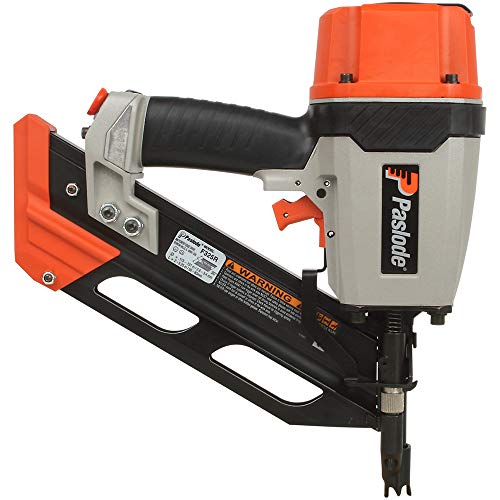
At a listed 4.17 lb this is by far the lightest thing in the group, and it's aimed squarely at remodel work rather than new framing.
Best for: remodellers moving interior walls and working overhead Skip it if: you need to drive a full 3-1/2 in nail
The listing weight of 4.17 lb makes this the lightest option here, less than half the DEWALT's 9.92 lb. Paslode's own copy describes it as its lightest framing nailer at 5.9 lbs, so the two figures disagree, and I'd treat the manufacturer's number as the one to plan around. Either way it sits at the bottom of this field.
Paslode says it fits between 16-inch on-centre studs and calls it a remodeler's fit for sheathing, blocking and moving interior walls. A bypass follower gives two-step reloading. The magazine takes 30-degree paper-collated nails from 2" to 3-1/4" with shank diameters of .113" to .131", and Paslode claims fewer jams and misfires with its own nails.
That nail spec is the catch. The ceiling is 3-1/4", so any spec calling for 3-1/2 in is out. The .131" shank ceiling is also narrower than the Freeman's stated .148". Three sellers list it, more than any other pick here, which at least gives you options. Listed dimensions run 14 x 6.5 x 14 in, taller in one axis than the MAX's stated body height.
Pros:
- Lightest listed weight in the set at 4.17 lb
- Rated by Paslode for 16" o.c. stud bays
- Two-step bypass reloading
- Three sellers stock it, the most here
Cons:
- Caps at 3-1/4" nails
- Shank ceiling of .131", narrower than the Freeman
- Two conflicting weight figures on the same listing
- No published warranty term
3. Metabo HPT NR90AES1 — Best for beginners
The safest first purchase in this group: a 5 year warranty, the full 3.5 in nail range, and the most ordinary nail collation of the six.

Best for: first-time buyers who want a 5 year warranty and a common nail size Skip it if: you need the shortest possible nose for tight bays
This is the one buyers choose most often here by a clear margin, and it's easy to see why. It's the second-cheapest of the six, it carries a published 5 year warranty, and it drives 21-degree plastic collated nails from 2" to 3.5", so nothing in a set of framing plans is off limits. Listed at 7.5 lb, with dimensions of 9 x 15 x 9 in, and released in 2019.
Metabo HPT calls it well balanced and lists flooring, framing, truss build-up, window build-up, subflooring, roof decking and wall sheathing among its applications. Selective actuation switches between sequential and contact nailing with a flip of a switch, and depth adjustment is tool-less to countersink or drive flush.
For a beginner that combination is hard to beat: a warranty term in writing, the widest nail range available here, and 21-degree plastic collated nails that any building supply counter will have on the shelf. What you give up is the tight-bay advantage. A 21-degree stick magazine runs long, and 15 in shows in the listed dimensions, so this is the least agile of the three full-range picks. If most of your work is in open framing rather than remodel cut-ins, that hardly matters.
Pros:
- 5 year warranty, the second longest here
- Full 2" to 3.5" nail range
- 21° plastic collated nails, widely stocked
- 7.5 lb, lighter than three others in this set
- Tool-less depth adjustment and switchable actuation
Cons:
- Long 21° magazine limits tight-bay access
- 15 in in the listed dimensions, taller than the MAX's stated height
- Colour and size both listed as unspecified
- No published magazine capacity
4. Freeman Compact Lightweight G22183CLW — Best for heavy use
A 7 year professional warranty, the longest published term in this set, on a tool Freeman lists at 6.6 lb.

Best for: long days where 6.6 lb and a 7 year warranty matter most Skip it if: your plans call for 3-1/2 in nails
Two figures make the case. The listed weight is 6.6 lb, second lightest here behind the Paslode, and the warranty is 7 years on the tool with 90 days on wearable parts. That's the longest published tool warranty of the six, and for someone using a nailer week in and week out, a warranty term is one of the few durability signals a listing actually gives you.
Freeman describes a magnesium body, a one-piece hardened steel drive blade and a carbon-fibre-reinforced aluminium magazine, and says the internals are optimised for airflow so it draws less air per shot. Its own copy quotes 6.45 lbs, slightly under the listed 6.6 lb. Compatible nails are 21-degree plastic collated full round head, 2" to 3-1/4" long, .113" to .148" diameter. That .148" ceiling is the widest shank stated in this group.
The ceiling on length is the problem. Like the Paslode it stops at 3-1/4", so it can't cover every framing spec. Listed dimensions of 11.1 x 19.9 x 5 in also make it the longest package here, which works against the compact billing, and it's the slowest-selling pick of the six with a single seller.
Pros:
- 7 year warranty, longest published term here
- 6.6 lb listed, second lightest in the set
- Widest stated shank range, up to .148"
- Magnesium body and steel drive blade
Cons:
- Nail length stops at 3-1/4"
- Longest listed dimensions of any pick here
- Slowest seller of the six, one seller only
- Two different weight figures on the listing
5. DEWALT DCN930B 20V 30° — Best for small spaces
The only cordless pick, so it's the only one that gets into a crawlspace or an attic without dragging a hose behind it.

Best for: punch-list and remodel work away from an air hose Skip it if: you're framing all day and hate weight
Cordless changes what "small spaces" means. A compressor and 50 feet of hose are what actually stops you working in a crawlspace, on a roof, or three storeys up a remodel. The DCN930B runs on DEWALT's 20V platform with a 30-degree magazine, and listed dimensions of 13.2 x 13.9 x 5.6 in put it among the more compact packages here.
Be clear about what you're buying. This is the bare tool. No battery, no charger, so it only makes sense if you already own 20V packs. And at 9.92 lb it's the heaviest pick in this group, more than double the Paslode's listed 4.17 lb, because the battery and motor ride on board instead of in a compressor across the room.
The listing is also the thinnest of the six. There's one feature line and it just restates the product name. No published nail length range, no magazine capacity, no depth-adjustment detail. Warranty is listed only as a manufacturer warranty with no term. If you want figures to compare, this listing won't give them to you, which is a genuine strike against it in a set where MAX publishes five detailed feature claims.
Pros:
- Only cordless pick here, no hose or compressor
- Compact listed footprint at 13.2 x 13.9 x 5.6 in
- 30° magazine angle for tighter access
- Runs on existing 20V batteries
Cons:
- Heaviest in the set at 9.92 lb
- Bare tool, battery and charger not included
- No published nail length range or magazine capacity
- Warranty listed with no term
- Only one seller lists it
6. DOTOOL 21 Degree Framing Nailer — Best budget pick
The cheapest of the six, and still one of only three here that drives a full 3-1/2 in nail.

Best for: occasional projects needing the full 2 in to 3-1/2 in range Skip it if: you want a published warranty term
Price position and nail capacity usually move together, and here they don't. This is the cheapest pick in the set, yet the listed size is 2-in to 3-1/2-in, matching the MAX and beating both the Paslode and the Freeman. For a homeowner building a deck or a shed to plans that specify 3-1/2 in nails, that single line makes it worth a look.
DOTOOL lists 21-degree offset round head nails, a no-mar tip, a tool-free jam release, sequential mode triggers and tool-less depth of drive adjustment. The body is described as lightweight aluminium, with a red rubber sleeve on the nose to reduce wear and cut slippage when toe-nailing. Listed weight is 8.9 lb.
That weight is the honest catch. It's heavier than the Metabo HPT at 7.5 lb, heavier than the Freeman at 6.6 lb, and more than twice the Paslode's listed figure, so calling it lightweight stretches things. Only sequential mode is mentioned, so you're not getting the contact-fire option the MAX and Metabo HPT both advertise. There's no published warranty, no dimensions and no magazine capacity, and one seller lists it. For occasional use those gaps are tolerable. For daily use they aren't.
Pros:
- Cheapest of the six
- Full 2-in to 3-1/2-in nail range
- Tool-free jam release and depth adjustment
- Rubber nose sleeve for toe-nailing grip
Cons:
- 8.9 lb, heavier than three cheaper-to-carry picks
- Sequential mode only, no contact fire mentioned
- No published warranty, dimensions or magazine capacity
- One seller only
Coil or stick: which magazine suits your work?
Five of these six use a stick magazine. One uses coil. That's the biggest structural difference in the group, and it's worth understanding before you buy nails you can't return.
Stick magazines hold a straight strip of nails, collated with plastic or paper at 21 or 30 degrees. The strip runs out behind and below the nose, which is what gives a stick nailer its long profile. Freeman's listed 19.9 in dimension shows how far that can run. The upside: 21-degree plastic collated nails are the most widely stocked framing fastener there is, so resupply is trivial. Four picks here use 21-degree, and the Paslode and DEWALT use 30-degree.
Coil magazines wind a wire-welded coil into a round canister that sits under the tool rather than behind it. That's how MAX gets to a 13-1/2 in body height, and how it fits 300 nails where a stick holds a fraction of that. The trade-off is supply. Coil framing nails are a narrower aisle, and 15-degree wire-welded coil isn't cross-compatible with anything else here.
Rule of thumb from the specifications alone:
- Sheathing and decking, long runs, few reloads: coil.
- Mixed remodel work with nails bought locally: stick.
- Already stocked with 21° plastic collated: stick, and don't overthink it.
What the listings do not tell you
Reading six listings side by side, the gaps are as informative as the figures. Here's what none of these pages will tell you about a compact framing nail gun.
- Required air pressure and consumption. Not one of the five pneumatic picks publishes an operating psi range or cubic feet per minute. That figure determines whether your compressor can keep up. A small pancake unit will run a framing nailer for trim-pace work and fall behind on production sheathing.
- Standing body height, in most cases. Only MAX states it, at 13-1/2 in. The dimensions on the other listings are package figures, and treating them as tool height will mislead you.
- Magazine capacity. MAX publishes 300 nails. The other five say nothing, so you can't compare reload frequency across them.
- Whether a warranty applies to your use. Metabo HPT lists 5 years and Freeman lists 7 with a separate 90-day wearable parts term. MAX, Paslode and DOTOOL publish no term at all, and DEWALT lists one with no length.
- What's in the box. DEWALT's is explicitly a bare tool. The others don't itemise cases, oil bottles or wrenches.
If any of those decides your purchase, check the manufacturer's own documentation before you commit rather than reading between the lines of a listing.
When a different pick wins
The keyword says compact, and Amazon's results don't fully honour it: two of these six publish nothing you could use to judge overall size, and only one states a body height. So treat compactness as something you verify against the manufacturer's specification sheet, not something I can promise from this data. With that caveat, here's when I'd move off the winner.
- Your plans specify 3-1/2 in nails. Three picks qualify: MAX, Metabo HPT, DOTOOL. The Paslode and Freeman both stop at 3-1/4 in.
- You're overhead most of the day. Paslode's listed 4.17 lb is the deciding figure. It's less than half the DEWALT.
- You already own 20V DEWALT batteries and there's no power on site. The DCN930B is the only cordless option here, bare tool notwithstanding.
- You want the longest warranty in writing. Freeman's 7 years beats Metabo HPT's 5, and beats the three picks with no published term.
- This is a one-project purchase. DOTOOL is the cheapest here and still covers the full nail range.
- You want the widest shank compatibility. Freeman states .113" to .148", the broadest range published in this set.
The verdict
The MAX SuperFramer CN890F3 is the best compact framing nail gun here because it's the only pick that answers the actual question in writing. Body height of 13-1/2 in, weight of 8.4 lbs, nails from 2" to 3-1/2", 300 in the magazine. Every other listing leaves you inferring size from package dimensions.
Two conditions flip it. First, if you already own boxes of 21-degree plastic collated nails, the coil magazine is a genuine cost you'd be paying for a size advantage you may not need, and the Metabo HPT NR90AES1 gives you the same 3.5 in nail ceiling with a published 5 year warranty at a much lower price position. Second, if your work is overhead or in existing walls rather than framing new ones, the Paslode F325R's listed 4.17 lb outweighs everything else. Paslode explicitly rates it for 16-inch on-centre bays and pitches it at sheathing, blocking and moving interior walls.
The Paslode's exact advantage over the MAX is weight, and nothing else. It gives up the 3-1/2 in nail, the 300-nail magazine and the stated body height to get there. If your arm is the limiting factor, take that trade. If your plans are, don't.
FAQ
Is a compact framing nail gun worth it over a full-size one?
A compact framing nail gun is worth it when you're working inside existing walls, between 16-inch on-centre studs, or overhead. Paslode markets the F325R specifically for that, and MAX's 13-1/2 in body height exists for the same reason. For open new framing on a slab, the size advantage matters far less and you can prioritise nail capacity instead.
What's the cheapest way into a compact framing nail gun?
The cheapest way in is the DOTOOL 21 Degree Framing Nailer, the lowest price position of these six. It still covers 2-in to 3-1/2-in nails, which two pricier picks here don't. You give up a published warranty term, published dimensions and contact-fire actuation. For a single deck or shed, that's a reasonable trade.
Will a 3-1/4 inch nailer meet framing specs?
A 3-1/4 inch nailer meets many framing specs but not all. Both the Paslode F325R and the Freeman G22183CLW cap at 3-1/4", so if your drawings call for 3-1/2 in fasteners at any connection, neither tool covers it. The MAX, Metabo HPT and DOTOOL all list capacity to 3-1/2 in. Check the plan before the tool.
MAX SuperFramer or Metabo HPT NR90AES1: which should I buy?
Buy the MAX SuperFramer if tight-bay access is your problem: 13-1/2 in body height and a 300-nail coil magazine are its answers. Buy the Metabo HPT NR90AES1 if you want a lower price position, a published 5 year warranty and 21-degree plastic collated nails you can buy anywhere. Both drive the full 3-1/2 in nail.
What's the most common framing nailer buying mistake?
The most common framing nailer buying mistake is matching the tool to a compressor that can't feed it. None of these five pneumatic listings publishes an air consumption figure, so a small pancake unit may keep pace on blocking and fall behind on production sheathing. Confirm the psi and airflow requirement with the manufacturer before you buy either piece.
Start with the nail. Pull your plans, find the longest fastener specified, and cross off anything that can't drive it. That one step eliminates two of these six immediately. Then decide whether your day is spent reaching into existing walls or standing over open framing, because that's what separates the MAX's 13-1/2 in body from Paslode's 4.17 lb. The MAX SuperFramer earns the default recommendation for a simple reason: it's the only tool here whose listing tells you how tall it is, and in a stud bay, that's the number you're betting on.