Best Budget Carbon Monoxide Detector: First Alert Wins
Five carbon monoxide alarms compared on power source, warranty length and what the listings actually publish. The plug-in First Alert leads, with a battery-only Kidde and a 10-year sealed X-Sense combo close behind.
The best budget carbon monoxide detector is the First Alert CO605, because it plugs into any standard outlet, keeps monitoring on battery backup during an outage, and carries a 7-Year Limited Warranty in a 4.2 oz body. If you need smoke detection in the same spot, the X-Sense SC07 combo is the better buy on its sealed 10-year battery. The specification that splits this field is not sensitivity. It's power source. Plug-in, AA cells and sealed lithium behave completely differently over a decade, and that difference decides where each alarm can go and how often you touch it.
Best budget carbon monoxide detector at a glance
| Pick | Power source | Warranty | Price |
|---|---|---|---|
| Best overall FIRST ALERT CO605 Plug-in Carbon Monoxide Detector |
Outlet plug-in battery backup |
7-Year Limited | Check Price |
| Best budget pick Kidde Carbon Monoxide Detector, AA Battery Powered |
2 AA batteries included |
Not published | Check Price |
| Best warranty X-Sense Smoke Detector Carbon Monoxide Detector Combo SC07 |
Sealed lithium 10-year claim |
5-year quality 60-day money-back |
Check Price |
| Best for quiet operation Kidde Carbon Monoxide + Explosive Gas Alarm |
Outlet plug-in 9V backup |
Not published | Check Price |
| Best premium TOPTES CT-580 Portable Carbon Monoxide Detector |
Rechargeable handheld |
Not published | Check Price |
How I matched five listings to five different buyers
I didn't rank these five by a single score, because five different people are shopping for a best budget carbon monoxide detector and they want different things. So I mapped the published data onto profiles first.
- The renter. Can't drill, can't rewire, wants protection tonight. The First Alert CO605 and the plug-in Kidde both fit a standard outlet. The First Alert is the smaller of the two at 5 x 3.4 x 1.38 in against 6.1 x 2.48 x 3.82 in.
- The person adding alarm number three. First Alert's own listing says to place one on each level of your home and in each bedroom. That means volume, and the AA-powered Kidde KN-COB-LP2 is the cheapest of the five to repeat.
- The one-device household. Wants smoke and CO from a single unit on the hallway ceiling. Only the X-Sense SC07 covers both.
- The gas-appliance household. Natural gas or propane in the house means a second hazard. Only the Kidde KN-COEG-3 lists explosive gas detection alongside CO.
- The tradesperson or camper. Needs a number, not an alarm. The TOPTES CT-580 is the only handheld here, and the only one with a stated 0-1000PPM range.
Three of the five publish a weight, ranging from 3.68 oz on the AA Kidde to 1 lb on the X-Sense. Two publish a warranty. Where a figure is missing from a listing, I said so rather than guessing at it.
Why price is not what decides a CO alarm
Everyone shopping for the best budget carbon monoxide detector compares the sticker. It's the wrong comparison, because a CO alarm has a fixed service life and then it's rubbish. The sensor degrades. First Alert's listing spells this out: the CO605 is equipped with an end-of-life signal chirp, so you know when it's time to replace the unit. That chirp is not a fault. It's the alarm telling you the clock ran out.
So the real number is the cost per protected year, and the lever on that is warranty plus battery strategy.
Look at what each pick does over a decade. The X-Sense SC07 claims a built-in sealed lithium battery good for a full decade with zero maintenance, no replacements and no low-battery chirps. Its published warranty is a 5-year quality warranty with a 60-day money-back guarantee and lifetime technical support. The First Alert CO605 carries a 7-Year Limited Warranty, the longest single warranty term in this set, and draws mains power so its backup battery is a fallback rather than the main supply.
The AA Kidde sits at the other end. It's the cheapest of the five, batteries are included, and there's no published warranty term at all. That's a genuine trade: lowest entry cost, least documented commitment.
Here's the trick most shoppers miss. Two cheap alarms in the right rooms beat one better alarm in the wrong room. Coverage first, then quality.
Plug-in, AA battery or sealed 10-year: which suits your home?
Power source dictates placement, and placement dictates whether the alarm ever wakes you.
- Plug-in with backup. The First Alert CO605 and the Kidde KN-COEG-3 both work with a standard 120V outlet. The First Alert adds battery backup for continuous monitoring; the Kidde uses a 9-volt battery backup for power outages. Outlets sit low on the wall, which is fine for CO because CO mixes with air rather than settling. What you lose is freedom: no outlet, no alarm.
- AA powered. The Kidde KN-COB-LP2 runs on 2 AA batteries, included, with no wiring needed. Its listing says you can mount it on a wall or set it on a tabletop. That flexibility is the whole point. It's also the lightest here at 3.68 oz and the smallest footprint at 2.83 x 1.65 x 4.72 in.
- Sealed lithium. The X-Sense SC07 gives up battery access entirely for a decade of claimed hands-off operation. It also mounts on a wall or ceiling with the included bracket, screws and anchor plugs, so it can go where a plug-in can't.
- Rechargeable handheld. The TOPTES CT-580 isn't a fixed alarm at all. It's a manual inspection tool you carry.
If you're renting, plug-in. If you're buying three, AA. If you never want to think about it again, sealed.
1. FIRST ALERT CO605 Plug-in Carbon Monoxide Detector — Best overall
The CO605 combines outlet power, battery backup and the longest published warranty in this group, which is exactly what a default recommendation needs.
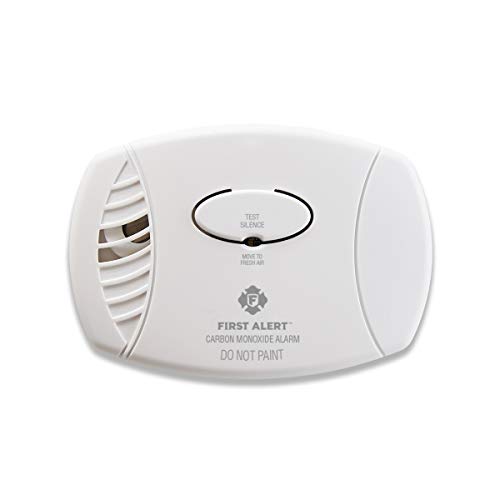
Best for: renters and anyone who wants an outlet-powered alarm with a long warranty Skip it if: you need ceiling mounting or a digital ppm readout
What separates this one inside the set is the warranty. Its 7-Year Limited Warranty is the longest single term published by any of these five, and the X-Sense is the only other pick that publishes one at all. First Alert says the unit uses an advanced electrochemical carbon monoxide sensor that detects CO accurately no matter where in the room the detector sits, and that the 85 decibel alarm sounds when levels reach dangerous concentrations. Operation is deliberately plain: one test and silence button.
At 4.2 oz and 5 x 3.4 x 1.38 in, it's compact enough that it won't dominate a hallway outlet. It's also the pick buyers here choose most often, sitting well ahead of the rest of this set on how quickly it moves. Two sellers list it, which is one more than three of the other four picks.
The trade-off is scope. This does CO and nothing else, so you'll still need a smoke alarm, and there's no display to show a ppm figure. The listing describes the model as CO606, one digit off the title's CO605, so confirm the exact unit on the page before ordering.
Pros:
- Longest published warranty here at 7 years
- Outlet power with battery backup for outages
- Smallest plug-in footprint of the two plug-ins
- End-of-life chirp flags replacement time
- Chosen most often by buyers in this set
Cons:
- No digital display or ppm reading
- Tied to an available outlet
- No smoke detection at all
- Listing model number differs from the title
2. Kidde Carbon Monoxide Detector, AA Battery Powered — Best budget pick
This is the cheapest of the five and the easiest to put anywhere, which makes it the alarm you buy two or three of.
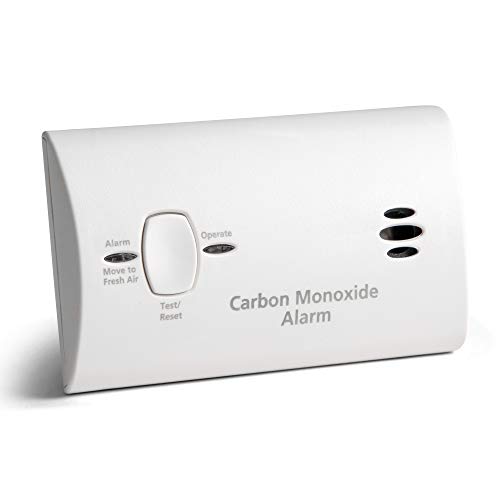
Best for: adding a second or third alarm on a tight budget Skip it if: you want a display or a long published warranty
Placement freedom is the case for this one. Kidde says installation needs no wiring, the unit runs on 2 AA batteries that come in the box, and you can mount it on a wall or simply set it on a tabletop. It keeps detecting during a power failure, since there's no mains supply to lose. At 3.68 oz it's the lightest pick here, and at 2.83 x 1.65 x 4.72 in it's the narrowest.
The sensing is electrochemical, per the listing. A green LED shows power, a red LED plus the 85-decibel alarm signals CO. Event Memory records the last time CO was detected or the unit was tested, which is a genuinely useful feature on a device you're meant to check monthly and mostly won't.
Because First Alert's own guidance is one alarm per level and per bedroom, cost per unit matters more than any single feature. This is the pick that makes full coverage affordable. Released in 2025, it's also one of the newest designs here.
What you give up against the First Alert is the warranty. Kidde publishes no term for this model, so you're relying on the retailer. There's no digital readout either, and AA cells mean an eventual battery swap the sealed X-Sense avoids.
Pros:
- Cheapest of the five picks here
- No wiring, mounts on wall or sits on a table
- Lightest unit in the set at 3.68 oz
- Batteries included in the box
- Event Memory logs last detection or test
Cons:
- No warranty term published
- Batteries need replacing over the years
- No digital CO level display
- Only one seller lists it
3. X-Sense SC07 Smoke and Carbon Monoxide Detector Combo — Best warranty
One unit covering both smoke and CO on a sealed decade-long battery, with the most detailed warranty package in this comparison.

Best for: a hallway or bedroom that needs both smoke and CO coverage Skip it if: you want an interconnected or Wi-Fi alarm
This is the only dual-hazard pick in the group. X-Sense pairs a photoelectric smoke sensor with an electrochemical CO sensor, and says the photoelectric side responds faster to slow-smouldering fires while helping reduce cooking-related false alarms. The listing states it meets UL 217 and UL 2034 standards for smoke and carbon monoxide detection, independently tested and certified, with clear certification markings on the unit.
The warranty is the deepest here on paper: a 60-day money-back guarantee, a 5-year quality warranty and lifetime technical support. Power is a built-in sealed lithium battery rated by X-Sense for a full decade, with no battery replacements and no late-night low-battery chirps. Mounting hardware is included, so it goes on a wall or ceiling without rewiring.
At 1 lb it's by far the heaviest pick, roughly four times the AA Kidde, and at 5.7 x 2 x 5.7 in it's a wide disc rather than a slim rectangle.
X-Sense flags the main limitation itself: the SC07 is a basic standalone unit with no wireless interconnection, no Wi-Fi and no base station support. In a multi-alarm house, one going off won't trigger the others.
Pros:
- Only pick covering smoke and CO together
- Sealed battery rated for 10 years, zero maintenance
- Cites UL 217 and UL 2034 certification
- 5-year warranty plus lifetime technical support
- Wall or ceiling mounting hardware included
Cons:
- No wireless interconnection or Wi-Fi
- Heaviest unit here at 1 lb
- Sealed battery means the whole unit is disposable
- Widest footprint of the five at 5.7 in
4. Kidde Carbon Monoxide + Explosive Gas Alarm — Best for quiet operation
The only pick that watches for natural gas and propane as well as CO, with a digital display that shows what it's reading before the 85 dB alarm ever fires.
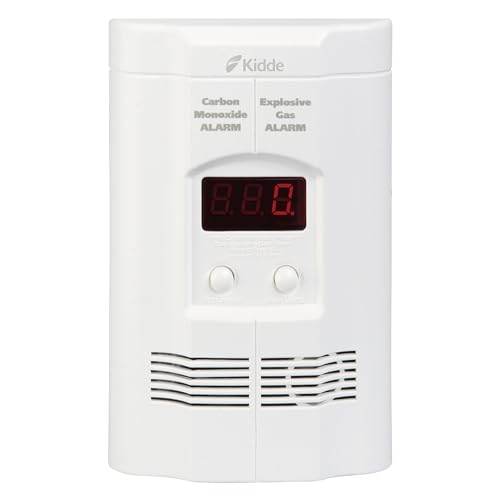
Best for: homes with natural gas or propane appliances Skip it if: you only need CO detection and nothing more
The reason this earns its label is the display. A digital LED readout shows the CO level the alarm is currently sensing, or states "GAS" when explosive gas is present, so you can glance at it and know things are fine without waiting for a siren to tell you. Peak Level Memory records the last time CO was detected or the unit was tested. LED status indicators cover the rest.
It plugs into a standard 120V outlet, with a 9-volt battery backup for outages, and the alarm is rated at 85 decibels. Kidde calls this the 3rd Edition of the KN-COEG-3, released in 2025. If your home runs on natural gas or propane, no other pick here addresses that second hazard.
It's the physically largest plug-in in the set at 6.1 x 2.48 x 3.82 in, so check clearance behind furniture near the outlet you have in mind.
Two things push against it. It's the most expensive plug-in here and publishes no warranty term, while the cheaper First Alert publishes seven years. It also lists no weight, so if that matters to you, the page won't answer it. Only one seller stocks it, and it's the slowest-moving pick in this group apart from the handheld.
Pros:
- Detects explosive gas as well as carbon monoxide
- Digital display shows current CO level
- Peak Level Memory logs last detection or test
- 9V battery backup during power outages
- Newest plug-in design in this set
Cons:
- No published warranty term
- Largest plug-in body at 6.1 in tall
- Costs more than the longer-warranted First Alert
- No published weight for the unit
5. TOPTES CT-580 Portable Carbon Monoxide Detector — Best premium
A handheld inspection meter with a stated 0-1000PPM range and a vibration alarm, useful for work and travel but not a substitute for a fixed alarm at home.

Best for: tradespeople and campers who need a handheld ppm reading Skip it if: you want an alarm that watches the house while you sleep
This is the outlier, and it's here because a spot-check meter answers a question the four fixed alarms can't. TOPTES describes the CT-580 as a manual inspection tool with a high-sensitivity DDS sensor, a stated range of 0-1000PPM and a TFT colour display. Three alarm modes are listed: indicator light, audible alarm and vibration. Vibration is the reason to want it in a noisy plant room or a tent, where a siren competes with everything else.
The body is ABS engineering plastic for grip, per the listing, and the unit is rechargeable rather than battery-swapped. TOPTES says it's certified by a nationally accredited lab. It's the only pick here in Orange, which for a tool you might drop in a crawlspace is a feature.
The published data is thin, though. There's no weight, no dimensions, no warranty term and no size listed, and it's the most expensive pick in this comparison. It's also the slowest seller of the five by a wide margin.
The bigger trade is functional. A handheld you carry can't wake you at 3am, so treat this as an addition to a fixed alarm rather than a replacement for one.
Pros:
- Stated 0-1000PPM reading range
- Vibration alarm alongside light and sound
- Rechargeable, no batteries to buy
- Colour TFT display for direct readings
- Two sellers list it
Cons:
- Not a fixed alarm, so no unattended monitoring
- Most expensive pick in this set
- No published weight, dimensions or warranty
- Slowest-moving pick here by a wide margin
Does a handheld meter belong in this comparison?
Fair question, since Amazon files the TOPTES CT-580 under carbon monoxide detectors alongside the wall units. The honest answer is that it does a different job.
A fixed alarm is a sentry. It sits in one room and screams when a threshold is crossed, whether you're awake, asleep or out. A handheld meter is a diagnostic instrument. You point it at a suspected source and read a number, in this case anywhere across 0-1000PPM on the CT-580's colour display.
Both are legitimate. Neither replaces the other. If a plug-in alarm chirps and you want to know whether the reading came from the furnace or the attached garage, a meter tells you. If you're camping with a propane heater or checking a rental before you sleep in it, a meter is the only one of these five you can pack.
But if you own exactly one CO device in your home, it should be a fixed alarm. Pick the First Alert CO605 or the AA Kidde first, and add the handheld later if your work or your travel calls for one.
What these listings do not tell you
Amazon's search returns plenty of results for a best budget carbon monoxide detector, but the qualifier is loose. What comes back is a spread of price positions rather than a curated cheap shelf, and this set proves it: the handheld TOPTES sits at the top of the range, the AA Kidde at the bottom. Judge affordability against your own ceiling, because the listings won't do it for you.
Other gaps worth knowing before you buy:
- Sensor lifespan. Only First Alert mentions an end-of-life chirp. The others don't state how long their sensors are rated to last, which is separate from battery life.
- Warranty coverage. Three of the five publish no term at all. That's not a defect claim, just an absence you should factor in.
- Interconnection. X-Sense states outright that the SC07 doesn't interconnect. The other four say nothing either way, so assume standalone unless the page confirms otherwise.
- Alarm loudness at distance. Three picks state 85 dB, which is the standard figure. That's measured at close range, not through a closed bedroom door.
- Certification. X-Sense names UL 217 and UL 2034; TOPTES cites a national accredited lab. The rest don't specify in the details supplied here.
Read the live page for anything on that list. It changes, and a published article can't.
The verdict
There's an entry tier, a middle and a top in this group, and each buys something different.
At the entry end, the Kidde KN-COB-LP2 is the cheapest of the five and the one to buy in multiples. Two AA cells, no wiring, 3.68 oz, wall or tabletop. It gets alarms into every bedroom, which is the single highest-value thing you can do in this category. The First Alert CO605 also sits at the entry end and is the better single purchase, because it adds outlet power, battery backup and a 7-Year Limited Warranty that nothing else here matches.
In the middle, the X-Sense SC07 buys you consolidation. One device covers smoke and CO, the sealed lithium battery is rated for a decade, and the warranty package runs to five years plus lifetime technical support. If you'd otherwise buy two alarms for one hallway, this is the better answer.
At the top, the Kidde KN-COEG-3 buys explosive gas detection and a live digital CO readout, which matters in a gas or propane home. The TOPTES CT-580 buys portability and a 0-1000PPM number in your hand.
The winner is the First Alert CO605. It publishes the longest warranty, it needs no tools, and it costs less than the two premium picks.
FAQ
Is a budget carbon monoxide detector worth buying at all?
A budget carbon monoxide detector is worth buying, because coverage matters more than features. First Alert's guidance is one alarm per level of your home and one in each bedroom. A cheap electrochemical alarm in the right room protects you; an expensive one in the wrong room doesn't. Buy enough units to cover sleeping areas first, then upgrade individual spots later if you want a display.
What is the best budget carbon monoxide detector for a rented flat?
The best budget carbon monoxide detector for a rental is the First Alert CO605, since it works with any standard outlet and needs no drilling or rewiring. Battery backup keeps it monitoring during an outage. If your outlets are all occupied, the AA-powered Kidde KN-COB-LP2 sits on a tabletop instead and comes with its batteries in the box.
How does the First Alert CO605 compare with the X-Sense SC07?
The First Alert CO605 compares favourably on warranty, with a 7-Year Limited Warranty against X-Sense's 5-year quality warranty. But the SC07 detects smoke as well as CO, runs a sealed lithium battery X-Sense rates for a decade, and mounts on a ceiling. Choose the First Alert for CO alone in an outlet; choose the SC07 to cover both hazards from one unit.
Do these detectors need a specific placement height?
Placement height matters less for CO than people expect, because carbon monoxide mixes with air rather than sinking or rising sharply. First Alert states its electrochemical sensor detects accurately no matter where in the room the detector sits. That's why an outlet-level plug-in works. What matters more is the room: put one near sleeping areas and on each floor of the house.
What mistake do buyers make with carbon monoxide alarms?
The mistake buyers make is treating a CO alarm as permanent. Sensors have a service life, and the First Alert CO605 includes an end-of-life chirp specifically to flag replacement time. People hear that chirp, pull the battery and assume the noise was a fault. Note your install date somewhere, and replace the whole unit when the alarm says so.
Start with coverage, not with the shortlist. Walk your home, count the levels and the bedrooms, and you'll know how many alarms you need before you know which one to buy. Then order the First Alert CO605 for the outlet nearest your sleeping area, because it's the pick that asks least of you: plug it in, press the button once, and its 7-Year Limited Warranty covers the rest. Add the AA Kidde for any room without a spare socket. Write the install date on the back of each unit in marker, and the next decade takes care of itself.
Last updated: September 7, 2026. Product availability re-checked.
This page contains affiliate links. As an Amazon Associate we earn from qualifying purchases, at no extra cost to you.