Best Budget Orbital Sander for Woodworkers
The SKIL SR211601 leads a five-sander shortlist for woodworkers who want strong dust control without paying premium money. Four alternates cover cordless, upgrade and minimal-kit buyers.
The best budget orbital sander for woodworkers is the SKIL SR211601, a 5-inch random-orbit tool weighing 3.44 lb with a 2.8-amp motor rated at 13,000 orbits per minute and a cyclonic dust box built into the body. If you already own a DEWALT 20V MAX battery, the DCW210B is the cordless pick at 2.16 lb with a 3-year limited warranty. Both sit inside the entry-to-mid range of the five sanders compared here.
Best budget orbital sander for woodworkers at a glance
| Pick | Speed (OPM/RPM) | Weight | Price |
|---|---|---|---|
| Best overall SKIL SR211601 |
13,000 OPM claim | 3.44 lb | Check Price |
| Best upgrade DEWALT DWE6423 |
8,000–12,000 OPM claim | 3.4 lb | Check Price |
| Best premium DEWALT DCW210B |
8,000–12,000 OPM claim | 2.16 lb | Check Price |
| Best minimal setup DEKOPRO DKOS30A125Y |
14,000 RPM claim | 3.62 lb | Check Price |
| Best budget pick HYCHIKA FL117 |
13,000 RPM claim | Not listed | Check Price |
How I cut the shortlist down to five
Three reasons knocked most listings out. First, no published motor spec. If a listing skips both amperage and orbit speed, there is nothing to compare and nothing to promise a woodworker. Second, no dust management story. Random-orbit sanding on hardwood dumps fine dust into the air fast, so a tool with no dust box, no port and no vacuum spec was not worth ranking. Third, a pad size that was not the 5-inch standard, because 5-inch hook-and-loop discs are the cheapest and most widely stocked abrasive a hobby shop can buy.
What survived is a set of five random-orbit sanders in the Sanders category on Amazon, four of them with a stated 5-inch pad and one, the DEWALT DCW210B, running the same 8-hole hook-and-loop pad as its corded sibling. Two are corded entry to mid-tier tools with dust boxes attached. Two are corded premium options from a name brand. One is a cordless bare tool for a battery platform you already own. Every pick sits inside the Random-Orbit Sanders sub-category, so like-for-like comparisons hold across weight, speed and warranty.
Between them, they cover the four realistic buying situations for a woodworker under a modest budget: strongest all-round value, longest-lived corded body, cordless on a shared battery, and cheapest tool that arrives ready to sand.
What actually decides a budget orbital sander?
Most guides to the best budget orbital sander for woodworkers compare orbits per minute. That is not what decides it. Orbit speed on a random-orbit sander tops out around 12,000 to 14,000 across every tool here, so the claim on the box does not separate them meaningfully. The number a woodworker feels is different.
Three things actually matter:
- How the dust leaves the tool. A cyclonic box empties without clogging. A cloth bag chokes on fine hardwood dust in minutes. A bare port needs a shop vac.
- Vibration under a full hand. Counterweight design and rubber grip decide whether an hour of sanding leaves your fingers numb.
- What breaks first, and whether it is covered. Switches ingest dust. Bearings wear. A 3-year warranty means something a 1-year warranty does not.
Speed matters last because every sander in this set claims a variable-speed dial. The threshold worth naming is warranty length: below a 2-year cover, treat the tool as consumable; at or above 3 years, it is a keeper. Only one of these five clears that bar.
1. SKIL SR211601 — Best overall
The SKIL SR211601 wins because it pairs the strongest published dust story in the set with a mid-tier price position and a full accessory kit.

Best for: a hobby woodworker who wants strong dust capture without paying premium money. Skip it if: you need cordless freedom on site.
Among these five, the SR211601 is the only one with an X-flow cyclonic dust collector built into the body, which SKIL describes as using cyclone force to drop dust into a transparent, easy-to-empty container. That is a real difference from the cloth bag on the HYCHIKA and the plain dust box on the DEKOPRO. SKIL rates the motor at 2.8 amps and 13,000 orbits per minute, with variable speed on the dial. At 3.44 lb and 5.51 x 7.87 x 4.8 in, it is compact enough to work into a cabinet corner without a wrist twist. SKIL publishes a 1-year limited warranty on model SR211601, which is short but is at least stated in writing. The tool ships with three sanding sheets to get you started.
The trade-off against the DEWALT corded sander is straightforward. The SR211601 sits at a mid price position and a shorter warranty; the DWE6423 sits higher and does not publish a stated warranty at all in this listing. Against the HYCHIKA and the DEKOPRO, the SKIL costs more, and the cyclonic dust box is what you pay for.
Pros:
- Cyclonic dust box, easy-to-empty transparent container
- 2.8-amp motor at a claimed 13,000 OPM
- Variable speed dial for different woods
- Compact 5.51 x 7.87 x 4.8 in body
- 1-year limited warranty stated on the listing
Cons:
- Corded only, no cordless option on this platform
- 1-year warranty is short for the price position
- Only three sanding sheets included
2. DEWALT DWE6423 — Best upgrade
The DWE6423 is the corded upgrade for a woodworker who already owns a shop vac and wants a shorter, more precise body.

Best for: a woodworker who already owns a shop vac and wants a longer-lived corded tool. Skip it if: you want a dust box included in the box.
DEWALT specs the DWE6423 with a 3-amp motor running between 8,000 and 12,000 OPM on the variable-speed dial, a separate counterweight described as reducing vibration, and a dust-sealed switch that the brand says protects against dust ingestion for longer switch life. The dust port fits the DWV010 or DWV012 dust extractors, so this is a tool designed around a vacuum rather than a box. At 3.4 lb and 6.38 x 10.3 x 5.44 in, it is the same weight as the SKIL but a longer body. DEWALT notes the shorter height lets the user get closer to the workpiece, which matters for panel work at a bench.
Two honest weaknesses against the SKIL: this listing does not publish a warranty figure, and the tool ships without an integrated dust box, so you are buying a hose fitting rather than a bin. That is why it is the upgrade rather than the overall pick.
Pros:
- 3-amp motor with 8,000–12,000 OPM claim
- Counterweight design for reduced vibration
- Dust-sealed switch, brand-stated
- Direct fit to DWV010 or DWV012 extractors
- Short body helps close-in work
Cons:
- No warranty stated on this listing
- No dust box included, vacuum required
- The longest body in the set at 10.3 in
3. DEWALT DCW210B — Best premium
The DCW210B is the cordless pick for a woodworker already on the DEWALT 20V MAX battery platform, and it carries the strongest warranty in the set.

Best for: a cordless-platform woodworker who values a 3-year warranty and light weight. Skip it if: you do not already own DEWALT 20V MAX batteries.
At 2.16 lb, the DCW210B is the lightest tool in this comparison, more than a pound under the SKIL and the DEKOPRO. DEWALT specs a brushless motor with variable-speed control from 8,000 to 12,000 OPM, a low-profile height for precise sanding, and a replaceable 8-hole hook-and-loop pad, part number DWE64233. The warranty printed on the listing is 3 years limited, with 1 year of free service and a 90-day money-back window. No other sander here matches that cover, and it is the single strongest reason a woodworker who owns the batteries should pick this over the corded DEWALT.
The catch is real. This is a bare tool. You need a 20V MAX battery, a charger, and enough spare pack capacity to sand a full project without stopping. Buying all of that from scratch pushes the total spend above every other pick, which is why the tool is premium rather than overall.
Pros:
- Brushless motor for runtime and efficiency
- 3-year limited warranty, 90-day money back
- Lightest in the set at 2.16 lb
- 8-hole hook-and-loop pad, replaceable
- Low profile helps get close to the surface
Cons:
- Battery and charger sold separately
- Highest total spend for a first-time cordless buyer
- No dust box, dust bag or hose in the box
4. DEKOPRO DKOS30A125Y — Best minimal setup
The DEKOPRO is the pick for a first-time buyer who wants sandpaper in the same box as the sander.

Best for: a first-time buyer who wants sandpaper included from day one. Skip it if: you want a published warranty on the tool.
DEKOPRO ships the DKOS30A125Y with 16 sanding discs at grits 60, 80, 120, 240, 400 and 1000, plus a detachable dust bag. The brand rates the motor at 2.5 amps and a claimed 14,000 RPM, with six variable speeds on the dial. That is more starter abrasive than any other pick in this comparison, and it means a beginner can move from coarse stock removal to a fine finish coat on the same afternoon without a second trip to the store. Weight is 3.62 lb, the heaviest of the five. The listed dimensions of 0.79 x 0.79 x 0.79 in are clearly a listing error, so treat handling claims cautiously and expect a body roughly in line with the SKIL.
The real trade-off against the SKIL is warranty and pedigree. DEKOPRO does not publish a warranty figure on this listing, and the brand is less established for a woodworker who needs a service network. You are buying the kit, not the long-term relationship.
Pros:
- 16 sanding discs across six grits included
- Six variable speeds on the dial
- Detachable dust bag in the box
- Claimed 14,000 RPM top speed
- Hook-and-loop disc change
Cons:
- No warranty published on the listing
- Heaviest tool in the set at 3.62 lb
- Listed dimensions are clearly an error
5. HYCHIKA FL117 — Best budget pick
The HYCHIKA FL117 is the cheapest tool here and the right call for occasional sanding on small projects.
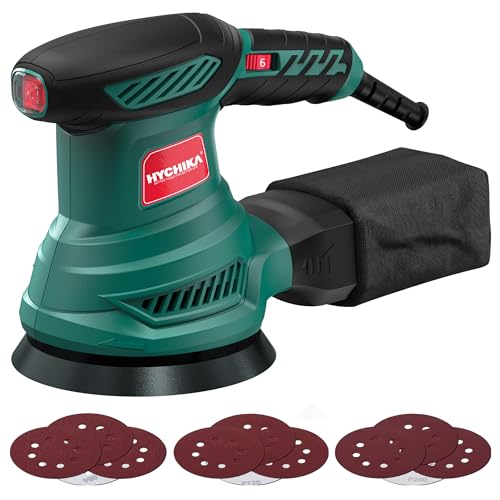
Best for: an occasional user sanding small furniture and craft projects. Skip it if: you sand for hours at a stretch.
HYCHIKA describes the FL117 as a 300W motor with a claimed top speed of 13,000 RPM and six variable speeds, an 8-hole vacuum pattern feeding an upgraded large-capacity dust bag, and 12 pieces of sandpaper in the box. The body measures 5.16 x 9.17 x 6.61 in with a textured rubber grip HYCHIKA says reduces fatigue when the tool vibrates. This is the cheapest of the five, which is the reason to buy it and the reason to know its limits.
Two limits worth being honest about. HYCHIKA does not publish a weight figure on this listing, and it does not publish a warranty term either. Sales rank tells a story too: the FL117 sells the slowest of the five in the Random-Orbit Sanders category by a wide margin, so second opinions from other woodworkers will be harder to find than for the SKIL or the DEWALT tools. For a rocking chair refinish or a set of shop jigs, that is a workable trade. For daily furniture-shop use, it is not.
Pros:
- Lowest price position in the set
- 12 sanding sheets included
- 8-hole vacuum pattern and large dust bag
- Six variable speeds on the dial
- Hook-and-loop pad for fast paper changes
Cons:
- No weight or warranty published
- The slowest seller of the five here
- Cloth dust bag, not a cyclonic box
Corded or cordless: which suits a woodworker better?
Four of the five picks here are corded, and one, the DCW210B, is cordless on the DEWALT 20V MAX platform. The choice is not about power. All five claim orbit speeds inside the same 8,000 to 14,000 band, and a random-orbit sander is not motor-limited on hardwood the way a router is. The choice is about where you sand.
A bench woodworker who works next to an outlet loses nothing with a cord. The cord is thinner than a vacuum hose, so it does not add drag, and mains power means the tool runs as long as your abrasive lasts. A site carpenter who sands a deck rail, a stair tread and a door in a single visit gains real time from cordless.
If you do not already own DEWALT batteries, the corded SKIL is the honest buy. If you own two or more 20V MAX packs from a drill kit, the DCW210B is the tool that fits into the routine you already have.
Dust collection: what these five actually offer
The five picks split three ways on dust:
- Cyclonic dust box built into the tool. The SKIL SR211601 is the only one here, per SKIL's description of an X-flow cyclonic collector.
- Cloth or plastic dust bag included. The DEKOPRO ships with a detachable dust bag; the HYCHIKA ships with what the brand calls an upgraded large-capacity dust bag over an 8-hole pattern.
- Dust port only, vacuum sold separately. Both DEWALT tools sit here. The DWE6423 fits the DWV010 or DWV012 extractors, per DEWALT's listing.
For a woodworker sanding indoors, the SKIL's box is the least fuss. For anyone with a shop vac already, the DEWALT corded tool is the cleanest air. A bag alone, on either budget pick, is fine for short sessions but will not keep fine hardwood dust out of the room.
How to read the speed numbers on the box
Every listing here shouts a top speed. Some say OPM, orbits per minute, some say RPM, revolutions per minute. On a random-orbit sander those are not the same thing, because the pad both rotates and orbits, and the brands do not always distinguish. Treat the printed top figure as the manufacturer's claim, not a tested rating.
What matters more is the speed range. A dial with real variable speed lets you slow the pad for a delicate finish coat, then wind it back up for stock removal. DEWALT publishes a range of 8,000 to 12,000 OPM on both its tools. SKIL, DEKOPRO and HYCHIKA publish a single top figure and a claim of six or more speeds without printing the low end. That is not disqualifying, but it is worth knowing before you buy.
What a woodworker still has to buy
None of these five sanders arrives with everything a woodworker needs to complete a real project. Plan on:
- Extra 5-inch hook-and-loop discs, in the grits the tool did not include. Every pick uses the same 5-inch standard, so abrasives are interchangeable across all four corded picks and easy to source.
- A dust mask rated for fine wood dust, regardless of which pick you choose. Even the SKIL's cyclonic box does not capture everything.
- A shop vacuum with a suitable hose adaptor, if you buy either DEWALT corded tool and want the dust-port design to work as intended.
- For the DCW210B, at least one 20V MAX battery and a compatible charger, since the listing is tool-only.
- A sanding block or two for corners and profiles the round pad cannot reach.
Budget for the abrasives first. A cheap sander with the right grit progression outperforms a premium sander with the wrong paper every time.
The verdict
The best budget orbital sander for woodworkers is the SKIL SR211601. It pairs a 2.8-amp motor with a claimed 13,000 OPM, a cyclonic dust box that empties from a transparent container, and a compact 5.51 x 7.87 x 4.8 in body at 3.44 lb, all inside a mid price position and with a 1-year limited warranty stated on the listing.
Two conditions flip the recommendation. If you already own DEWALT 20V MAX batteries and a charger, the DCW210B is the smarter buy, because it drops to 2.16 lb, ships with a 3-year limited warranty and a 90-day money-back window, and gives you cordless freedom the SKIL cannot match. If you already own a shop vacuum and want a corded tool built around it, the DEWALT DWE6423 is the upgrade, with a 3-amp motor, a dust-sealed switch, and a direct fit to DWV010 or DWV012 extractors.
The DEKOPRO and the HYCHIKA are honest budget picks. Both throw abrasives into the box and both accept the trade-offs that come with an entry price, chiefly a shorter feature list and no published warranty. Neither dislodges the SKIL as the default choice.
FAQ
Is a budget orbital sander good enough for real woodworking?
A budget orbital sander is good enough for hobby furniture, cabinet refinishing and small carpentry, provided the tool has variable speed and either a dust box or a vacuum port. Every pick in this comparison meets that bar. What a budget tool gives up is warranty length and long-run switch life, not sanding quality on a single project.
Is the DEWALT DCW210B worth the extra money?
The DEWALT DCW210B is worth the extra money if two things are true: you already own 20V MAX batteries, and you want the 3-year limited warranty plus the 90-day money-back window DEWALT publishes on this listing. If you have to buy a battery and charger as well, the total spend rises above the corded picks and the value case gets weaker.
What size sanding pad do these tools use?
The sanding pad size on every pick that publishes it is 5 inches, the standard random-orbit format. SKIL, the two DEWALT tools, DEKOPRO and HYCHIKA all use 5-inch hook-and-loop discs. That means abrasives are interchangeable between them, and you can stock a single set of grits for whichever tool you own.
SKIL SR211601 vs DEWALT DWE6423, which should a beginner buy?
SKIL SR211601 vs DEWALT DWE6423 comes down to dust. The SKIL includes a cyclonic dust box in the tool, so a beginner sanding indoors gets clean air without a vacuum. The DWE6423 assumes you already own a DWV010 or DWV012 extractor. For a first sander, the SKIL is the easier buy; the DEWALT is the upgrade.
Which feature do woodworkers most often overpay for?
The feature woodworkers most often overpay for is peak orbit speed. Every tool here claims a top figure between 12,000 and 14,000, so paying more for a higher number on the box buys almost nothing. The specifications worth paying for are a longer warranty, a brushless motor, a sealed switch and a proper dust box or extractor port.
Start with the SKIL SR211601 unless a specific reason pushes you elsewhere: a battery platform you already own, a shop vacuum ready to plug in, or a starter kit that has to include abrasives from the first cut. Order a fresh pack of 5-inch discs in 80, 120 and 220 grit at the same time, because the sheets in the box will not last a serious project. Woodworkers who buy the sander and the abrasives together finish their first piece the same weekend, and that is the honest reason the SKIL is the default in this comparison.
Last updated: September 7, 2026. Product availability re-checked.
This page contains affiliate links. As an Amazon Associate we earn from qualifying purchases, at no extra cost to you.