Best Compact Orbital Sanders by Weight and Reach
Six random orbit sanders lined up by weight, height and dust handling, with the SKIL SR211601 leading on grip comfort and the DEWALT DWE6423 close behind on power.
The best compact orbital sander for most people is the SKIL SR211601, a 5-inch random orbit sander that weighs 3.44 lb and pairs a 2.8-amp motor with a cyclonic dust box the listing rates at 13,000 orbits per minute. Buyers comparing these tools tend to fixate on motor amps. That is not what decides it. Height above the workpiece, weight in the hand, and how you handle the dust are what separate a sander you finish a project with from one you set down after twenty minutes.
Best compact orbital sander at a glance
| Pick | Weight | Speed (claim) | Price |
|---|---|---|---|
| Best overall SKIL 5" Random Orbital Sander SR211601 |
3.44 lb | 13,000 OPM claim | Check Price |
| Best upgrade DEWALT DWE6423 Random Orbit Sander |
3.4 lb | 8,000–12,000 OPM claim | Check Price |
| Best minimal setup DEWALT 20V MAX DCW210B |
2.16 lb | 8,000–12,000 OPM claim | Check Price |
| Best premium Milwaukee M18 2648-20 |
2 lb | not listed | Check Price |
| Best budget pick HYCHIKA 5-Inch Random Orbital Sander |
not listed | 13,000 RPM claim | Check Price |
| Best for pros DEKOPRO 5" Random Orbital Sander |
3.62 lb | 14,000 RPM claim | Check Price |
How I narrowed the field to six
I started with several dozen listings under Sanders > Random-Orbit Sanders and cut hard on three criteria before comparing anything else. The goal was to end up with a set where the differences were about how each tool handles a small workpiece, not about whether it should exist at all.
The criteria, in order:
- A published pad size or body dimension that makes "compact" honest. Every finalist is a 5-inch pad class or a low-profile body. Full-size 6-inch machines were cut.
- A named motor spec or a battery platform. Vague power claims without either amps or a voltage got dropped, because they leave nothing to compare.
- A stated way to handle dust. Onboard box, bag, or a port that fits a named extractor. A sander without a dust plan is a sander that lives in a haze.
The reason those three, in that order, is that a compact sander lives or dies by whether you can see and feel the surface you are working on. Amp draw sits below all of that: two of the six do not publish an amp figure at all, and both are still credible tools because they publish weight and height instead. If a listing did not give me a figure I could line up against the others in this set, I cut it. What survived is a set of six where every pick has at least one genuine reason to be here and at least one honest weakness against the others.
What actually makes a sander feel compact?
Most guides treat "compact" as marketing. In this set it is measurable. Two numbers matter more than the rest.
Body height above the pad. A shorter tool lets your hand sit lower, which puts your wrist over the workpiece rather than behind it. DEWALT specifically calls this out on both the DWE6423 ("shorter height allows the user to get closer to the workpiece") and the DCW210B ("low-profile height allows user to get close to work surface"). It is the single feature that separates a controllable palm sander from one you fight.
Weight in the hand. The Milwaukee 2648-20 is listed at 2 lb, the DEWALT DCW210B at 2.16 lb, the two DEWALT and SKIL corded models at 3.4 to 3.44 lb, and the DEKOPRO at 3.62 lb. That is a spread of over 1.6 lb across six tools that all look similar in photos. On a vertical surface, after ten minutes, you feel every ounce of it.
Pad diameter is a distant third. Every pick here except the Milwaukee explicitly quotes a 5-inch pad, and even where it is not written, the category is set up around that size. Do not choose on pad size. Choose on the two numbers above.
1. SKIL 5" Random Orbital Sander SR211601 — Best overall
A light, well-balanced corded 5-inch with the tidiest onboard dust handling in the set.

Best for: hobbyists who want a light, controllable 5-inch sander with onboard dust collection Skip it if: you need to plug into a shop vac and skip the dust box entirely
The SKIL wins on the numbers that actually decide this category. At 3.44 lb with a body of 5.51 x 7.87 x 4.8 in, it is the shortest and least awkward corded pick in the set, and it is the only one here with a transparent cyclonic dust container you can watch fill. SKIL rates the motor at 2.8 amps and 13,000 orbits per minute, with variable speed control across that range, so slowing down for finish grits does not mean fighting the tool. A soft rubber grip and a counterweight balance the vibration path. The trade-off is the one you accept for every dust-box sander: the container is small, and on a long session you will empty it several times rather than run a hose. The one-year limited warranty is the shortest published in this set, and only one seller lists the tool.
Pros:
- Lightest corded pick at 3.44 lb
- Transparent cyclonic dust box you can monitor
- Variable speed across the 13,000 OPM range
- Compact body at 5.51 x 7.87 x 4.8 in
- The one buyers choose most often here
Cons:
- One-year limited warranty is the shortest in the set
- Only one seller stocks it
- Onboard dust box fills faster than a hose-fed setup
2. DEWALT DWE6423 Random Orbit Sander — Best upgrade
A corded, low-profile DEWALT built to fit directly onto a DWV010 or DWV012 dust extractor.

Best for: anyone who already runs a DEWALT dust extractor or wants a stiffer, longer body Skip it if: you want a shorter footprint or an onboard dust container
Pick this if you already own a shop vac or dust extractor. The DWE6423 is 3.4 lb, a hair lighter than the SKIL, and its port is designed to fit the DWV010 or DWV012 collectors directly rather than through an adapter. DEWALT quotes a 3-amp motor spinning the pad between 8,000 and 12,000 OPM, a separate counterweight to cut vibration, and a dust-sealed switch that keeps grit out of the electrical path. That is the difference between a hobby sander and one built for weeks of continuous work. The body is longer than the SKIL at 6.38 x 10.3 x 5.44 in, which trades some tight-corner access for a more planted feel on flat panels. No warranty is stated on the listing, which is a genuine gap for a tool at this price position, and two sellers offer it, which is more choice than most picks here.
Pros:
- Dust port mates directly to DWV010/DWV012 extractors
- 3-amp motor with 8,000–12,000 OPM variable speed
- Separate counterweight cuts vibration
- Dust-sealed switch for longer service life
- Two sellers list it, more choice than most picks here
Cons:
- No warranty stated in the listing
- Longer footprint than the SKIL at 10.3 in
- No onboard dust box, so a vac or bag is required
3. DEWALT 20V MAX DCW210B — Best minimal setup
A brushless, cordless 20V MAX sander at 2.16 lb with the strongest published warranty in the set.

Best for: DEWALT 20V MAX users who want to drop the cord for punch-list sanding Skip it if: you do not already own a 20V MAX battery, since this is a bare tool
The DCW210B is the pick if you are already on the DEWALT 20V MAX platform. At 2.16 lb bare, it is the second-lightest tool in this set, and DEWALT builds the same low-profile body and dust-sealed switch into it. The brushless motor runs from 8,000 to 12,000 OPM under variable speed, and the 8-hole hook-and-loop pad is a replaceable part (DWE64233) rather than something you have to send back to service. It carries a 3-year limited warranty with 1-year free service and a 90-day money-back window, which is by a wide margin the longest published coverage in this set. The catch is the one every bare tool carries: no battery, no charger. If you are not already in the ecosystem, the total cost climbs quickly, which is why the price position here understates the real outlay. It is also the second-most-expensive pick in the set.
Pros:
- Cordless bare tool for DEWALT 20V MAX users
- Brushless motor for longer runtime and life
- 3-year limited warranty is the longest in the set
- Second-lightest pick at 2.16 lb
- Replaceable 8-hole hook-and-loop pad
Cons:
- No battery or charger included
- The second-most-expensive pick here
- Only useful if you already own 20V MAX packs
4. Milwaukee M18 2648-20 — Best premium
The lightest sander in this set at 2 lb, on Milwaukee's M18 cordless platform.

Best for: Milwaukee M18 users who want the lightest sander in this set at 2 lb Skip it if: you need a published warranty or a detailed spec sheet
The Milwaukee 2648-20 is the most expensive pick here and also the lightest, at a listed 2 lb. Its body is 7 x 6 x 11 in, and it sells as a bare tool on the M18 platform. If you already run M18 for drills, drivers and impacts, the case is straightforward: one battery ecosystem, one charger, and a sander you can grab off the shelf without dragging a cord across the shop. What you do not get from the listing is much of a spec sheet. There is no published warranty, no amp-hour recommendation, and no motor OPM figure. That is not a red flag for Milwaukee as a brand, but it does mean you are buying on platform loyalty rather than a numerical comparison, and it costs the tool the top spot in a data-driven roundup. If any of the corded picks match your workflow, they will show you more of their hand.
Pros:
- Lightest pick in this set at 2 lb
- Cordless on Milwaukee's M18 platform
- Compact 7 x 6 x 11 in body
- Bare-tool format keeps duplicate batteries out of the cart
Cons:
- Highest price position in this set
- No published warranty
- No motor OPM figure listed
- Sparse listing detail overall
- The slowest seller of the six
5. HYCHIKA 5-Inch Random Orbital Sander — Best budget pick
The cheapest way into a 5-inch random orbit sander here, and it ships with 12 sanding discs.
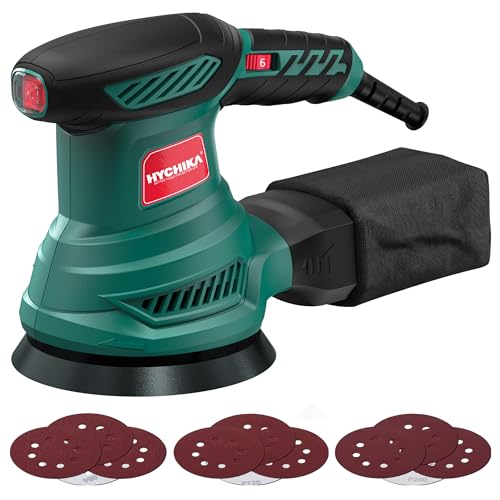
Best for: first-time buyers who want a 5-inch sander with sandpaper already in the box Skip it if: you plan to run it for hours a day on paid work
If a sander is a once-a-month tool for you, the HYCHIKA earns the spot. It is the cheapest of the six, and HYCHIKA quotes a 300W motor delivering up to 13,000 RPM with six-speed control, an eight-hole vacuum pattern paired with a dust bag, a hook-and-loop pad, and 12 sanding discs in the box. That is a full-kit purchase rather than a bare tool, which changes the math for a beginner. What it does not do is publish a weight, and the model number in the listing is a generic one, which is common in this price band and worth going in with eyes open. The body is 5.16 x 9.17 x 6.61 in, which is longer than the SKIL and shorter than the DEWALT DWE6423. It also has the second-slowest sales rank in this set, well behind the SKIL and both DEWALTs.
Pros:
- The cheapest of the six
- Six-speed variable control up to 13,000 RPM claim
- 12 sanding discs included
- Hook-and-loop pad for fast paper changes
- Dust bag included
Cons:
- No weight published
- Second-slowest seller of the six
- Full brand and model naming is loose
6. DEKOPRO 5" Random Orbital Sander — Best for pros
A six-speed kit with 16 discs across six grits, ready to sand out of the box.

Best for: someone stepping up from a sheet sander who wants six speeds and 16 discs included Skip it if: grams matter to you, since this is the heaviest pick at 3.62 lb
The DEKOPRO leans into the "starter kit" idea harder than the HYCHIKA. DEKOPRO quotes a 2.5-amp motor running up to 14,000 RPM, six variable speeds, and 16 sanding discs across 60, 80, 120, 240, 400 and 1000 grits, which is genuinely useful because it covers coarse stock removal through to polish without a separate paper run. A hook-and-loop pad handles fast paper changes, and there is a detachable dust bag. The catch is weight: at 3.62 lb, this is the heaviest tool in the set, and it has the highest quoted OPM claim in the set as well, so the vibration path is doing real work. The dimensions on the listing are clearly a placeholder (0.79 x 0.79 x 0.79 in), which is a listing-quality issue rather than a real spec. Second-cheapest here, and better sold than the HYCHIKA on published sales rank.
Pros:
- The second-cheapest here
- 16 discs across six grits included
- Six-speed dial up to 14,000 RPM claim
- Detachable dust bag
- Ventilation design called out for heat
Cons:
- Heaviest pick in this set at 3.62 lb
- Listing dimensions are clearly a placeholder
- No published warranty
Corded or cordless: which suits your bench?
Half of this set is corded and half is cordless, and the split is more useful than any brand loyalty.
Corded picks (SKIL SR211601, DEWALT DWE6423, HYCHIKA, DEKOPRO) give you continuous power for as long as the outlet holds up. They tend to publish amp figures: 2.5A on the DEKOPRO, 2.8A on the SKIL, 3A on the DEWALT DWE6423. On long sanding sessions, or when you are working through several grits on a large panel, corded is the honest choice. A sander that dies partway through a grit leaves a witness line you then have to sand out.
Cordless picks (DEWALT DCW210B, Milwaukee 2648-20) shine on punch-list work. Both are notably lighter, both are bare tools, and both assume you are already on the platform. If you have to buy in from scratch, you are paying for a battery, a charger and a tool at once, and the price position of the bare tool alone will mislead you.
The cutoff is simple. If your longest session is under an hour and you already own compatible batteries, cordless. If you sand for a living, or you plan to attach a dust extractor, corded.
How well does the onboard dust box really work?
Every finalist has some form of dust handling, but they are not equivalent.
- Cyclonic dust box: the SKIL. Uses cyclone force to drop dust into a transparent container. Easier to empty than a bag, and you can see when it is full.
- Dust bag: the HYCHIKA and the DEKOPRO. Cheap, adequate, and the bag pulls off for emptying. Fills faster than it looks like it should.
- Direct port to a named extractor: the DEWALT DWE6423. The port fits the DWV010 or DWV012 collectors. This is the setup that keeps a shop breathable during long work.
- Port only, ecosystem-dependent: the DEWALT DCW210B and the Milwaukee 2648-20 both take a hose but the listings do not spell out a specific extractor pairing.
The honest reality of every onboard box or bag is that it captures a share of the dust, not all of it. If you are working indoors, in a finished room, or on anything reactive to airborne particles, the DEWALT DWE6423 paired with a vac is the setup here that gives you the cleanest bench. If you are outdoors on a deck or in a garage with the door open, any of these will do the job.
What the listings do not tell you
A few things the Amazon pages leave out that shape which of these you actually want.
- Replacement pad availability. The DEWALT DCW210B calls out its pad part number (DWE64233). The others do not, which means if you wear a pad out, sourcing a replacement is a search rather than an order.
- Battery amp-hour recommendations for the cordless picks. Neither the DCW210B nor the Milwaukee 2648-20 lists a preferred pack size. A larger amp-hour battery adds weight to a tool whose whole appeal is being light.
- How the variable-speed dial is graduated. The SKIL, DEWALT DWE6423 and DCW210B quote ranges. The HYCHIKA and DEKOPRO quote six discrete positions. Six positions is easier to remember; a continuous dial is more precise.
- Noise. Nobody quotes a decibel figure. All of these tools are loud. Ear protection is not optional.
Two of these gaps have workarounds and two do not. Pad availability and dial behaviour you can research before you order. Battery weight and noise you only find out with the tool in your hand.
The verdict
The SKIL SR211601 is the best compact orbital sander for most buyers because it lands the three numbers that matter for this category: 3.44 lb in the hand, a body under 8 in long, and a transparent cyclonic dust box that keeps a hobby bench workable without a shop vac. It is also the pick that sells fastest in this set, and the price position sits in the middle of the field rather than at either extreme.
Two conditions flip the recommendation. If you already own a dust extractor or run DEWALT corded tools, the DWE6423 is the better buy: the direct port fit to the DWV010 and DWV012 is the cleanest dust-handling story here, and the 3-amp motor with a dust-sealed switch is built for longer service. If you are already on the DEWALT 20V MAX platform, the DCW210B drops the cord entirely at 2.16 lb and carries the strongest published warranty in the set at three years limited.
Everyone else, including buyers on Milwaukee M18 and first-timers on a budget, has a valid pick here. The SKIL is the default.
FAQ
Is a compact orbital sander worth it over a full-size model?
Is a compact orbital sander worth it depends on what you actually sand. For furniture panels, doors, cabinets, small tabletops and DIY work, a 5-inch pad is easier to control and less tiring than a 6-inch machine. For flooring or long deck boards, a bigger, heavier sander finishes faster. Every pick in this set is aimed at the first job, not the second.
How much does a good compact orbital sander cost?
A good compact orbital sander sits in the middle of a wide range. The HYCHIKA and DEKOPRO are the entry tier and include sandpaper kits, the SKIL and the corded DEWALT DWE6423 sit in the middle, and the DEWALT 20V MAX and Milwaukee M18 are the premium bare tools. Where you land depends on whether you value a full kit, a corded workhorse, or a cordless platform play.
What is the difference between the DEWALT DWE6423 and the DCW210B?
The difference between the DEWALT DWE6423 and the DCW210B is corded versus cordless. The DWE6423 is a corded 3-amp sander at 3.4 lb with a port designed for DEWALT dust extractors. The DCW210B is a 20V MAX brushless bare tool at 2.16 lb with a three-year warranty. The DCW210B is lighter, but the DWE6423 is the better long-session choice.
Can I use a compact orbital sander for metal or just wood?
Can I use a compact orbital sander on metal depends on the disc, not the tool. The listings here call out woodworking, finishing and polishing. With the right abrasive, a random orbit sander will scuff metal for paint prep, but heavy stock removal on steel is not what any of these are designed for. Match the grit to the material and keep the pressure light.
Does a bigger motor mean a better finish?
Does a bigger motor mean a better finish, not really. Motor amps or OPM claims tell you how fast the pad can move, not how smooth the surface ends up. Grit progression, dust extraction, pad flatness and how steady you keep the tool matter more. The 2.5A DEKOPRO can leave the same finish as the 3A DEWALT if you work the grits in order and let the sander do the work.
Start with the SKIL SR211601 unless you have a specific reason to pick otherwise, and you will spend the money once. The reason to default to it is not that it wins any single specification: the Milwaukee is lighter, the DEWALT DWE6423 has more amps, the DEKOPRO has more discs in the box. It is that the SKIL is the only pick here that lands a light body, a short footprint, variable speed across the full range, and a dust box you can actually monitor, in one tool, without asking you to buy into a battery platform first. That is what compact means when the sanding starts.
Last updated: September 7, 2026. Product availability re-checked.
This page contains affiliate links. As an Amazon Associate we earn from qualifying purchases, at no extra cost to you.