Best Budget Wood Planer for Real Shop Work
A ranked look at five affordable planers, from a 0.55 lb block plane to a 6-amp corded model, with the depth-adjustment figures that actually separate them.

By Taylor DavidsonUpdated 14 min read
On this page
- Best budget wood planer for woodworkers at a glance
- Which buyer does each of these planers fit?
- Powered or hand planer: which do you actually need?
- 1. WEN 6530 6-Amp Electric Hand Planer — Best overall
- 2. JORGENSEN NO.60-1/2 6-1/4" Wood Planer — Best premium
- 3. Amazon Basics Woodworking Hand Planer — Best for families
- 4. WEN 6528 3.8-Amp Electric Hand Planer — Most versatile
- 5. JORGENSEN No.101 Mini Wood Planer — Best budget pick
- How I screened this shortlist
- What the listings do not tell you about a budget wood planer
- What more money buys in this set
- The verdict
- FAQ
The best budget wood planer for woodworkers is the WEN 6530, a 6-amp corded planer with 16 depth stops running from 0 to 1/8 inch across a 3-1/4-inch cutting width. If your work is chamfers, end grain and door edges rather than rough stock, the JORGENSEN NO.60-1/2 block plane does that job better at 1.48 lb. Most shopping guides line these tools up by amps or by blade steel. Neither figure decides it. What decides it is how finely you can set the depth of cut, and how wide a bite the tool takes in one pass.
Best budget wood planer for woodworkers at a glance
| Pick | Cutting width | Depth control | Price |
|---|---|---|---|
Best overall WEN 6530 6-Amp Electric Hand Planer |
3-1/4 in | 16 stops 0 to 1/8 in |
Check Price |
Best premium JORGENSEN NO.60-1/2 6-1/4" Wood Planer |
6-1/4 in body | Knob-adjustable blade | Check Price |
Best for families Amazon Basics Woodworking Hand Planer |
2 in blade | Adjustable mouth and depth gauge |
Check Price |
Most versatile WEN 6528 3.8-Amp Electric Hand Planer |
2-3/8 in | 9 stops 0 to 1/16 in |
Check Price |
Best budget pick JORGENSEN No.101 Mini Wood Planer |
Mini block body | Knob-adjustable blade | Check Price |
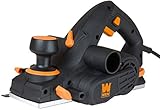

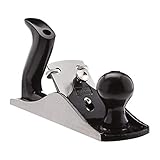
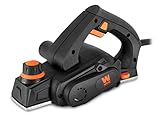

Which buyer does each of these planers fit?
Five tools, five different jobs. Match yourself to one of these before you look at anything else.
- You hang doors, fit stair treads or dress framing lumber. You need width and power. The WEN 6530 takes a 3-1/4-inch bite and steps depth in 16 increments up to 1/8 inch. That is the pick.
- You build small furniture and want clean end grain. A low-angle block plane suits you. The JORGENSEN NO.60-1/2 weighs 1.48 lb and fits one hand.
- Two or three people share your bench, including a teenager learning. The Amazon Basics No.4 bench plane is a 2.66 lb cast-iron body with a 2-inch blade and no cord to trip over.
- You plane narrow edges, often above shoulder height. The WEN 6528 weighs 4.3 lb, a full 2.2 lb less than the 6530, and its 1/16-inch maximum depth makes it harder to gouge a board.
- You just want to knock off splinters and ease corners. The JORGENSEN No.101 is 0.55 lb and 1.97 x 3.54 x 1.26 in. It lives in an apron pocket.
Notice that only two of the five are powered. That split is the real decision here, and I'll come back to it.
Powered or hand planer: which do you actually need?
Amps look like the headline number. They aren't. A 6-amp motor spinning 34,000 cuts per minute removes material fast, and speed is exactly what ruins a workpiece when you only meant to take a shaving off a drawer side.
Here's the split in plain terms:
- Powered planers remove stock. Both WEN models step through fixed depth positions, so you get a repeatable bite. The 6530 offers 16 stops to 1/8 inch; the 6528 offers 9 stops to 1/16 inch.
- Hand planes refine surfaces. The three JORGENSEN and Amazon Basics entries have no motor and no cord. Depth is set by turning a knob or an adjuster and reading the shaving.
- Only powered planers here have a stated warranty. The 6530 lists 2 years, and the 6528's listing states two years as well. None of the three hand planes publishes a warranty term.
The practical rule: if you're taking off more than about 1/16 inch of material along a run of stock, a motor saves you real time. Below that, a hand plane gives you control a corded tool never will. A best budget wood planer for woodworkers doing both kinds of work is really two tools, and the cheapest of the five costs so little relative to the rest that pairing it with a powered model is a reasonable plan.
1. WEN 6530 6-Amp Electric Hand Planer — Best overall
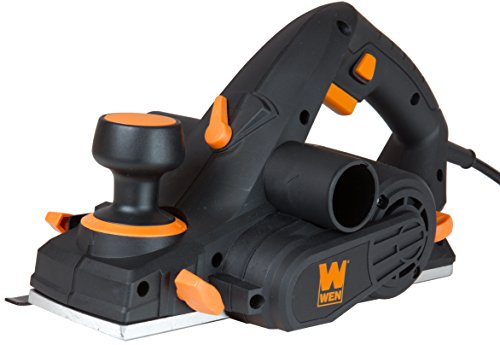
The widest cut and the finest depth stepping in this set, in a 6.5 lb body with a published 2-year warranty.
Best for: flattening doors, studs and rough stock fast Skip it if: your work is small trim and end grain
Two figures put this one on top. The cutting width is 3-1/4 inches, the widest here, and the depth adjuster offers 16 positive stops between 0 and 1/8 inch. That combination is what a woodworker dressing a sticking door or truing a glued-up panel edge actually wants: one pass covers most of the surface, and each click of the dial is a known, repeatable increment. WEN states the 6-amp motor delivers up to 34,000 cuts per minute.
It's the only pick with a rabbeting capability called out in the listing, with a 5/16-inch guide for rabbets up to 1 inch. The box includes a dust bag, a kickstand, a parallel fence bracket and a 2-year warranty, which makes it the most complete kit of the five.
The trade-offs are real. At 6.5 lb it's the heaviest tool here, more than double the 2.66 lb Amazon Basics bench plane and eleven times the No.101. It sits in the more expensive half of this set, only one seller lists it, and it needs a cord and somewhere for chips to go. For a shaving off a drawer bottom, it's the wrong tool.
Pros:
- Widest cut in the set at 3-1/4 inches
- 16 depth stops from 0 to 1/8 inch
- Rabbets up to 1 inch with the 5/16-inch guide
- Ships with dust bag, kickstand and fence bracket
- 2-year warranty stated
Cons:
- Heaviest pick at 6.5 lb
- Corded, so cable management is on you
- Only one seller lists it
- Overkill and hard to control on fine trim work
2. JORGENSEN NO.60-1/2 6-1/4" Wood Planer — Best premium
The one-handed block plane in this set, with a ductile iron body and an O1 tool steel blade.

Best for: end grain, chamfers and one-handed trim work Skip it if: you need to hog off material quickly
This is the tool the two WEN planers cannot replace. It's a 6-1/4-inch block plane weighing 1.48 lb, which means you can hold the work in one hand and plane with the other. Chamfering a table edge, easing a tenon shoulder, cleaning up end grain on a mitre: that's block plane territory, and neither powered pick belongs there.
JORGENSEN says the blade is O1 tool steel, finely sharpened, and that the body is ductile iron and drop-tested. Depth is set by turning a knob rather than clicking through stops, which is slower to dial in than the WEN 6530's 16 positions but gives you shavings finer than any fixed increment allows. An instruction manual is included.
It carries the highest price position of the five, and it's the slowest seller here, which tells you most shoppers arriving at this category are looking for a motor. There's no published warranty term, no dust collection to speak of, and no fence. The honest trade-off: you're paying the most in this set for the least material removed per minute. That's the correct choice for finish work and the wrong one for stock prep.
Pros:
- Lightest full-size plane here at 1.48 lb
- O1 tool steel blade per the listing
- Ductile iron body, drop-tested per JORGENSEN
- Knob depth adjustment for very fine shavings
Cons:
- Highest price position in the set
- No stated warranty term
- Slowest seller of the five
- Removes material far slower than either powered pick
3. Amazon Basics Woodworking Hand Planer — Best for families
A No.4 bench plane with a 2-inch blade and an adjustable mouth, and the only pick with more than one seller besides the NO.60-1/2.

Best for: smoothing board faces and shared shop use Skip it if: you have no way to sharpen and tune a blade
The No.4 smoothing plane is the pattern most woodworkers learn on, and this is the cheapest route into it here bar the mini block plane. At 2.66 lb and 2.5 x 9.8 x 4.8 in, it has a front knob and a rear grip, which is why it tracks straight over a board face in a way a one-handed block plane cannot.
Amazon Basics lists a 2-inch steel blade, an adjustable mouth and a depth gauge, plus a cast-iron body they say reduces vibration. Adjustment screws and a lever cap handle blade positioning, and the manual covers keeping the sole flat. Two sellers stock it, the widest availability in this set.
Where it gets awkward is the tuning. Entry-level bench planes generally need the blade honed and the sole checked before they cut cleanly, and nothing in the listing suggests otherwise. If nobody in your shop owns a sharpening stone, that's a real barrier. There's no published warranty, and no model of the tool exists that removes 1/8 inch in a pass the way the 6530 does. Against the JORGENSEN pair, you get more sole length and two handles; against the WEN pair, you give up speed entirely.
Pros:
- Two-handled No.4 pattern for long, straight strokes
- 2-inch steel blade with adjustable mouth
- Cast-iron body per the listing
- Second-cheapest pick here
- Two sellers stock it
Cons:
- Needs sharpening and sole checking to perform
- No stated warranty
- Narrowest blade of the two bench-style options at 2 inches
- Slower than either powered planer on rough stock
4. WEN 6528 3.8-Amp Electric Hand Planer — Most versatile
A 4.3 lb powered planer whose 1/16-inch depth ceiling makes it much harder to over-cut than the 6530.

Best for: narrow edges and long overhead sessions Skip it if: you plane boards wider than 2-3/8 inches
This is the powered planer for people who don't trust themselves with 1/8 inch of depth. The 6528 cuts 2-3/8 inches wide and offers 9 positive stops from 0 to 1/16 inch, half the maximum bite of the 6530. On a door edge or a cabinet stile, that ceiling is a safety net. WEN states a 3.8-amp motor delivering up to 32,000 cuts per minute.
Weight is the other argument. At 4.3 lb it's 2.2 lb lighter than the 6530, and if you've ever planed the top edge of a hung door for twenty minutes you know what that difference does to your shoulders. There's an onboard storage slot for the blade adjustment wrench, a kickstand to keep the drum off your workpiece, and a two-year warranty per the listing. It sits roughly mid-range for price in this set.
The cuts are narrower, which means more passes on any wide surface, and there's no dust bag or fence bracket mentioned in the listing, both of which the 6530 includes. Only one seller lists it, and it's a slower seller than the 6530. Buy it for control and comfort, not for throughput.
Pros:
- 2.2 lb lighter than the 6530
- 1/16-inch depth ceiling limits over-cutting
- Onboard wrench storage and kickstand
- Two-year warranty per the listing
- Mid-range price position here
Cons:
- Cuts nearly an inch narrower than the 6530
- No dust bag or fence bracket listed
- Fewer depth stops, at 9 versus 16
- Only one seller lists it
5. JORGENSEN No.101 Mini Wood Planer — Best budget pick
The cheapest of the five and the only one that fits in a pocket, at 0.55 lb.

Best for: deburring, easing edges and pocket-carry touch-ups Skip it if: you need to true a full board face
At 1.97 x 3.54 x 1.26 in and 0.55 lb, this is a specialist. It's a mini block plane for chamfering a sharp corner, cleaning a saw-cut edge, fitting a small drawer runner, or trimming a plug flush. Every other tool here is too big for those jobs. This one lives in the pocket of your apron and comes out ten times a session.
JORGENSEN lists the same materials as the larger NO.60-1/2: an O1 tool steel blade and a ductile iron body they describe as drop-tested. Depth is set by a knob. It's the cheapest pick in this set and it sells faster than every other planer here except nothing, in fact it's the one buyers choose most often across these five, which tracks with how many people want a cheap tool for small tasks.
The limits are obvious from the dimensions. A 1.97-inch body cannot register flat across a wide board, so you will never true a face or a long edge with it. There's no warranty term published, no fence, no mouth adjustment described beyond blade depth. Against the Amazon Basics No.4 it does a completely different job for less money, which is the whole reason to own one alongside something bigger rather than instead of it.
Pros:
- Cheapest pick in this set
- Just 0.55 lb and pocket-sized
- O1 tool steel blade per the listing
- The one buyers choose most often here
Cons:
- Body too short to flatten a board face
- No stated warranty
- Only one seller lists it
- Not a substitute for a full-size plane
How I screened this shortlist
I built this set around buyer profiles rather than around a single specification, because a corded planer and a block plane are not competing for the same job.
Four profiles drove the picks:
- The stock-prep woodworker who needs material gone. That demanded a powered pick with a wide cut and repeatable depth stops, which is how the WEN 6530 landed at number one.
- The furniture maker working end grain and small joinery. That demanded a block plane, filled by the JORGENSEN NO.60-1/2 at 1.48 lb.
- The shared-bench household where cords and 34,000 cuts per minute are a liability. That's the Amazon Basics No.4.
- The occasional trimmer who wants one cheap tool for corners and splinters, served by the No.101.
The WEN 6528 earned its slot as the bridge: powered, but with a 1/16-inch depth ceiling and 4.3 lb of weight rather than 6.5 lb.
What I did not screen for was blade steel alone. Three of the five listings make claims about their cutting edge, and none of them is verifiable from a listing. Depth adjustment, cutting width and weight are published figures you can compare directly, so those carried the ranking.
What the listings do not tell you about a budget wood planer
Three gaps in this data are worth knowing before you buy.
Sharpening is assumed, never explained. The JORGENSEN listings state O1 tool steel blades and the Amazon Basics listing states a 2-inch steel blade. None tells you the bevel angle or whether the edge is ready to cut out of the box. Budget for a stone.
Warranty coverage is uneven. Only the two WEN planers publish a term, both at two years. The three hand planes list no warranty at all. That doesn't mean there's none, only that you're buying without a stated one.
Dust and chips are your problem on one of the two powered picks. The 6530's listing names a dust bag. The 6528's does not. Planing indoors without collection means shavings across the whole shop.
Availability is thin. Three of the five have a single seller listed. The Amazon Basics No.4 and the JORGENSEN NO.60-1/2 each have two. That's the extent of what's published.
What more money buys in this set
Moving up in price here does not buy you a better tool. It buys you a different one.
The cheapest pick, the No.101, buys pocket portability and nothing else. The second-cheapest, the Amazon Basics No.4, buys sole length and two handles. Mid-range gets you the WEN 6528: a motor, 9 depth stops and a warranty. The more expensive half splits oddly. The WEN 6530 buys width, 16 stops, a rabbeting guide and a full accessory kit. The single most expensive pick, the JORGENSEN NO.60-1/2, buys precision in a tool with no motor at all.
So price tracks capability only inside each type. Across types it tells you nothing, and that's the trap in shopping for the best budget wood planer for woodworkers by cost alone. Decide powered or hand first. Then let price sort the options within that group.
The verdict
At the entry end, the JORGENSEN No.101 is a genuinely useful 0.55 lb tool for corners, plugs and splinters, and it's the one buyers here reach for most. It is not a planer for board faces, and it doesn't pretend to be.
In the middle, the choice is between two very different things. The Amazon Basics No.4 gives you a 2.66 lb cast-iron bench plane with a 2-inch blade for the price of a takeaway meal, provided you'll sharpen it. The WEN 6528 gives you a 4.3 lb motor with 9 depth stops capped at 1/16 inch, which is the most forgiving powered option here.
At the top, the WEN 6530 is the best budget wood planer for woodworkers who need stock removed: 3-1/4 inches of cutting width, 16 depth stops to 1/8 inch, a rabbeting guide to 1 inch, dust bag, fence bracket and a 2-year warranty. The JORGENSEN NO.60-1/2 costs more and removes less, and it's still the right buy if your work is end grain and chamfers.
The cutoff is simple. Above 1/16 inch of material to remove, go powered. Below it, go by hand.
FAQ
Is a budget wood planer worth buying over a more expensive model?
A budget wood planer is worth buying when the published figures cover your actual work. The WEN 6530 lists 16 depth stops to 1/8 inch and a 3-1/4-inch cut, which handles doors and rough stock. What you give up at this level is refinement of the fit and finish, not the core capability. Most of these tools also expect you to sharpen the blade yourself.
Which is the best budget wood planer for woodworkers doing fine furniture work?
The best budget wood planer for woodworkers doing fine furniture work is the JORGENSEN NO.60-1/2 block plane. At 1.48 lb it works one-handed on chamfers and end grain, where a powered planer taking 1/8-inch bites would ruin the surface. Its knob depth adjustment produces shavings finer than any fixed-stop tool in this set. Pair it with a stone.
How does the WEN 6530 compare to the WEN 6528?
The WEN 6530 compares to the 6528 on three published figures. The 6530 cuts 3-1/4 inches wide with 16 stops to 1/8 inch and weighs 6.5 lb. The 6528 cuts 2-3/8 inches with 9 stops to 1/16 inch and weighs 4.3 lb. Choose the 6530 for throughput and the 6528 for lighter, more forgiving work overhead.
What cutting depth do I need on a hand planer?
The cutting depth you need depends on the job. For dressing framing lumber or door edges, the 6530's range to 1/8 inch saves passes. For cabinet stiles and finish surfaces, the 6528's 1/16-inch ceiling is safer, since a deeper setting on a narrow edge digs in fast. Hand planes here adjust by knob with no fixed limit stated.
What mistake do first-time planer buyers make?
The mistake first-time planer buyers make is treating amps as the deciding number. A 6-amp motor at 34,000 cuts per minute removes material quickly, which is exactly wrong for finish work. Buy for depth control and cutting width instead. And check whether you own a sharpening stone before you buy any hand plane in this price range.
Pick your side of the 1/16-inch line and the decision makes itself. If you're squaring doors, dressing studs or flattening glue-ups, the WEN 6530 gives you the widest cut and the finest depth stepping of these five, plus the only kit here that arrives with a dust bag and a fence bracket. If your bench work is small and your surfaces need to look finished, buy the JORGENSEN block plane and a stone, and add the No.101 for the corners. Two tools cover almost everything a small shop throws at you.