Best Cordless Belt Sander When Outlets Are Scarce
Seven belt sanders, three of them cordless. Here's which one actually earns the battery premium, which corded pick still makes more sense in a fixed shop, and the specification most shoppers ignore.
The best cordless belt sander for woodworkers is the DEWALT DCW220B, because its 25-speed selection dial and 3 x 21 in belt give you more control and more sanding surface than anything else here that runs on a battery. If your work is mostly flush against walls, stair risers and cabinet interiors, the Eastyle MFBS01 and its 3 x 18 in belts with a claimed 3-second tension release is the better buy. Three of these seven run cordless. The other four are corded, and that matters.
Here's who should stop reading. If your bench sits three feet from an outlet and never moves, a battery sander buys you nothing but a heavier tool and a charging routine. Buy corded, spend the difference on belts, and get on with it. The rest of this is for people who sand on a jobsite, on a deck, on a ladder, or in a garage where the only receptacle is behind a car.
Best cordless belt sander for woodworkers at a glance
| Pick | Belt size | Speed control | Price |
|---|---|---|---|
| Best overall DEWALT 20V MAX Belt Sander |
3 x 21 in (cordless) |
25-speed dial + variable trigger |
Check Price |
| Runner-up Eastyle Upgraded Brushless Belt Sander |
3 x 18 in (cordless) |
6 speeds to 1247 FPM claim |
Check Price |
| Best minimal setup VERVEWAVE 20V Cordless Bandfile Sander |
Narrow bandfile (cordless) |
6 speeds 4–16.6 m/s claim |
Check Price |
| Best for pros WEN HB321V Variable Speed Belt Sander |
3 x 21 in (corded) |
Variable 620–1200 FPM |
Check Price |
| Best budget pick WEN 6321 7-Amp Belt Sander |
3 x 21 in (corded) |
Single speed 13 ft/sec claim |
Check Price |
| Most versatile SKIL 7510-01 Belt Sander |
3 x 18 in (corded) |
Single speed 6.0 A motor |
Check Price |
| Best upgrade Jellas 7Amp Handheld Belt Sander |
3 x 21 in (corded) |
6-dial knob 13 ft/sec claim |
Check Price |
Why only three of these seven are actually cordless
Search for a best cordless belt sander for woodworkers and Amazon hands you a mixed field. That's not a bug in the search, it's the state of the category. Belt sanders draw hard and continuously, so battery versions arrived late and there still aren't many of them.
Of the seven here, three run on a DEWALT 20V MAX battery: the DEWALT DCW220B, the Eastyle MFBS01 and the VERVEWAVE WT8841-12. The other four plug in. I've kept the corded four in because they're the honest comparison point, and because two of them cost less than a spare battery.
None of the four corded picks can be made cordless. No adapter, no workaround. So read the table's third column first:
- Cordless: DEWALT DCW220B, Eastyle MFBS01, VERVEWAVE WT8841-12
- Corded: WEN HB321V, WEN 6321, SKIL 7510-01, Jellas S1T-SW02A-76
One more thing worth flagging. All three cordless picks are listed as tool-only. The VERVEWAVE listing states plainly that no battery and no charger are included, and the Eastyle is described as a bare tool. If you don't already own DEWALT 20V MAX packs, the battery is a second purchase.
How I cut this field down to seven
Three reasons killed candidates before I compared anything.
- No published belt dimension. A belt sander without a stated belt size is a tool you can't buy consumables for. Any listing that wouldn't name 3 x 18 or 3 x 21 was out.
- No dust handling mentioned at all. Belt sanding produces the coarsest, fastest dust of any sanding operation. Six of these seven name either a bag, a port, or both.
- Battery platform nobody owns. A cordless sander tied to a proprietary pack you'll never buy again is a dead end. All three cordless picks here run DEWALT 20V MAX, which is the platform most likely to already be on your shelf.
What survived splits cleanly. Two picks give you a 3 x 21 in belt with real speed control. Two give you a 3 x 21 in belt cheaply. One gives you pressure feedback. One turns upside down and becomes a bench sander. One is a narrow-arm bandfile that does work a flat-platen sander physically cannot.
I compared the published specifications side by side, column against column: belt size, weight, dimensions, stated speed range, warranty, what's in the box. Where a manufacturer made a claim I couldn't verify against a standard, I've said so in the text rather than treating it as measured fact.
1. DEWALT 20V MAX* Belt Sander — Best overall
The DCW220B pairs the largest belt in the cordless group with the finest speed control of any pick here, which is why it's the default recommendation.

Best for: woodworkers already invested in DEWALT 20V MAX batteries Skip it if: you want belts and a battery included in the box
Speed control is what separates this from the other two cordless picks. DEWALT lists a variable-speed trigger plus a 25-speed selection dial. The Eastyle and VERVEWAVE both list six settings. Twenty-five steps versus six is the difference between creeping up on a figured maple surface and guessing.
The body measures 8.66 x 13.4 x 6.69 in, the largest footprint of any pick here, which is consistent with a 3 x 21 in belt. DEWALT claims 16.7% more sanding surface area than a named competitor's 3 x 18 in cordless model, and up to 22% more power from the brushless motor. Both are the manufacturer's figures, framed against a comparison you can't run at home, so treat them as directional. The dust claim is more specific: up to 95% collection efficiency, but only through DEWALT's AirLock connector, which is sold separately.
Belt changes are tool-free via a quick-release lever. There's a manufacturer warranty listed, though no term is published, which is odd for the most expensive pick in this group.
That's the trade-off. This is the priciest of the seven, it ships as a bare tool with no belts named in the listing, and only one seller stocks it. You're buying the platform and the control, not a kit.
Pros:
- 25-speed dial, the finest speed control here
- Largest cordless belt at 3 x 21 in
- Tool-free quick-release belt changes
- Brushless motor for longer battery runtime
- Runs on DEWALT 20V MAX packs
Cons:
- Most expensive pick in this group
- Bare tool, no battery or charger
- 95% dust figure requires a separately sold AirLock connector
- No warranty term published
- Only one seller lists it
2. Eastyle Upgraded Brushless Belt Sander — Runner-up
A cordless 3 x 18 in sander with a low-profile nose, ten belts in the box and a 5-year warranty, which is the longest coverage of any pick here.

Best for: flush sanding against walls and stair risers Skip it if: you need a wide 3x21 belt footprint
The warranty is the standout number. Eastyle publishes 5 years. Only two other picks in this set publish a term at all, both WEN models at 2 years, and the DEWALT lists a warranty with no length attached. For a sander you plan to keep, five years is a real answer.
At 5 lb and 6.7 x 7 x 5.7 in, this is the lightest and most compact of the picks that publish a weight. Eastyle describes a low-profile nose and a flat side for flush sanding right up against walls and stair risers. That's the case for it over the DEWALT: on a stair job or built-in cabinetry, the DCW220B's 13.4 in length works against you.
The kit is generous. Ten 3 x 18 in aluminium oxide belts, split 4 x 80, 4 x 100 and 2 x 120 grit, plus a detachable bag and a universal adapter for 1-1/4 in or 35mm shop hoses. Eastyle claims 85% dust capture in the bag, six speeds up to 1247 FPM, and belt changes in under 3 seconds via a single tension lever. All manufacturer figures.
The cost of that compact body is belt length. A 3 x 18 in belt covers less per pass than a 3 x 21 in, so flattening a wide tabletop takes longer. It also sells the slowest of these seven, and it sits in the top price bracket without the DEWALT's speed resolution.
Pros:
- 5-year warranty, longest published here
- Lightest published weight at 5 lb
- Ten belts included across three grits
- Flat side and low nose for flush sanding
- Vacuum adapter for 1-1/4 in or 35mm hoses
Cons:
- 3 x 18 in belt covers less than the 3 x 21 in picks
- Only six speed settings, versus 25 on the DEWALT
- Slowest seller of these seven
- Premium price without the DEWALT's control range
- Battery and charger not included
3. VERVEWAVE 20V Cordless Belt Sander Bandfile Sander — Best minimal setup
A narrow-arm bandfile that reaches into curves, tube stock and internal corners no flat-platen sander can touch.

Best for: reaching curves, tube stock and awkward internal corners Skip it if: you sand wide flat panels all day
This is a different tool wearing the same category name. The dimensions tell you everything: 3.74 x 20.1 x 4.53 in. Twenty inches long, under four inches wide. That's a bandfile, and it does jobs the other six physically cannot reach.
VERVEWAVE lists a 170° rotating arm on a tool-free telescopic mount, which is how you get abrasive onto the inside of a curve, along a spindle, or into the corner of a glued-up frame. The listing names six speeds from 4 to 16.6 m/s and a maximum of 3268 ft/min from a pure copper brushless motor. It's specified for wood panels and iron plates both, so metal work is in scope.
It's the cheapest of the three cordless picks, and the count of 6 in the listing suggests belts are supplied, though the grits aren't broken out. Belt changes are tool-free. Two sellers stock it, the only pick here with more than one, which is a minor point in its favour on availability.
The limits are obvious and worth stating plainly. A narrow belt is the wrong tool for flattening a door or levelling a glue line across a panel. No weight is published. No warranty is published. No dust bag or port is mentioned anywhere in the listing, which on a sander this aggressive means you're supplying your own extraction or breathing it.
Pros:
- Reaches curves and internal corners no flat sander can
- 170° rotating telescopic arm, tool-free
- Cheapest of the three cordless picks
- Six speeds spanning coarse and fine work
- Two sellers stock it
Cons:
- Narrow belt is poor for wide flat panels
- No dust collection mentioned at all
- No published weight or warranty
- Battery and charger not included
4. WEN 7.5-Amp 3-by-21-Inch Variable Speed Handheld Portable Belt Sander — Best for pros
The strongest amp rating here with a published speed range, which is a lot of sanding capability for a corded tool.

Best for: a shop that wants variable speed without paying for a battery platform Skip it if: you need to work away from power
Two numbers make the case. This is a 7.5-amp motor, the highest amp figure in the set, and WEN publishes an actual range rather than a single figure: 620 to 1200 feet per minute. That's a stated, verifiable spread. Compare it to the cordless picks, where the numbers are maximums and the low end is described in vague terms.
For fine work that range matters. Drop to the bottom of it for veneer and thin stock, run it wide open for stock removal on construction lumber. Combined with the 3 x 21 in belt, this covers more ground per pass than either the Eastyle or the SKIL.
WEN lists a quick-release belt tension lever, a lock-on switch for continuous runs, a detachable dust bag, a 1-1/4 in dust port and one 80-grit belt to start. The stated 6.4 lb weight comes from the feature copy rather than a published spec field. Warranty is 2 years.
It's also the second-cheapest of the seven, which is the real story. You get variable speed, a 3 x 21 in belt and a warranty for less than any cordless pick here.
The catch is the cord, and that's not a small catch for a jobsite. The published specifications are also thin: no weight field, no dimensions, no colour. If your shop is fixed, none of that matters. If it isn't, this is the wrong tool.
Pros:
- 7.5 amps, highest rating here
- Published 620 to 1200 FPM speed range
- 3 x 21 in belt, largest footprint in the set
- 2-year warranty and a 1-1/4 in dust port
- Second-cheapest of the seven
Cons:
- Corded, so no jobsite portability
- Only one belt included
- Thin published specifications, no weight or dimensions listed
- Only one seller lists it
5. WEN 6321 7-Amp 3 in. x 21 in. Corded Belt Sander — Best budget pick
The cheapest way into a full-width 3 x 21 in belt, with a 2-year warranty attached.
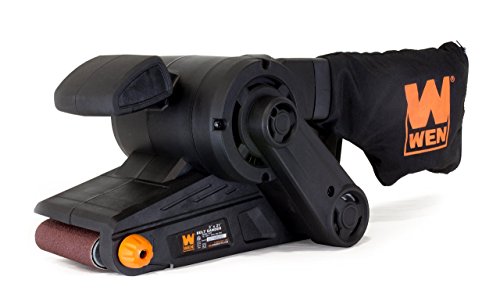
Best for: occasional flattening and paint removal on a tight budget Skip it if: you want to dial the belt speed down for veneer
This is the cheapest pick of the seven, and it still gives you the full 3 x 21 in belt. That combination is unusual. WEN publishes 6.2 lb and 6.5 x 12 x 6 in, making it the second-lightest of the picks that state a weight, and a 2-year warranty backed by what WEN describes as a nationwide network of technicians.
The 7-amp motor is claimed to rotate the belt at over 13 feet per second. There's a detachable dust bag and a lock-in switch for continuous sanding. It also sells faster than any other pick in this group, which tells you something about where most shoppers land.
The missing feature is the one that matters most for woodworking: speed control. This runs at one speed, full out. On construction lumber, deck boards or old paint, that's fine and arguably preferable. On thin stock, veneer or anything figured, a single-speed 3 x 21 in belt is how you sand through a surface before you've registered what happened.
It's corded, so it's out of the cordless conversation entirely. Against the HB321V just above it, you're giving up variable speed and half an amp to save very little. I'd stretch for the HB321V unless the budget is genuinely fixed.
Pros:
- Cheapest pick in this group
- Full 3 x 21 in belt at the entry price
- 2-year warranty with technician network
- 6.2 lb, second-lightest published weight
- Sells faster than the rest of this set
Cons:
- Single speed only, no dial or trigger control
- Corded
- No dust port specified, bag only
- Only one seller lists it
6. SKIL 6 Amp 3"x18" Belt Sander with Pressure Control — Most versatile
The only pick here that tells you when you're pressing too hard, which is the single most common belt sanding mistake.

Best for: beginners who lean too hard on a sander Skip it if: you want the longest belt in this group
Pressure control is a genuinely uncommon feature and it solves a real problem. A belt sander works best under its own weight with your hands only guiding it. Push down and you glaze the abrasive, stall the belt and dig hollows into flat stock. SKIL's system warns you when excessive pressure is applied, which shortcuts the months it usually takes to unlearn that instinct.
The rest is solid rather than exciting. A 6.0 A motor, described by SKIL as enough to sand any type of wood surface, and a 3 x 18 in belt. At 5.51 lb and 5.75 x 12.3 x 6.25 in it's the narrowest body of the corded group, which helps in tight quarters. SKIL lists micro-filtration for fine particles, auto-track belt alignment to keep the belt centred without manual adjustment, and compatibility with standard 1-1/4 in vacuum hoses. Released in 2018.
Auto-tracking is worth more than it sounds. A belt that wanders off the platen scuffs your work and wears unevenly.
Two real limits. The 6.0 A motor is the lowest rating of the seven, and the 3 x 18 in belt is shorter than the four 3 x 21 in picks, so it's slower across a wide surface. There's no published warranty term, and it sells more slowly than either WEN. It's also corded, so it doesn't answer the cordless question at all.
Pros:
- Pressure control warning, unique in this set
- Auto-track keeps the belt centred
- Micro-filtration for fine dust
- 5.51 lb and the narrowest corded body here
- Fits standard 1-1/4 in vacuum hoses
Cons:
- Lowest amp rating of the seven at 6.0 A
- 3 x 18 in belt, shorter than four other picks
- No published warranty term
- Single speed and corded
7. Jellas 7Amp Handheld Belt Sander — Best upgrade
Clamps upside down into a bench sander, which turns one tool into two workstations.

Best for: small parts you'd rather bring to the tool Skip it if: you need cordless portability
The conversion trick is the reason to consider this one. Jellas supplies two metal C clamps so the sander can be inverted and fixed to a bench, with a lock-on button holding the trigger. Invert it and small parts come to the abrasive instead of the other way round, which is how you shape a dowel end, true a mitre or clean a small bracket without chasing it across the bench.
The belt kit is the widest spread here: 10 belts at 2 each of 40, 60, 80, 120 and 180 grit. That covers heavy stock removal through pre-finish work with nothing else to buy. The listing count of 11 lines up with the sander plus ten belts.
Jellas lists a 7 Amp 120V motor rotating the belt at over 13 feet per second, with a 6-dial variable speed knob and a 3 x 21 in belt. The body measures 6.3 x 5.91 x 13.4 in. There's a detachable dust bag. The listing includes a specific note about matching the arrow on the belt to the arrow on the machine, which is the kind of instruction that saves a torn belt on day one.
The problems are the corded supply and the published data. It's a premium-priced tool with no weight, no warranty and no colour-independent spec sheet to speak of. For that money the cordless Eastyle publishes a 5-year warranty. And whatever the bench conversion gives you, it doesn't give you portability.
Pros:
- Converts to a bench sander with two included C clamps
- 10 belts spanning 40 to 180 grit
- 6-dial variable speed knob
- Full 3 x 21 in belt
- Detachable dust bag
Cons:
- Corded, so no jobsite use
- No published weight or warranty
- Premium price with thin published specifications
- Only one seller lists it
What actually decides a cordless belt sander for woodworkers?
Most guides lead with amps or maximum belt speed. Neither decides it. Here's what does, in order.
Speed resolution at the low end. Belt sanders remove material fast. The failure mode isn't lack of power, it's sanding through a veneer or hollowing a panel in four seconds. A tool that only offers "6 settings" tells you the top number and hides the bottom. The DEWALT's 25-speed dial and the WEN HB321V's published 620 to 1200 FPM range are the only two picks here that give you a genuinely fine low end.
Belt length, because it sets your pass count. Four picks use 3 x 21 in belts: the DEWALT, both WENs and the Jellas. Two use 3 x 18 in: the Eastyle and the SKIL. The VERVEWAVE uses a narrow bandfile belt. On a tabletop, a 3 in wide by 21 in belt clears the surface in fewer passes, and fewer passes means fewer chances to tip the tool and gouge.
Where the dust goes. Belt sanding produces coarse dust at volume. A bag is a compromise, a 1-1/4 in port to a shop vac is the answer. The SKIL, both WENs and the Eastyle all name a 1-1/4 in connection. The DEWALT's 95% figure needs its own connector, sold separately.
Whether you already own the battery. Every cordless pick here is a bare tool on the DEWALT 20V MAX platform. If you own the packs, the cordless premium is smaller than it looks. If you don't, add a battery and a charger to the maths before deciding.
Belt size, speed range and the specs worth comparing
If you're judging a sander I haven't covered, these are the fields to demand before buying.
- Belt dimension, stated as two numbers. 3 x 18 or 3 x 21. If a listing won't say, you can't source consumables reliably.
- A speed range, not a maximum. "Up to 1247 FPM" tells you nothing about controllability. "620 to 1200 FPM" tells you everything.
- Dust port diameter. 1-1/4 in is the standard shop vac fitting. A bag alone means dust in the air.
- A warranty term in years. Three of these seven publish one: 5 years on the Eastyle, 2 years on both WENs. "Manufacturer warranty" with no number attached is not a term.
- Published weight. Anything from roughly 5 to 6.4 lb here. Above that, overhead work and vertical surfaces get unpleasant fast.
- What's in the box. The Jellas includes 10 belts across five grits, the Eastyle 10 across three, the WEN HB321V exactly one. That gap is real money.
One caveat on weights. The DEWALT listing shows 1 lb, which cannot describe a 3 x 21 in belt sander with an 8.66 x 13.4 x 6.69 in body. Treat that field as unreliable and judge the size from the dimensions instead. It's a good reminder that a spec field can be wrong, and cross-checking two fields against each other catches most of it.
Is a battery sander worth it in a fixed workshop?
Honestly, no. And I'd rather say that than sell you a battery you don't need.
A belt sander is a stationary-ish operation. You clamp the work, you stand there, you sand. If the bench has an outlet, a cord is a minor nuisance and running time is unlimited. The WEN HB321V gives you a 3 x 21 in belt, 7.5 amps, a published 620 to 1200 FPM range and a 2-year warranty for less than any cordless pick in this group.
The battery earns its keep in four situations, and they're specific:
- Deck, fence and exterior work, where the nearest receptacle is a hundred feet and two extension cords away.
- Site work in unfinished spaces, before power is live.
- Ladder and scaffold work, where a cord is a genuine trip and snag hazard.
- A shop with one working outlet already occupied by a dust collector.
If two or more of those describe your week, buy the DEWALT and use your existing packs. If none of them do, buy corded. That's the whole calculation.
What the listings leave out
Four gaps to plan around.
Runtime per battery is nowhere stated. Not one cordless listing here gives you square feet per charge or minutes at a given speed. Brushless motors and "22% more runtime" claims are relative, not absolute. Budget on owning two packs.
Platen flatness isn't specified. A belt sander is only as flat as the plate behind the belt. Nobody publishes a tolerance, and it's the single biggest factor in whether your panel comes out level or wavy.
Belt tracking is only sometimes addressed. The SKIL names auto-track alignment. The other six don't say either way, which usually means a manual tracking knob you'll be adjusting.
Sound levels are absent across all seven. Belt sanders are loud tools. No pick in this set publishes a decibel figure, so assume hearing protection is mandatory regardless of which you pick.
The verdict
Three tiers, and the boundaries are clear.
Entry tier. If the budget is fixed and you have power at the bench, the WEN 6321 gives you a 3 x 21 in belt, 6.2 lb and a 2-year warranty for the least money here. It runs at one speed, so keep it away from veneer and thin stock. Stretch slightly to the WEN HB321V and you add 7.5 amps and a published 620 to 1200 FPM range, which is the best value in this whole group.
Middle tier. The SKIL 7510-01 buys you pressure control and auto-track belt alignment, and it's the pick I'd hand a beginner. The VERVEWAVE bandfile sits here too as a cordless specialist: it reaches curves and internal corners nothing else here can, but it won't flatten a panel and it lists no dust collection at all.
Premium tier. This is where the best cordless belt sander for woodworkers actually lives. The DEWALT DCW220B takes it on a 25-speed dial plus variable trigger and a 3 x 21 in belt, the most control and the most surface area of any cordless pick. The Eastyle MFBS01 is the one to buy instead if your work is flush sanding: its low-profile nose, flat side, 5 lb weight and 5-year warranty beat the DEWALT on stairs and against walls. The Jellas is premium-priced but corded, and its bench conversion is a nice extra rather than a reason to choose it.
The cutoff: if you need to sand where there's no outlet, buy the DEWALT. If you don't, buy the WEN HB321V and spend the difference on belts.
FAQ
What's the best value cordless belt sander for woodworkers here?
The best value cordless belt sander for woodworkers in this group is the VERVEWAVE WT8841-12, the cheapest of the three battery picks. It runs on DEWALT 20V MAX packs, offers six speeds and a 170° rotating arm. But it's a narrow bandfile, not a flat-platen sander, so it's only good value if curves and corners are your actual work.
Is a cordless belt sander worth it over a corded one?
A cordless belt sander is worth it only if you regularly sand away from an outlet: decks, fences, unfinished site work, ladders. In a fixed shop, the corded WEN HB321V gives you 7.5 amps, a 3 x 21 in belt and a published 620 to 1200 FPM range for less than any cordless pick here, plus unlimited runtime.
Do I need a battery and charger with these cordless picks?
You need a battery and charger separately for all three cordless picks. The VERVEWAVE listing states plainly that neither is included, and the Eastyle is described as a bare tool. All three use DEWALT 20V MAX packs, with the Eastyle also listing 60V compatibility. Factor two batteries into your budget, since no listing publishes runtime figures.
DEWALT DCW220B or Eastyle MFBS01: which should I buy?
Between the DEWALT DCW220B and the Eastyle MFBS01, choose by the work. The DEWALT wins on control and coverage: a 25-speed dial and a 3 x 21 in belt. The Eastyle wins on access and coverage of a different kind: 5 lb, a flat side for flush sanding, 10 belts included and a published 5-year warranty against the DEWALT's unspecified term.
What's the most common mistake with a belt sander?
The most common mistake with a belt sander is pressing down. These tools work under their own weight with your hands guiding only. Push and you glaze the abrasive, stall the belt and dig hollows into flat stock. The SKIL 7510-01 is the only pick here with a pressure control warning, which is why it suits beginners.
Start by answering one question: does your sanding happen within reach of an outlet? If yes, buy the WEN HB321V, add a few belts in 80 and 120 grit, and skip the battery conversation entirely. If no, the DEWALT DCW220B is the pick, and the reason is narrower than power. It's the 25-speed dial. Cordless tools tempt you to work fast in awkward positions, and fine speed control at the low end is what keeps a fast tool from wrecking a surface you can't un-sand. That's worth more on a ladder than in a shop.
Last updated: September 7, 2026. Product availability re-checked.
This page contains affiliate links. As an Amazon Associate we earn from qualifying purchases, at no extra cost to you.