Best Budget Belt Sanders by Belt Size and Amps
Seven belt sanders compared on published belt size, amp draw, weight and warranty, with a named winner and the three conditions that flip the pick to something else.
The best budget belt sander for contractors is the WEN 6321, because a 3 x 21 in. belt and a 7-amp motor at only 6.2 lb is the combination that clears framing lumber fast without wearing your shoulders out. If you already run M18 batteries, the Milwaukee 2832-20 takes the job instead and drops the cord entirely. Most buyers here compare amps first, and amps are the wrong place to start.
Best budget belt sander for contractors at a glance
| Pick | Belt / disc | Power | Price |
|---|---|---|---|
| Best overall WEN 6321 7-Amp Corded Belt Sander |
3 x 21 in. handheld | 7-amp corded | Check Price |
| Best premium Milwaukee M18 Fuel 3 x 18 Belt Sander |
3 x 18 in. handheld | M18 brushless, 750–1350 SFM claim | Check Price |
| Best for heavy use DEWALT 20V MAX Belt Sander DCW220B |
3 x 21 in. handheld | 20V MAX brushless, 25-speed dial claim | Check Price |
| Best compact SKIL 6 Amp 3 x 18 in. Belt Sander 7510-01 |
3 x 18 in. handheld | 6-amp corded | Check Price |
| Best for beginners Jellas 7Amp Handheld Belt Sander |
3 x 21 in. handheld | 7-amp, 6-dial speed claim | Check Price |
| Best for families VEVOR 6 in. Disc & 4 x 36 in. Belt Sander |
4 x 36 in. belt + 6 in. disc | 400W, 600 RPM belt claim | Check Price |
| Runner-up WEN Benchtop Belt and Disc Sander 6502T |
4 x 36 in. belt + 6 in. disc | 4.3-amp, 3600 RPM claim | Check Price |
Why belt width beats amperage on a job site
Amperage is the number every listing shouts. It is also the number that misleads you most.
A belt sander removes material by dragging abrasive across wood under the weight of the tool. What decides how fast that happens is contact area and how long the belt stays cool between passes. A 3 x 21 in. platen puts more grit on the board per stroke than a 3 x 18 in. platen, and it runs a longer loop, so each grain does less work per revolution. That is why a 7-amp 3 x 21 in. machine and a 6-amp 3 x 18 in. machine feel further apart in the hand than one amp of difference suggests.
The second thing that decides it is weight, and weight cuts both ways. The WEN 6321 lists at 6.2 lb, the SKIL 7510-01 at 5.51 lb, and the Milwaukee 2832-20 at 8.84 lb. On a flat glue-up, mass is free downforce and the heavier tool wins. Held sideways against a stair stringer or overhead on a beam, the same mass becomes forearm fatigue inside ten minutes.
So the order of decisions in the best budget belt sander for contractors category runs like this:
- Belt size, because it sets removal rate and belt cost.
- Weight, because it sets how long you can hold it where the work actually is.
- Corded or cordless, because it decides whether you carry an extension cord or two batteries.
- Amps or volts, last, as a tiebreaker between tools that already match on the first three.
How I narrowed the field and what got cut
I lined up the published specifications from all seven listings side by side and sorted on the fields that repeat across every one of them: belt dimensions, weight, overall size, warranty and model number. Anything that only one listing published, I treated as a claim rather than a comparison point.
What that screen exposed straight away is how uneven the published data is across the best budget belt sander for contractors field. Two of the seven publish a warranty term you can read before you buy. Only the WEN 6321 states a number of years, at 2 years. The DEWALT DCW220B lists a manufacturer warranty without a term attached. The remaining five publish nothing under warranty at all, which is a fact about the listing, not proof the tool is unsupported.
Three listings were cut down the ranking rather than out of it, for reasons worth naming:
- No weight figure published. The Jellas listing gives dimensions of 6.3 x 5.91 x 13.4 in. but no weight, and weight is the second criterion in this category. That drops it below tools you can size up before ordering.
- Bench-bound. The WEN 6502T and the VEVOR BSH1510C are benchtop combos. The VEVOR alone is 33.7 lb. Neither is going up a ladder.
- Battery not included. The DEWALT DCW220B is a bare tool. That is honest labelling, and it still means the box you open is not a working sander.
Every remaining pick got the same test on paper: does the published spec sheet answer the four questions above, and where it does not, does the tool earn its place another way?
1. WEN 6321 7-Amp Corded Belt Sander — Best overall
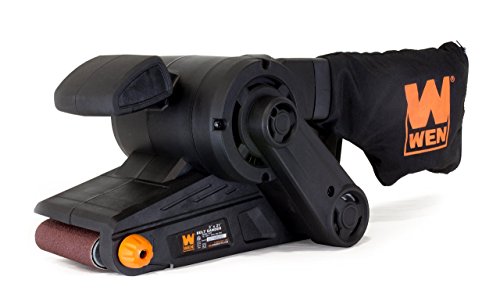
A 3 x 21 in. platen, a 7-amp motor and a published 2 year warranty at 6.2 lb is the cleanest match to what site work asks for.
Best for: a one-van trim carpenter who needs a 3 x 21 in. platen and a published warranty Skip it if: you already own a cordless platform and never want a cord again
Within this set of seven, the 6321 is the only tool that combines the larger 3 x 21 in. belt, a 7-amp corded motor, a stated weight, a stated warranty term and the cheapest position of the group. Nothing else here checks all five. WEN says the motor drives the belt at over 13 feet per second and that a lock-in switch lets you sand continuously without holding the trigger, which matters on long runs of decking or subfloor where a dead-man trigger becomes the sore spot in your hand.
At 6.2 lb it sits between the SKIL and the Milwaukee, which is the useful place to be. Heavy enough that the platen tracks itself across a flat surface, light enough for vertical work on jambs and casing. The overall body measures 6.5 x 12 x 6 in., the most compact footprint of any 3 x 21 in. tool here.
The trade-off is straightforward. You get a cord, a fabric dust bag rather than an extractor port, and no variable speed dial, while the Milwaukee and DEWALT both claim speed control. It also sells faster than every other handheld in this group, which tells you buyers keep reaching for it.
Pros:
- 3 x 21 in. belt, the larger handheld size here
- Cheapest of the seven picks
- 2 year warranty, the only stated term in the set
- 6.2 lb with a compact 6.5 x 12 x 6 in. body
- Lock-in switch for continuous sanding runs
Cons:
- Corded, so an extension reel travels with it
- No variable speed control published
- Dust bag only, with no stated vacuum port
- Only one seller lists it
2. Milwaukee M18 Fuel 3 x 18 Belt Sander — Best premium
The heaviest handheld here at 8.84 lb, with a published belt speed range that no other pick in this group states.

Best for: an M18 owner who wants corded-class removal without a cord Skip it if: you need a belt longer than 18 in. or you own no M18 batteries
The 2832-20 is the most expensive pick in this comparison, and the specification that justifies it is the variable speed dial. Milwaukee states a range from 750 to 1350 SFM, the only surface-feet figure published anywhere in this set. That range is what lets you drop the removal rate for veneer or a painted door and open it back up for a hardwood edge. The brand also claims the brushless motor generates the power and torque of larger 8A corded belt sanders, which is a comparison to corded tools rather than a measured output.
At 8.84 lb it is heaviest handheld here by more than 2 lb over the WEN. On a bench or a flat door blank, that mass does useful work. Overhead it is a different tool entirely. The body measures 9.1 x 7.3 x 12.7 in., and the listing notes a tool-free belt change lever.
Two limits keep it off the top spot. The belt is 3 x 18 in., so it covers less per pass than the 3 x 21 in. WEN and DEWALT. And it publishes no warranty term and no included battery, so the highest price position in the set buys you the least complete package on paper.
Pros:
- Published belt speed range of 750 to 1350 SFM
- Tool-free belt change lever
- Brushless motor with overload protection claim
- Two sellers list it, more than any other pick here
Cons:
- Heaviest handheld in the set at 8.84 lb
- Shorter 3 x 18 in. belt than the WEN or DEWALT
- No warranty term published
- Highest price position with no battery in the box
3. DEWALT 20V MAX Belt Sander DCW220B — Best for heavy use
The only cordless pick with the larger 3 x 21 in. platen, plus a 25-speed dial claim and a dust extraction figure.

Best for: a 20V MAX owner sanding all day and running a dust extractor Skip it if: you want a complete tool in one box
Cordless sanders usually shrink the belt to save runtime. The DCW220B does not, and that single decision is why it beats the Milwaukee on paper for long days. DEWALT claims 16.7% more sanding surface area than the Milwaukee 2832-20 and up to 22% more power from the brushless motor. Those are the manufacturer's comparisons, not independent measurements, but the belt dimension behind the first one is a fact you can check on the listing.
The dust story is the other reason it sits here. DEWALT states up to 95% dust collection efficiency through a tool-free AirLock-compatible port, with the connector sold separately. On a remodel where you are sanding inside a finished room, an extractor port beats a cloth bag every time. The listing also claims a variable speed trigger with a 25-position dial.
The body measures 8.66 x 13.4 x 6.69 in. The listing's 1 lb weight is a shipping figure for a bare tool and not a usable comparison against the WEN's 6.2 lb, so I would not plan around it. Warranty is stated only as a manufacturer warranty with no term. And it arrives as a tool alone.
Pros:
- 3 x 21 in. belt, the only cordless pick with the larger size
- Claimed up to 95% dust collection with an extractor
- 25-speed selection dial claim for fine control
- Quick-release tool-free belt changes
Cons:
- Bare tool, so battery and charger cost extra
- AirLock connector sold separately
- No warranty term published
- Published weight figure is not usable for comparison
4. SKIL 6 Amp 3 x 18 in. Belt Sander 7510-01 — Best compact
Lightest tool in the whole comparison at 5.51 lb, and the only entry-price pick with a stated vacuum hose fitting.

Best for: stair stringers, treads and other tight overhead or vertical work Skip it if: you flatten wide glue-ups and want fewer passes
Weight is the reason this one exists in the lineup. At 5.51 lb it is 0.69 lb lighter than the WEN and more than 3 lb lighter than the Milwaukee, inside a 5.75 x 12.3 x 6.25 in. body. Sanding a stair skirt at shoulder height or working a door edge in place, that difference decides whether you finish the run or set the tool down twice.
Two feature claims stand out. SKIL says pressure control technology warns you when you are leaning too hard, which is the single most common mistake with a belt sander and the fastest way to gouge a board. The listing also claims auto-track belt alignment to keep the belt centred, plus micro-filtration for fine dust, and states the dust port fits standard 1-1/4 in. vacuum hoses. That hose size is the only vacuum fitting dimension published across all seven listings.
Where it gives ground is removal rate. A 6-amp motor on a 3 x 18 in. belt is the smallest engine and second-smallest platen in the group, so flattening a wide tabletop takes more passes than the WEN needs. The listing publishes no warranty term, and its 2018 release date makes it the oldest design here.
Pros:
- Lightest pick in the set at 5.51 lb
- Fits standard 1-1/4 in. vacuum hoses
- Pressure control warning claim
- Auto-track belt centring claim
- Second-cheapest of the seven
Cons:
- 6-amp motor, the lowest corded rating here
- 3 x 18 in. belt covers less per pass
- No warranty term published
- Oldest design in the group, released 2018
5. Jellas 7Amp Handheld Belt Sander — Best for beginners
Ships as an 11-piece kit with ten sanding belts across five grits and two clamps, so nothing else is needed on day one.

Best for: someone buying a first belt sander who wants belts included Skip it if: you need a published warranty or a weight figure before you buy
Count is the spec that separates this listing from every other pick: 11 items in the box, against 1 for the others. Jellas says that covers 10 sanding belts, two each in 40, 60, 80, 120 and 180 grit aluminium oxide, plus two metal C-clamps. Those clamps matter more than they sound. The brand says the tool can be inverted and fixed to a table so it works as a small bench sander, which is a second machine for no extra money and no bench footprint.
The motor is claimed at 7 amps and 120V driving the belt at over 13 feet per second, on a 3 x 21 in. belt, with a six-position variable speed knob and a lock-on button. On paper that reads as the same class as the WEN 6321 with a speed dial added. The body measures 6.3 x 5.91 x 13.4 in.
The listing is thinner than the rest where it counts for a working tool. No weight figure, no warranty term, no vacuum port dimension, and it is the slowest-selling handheld of the four here. For a first sander with a stack of belts included, that is a fair trade. For a tool you depend on Monday morning, the missing warranty is the gap.
Pros:
- 11-piece kit with 10 belts in five grits
- 3 x 21 in. belt, the larger handheld size
- Six-dial variable speed claim
- Two C-clamps for inverted bench use
- Third-cheapest of the seven
Cons:
- No weight published, so handling is unknown
- No warranty term published
- No vacuum port size stated
- Slowest-selling handheld in this group
6. VEVOR 6 in. Disc & 4 x 36 in. Belt Sander — Best for families
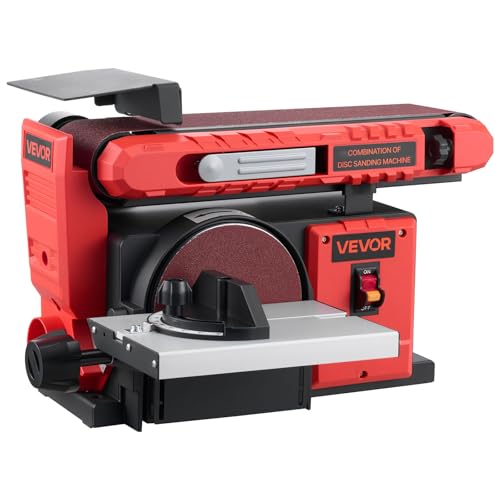
A 4 x 36 in. belt plus a 6 in. disc with a worktable that tilts 0 to 45 degrees, for shaping small parts rather than surfaces.
Best for: a shop bench where knife grinding and small-part squaring happen Skip it if: the tool has to travel between sites
This is a different machine doing a different job. Instead of moving the sander over the work, you bring the work to the sander, which is how you square an end, chamfer an edge or grind a bevel repeatably. The 4 x 36 in. belt is the widest abrasive in this comparison, and VEVOR says it tilts from 0 to 90 degrees for horizontal or vertical work while the 6 in. disc table tilts 0 to 45 degrees.
The claimed motor is 400W, with the disc at 3550 RPM and the belt at 600 RPM. That belt figure is worth reading carefully: it is a slow, controlled speed suited to knife sharpening and careful shaping rather than fast stock removal. There is a dust collection port for a vacuum, and at 33.7 lb inside a 12 x 19.9 x 15.7 in. frame it sits in the middle price position of the group.
The limitation is fixed in the specification. At 33.7 lb it stays where you bolt it, so it cannot touch installed trim, a stair tread in place or a floor. Buy it as a second machine alongside a handheld, never instead of one. No warranty term is published either.
Pros:
- Widest abrasive here at 4 x 36 in.
- Disc table tilts 0 to 45 degrees
- Belt tilts 0 to 90 degrees for vertical work
- Dust collection port for a vacuum
- Mid price position with two sanding surfaces
Cons:
- 33.7 lb, so it stays on the bench
- 600 RPM belt speed claim suits shaping, not fast removal
- No warranty term published
- Cannot reach installed work of any kind
7. WEN Benchtop Belt and Disc Sander 6502T — Runner-up
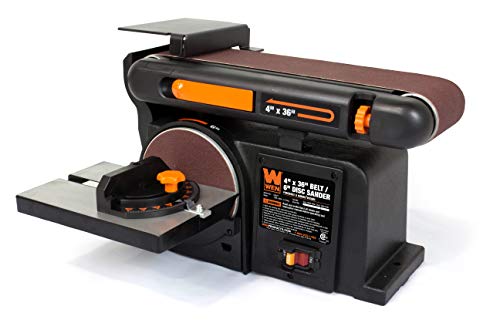
Cast iron base and a 4 x 36 in. belt with a 6 in. disc, for a bench that needs vibration-free small-part work.
Best for: a fixed bench that needs a 4 x 36 in. belt and a 6 in. disc Skip it if: you need to sand a floor, a door in place, or anything you cannot carry to the bench
The 6502T covers the same ground as the VEVOR with one clear difference in the materials. WEN says the base is cast iron to prevent heavy vibrations, and on a benchtop machine that mass is what keeps a small workpiece from chattering against the belt. The claimed 4.3-amp motor runs up to 3600 RPM, and a tension release lever handles grit changes without tools.
Geometry is the same two-surface layout: a 4 x 36 in. belt that tilts from 0 to 90 degrees and a 6 in. disc, in a 12.5 x 22 x 11 in. frame. That is the longest footprint of any pick here, so measure your bench before ordering. It also sells faster than any other machine in this comparison, which suggests plenty of shops reach for exactly this format.
Two things put it last. The listing publishes no weight and no warranty term, and it sits in the most expensive price band while being the least portable format in the group. Against the VEVOR at a lower price position with a tilting disc table and a stated dust port, the cast iron base has to carry the whole argument.
Pros:
- Cast iron base for vibration damping
- 4 x 36 in. belt with a 6 in. disc
- Belt tilts 0 to 90 degrees
- Tool-free tension release for grit changes
- Sells faster than any other pick here
Cons:
- Premium price position for a bench-only machine
- No weight or warranty published
- Longest footprint at 22 in.
- No dust port dimension stated
Handheld or benchtop: which one belongs in your truck?
Four of these seven are handheld tools and three of those are 3 x 21 in. or 3 x 18 in. platens you push across a surface. Two are benchtop combos with a 4 x 36 in. belt and a 6 in. disc. That split is the largest single fork in the best budget belt sander for contractors decision, and it is not really about price.
Handheld wins whenever the work cannot move. Installed casing, a stair tread, a door hung in its jamb, deck boards, a subfloor patch. Weight is the constraint, which is why the 5.51 lb SKIL and the 6.2 lb WEN sit in the top half of this ranking.
Benchtop wins whenever the work is small enough to carry. Squaring an end grain cut, grinding a consistent bevel, cleaning up a mitre until it closes. The VEVOR states a worktable that tilts 0 to 45 degrees, and that table is the whole point: it makes a repeatable angle rather than a freehand guess.
A short way to decide:
- If your work is fixed in place, buy handheld and treat everything else as optional.
- If your work fits in one hand, buy benchtop and expect better accuracy than any handheld gives.
- If both are true, start with the handheld. You can clamp a handheld upside down, as Jellas suggests with its two C-clamps. You cannot carry a 33.7 lb bench machine to a stair landing.
What the extra money actually buys in this set
Across these seven listings, moving up the price ladder does not buy you a bigger belt. It buys you the cord going away and a speed dial appearing.
The cheapest pick, the WEN 6321, already has the largest handheld belt at 3 x 21 in. and the only stated warranty term at 2 years. The most expensive handheld, the Milwaukee 2832-20, has a shorter 3 x 18 in. belt. So belt size and price are close to unrelated here, which is unusual and worth knowing before you spend.
What the higher positions genuinely add:
- Cordless operation. Both premium handhelds run on battery platforms, and both ship without one.
- Published speed control. The Milwaukee states 750 to 1350 SFM and DEWALT claims a 25-position dial. Neither WEN handheld publishes a speed range.
- Dust extraction claims. DEWALT claims up to 95% collection efficiency with a separate AirLock connector, against the WEN's cloth bag.
- A second sanding surface. The two benchtop combos add a 6 in. disc, though only at bench-bound weights.
What it does not add: a longer warranty, a lighter tool, or a wider handheld belt. The 5.51 lb SKIL, second-cheapest here, is lighter than everything above it.
What the listings will not tell you about belts and dust
Two costs hide behind every belt sander purchase, and neither appears in a spec table.
The first is abrasive. Belt sanders eat belts, and the size you buy locks you into a consumable for the life of the tool. Three sizes appear across these seven picks: 3 x 21 in., 3 x 18 in., and 4 x 36 in. Milwaukee states plainly that the 2832-20 is compatible only with 3 x 18 sanding belts. Before you commit, check which of those three sizes your local supplier actually stocks, because ordering a specialty size mid-job is how a Friday afternoon disappears.
The second is dust, and this is where the listings diverge sharply. The WEN 6321 and the Jellas both describe a detachable dust bag. SKIL states its port fits standard 1-1/4 in. vacuum hoses, the only hose dimension published in the whole set. DEWALT describes an AirLock-compatible connection sold separately. VEVOR and the WEN 6502T both describe a dust collection port for a vacuum without giving a size.
A cloth bag is fine outdoors on framing lumber. Sanding inside an occupied house, a bag means fine dust settles on every horizontal surface in the room, and you will spend longer cleaning than sanding. That is the real argument for the SKIL's stated hose size or the DEWALT's extraction claim, and it is not a specification most buyers weigh until after the first indoor job.
When a different pick wins
The WEN 6321 is the default. Three conditions move it.
- You already own the batteries. If your van runs M18, the Milwaukee 2832-20 removes the extension cord from your day and adds a published 750 to 1350 SFM speed range. If you run 20V MAX instead, the DEWALT DCW220B does the same while keeping the larger 3 x 21 in. belt.
- Most of your sanding happens vertically or overhead. Stair skirts, jamb edges, beam faces. The SKIL 7510-01 at 5.51 lb is the lightest tool here, and its pressure control warning claim helps when you cannot feel the platen properly from an awkward angle.
- The parts fit in your hand. Knife bevels, mitre cleanup, squaring short stock. Neither WEN handheld does this well. The VEVOR BSH1510C, with a disc table tilting 0 to 45 degrees and a 4 x 36 in. belt, does it repeatably, and the WEN 6502T does it on a cast iron base.
One more flip worth naming. If this is your first belt sander and you own no abrasives at all, the Jellas kit arrives with 10 belts in 40 through 180 grit. That saves a separate order and gets you sanding the day the box lands.
The verdict
The WEN 6321 is the best budget belt sander for contractors in this group because it wins on the two specifications that actually decide the category and costs the least while doing it. A 3 x 21 in. belt is the larger handheld size here, 6.2 lb keeps it usable on vertical work, and the 2 year warranty is the only stated term across all seven listings. Add the lock-in switch for long runs and the compact 6.5 x 12 x 6 in. body, and nothing else here matches that combination at the cheapest price position in the set.
Two conditions flip it. If you already run M18 batteries, the Milwaukee 2832-20 gives you the only published belt speed range in this comparison, 750 to 1350 SFM, and drops the cord. Its advantage is control, not coverage, since the belt is 3 x 18 in. rather than 3 x 21 in. And if most of your sanding happens at shoulder height or above, the SKIL 7510-01 at 5.51 lb is the lightest tool here with a stated 1-1/4 in. vacuum hose fitting.
Worth saying plainly: none of these listings publishes a duty-cycle rating or a commercial-use certification, so "contractor grade" is a judgment you make from belt size, weight and warranty rather than a claim any of them makes.
FAQ
Is a budget belt sander worth it for daily job-site use?
A budget belt sander is worth it for daily use if you match the belt size to the work and accept that consumables, not the tool, are the ongoing cost. The WEN 6321 pairs a 3 x 21 in. platen with a stated 2 year warranty at the cheapest price position here, which is the strongest paper case in this group for a tool that gets used hard.
What is the best budget belt sander for contractors who work mostly indoors?
The best budget belt sander for contractors working indoors is the one with a real extraction path, not a cloth bag. The SKIL 7510-01 states its port fits standard 1-1/4 in. vacuum hoses, the only hose dimension published across these seven listings. The DEWALT DCW220B claims up to 95% dust collection with a separately sold AirLock connector, which is the other route.
Does belt size matter more than motor amps?
Belt size matters more than amps because contact area sets how much abrasive touches the wood per pass. A 3 x 21 in. platen covers more ground per stroke than 3 x 18 in., and the longer loop spreads heat across more grit. Compare the WEN 6321's 3 x 21 in. belt against the Milwaukee's 3 x 18 in. before you compare their motors.
WEN 6321 or SKIL 7510-01: which should I buy?
Choose the WEN 6321 or the SKIL 7510-01 on weight and belt size. The WEN gives you a 3 x 21 in. belt, a 7-amp motor and a 2 year warranty at 6.2 lb, so it flattens wide surfaces in fewer passes. The SKIL is 5.51 lb, the lightest here, with a 3 x 18 in. belt and a stated 1-1/4 in. hose fitting for vertical and overhead work.
What mistake ruins boards with a new belt sander?
The mistake that ruins boards is pressing down. A belt sander removes material fast enough on its own weight, and leaning on it digs a hollow you then have to sand out of the surrounding surface. Keep the tool moving with the grain and let the platen float. SKIL claims its pressure control warns you when you are pushing too hard, which is a genuinely useful guardrail.
Start with the belt size your work demands, then check what your abrasive supplier keeps on the shelf in that size. For most site work that points at a 3 x 21 in. platen, and in this group the WEN 6321 delivers it at 6.2 lb with the only warranty term anyone here publishes. Buy the SKIL instead if your ladder time outweighs your bench time, or the Milwaukee if the batteries are already in your van. Whichever you choose, order a spare set of belts in the same order. The tool arrives ready; the abrasive is what runs out first.
Last updated: September 7, 2026. Product availability re-checked.
This page contains affiliate links. As an Amazon Associate we earn from qualifying purchases, at no extra cost to you.