Best Lightweight Belt Sander for a Home Workshop
Six belt sanders compared on published specs: belt size, weight, warranty and what each one is actually built to do. The WEN 6321 leads at 6.2 lb, with a benchtop upgrade and a cordless option behind it.
The best lightweight belt sander for homeowners is the WEN 6321, a 6.2 lb corded machine with a 3 x 21 in belt and a two-year warranty behind it. If you already own DEWALT 20V MAX batteries, the cordless DCW220B is the smarter buy instead. Most shoppers compare amp ratings first, and that's the wrong opening move. Belt length is what changes how a sander behaves on a wide surface, and the six picks here split into 21-inch, 18-inch and 36-inch machines.
Best lightweight belt sander for homeowners at a glance
| Pick | Belt size | Weight | Price |
|---|---|---|---|
| Best overall WEN 6321 7-Amp Corded Belt Sander |
3 x 21 in | 6.2 lb | Check Price |
| Best premium DEWALT 20V MAX Belt Sander DCW220B |
3 x 18 in claim | 1 lb listed | Check Price |
| Best for pros SKIL 6 Amp Belt Sander 7510-01 |
3 x 18 in | 5.51 lb | Check Price |
| Best minimal setup Jellas 7Amp Handheld Belt Sander |
3 x 21 in | Not published | Check Price |
| Best upgrade WEN 6502T Benchtop Belt and Disc Sander |
4 x 36 in + 6 in disc | Bench-mounted | Check Price |
| Best budget pick S SATC 3x18 Sanding Belts, 20-Pack |
3 x 18 in | Consumable | Check Price |
How I cut this field down to six
Three things knocked listings out before I compared anything.
The first was missing dimensions. A sander with no published length and width can't be judged against the rest for reach or storage, and I'm not going to guess. The second was belt sizes nobody stocks. Odd widths exist, and they leave you hunting for replacement belts at every grit change. Every handheld pick here runs a 3-inch belt, which is the width most abrasive packs are cut to. The third was mixed-category clutter: sheet sanders and random orbit tools that show up under the same searches but do a different job.
What survived is a deliberately uneven group, and that's the point:
- Three handheld corded machines, at 3 x 21 in and 3 x 18 in
- One cordless brushless handheld, sold as a bare tool
- One benchtop combination machine with a 4 x 36 in belt
- One abrasive pack, because belts run out faster than first-time buyers expect
I compared published specifications side by side rather than manufacturer prose. Weight, belt size, physical dimensions and warranty carried the most weight in the ranking, because those four are the ones you can check against the listing yourself in under a minute.
Why belt width decides this more than amps
Every listing in this category leads with amps. The WEN 6321 and the Jellas both state 7 amps. The SKIL states 6 amps. That gap sounds decisive and mostly isn't, because the sanding happens where the belt touches the wood, and belt geometry controls that contact.
Here's the trick with belt length. A 21-inch belt puts more abrasive on the surface per pass than an 18-inch belt at the same width. On a tabletop or a door slab, that means fewer passes and less risk of leaving a dished spot where you paused. On a narrow stile or a chair rail, that same length becomes a liability, because the longer platen bridges detail you were trying to keep.
So the deciding criterion for a lightweight belt sander for homeowners is simple:
- Wide flat surfaces, mostly. Go 3 x 21 in.
- Narrow parts, edges and confined corners. Go 3 x 18 in.
- Small parts you can bring to the tool. Go benchtop, 4 x 36 in.
Amps matter as a tiebreaker inside each of those brackets, not across them. The SKIL is the only pick here whose listing states a standard 1-1/4 in vacuum port, and for most home projects, dust handling changes the experience more than a single amp of draw.
1. WEN 6321 7-Amp Corded Belt Sander — Best overall
The 6321 is the best lightweight belt sander for homeowners because it pairs the longest handheld belt in this set with the lowest published handheld weight and the only clearly stated warranty term.
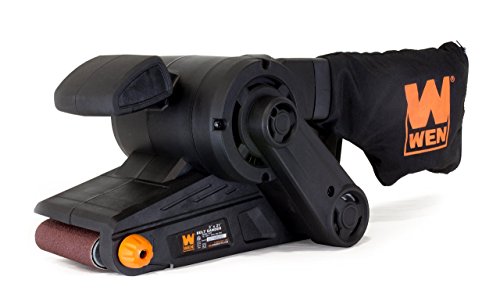
Best for: furniture stripping and door edges in a garage workshop Skip it if: you need cord-free reach outdoors
Two numbers put this one in front. It weighs 6.2 lb and runs a 3 x 21 in belt, so you get the larger contact patch without carrying a heavier machine than the 5.51 lb SKIL. That combination is what makes long sessions tolerable when you're leaning over a workbench rather than pushing down on a floor.
WEN says the 7-amp motor drives the belt at over 13 feet per second, and the listing describes a lock-in trigger so you aren't squeezing continuously through a long pass. A detachable dust bag is included. At 6.5 x 12 x 6 in, it slides onto a shelf rather than claiming a floor corner.
The two-year warranty is the quiet advantage. It's the only pick here with a specific term published, which matters on a tool with a consumable drive belt and a motor that lives in dust.
The trade-off is reach. There's no vacuum port stated, so you're on the bag, and the cord decides where you can work. If your projects are outdoors and away from an outlet, the DEWALT solves a problem this one can't.
Pros:
- Longest handheld belt here at 3 x 21 in
- Lightest published handheld weight, 6.2 lb
- Only pick with a stated 2 year warranty
- Compact 6.5 x 12 x 6 in body stores easily
- Lock-in trigger for continuous passes
Cons:
- No vacuum port listed, bag collection only
- Corded, so outlet placement limits reach
- Only one seller lists it
- 21-inch platen bridges narrow detail work
2. DEWALT 20V MAX Belt Sander DCW220B — Best premium
The DCW220B is the only cordless pick in the set, and the only one whose listing describes a 25-position speed dial.

Best for: anyone already holding 20V MAX batteries Skip it if: you don't own the battery platform
Cordless is the whole argument. Fence rails, deck boards and anything at the far end of a yard stop being an extension-cord problem. DEWALT claims up to 22% more power from the brushless motor versus its corded comparison, and up to 95% dust collection efficiency through an AirLock connector that the listing states is sold separately.
The variable speed trigger with a 25-speed dial is the most granular speed control published across these six. On veneer or painted trim, the ability to start slow is worth more than raw output. The listing also describes a tool-free quick-release for belt changes.
Read the model designation carefully: this is the B suffix, tool only. No battery, no charger. The listed weight of 1 lb reflects the bare-tool packaging rather than the sander in your hands, so treat the 8.66 x 13.4 x 6.69 in dimensions as the more useful figure.
It's the most expensive pick here, and once you add a battery and the dust connector it climbs further. Buying into the platform from scratch for one sander rarely makes sense.
Pros:
- Only cordless option in this set
- 25-speed dial, the finest speed control here
- Brushless motor, claimed 22% power gain
- Tool-free quick-release belt changes
Cons:
- Bare tool, no battery or charger included
- Dust connector sold separately per the listing
- Highest price position of the six
- Listed 1 lb weight reflects packaging, not the tool
- Warranty stated only in general terms
3. SKIL 6 Amp Belt Sander 7510-01 — Best for pros
The SKIL 7510-01 is the lightest machine in the group at 5.51 lb, and the only one whose listing names a 1-1/4 in vacuum fitting.

Best for: long sessions where you plan to hook up a shop vac Skip it if: you want the longest belt in the set
At 5.51 lb this is the one you'll notice least after an hour of overhead or vertical work, and its 5.75 x 12.3 x 6.25 in footprint is the narrowest handheld here. The narrower body is the real reason to pick it: a 3 x 18 in belt gets closer into corners than a 21-inch platen does.
SKIL describes pressure control technology that warns you when you're leaning too hard, which addresses the single most common beginner mistake with a belt sander. The listing also claims auto-track belt alignment to keep the belt centred and micro-filtration for fine dust. The stated 1-1/4 in vacuum compatibility means a standard shop vac hose fits, and that turns a dusty job into a manageable one.
At 6 amps it draws the least of the corded handhelds, and the shorter belt means more passes on a wide panel. The listing publishes no warranty term either, which is a step back from the WEN 6321.
Pros:
- Lightest handheld here, 5.51 lb
- Fits standard 1-1/4 in vacuum hoses
- Pressure control warning for heavy-handed use
- Narrowest body at 5.75 in wide
- Auto-track belt alignment claimed
Cons:
- Shortest handheld belt, 3 x 18 in
- Lowest amp rating of the corded picks, 6 amps
- No warranty term published
- No sanding belts included
4. Jellas 7Amp Handheld Belt Sander — Best minimal setup
This one arrives as a kit of 11 pieces, including 10 sanding belts across five grits, so it's the only pick you can use the day it lands.

Best for: a first sander bought with nothing else on hand Skip it if: you want a published weight and warranty before buying
The count of 11 is what separates this from everything else here. Jellas lists 10 aluminium oxide belts, two each of 40, 60, 80, 120 and 180 grit, which covers stripping through to a pre-finish surface. Every other handheld here needs a separate abrasive order.
It runs a 3 x 21 in belt, matching the WEN 6321 for contact area, and Jellas describes a 7 amp motor moving the belt at over 13 feet per second. There's a six-position variable speed knob, so you get speed control the WEN doesn't publish. The listing also claims two metal C-clamps that let you invert the tool and fix it to a table as an improvised bench sander, plus a lock-on button and a detachable dust bag.
The gaps are in the specification sheet. No weight is published and no warranty term is stated, which is a real disadvantage in a category where fatigue and motor life are the two things you care about. It's also the slowest seller of the six.
Pros:
- Includes 10 belts across five grits
- 3 x 21 in belt, longest tied in this set
- Six-position variable speed knob
- Clamps for inverted bench-sander use
- Detachable dust bag included
Cons:
- No published weight figure
- No warranty term stated
- Slowest seller in this group
- Only one seller lists it
- Bench-mount clamping is improvised, not a fixed stand
5. WEN 6502T Benchtop Belt and Disc Sander — Best upgrade
The 6502T is a stationary machine, so it wins on control and loses on portability, and that swap is the entire decision.
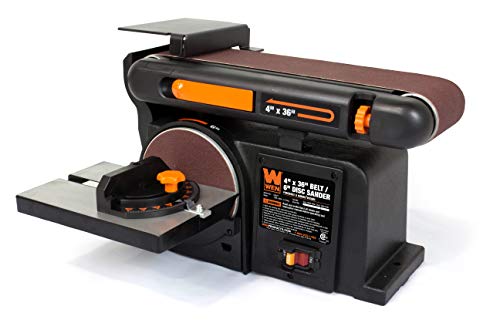
Best for: shaping small parts at a fixed bench station Skip it if: the work can't come to the tool
Two sanding surfaces in one footprint. WEN lists a 4 x 36 in belt and a 6 in disc, driven by a 4.3 amp motor rated up to 3600 RPM. The belt tilts from 0 to 90 degrees, which is what makes bevels and repeatable angles achievable in a home shop. A tension release lever handles grit changes.
The 4-inch belt is the widest here by a full inch, and the cast iron base is there to keep vibration out of the work. When you're squaring the end of a small part, feeding it into a fixed belt beats balancing a handheld tool on top of it. That's a genuinely different kind of accuracy.
At 12.5 x 22 x 11 in it needs dedicated bench space, and it's a premium-tier buy. There's no published weight and no stated warranty term, and the 4 x 36 in belts are a less common size than the 3-inch belts the rest of this set uses. It also can't touch an installed door or a deck board, which is what most homeowners actually bought a sander for.
Pros:
- Belt and 6 in disc in one machine
- Widest belt here, 4 x 36 in
- Belt tilts 0 to 90 degrees for bevels
- Cast iron base to damp vibration
- Tool-free tension release for grit swaps
Cons:
- Stationary, work must come to it
- Needs 12.5 x 22 x 11 in of bench space
- No published weight or warranty term
- 4 x 36 in belts are a less common size
- Premium price position
6. S SATC 3x18 Sanding Belts, 20-Pack — Best budget pick
This is abrasive, not a machine, and it's the cheapest of the six by a clear margin.

Best for: restocking a 3 x 18 in sander you already own Skip it if: you don't have a sander yet
Belts wear out, and first-time buyers underestimate how fast. This pack holds 20 pieces in 3 x 18 in: three each of 60, 80, 120, 150, 240 and 400 grit, plus two of 40 grit. That's seven grit steps, from heavy stripping to a finish-ready surface, in one box.
S SATC describes open-coat aluminium oxide grain with anti-static and anti-clogging properties, and a diagonal lap splice meant to reduce the bump you feel at the seam. The grit number is printed on the cloth backing, which sounds trivial until you have four used belts on the bench and no idea which is the 120. It's also the only listing here with more than one seller.
The obvious limitation is fit. At 3 x 18 in these suit the SKIL 7510-01, not the 3 x 21 in WEN 6321 or Jellas, and not the 4 x 36 in benchtop. No weight, quantity-per-grit substitutions or warranty details are published beyond the grit breakdown either.
Pros:
- Cheapest pick in this set
- 20 belts across seven grits, 40 to 400
- Grit printed on the cloth backing
- Diagonal lap splice to smooth the seam
- Stocked by more than one seller
Cons:
- Fits 3 x 18 in machines only, not the 21-inch picks
- Not a sander, so it can't stand alone
- Only two belts at the coarse 40 grit
- No warranty information published
Is a lightweight belt sander enough for floors and decks?
Partly, and this is where search results mislead. Nothing in this set is a floor sander. A drum machine for hardwood floors is a rented, waist-high tool that weighs more than any pick here, so treat these as tools for surfaces you can reach with your hands.
For deck boards and porch rails, a handheld belt sander does real work. The 3 x 21 in models cover a board face faster, and the cordless DCW220B removes the extension cord from a job that's usually far from an outlet. For a full floor, judge the job yourself before you commit: square footage, how many passes the finish needs, and whether you can stay bent over that long.
Where these tools genuinely earn their keep in a home:
- Stripping paint or varnish off doors, shutters and furniture
- Flattening glued-up panels before finish sanding
- Levelling a sticking door edge
- Squaring cut ends on framing lumber
- Knocking down a rough deck board before staining
What does the weight figure actually change?
Weight controls two separate things, and they pull in opposite directions.
Downward pressure is the first. A heavier sander loads the belt with its own mass, so it removes material with less effort from you. That's helpful on a horizontal surface and a hazard on veneer, where the tool digs in before you notice.
Fatigue is the second, and it's the one homeowners feel. The published figures here run from 5.51 lb for the SKIL to 6.2 lb for the WEN 6321. That 0.69 lb gap sounds trivial on paper and becomes obvious in the wrist after forty minutes of vertical work on a door.
The Jellas publishes no weight at all, and the DEWALT's listed 1 lb clearly reflects the bare-tool box rather than the sander itself. Where a weight isn't published, use the dimensions as a proxy for bulk: the SKIL is the narrowest handheld body at 5.75 in, the DEWALT the widest at 8.66 in.
My advice for a lightweight belt sander for homeowners is straightforward. Under 6 lb, you can work vertically and overhead without a break. Above that, plan on horizontal work and let the tool's mass do the pressing.
Corded or cordless for a home workshop?
Five of these six run on a cord, and that ratio tells you something about the category.
Corded machines here publish higher amp figures, 7 amps on the WEN 6321 and Jellas, and they never stop mid-pass. Belt sanding is sustained, high-draw work, so the cord is doing real work rather than just saving money. The WEN's lock-in trigger exists because passes are long.
Cordless buys freedom of position. The DCW220B is the pick for a deck, a fence or a detached garage with one outlet, and its 25-speed dial gives finer control than anything else in this set. The catch is the bare-tool format: no battery, no charger, and the AirLock dust connector listed separately.
Buy corded if your projects happen inside a garage or basement near an outlet. Buy the DEWALT if you already own 20V MAX batteries, because at that point you're paying for a sander instead of a system.
What the listings leave out
Four gaps show up repeatedly, and knowing them keeps expectations honest.
- Belt supply. Only the Jellas kit and the S SATC pack include abrasive. Buy belts with the machine, in at least three grits.
- Dust reality. A bag catches some dust. The SKIL is the only pick stating a 1-1/4 in vacuum port, and DEWALT's claimed 95% figure depends on a connector sold separately. Expect to sweep.
- Warranty terms. Only the WEN 6321 publishes a specific length, two years. DEWALT states a manufacturer warranty in general terms. The other four say nothing.
- Noise. No pick in this set publishes a decibel figure. Belt sanders are loud tools. Wear hearing protection regardless.
The verdict
If you're buying one sander for general household work, the WEN 6321 is the pick. It's the best lightweight belt sander for homeowners because it's the only machine here that combines a 3 x 21 in belt, a published 6.2 lb weight and a stated two-year warranty, and those three facts are all checkable on the listing before you commit.
If your work happens away from an outlet, the DEWALT DCW220B wins instead, and its exact advantage is position rather than power: cordless operation plus a 25-position speed dial that no other pick publishes. The cutoff is whether you already own 20V MAX batteries. If you do, buy the bare tool. If you don't, the cost of the platform buys you a corded sander and a full set of belts.
Two smaller flips are worth naming. If most of your parts are small enough to carry to a bench, the WEN 6502T with its 4 x 36 in belt and tilting table gives control a handheld can't match. And if you're working on narrow stiles, rails and corners, the 3 x 18 in SKIL at 5.51 lb reaches where a 21-inch platen won't.
FAQ
Is a lightweight belt sander worth it for occasional home projects?
A lightweight belt sander is worth it if your projects involve stripping finish or flattening panels, because no other sander removes material as fast. For light scuff sanding before paint, an orbital does the job with less risk. The WEN 6321 at 6.2 lb is the sensible entry point, with a two-year warranty published.
What does more money buy in this category?
More money buys format, not aggression. The entry tier here gets you a corded 3 x 21 in handheld with a dust bag. Mid-tier adds belt assortments or a stated vacuum port. The premium tier buys either cordless freedom with a 25-speed dial or a fixed benchtop station with a 4 x 36 in belt and a tilting table.
Will 3 x 18 in belts fit the WEN 6321?
3 x 18 in belts will not fit the WEN 6321, which takes 3 x 21 in belts. The S SATC 20-pack suits the SKIL 7510-01 instead. Belt length is not adjustable, so check the two numbers on your machine's platen before ordering abrasive. The WEN 6502T is different again at 4 x 36 in.
WEN 6321 or SKIL 7510-01, which should I pick?
Between the WEN 6321 and SKIL 7510-01, choose by the surfaces you sand. The WEN's 3 x 21 in belt covers wide panels and doors in fewer passes and carries a two-year warranty. The SKIL is lighter at 5.51 lb, narrower at 5.75 in, and the only one listing a 1-1/4 in vacuum port for shop-vac dust control.
What mistake do first-time belt sander buyers make?
The mistake first-time buyers make is pressing down. A belt sander removes material fast on its own weight, and leaning on it gouges the surface and stalls the belt. Keep the tool moving with the grain and let it float. SKIL's pressure control warning exists precisely because this error is so common with new users.
Start with the WEN 6321 and a three-grit belt supply in 3 x 21 in, and you're equipped for almost every sanding job a house throws at you. What makes it the right default isn't the 7 amp motor. It's that WEN publishes the numbers that matter, weight, belt size, footprint and warranty length, so nothing about the tool surprises you after it arrives. Add the SKIL later if you find yourself fighting corners, or the 6502T if your work drifts toward small parts. One good handheld first, then specialise.
Last updated: September 7, 2026. Product availability re-checked.
This page contains affiliate links. As an Amazon Associate we earn from qualifying purchases, at no extra cost to you.