Best Fire Extinguisher for Office Wall Mounting
Seven fire safety picks compared on UL rating, weight and mounting hardware, with a named winner and the three conditions that flip the recommendation.
The best fire extinguisher for office use is the First Alert HOME2PRO, a 9.6 lb all-metal unit the listing rates at UL 2-A:10-B:C with a 12-year limited warranty. If nobody on your floor has ever handled one, the 3.9 lb Kidde Basic 110 is easier to lift and aim. Get the choice wrong and you end up with the classic office failure: a canister too heavy for the person nearest the flames, sitting on the carpet behind a filing cabinet where nobody can find it.
That failure mode is worth sitting with. An extinguisher that discharges for a few seconds and empties before the fire is out is bad. An extinguisher nobody can reach in eight seconds is worse, because it is functionally not there. Weight, mounting and location decide more office outcomes than agent chemistry does.
One caution up front. Amazon's results for this search mix true office-grade units with home models and mounting hardware, and none of these listings carries a workplace certification, an inspection tag or a compliance statement. Your local fire code, not a product page, decides what your building needs.
Best fire extinguisher for office at a glance
| Pick | UL rating | Weight | Price |
|---|---|---|---|
| Best overall First Alert Fire Extinguisher |
2-A:10-B:C | 9.6 lb | Check Price |
| Best for beginners Kidde Basic 110 |
1-A:10-B:C | 3.9 lb | Check Price |
| Best premium Kidde Pro 460 Commercial |
4-A:60-B:C | Not published | Check Price |
| Best for heavy use Ougist ABC Dry Chemical |
2-A:10-B:C claim | 5 lb agent claim | Check Price |
| Most versatile Buckeye 10914 ABC |
Class A, B, C | 5 lb agent | Check Price |
| Best for families Ougist Signature ABC |
Class A, B, C | 2.5 lb | Check Price |
| Best budget pick BAYANSILU Bracket, 2-Pack |
Mount only | 6.4 oz | Check Price |
Which buyer are you? Four office profiles
I sorted these seven listings by the buyer they actually fit rather than by specification alone, because a 4-A:60-B:C canister in a two-desk studio is money spent on the wrong problem.
- The one-room office. One or two people, a laptop charger, a kettle, a paper bin. You need a light unit that anyone can lift off a hook and squeeze. The Kidde Basic 110 at 3.9 lb is the profile match.
- The small commercial suite. A corridor, a kitchenette, a copier, maybe eight to twenty people. This is the mainstream case and where the First Alert sits, with a 2-A rating and a wall hook in the box.
- The workshop or warehouse floor. Open space, machinery, stored stock. Class A fuel load is high and the walk to the nearest hook is long. The Kidde Pro 460 exists for this.
- The multi-site buyer. Vans, break rooms, storage units, a home office. You want a repeatable unit you can order again, and you accept less published detail in return.
Two picks sit outside those profiles on purpose. The Ougist Signature at 2.5 lb is a supplementary unit, not a floor's primary defence. The BAYANSILU bracket is not an extinguisher at all; it fixes the mounting problem that ruins more office setups than any spec sheet does.
1. First Alert Fire Extinguisher — Best overall
A published UL 2-A:10-B:C rating, a 12-year limited warranty and a wall hook in the box make this the safest default for a small office.
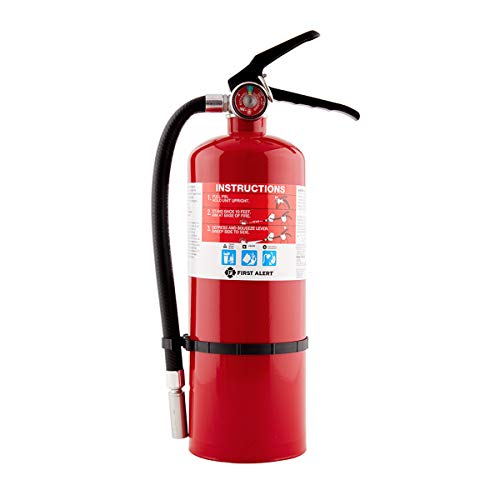
Best for: a small office that needs one unit covering a corridor and a kitchenette Skip it if: you can't mount 9.6 lb on the wall you have
Three things separate this pick from the rest of the set. It publishes a UL rating in plain text, 2-A:10-B:C, so you can hold it against whatever number your fire code asks for. It publishes a 12-year limited warranty, the longest stated coverage of any listing here. And it publishes full dimensions, 17 x 5.75 x 6 in, which matters when you are choosing between a wall gap and a cupboard nook.
The 2-A half of that rating is the office-relevant part. Class A is paper, cardboard, timber and textiles, which is most of what burns in an office. The First Alert doubles the Kidde Basic 110's Class A figure while matching its 10-B:C. First Alert describes all-metal construction with a commercial-grade metal valve, mono ammonium phosphate agent, and recharging by certified professionals after use.
The trade-off is mass. At 9.6 lb it is the heaviest unit here with a published weight, more than double the Kidde Basic. That is real capability, but it is also a canister some staff will struggle to hold steady at arm's length. It costs more than three of the picks here for that extra Class A coverage.
Pros:
- Published UL 2-A:10-B:C rating you can check against code
- Longest stated warranty in this set at 12 years
- Wall hook and colour-coded pressure gauge included
- Rechargeable rather than disposable
- Full dimensions published for mounting planning
Cons:
- 9.6 lb is heavy for a one-handed discharge
- Only one seller lists it, so replacements may be awkward
- Fourth-cheapest of the seven, above both entry Kidde and Ougist units
- 17 in tall needs real clearance under a shelf
2. Kidde Basic 110 Fire Extinguisher for Home — Best for beginners
At 3.9 lb this is the lightest full extinguisher here, and it's the one buyers choose most often in this set.

Best for: a first extinguisher in a one-room office or a home workspace Skip it if: your space has a server rack or a commercial kitchen
Weight is the whole argument. At 3.9 lb, the FA110G is 5.7 lb lighter than the First Alert, and that difference decides whether an untrained person can hold the horn steady while sweeping the base of a fire. Kidde publishes a 1-A:10-B:C rating, aluminium construction, an easy-pull safety pin and a green-zone pressure indicator. Dimensions are 15.5 x 4.81 x 3.88 in, the narrowest profile in this group, so it slips into gaps the wider canisters won't.
It is also, by a wide margin, the fastest-selling unit here. That has a practical benefit beyond popularity: a common model is one your facilities contractor already knows how to service and replace.
The compromise is the 1-A. Half the Class A capability of the First Alert means less powder for paper and timber, which is exactly what an office stores in volume. Kidde's stated 6-year warranty is half the First Alert's 12. If this is the only unit on a floor of any size, you are relying on a small canister to buy time for a full evacuation, and that is a thinner margin than I'd want.
Pros:
- Lightest full extinguisher in this set at 3.9 lb
- Narrowest body here, 3.88 in deep
- Published 1-A:10-B:C rating and 6-year warranty
- Second-cheapest of the seven picks
- The one buyers choose most often here, so servicing is easy
Cons:
- 1-A Class A rating is the lowest of the rated units
- 6-year warranty is half the First Alert's coverage
- Aluminium body is less rugged than impact-resistant steel
- Undersized as a lone unit for anything past a single room
3. Kidde Pro 460 Commercial Fire Extinguisher — Best premium
A 4-A:60-B:C rating with a stated 21-second discharge and 20-foot range is the most firefighting capability in this comparison.

Best for: warehouses, workshops and large open-plan floors Skip it if: you need published weight and dimension figures before you buy
The numbers on the label are what you're buying. 4-A doubles the First Alert's Class A capability and quadruples the Kidde Basic's. 60-B is six times the Class B figure of every other rated unit here. Kidde states a discharge time of 21 seconds and a 20-foot range, which is the only reach figure in the set backed by a stated duration, and range is what lets you fight a fire in a machine bay without standing over it.
Construction is described as impact-resistant steel with a heavy-duty metal valve assembly, and it's rechargeable. For a workshop where an extinguisher gets knocked, dragged and remounted, that matters more than in a carpeted suite.
Two gaps are hard to ignore. The listing publishes no weight and no dimensions, so you cannot plan a mounting position or judge whether your lightest staff member can handle it. A 10-pound-class commercial unit is heavy, and the specification that would confirm it is absent. It is also the most expensive pick here. For a two-desk office, most of that 60-B rating is capability you will never call on, and it moves slowly compared with the Kidde Basic.
Pros:
- Highest published rating in this set, 4-A:60-B:C
- Stated 21-second discharge with a 20-foot range
- Impact-resistant steel body and heavy-duty metal valve
- Rechargeable after use
Cons:
- No published weight or dimensions for mount planning
- Most expensive pick in this comparison
- No stated warranty period on the listing
- Over-specified for a small carpeted office
4. Ougist ABC Dry Chemical Fire Extinguisher — Best for heavy use
A 5 lb agent charge and a quick-release handle aimed at people who've never pulled a pin under pressure.

Best for: multi-site buyers stocking vans and break rooms alike Skip it if: you want a published warranty and full dimensions
Ougist's pitch is the activation step. The company says a patented handle removes the safety pin without twisting or fiddling, and that anyone from a grandparent to a child can trigger it. That's a manufacturer claim, not a measured one, but the underlying point is legitimate: hesitation at the pin is a documented failure mode, and design that shortens it has value in a workplace where nobody has trained.
The listing states a 5 lb agent charge and a 2-A:10-B:C rating, matching the First Alert's rating on paper, plus a usable distance up to fifteen feet. Ougist describes ABC dry powder for grease, electrical faults, wood, textiles and flammable gases, and a six-year quality programme with a production date marked on the body. That date stamp is genuinely useful, since knowing an extinguisher's age is half of maintaining it.
Where it falls short is documentation. The published specifications run to size, colour and model number, and nothing else. No listed weight, no dimensions, no warranty term. Everything above is the brand's own copy rather than a spec table you can verify, and it's the most expensive of the three units that state a 2-A:10-B:C rating.
Pros:
- Stated 5 lb agent charge with 2-A:10-B:C claim
- Quick-release handle aimed at untrained users
- Production date marked on the body
- Six-year quality programme stated by the brand
Cons:
- Published specifications cover only size, colour and model
- No listed weight or dimensions for mounting
- Costs more than the rated, better-documented First Alert
- Rating and capacity rest on brand copy alone
5. Buckeye 10914 ABC Multipurpose Dry Chemical — Most versatile
An anodised aluminium valve, a 5 lb agent capacity and a wall hook, built the way a service contractor expects.
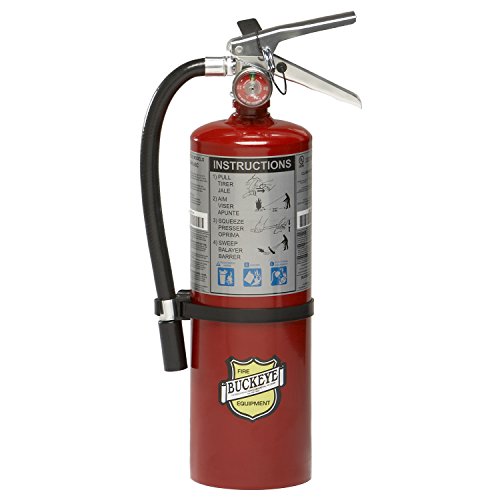
Best for: a facilities manager standardising on serviceable hardware Skip it if: you want the popular, easy-to-replace choice
Buckeye is the industry-supply pick in this group. The listing states 5 lb agent capacity, ABC dry chemical suitable for Class A, B and C fires, anodised aluminium valve assemblies for strength and corrosion resistance, colour-coded gauges and a wall hook. Physical dimensions come in two forms on the page: a 3-3/8 in diameter by 7-1/4 in width by 16-3/8 in height figure from the manufacturer, and a shipping figure of 18.2 x 6.6 x 5.4 in. The narrow 3-3/8 in cylinder is the number that matters for a tight corridor mount.
Corrosion resistance is the quiet advantage. In a damp basement plant room or a loading bay, the valve is what fails first, and an anodised aluminium assembly is a real answer to that. It's also the only pick here with more than one seller listed, which gives you a second sourcing route.
Two honest problems. Buckeye publishes no UL rating figure on this listing, only the Class A, B and C designation, so you cannot compare its Class A capability against the First Alert's 2-A. And it's the slowest-moving pick of the seven by a long stretch, which for a product you may need to match or replace in three years is a consideration rather than a virtue.
Pros:
- Anodised aluminium valve for corrosion resistance
- Stated 5 lb agent capacity with wall hook included
- Narrow 3-3/8 in cylinder suits tight mounting spots
- Two sellers listed, unlike every other pick here
Cons:
- No UL rating figure published, only Class A, B, C
- Slowest-moving pick in this comparison
- Second-most expensive of the seven
- Conflicting dimension figures on the listing require care
6. Ougist Signature ABC Fire Extinguisher — Best for families
At 2.5 lb and 14.2 in tall, this is the smallest extinguisher here and the easiest to keep in a car boot or desk drawer.

Best for: a second unit for a home office or car Skip it if: it is the only extinguisher in a commercial space
Size is the entire case. At 2.5 lb and 14.2 x 5.71 x 3.74 in, this is the shortest and lightest extinguisher in the comparison, roughly a quarter the mass of the First Alert. That makes it the one you can actually place where the risk is: beside a desk with three power strips under it, in a car, in a storage cupboard. Ougist rates it for Class A, B and C fires and repeats the patented pin-free handle design from its larger sibling.
I'd treat it as a supplement rather than a floor's primary unit. A 2.5 lb charge empties fast, and there's a reason commercial specs run to 5 and 10 lb classes. Where it earns its place is coverage density: two small units at opposite ends of a room beat one large unit thirty feet away, because distance to the nearest extinguisher is what decides whether anyone reaches it.
Documentation is thin and one detail is contradictory. The listing describes it as 2.5 lb in the specifications, then states "weighing 5 lb" in a feature bullet. It publishes no UL rating figure and no warranty term. For an office where an inspector may ask questions, that ambiguity is a problem the First Alert simply doesn't have.
Pros:
- Smallest and lightest extinguisher here at 2.5 lb
- 14.2 in body fits drawers, boots and tight cupboards
- Rated for Class A, B and C fires
- Third-cheapest pick in this set
Cons:
- Listing states 2.5 lb in specs and 5 lb in a feature bullet
- No UL rating figure and no stated warranty
- Small charge means a short discharge window
- Too little capacity to be a lone commercial unit
7. BAYANSILU Universal Fire Extinguisher Bracket — Best budget pick
Two iron L-hooks at 6.4 oz that solve the problem most offices actually have: the extinguisher is on the floor.
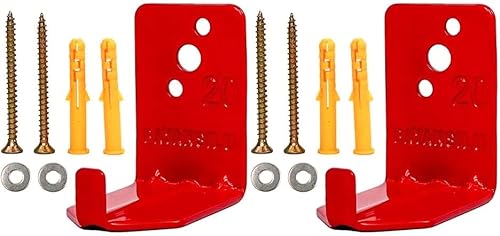
Best for: anyone whose extinguisher is sitting on the floor right now Skip it if: you don't already own an extinguisher
This is the cheapest thing in the comparison and it isn't an extinguisher, so read it as an add-on. BAYANSILU supplies two brackets, made from iron, described as a universal hook rated for 15 to 40 lb extinguishers. Each hook weighs 6.4 oz. The box includes screws, soft iron washers, plastic anchors and a manual, so a DIY install needs a drill and nothing else.
I've put it in the ranking because mounting is the step offices skip. An extinguisher behind a door or under a desk is one nobody finds in the eight seconds they have. Two hooks let you cover two zones on one floor, which is usually the better layout than a single unit in reception.
Read the compatibility line carefully. The 15 to 40 lb range described here is heavier than most of the extinguishers on this page, and the two picks with published weights, at 3.9 lb and 9.6 lb, sit well below it. The First Alert and the Buckeye both include their own wall hooks already. There are no published load-test figures, no stated warranty, and it's the slowest seller of the seven. Check the neck diameter of your canister against the hook before drilling anything.
Pros:
- Cheapest item in this comparison
- Two brackets in the pack for two-zone coverage
- Screws, washers and anchors included
- Iron construction rather than stamped sheet
Cons:
- Not an extinguisher, so it protects nothing on its own
- Stated 15 to 40 lb range exceeds most picks here
- Redundant with the First Alert and Buckeye wall hooks
- No load-test data or stated warranty published
What the UL rating on the label actually means
The code on the cylinder is the only spec on these listings you can compare directly, and it reads as three parts. A fire extinguisher for office use is usually specified by that code rather than by brand.
- The A number is Class A capability, for paper, wood, cardboard and textiles. Higher means more of it. The First Alert's 2-A is twice the Kidde Basic's 1-A; the Kidde Pro's 4-A is four times.
- The B number is Class B, for flammable liquids like solvents and cooking oil. Five of these picks state 10-B. The Kidde Pro states 60-B.
- The C is not a quantity. It means the agent is non-conductive and safe on live electrical equipment. It's either there or it isn't.
Every rated unit here is B:C-capable, so electrical safety is a given across the set. Class A is where they separate, and Class A is what an office is mostly made of: reams of paper, cardboard shipping boxes, upholstered chairs, carpet.
Three picks publish no UL figure at all. The Buckeye and both Ougist units state Class A, B and C coverage without numbers, and the Ougist 5 lb adds a 2-A:10-B:C claim in its marketing copy rather than its specification table. If a landlord or insurer ever asks for a rating in writing, the two units that give you one on the page are the First Alert and the two Kiddes.
Where should a fire extinguisher for office space be mounted?
Placement beats specification, and it's the part nobody plans. Here's how I'd approach the walls before ordering anything.
- Mount it on the escape route, not at the hazard. You want to be backing toward the door while you fight the fire, never toward the back wall.
- Put it at eye level or lower. A 9.6 lb canister above shoulder height is hard to unhook cleanly.
- Measure the height first. The First Alert needs 17 in of clearance; the Ougist Signature needs 14.2 in. That difference decides whether it fits under a shelf.
- Check the depth for corridors. The Kidde Basic 110's 3.88 in and the Buckeye's 3-3/8 in cylinder both suit narrow walkways where a wider body gets clipped by trolleys.
- Keep sight lines clear. Behind a coat stand or a door on a hook is the same as nowhere.
Two picks include mounting hardware in the box: the First Alert lists a wall hook, and the Buckeye lists wall hooks that it says extend service life. The Kidde Basic 110 and both Ougist units don't state a bracket, which is where the BAYANSILU 2-pack comes in, subject to checking that neck fit.
Does weight matter more than agent capacity?
For most offices, yes, and this is the point where the obvious specification misleads. The temptation is to buy the biggest number. Bigger canisters hold more agent and discharge longer, and on paper the Kidde Pro 460 wins outright.
But an extinguisher only works if the person nearest the fire can lift it, carry it several metres, hold it steady one-handed and sweep the base of the flames. That's a physical task, and 9.6 lb held at arm's length is not the same as 9.6 lb held against your hip. Choosing the best fire extinguisher for office use means matching capability to who's actually on the floor at 7pm.
The published weights here span 2.5 lb to 9.6 lb, and two picks publish no weight at all. My rule of thumb: if the people on your floor include anyone who'd struggle with a full kettle, size down and add a second unit rather than buying one big canister. Two 2-A units at opposite ends of a floor cover more ground than one 4-A in reception.
Where capacity does win is fuel load. A workshop with timber stock, a warehouse with pallets, a plant room with solvents. Those are the spaces where a fire outgrows a 5 lb charge in seconds, and where the Kidde Pro's stated 21-second discharge and 20-foot range earn their cost.
What these listings don't tell you
Four gaps run through this set, and they're worth knowing before you commit.
Nothing here states a workplace compliance status. No inspection tag, no service certificate, no reference to a code section. Several listings use the word office in their marketing, which is why Amazon returned them for this search, but marketing copy is not certification. Your fire authority sets the requirement.
Recharge and service aren't priced or arranged. The First Alert says recharging is possible by certified professionals; the Kidde Pro says rechargeable. Neither tells you who does it or how often. Dry chemical units need periodic checks whether or not they've been used, and that's a service contract, not a purchase.
Two picks publish almost no specifications. The Ougist 5 lb lists size, colour and model number and stops. The Kidde Pro 460 lists no weight and no dimensions. You're buying on brand copy and taking the mounting question on trust.
Warranty coverage is patchy. Only two listings state a term: 12 years for the First Alert, 6 years for the Kidde Basic 110. The other five say nothing, including both premium-position picks. For a device that sits untouched for a decade, a published warranty term is genuinely meaningful information, and its absence should shift you toward the units that give one.
When a different pick wins
The First Alert is the default, not the answer for everyone. Three specific conditions flip it.
- Nobody on the floor has handled an extinguisher. Go for the Kidde Basic 110. The 5.7 lb weight saving over the First Alert is the difference between a controlled sweep and a dropped canister, and its 10-B:C matches the winner exactly.
- Your space has a real fuel load. Timber, stock, solvents, machinery. Then the Kidde Pro 460's 4-A:60-B:C and stated 20-foot range are the specification you need, and the missing weight figure becomes a question for the seller rather than a dealbreaker.
- You need coverage in two places at once. Buy two small units instead of one large one. An Ougist Signature at 2.5 lb by the desks and a Kidde Basic 110 by the kitchenette beats a single heavier canister thirty feet from both.
One more flip that isn't about the extinguisher. If you already own a working unit and it's standing on the floor, the BAYANSILU brackets fix a bigger risk than upgrading the canister does. Check the neck fit against the stated 15 to 40 lb design range first.
The verdict
The First Alert HOME2PRO is the fire extinguisher for office use I'd default to, and the reason is documentation as much as capability. It publishes a UL 2-A:10-B:C rating you can hold against a code requirement, a 12-year limited warranty that's double the next-longest here, full dimensions at 17 x 5.75 x 6 in, and a wall hook in the box. That combination doesn't exist anywhere else in this set.
Two conditions flip it. If nobody in your workplace has handled an extinguisher, the Kidde Basic 110 wins on the only spec that decides real-world use: 3.9 lb against 9.6 lb, with an identical 10-B:C rating and a 3.88 in profile that fits a narrow corridor. Its cost is the 1-A, half the First Alert's Class A capability, in a room full of paper.
If your space carries a serious fuel load, the Kidde Pro 460 takes it. Its exact advantage is scale: 4-A:60-B:C is double the winner's Class A and six times its Class B, with a stated 21-second discharge and 20-foot range. You pay for that with the highest price position here and a listing that publishes no weight or dimensions.
Everything else has a narrower brief. The Buckeye suits a facilities manager who cares about a corrosion-resistant valve. The two Ougist units are supplements and multi-site stock. The BAYANSILU brackets are hardware, not protection.
FAQ
Is a commercial fire extinguisher worth it for a small office?
A commercial fire extinguisher is worth it only when your fuel load justifies it. The Kidde Pro 460's 4-A:60-B:C rating is built for warehouses and workshops with timber, stock or solvents on the floor. In a carpeted two-desk suite, most of that Class B capability goes unused, and the First Alert's 2-A:10-B:C at a lower price position covers paper, plastics and electrical risks properly.
Which fire extinguisher for office use gives the most capability per pound?
The most capability per pound in this set is the Kidde Basic 110, at 3.9 lb for a 1-A:10-B:C rating. The First Alert doubles the Class A figure but weighs 9.6 lb to do it, so you're paying 5.7 lb for one extra A step. If a lighter canister means someone will actually use it, the Kidde's ratio is the one that matters.
Do I need a wall bracket, or is one included?
You need a wall bracket unless your unit includes one. The First Alert lists a wall hook in the box, and the Buckeye 10914 lists wall hooks it says extend service life. The Kidde Basic 110, Kidde Pro 460 and both Ougist units don't state mounting hardware. The BAYANSILU 2-pack fills that gap, though its stated 15 to 40 lb design range sits above most picks here.
First Alert HOME2PRO or Kidde Basic 110: which should I buy?
Choose between the First Alert HOME2PRO and the Kidde Basic 110 on two figures. Class A rating: 2-A versus 1-A, favouring First Alert in a paper-heavy space. Weight: 9.6 lb versus 3.9 lb, favouring Kidde for untrained users. The First Alert also states 12 years of warranty against Kidde's 6, and includes a wall hook the Kidde doesn't.
What's the most common mistake buying an office extinguisher?
The most common mistake buying an office extinguisher is treating the purchase as the whole job. An unmounted canister behind a door protects nobody, and dry chemical units need periodic pressure checks whether or not they've been discharged. Plan the wall position and the inspection schedule before you order, and confirm what rating your local fire authority requires rather than trusting a product page.
Start with the wall, not the canister. Walk your floor, pick the spot on the escape route where someone backing toward the exit would reach, measure the clearance, and then order the unit that fits it. The First Alert HOME2PRO is the right default because it's the one pick that answers every question you'll be asked later: what's the rating, how long is it covered, and where does it hang. Drop to the Kidde Basic 110 if lifting 9.6 lb under pressure is unrealistic for your staff, and confirm the rating your fire authority wants before you drill.
Last updated: September 7, 2026. Product availability re-checked.
This page contains affiliate links. As an Amazon Associate we earn from qualifying purchases, at no extra cost to you.