Best Portable Plug In CO Detector for Travel Bags
Plug-in CO alarms all look the same in a listing photo. Weight, plug design and warranty length are what actually separate them, and only two of these five publish a warranty at all.
The best portable plug in carbon monoxide detector is the Kidde COP, a 6.88 oz plug-in unit with a rotating plug, two AA backup batteries in the box, and a 10-year limited warranty. If you're buying three or four alarms to cover a whole house, the First Alert CO605 is the cheapest of the five here and the lightest at 4.2 oz. The deciding number in this category isn't decibels, since four of these five claim the same 85 dB. It's the plug and the warranty.
Best portable plug in carbon monoxide detector at a glance
| Pick | Weight | Warranty | Price |
|---|---|---|---|
| Best overall Kidde Carbon Monoxide Detector (COP) |
6.88 oz | 10-year limited | Check Price |
| Best budget pick FIRST ALERT CO605 Plug-in Carbon Monoxide Detector |
4.2 oz | 7-year limited | Check Price |
| Best for quiet operation Kidde Carbon Monoxide Detector (COPD) |
6.88 oz | 10-year limited | Check Price |
| Best upgrade Siterlink Carbon Monoxide Detectors Plug in |
Not published | None stated | Check Price |
| Best premium SITERWELL Plug in Carbon Monoxide Detector |
6.4 oz | None stated | Check Price |
How I screened these five listings
I started with the plug. A best portable plug in carbon monoxide detector has to live in a wall socket, and a socket you don't control is the whole problem when you travel. Hotel outlets sit behind nightstands, run horizontally, and share space with a lamp cord.
So I lined up the published specifications side by side and sorted the five by what a bag actually cares about:
- Plug type. Two of the five publish something specific: Kidde says both its units use a rotating plug that fits vertical or horizontal outlets, and Siterlink says its plug folds flat.
- Weight and footprint. Three of the five publish both. The spread runs from 4.2 oz to 6.88 oz, and the thinnest body here is the First Alert at 1.38 in deep.
- Backup power. Every one of the five claims some form of it. Two ship with AA cells included, two claim a sealed 10-year battery, one lists only "battery backup".
- Published warranty. Only two of the five state one. That's the sharpest divide in the whole set.
- Sensor type. Three listings name an electrochemical sensor. The two Kidde units don't name a sensor type but cite UL 2034 5th Edition and ETL listing.
What got cut in my head, and it's worth saying: nothing here is a battery-only travel puck. Every pick needs a live outlet to run on mains power. That's the trade-off you accept with this whole category.
What actually decides a portable CO alarm?
Most guides to the best portable plug in carbon monoxide detector compare alarm volume. That's a dead end. Four of these five listings claim the same 85 dB, and the fifth doesn't publish a figure at all, so there's nothing to choose between them on noise.
Three things do the deciding.
The plug orientation. A fixed vertical plug in a horizontal outlet either won't seat or hangs at 90 degrees and blocks the socket beside it. Kidde publishes a rotating plug on both units. That single detail is worth more on a trip than any sensor claim.
The warranty. CO sensors have a service life. Both Kidde units carry a 10-year limited warranty, the First Alert carries 7 years, and the two Siterwell-family units publish nothing. A warranty length is also the clearest signal you get about how long the manufacturer expects the sensor to stay accurate.
Whether you can read a number. Four of these five are alarm-only: they scream, and a light comes on. The Kidde COPD adds a backlit display that the listing says shows CO levels. Low-level CO exposure over hours is the scenario a bare alarm misses entirely, because the alarm threshold sits well above the level that gives you a headache.
Everything else is close enough that you can pick on price position and be fine.
1. Kidde Carbon Monoxide Detector (COP) — Best overall
The rotating plug and the 10-year limited warranty put this one ahead of the field for anyone who wants a single alarm that works at home and in a hotel.

Best for: someone who wants one alarm that works at home and in a hotel room Skip it if: you want to read the CO number off a screen
Two specifications separate this from the rest of the set. The plug rotates, which Kidde says lets it sit in vertical or horizontal outlets, and the warranty runs 10 years, matching only its own sibling. It weighs 6.88 oz and measures 5.47 x 1.52 x 5.47 in, so it's a square palm-sized body about an inch and a half deep.
Kidde lists a loud 85 dB alarm, an LED hazard light, and a combined test and hush button. The listing claims no nighttime chirps and cites UL 2034 5th Edition testing with an ETL listing. Two AA backup batteries are included, so it keeps monitoring through an outage without a trip to the store.
It's also the one buyers choose most often out of the two Kidde units here. Sits roughly mid-range for this set on price.
The trade-off is the readout. You get a warning light and a siren, not a number, so you can't watch a low-level CO reading climb. Its sibling costs more and fixes exactly that.
Pros:
- Rotating plug fits vertical or horizontal outlets
- 10-year limited warranty, longest published here
- Two AA backup batteries included
- 85 dB alarm with test and hush button
- Cited UL 2034 5th Edition and ETL listing
Cons:
- No display, so no CO number to read
- 6.88 oz ties for heaviest in this set
- Only one seller lists it
- 1.52 in depth is thicker than the First Alert
2. FIRST ALERT CO605 Plug-in Carbon Monoxide Detector — Best budget pick
The lightest and cheapest pick here, and the obvious choice when you need three or four alarms rather than one.
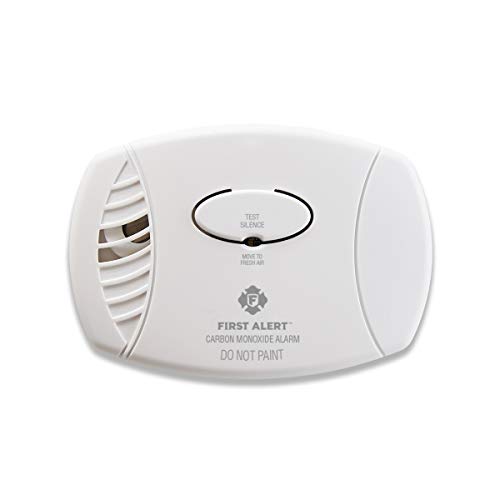
Best for: buying several units to cover every level of a house Skip it if: you need the longest published warranty
At 4.2 oz this is the lightest of the five, and at 5 x 3.4 x 1.38 in it's also the shallowest. That 1.38 in depth matters more than the weight does, because a slimmer body is less likely to get shoved off the plug by a headboard or a nightstand.
First Alert lists an advanced electrochemical carbon monoxide sensor and says placement in the room doesn't affect accuracy. There's a single test and silence button, an 85 dB alarm at dangerous CO levels, and an end-of-life chirp so you know when the unit is done. The warranty is 7 years, shorter than either Kidde but the only other published figure in the set.
It's the cheapest of the five and it sells faster than everything else here. Two sellers stock it, the most in this group.
The listing dates to 2007 and it shows: no display, no stated plug rotation, and no confirmation the backup batteries ship in the box. For a whole-house buy, none of that changes the answer.
Pros:
- Cheapest of the five picks
- Lightest here at 4.2 oz
- Shallowest body at 1.38 in deep
- Named electrochemical sensor
- End-of-life replacement chirp
Cons:
- 7-year warranty, shorter than both Kidde units
- No plug rotation published
- No display or CO level readout
- Listing dates to 2007, oldest design here
3. Kidde Carbon Monoxide Detector (COPD) — Best for quiet operation
Same body and same warranty as the overall winner, plus the only backlit CO display in this set.

Best for: a bedroom where you want CO levels visible at a glance Skip it if: a backlit screen in a dark room bothers you
This is the COP with a screen. Weight is identical at 6.88 oz, dimensions are identical at 5.47 x 1.52 x 5.47 in, the warranty is the same 10-year limited term, and the rotating plug carries over. The difference is a backlit display that Kidde says shows CO levels.
That readout is the reason to pay the premium. A bare alarm tells you nothing until CO reaches a dangerous threshold, so a number lets you notice a slow rise from a furnace or a blocked flue before the siren fires. Kidde also lists 85 dB, an LED hazard light, no nighttime chirps, and power surge immunity, and it cites UL 2034 5th Edition with an ETL listing. Two AA cells are included.
This is the most expensive pick here. It's also the slower seller of the two Kidde units, which tracks with the price gap rather than anything about the hardware.
The catch is the screen itself in a bedroom. A backlit display sitting at outlet height is a glow you can't hush, and if that bothers you the COP does the same safety job for less.
Pros:
- Only pick here with a backlit CO level display
- 10-year limited warranty
- Rotating plug for vertical or horizontal outlets
- Two AA backup batteries included
- Power surge immunity listed
Cons:
- Most expensive pick in this set
- Backlit screen glows in a dark bedroom
- Identical 6.88 oz weight for no size saving
- Only one seller lists it
4. Siterlink Carbon Monoxide Detectors Plug in — Best upgrade
The foldable plug is the single best travel feature in this comparison, and it comes at the second-cheapest price here.

Best for: packing into a carry-on with no battery shopping Skip it if: you want published weight and dimensions before you buy
A folding plug is genuinely different from a rotating one. Rotating solves the outlet; folding solves the suitcase, because the prongs tuck flat instead of digging into whatever they're packed against. Siterlink is the only pick here that publishes that design.
The listing pairs AC operation with a claimed 10-year replaceable battery for backup, which means no AA hunt at the start of a trip. Siterlink also describes a newly electrochemical sensor and a soft green breathing-style status light it says mimics human respiration, aimed squarely at bedroom use. Setup is unfold, plug in, done.
Here's the problem: this is the thinnest listing in the set. No published weight, no dimensions, no warranty term. For a device whose whole appeal is fitting in a bag, the absence of a size figure is a real gap, and it's why this sits fourth rather than second.
It's the slower-selling of the two Siterwell-family units and only one seller lists it.
Pros:
- Only foldable plug in this comparison
- Second-cheapest of the five
- Claimed 10-year backup battery, no AA purchase
- Soft breathing-style green status light
- No-tool plug-and-play setup
Cons:
- No published weight or dimensions
- No stated warranty period
- No alarm decibel figure published
- Only one seller lists it
5. SITERWELL Plug in Carbon Monoxide Detector — Best premium
The only 2-pack in this roundup, which is the argument for it: two rooms or two trips covered in one purchase.

Best for: covering two rooms or two trips with one purchase Skip it if: you want a stated warranty period
Every other pick in this set ships as a single unit. This one is listed as a 2-pack, which changes the value maths entirely, because CO guidance calls for an alarm on each level of a home and outside sleeping areas. Two units in one order is a shortcut to that.
The body is 6.4 oz and 1.65 x 4.72 x 2.76 in. SITERWELL points at travel directly and repeats that footprint, saying it drops into a suitcase, backpack or handbag. Backup comes from a claimed 10-year battery. There's a colour-coded breathing light with a documented scheme, green for normal operation and yellow for a fault, plus a one-touch silence function. The listing names fireplaces, gas appliances, boilers, heaters and clogged chimneys as the CO sources it's built for.
The problems are real. No warranty is stated, one feature bullet is just the product name repeated, and no decibel figure appears anywhere. It's also the slowest seller of the five and the second-highest price position, which is a lot to ask on a listing this sparse.
Pros:
- Only 2-pack in this set
- Published 4.72 x 2.76 in travel footprint
- 6.4 oz, lighter than both Kidde units
- Documented green and yellow light states
- Claimed 10-year backup battery
Cons:
- No stated warranty period
- No published alarm decibel figure
- Slowest seller of the five
- Listing bullets are thin and partly repeated
Does "travel-ready" mean it's really portable?
Three of these five listings market themselves for travel, and the phrase does real work in this category. Read it carefully though.
Every pick here needs a live 120V outlet to run on mains power. The backup battery is for outages, not for use away from a socket, so none of these is a detector you clip to a tent or drop in a car. If you want the best portable plug in carbon monoxide detector for hotel rooms and vacation rentals, that's the right frame. Camping is not.
What genuinely helps in a bag:
- A plug that stows. Siterlink's folds. Both Kidde units rotate, which helps at the wall but not in luggage.
- A shallow body. The First Alert's 1.38 in depth is the thinnest here, and shallow beats light when the outlet sits behind furniture.
- A sealed backup battery. Siterlink and SITERWELL both claim 10-year cells, so there's nothing to buy before you leave.
- A published footprint. SITERWELL states 4.72 x 2.76 in outright. Siterlink states nothing, which is odd for a pick sold on portability.
Kidde marks its travel claim with an asterisk on both units. Treat that as a manufacturer note to read on the listing itself, not a specification.
Plug design: the spec nobody checks
Here's the trick with wall-powered alarms: the socket decides everything. Most shoppers miss this because listing photos always show the unit floating against white, never wedged behind a hotel nightstand.
Three plug situations break a portable unit:
- A horizontal outlet. Common in older wiring and in hotel headboard panels. A fixed vertical plug either won't seat or the alarm hangs sideways.
- A shared duplex socket. A 5.47 in square face covers the second outlet. The First Alert's 5 x 3.4 in face is narrower on one axis and less likely to.
- A recessed or furniture-blocked socket. Depth wins. 1.38 in clears more headboards than 1.65 in does.
Kidde's rotating plug answers the first situation on both its units. Siterlink's foldable plug answers the packing problem instead. Nobody in this set solves all three, so pick for the outlet you'll actually meet most often. If that's a rental with unpredictable sockets, take the rotating plug.
What the listings don't tell you
A few gaps in this data are worth naming before you buy any best portable plug in carbon monoxide detector on the strength of a bullet list.
Sensor life versus warranty. A 10-year limited warranty is not a promise the sensor reads accurately for 10 years. The First Alert is the only pick that publishes an end-of-life chirp, which is the feature that actually tells you when to replace the unit.
Decibel figures. Four listings claim 85 dB. Neither Siterwell-family pick publishes one, so you can't compare them on volume at all.
Where "10-year battery" applies. Siterlink and SITERWELL both claim a decade-long backup cell. Neither states whether the whole unit is sealed for that term.
Sensor type on the Kiddes. Neither Kidde listing names a sensor technology. Both cite UL 2034 5th Edition testing and ETL listing instead, which is a standards claim rather than a hardware one.
Placement guidance is the other blind spot. First Alert is the only pick that spells it out, saying one unit per level and one in each bedroom. That guidance applies to every pick here regardless of brand.
The verdict
If you're buying one alarm and it travels with you, the Kidde COP is the pick. The rotating plug handles outlets you can't predict, the 10-year limited warranty is the longest published in this set, and the two AA cells arrive in the box. Nothing else here matches that combination.
If you're buying for a whole house, the First Alert CO605 is the answer. It's the cheapest of the five, it's the lightest at 4.2 oz, it's the shallowest at 1.38 in deep, and it's the only pick with a published end-of-life chirp. Three of these cost less than one of the Kidde units in most price positions, and CO guidance wants an alarm on every level anyway.
The cutoff is quantity. One unit, go Kidde. Three or more, go First Alert.
Two conditions flip that. If you want to see an actual CO reading rather than wait for a siren, pay the premium for the Kidde COPD, which is the only pick here with a backlit display. And if your bag matters more than your wall, the Siterlink's foldable plug is the only one in this set that packs flat, though you're buying it without a published weight, size or warranty.
FAQ
Is a portable plug in carbon monoxide detector worth buying?
A portable plug in carbon monoxide detector is worth buying if you stay in hotels, rentals or older homes with gas appliances. CO is odourless, and unfamiliar buildings mean unfamiliar furnaces and water heaters. At 4.2 oz to 6.88 oz these units add almost nothing to a bag, and every pick here runs on a standard outlet with battery backup for outages.
Which is cheaper, the First Alert CO605 or the Kidde COP?
The First Alert CO605 is cheaper. It's the lowest price position of all five picks here, while the Kidde COP sits roughly mid-range. The gap buys you Kidde's rotating plug and a 10-year limited warranty instead of 7 years. For a single travelling alarm the Kidde earns it. For four alarms across a house, it usually doesn't.
Do these detectors work without being plugged in?
These detectors work without mains power only on backup batteries, and that's meant for outages rather than off-grid use. The two Kidde units include two AA cells. Siterlink and SITERWELL each claim a 10-year backup battery. First Alert lists battery backup without naming the cell type. All five still need a 120V outlet for normal operation.
How long does a plug-in CO alarm last before replacement?
A plug-in CO alarm lasts as long as its sensor stays accurate, and the published warranty is your best proxy. Both Kidde units carry a 10-year limited warranty, and the First Alert CO605 carries 7 years with an end-of-life chirp to tell you when it's finished. The Siterlink and SITERWELL listings state no warranty term at all.
What's the biggest mistake when buying a portable CO detector?
The biggest mistake when buying is shopping on alarm volume. Four of these five claim the same 85 dB, so it decides nothing. Buy on plug design and warranty instead. A fixed vertical plug fails in a horizontal hotel outlet, and a missing warranty term means no published sense of how long the sensor stays reliable.
Start with the outlet you'll be plugging into most. If it's a different one every few weeks, the Kidde COP's rotating plug and 10-year warranty make it the safe default, and the two AA cells in the box mean it's ready the day it arrives. If you're covering a house instead of a suitcase, order three or four First Alert CO605 units and put one on each level plus one outside each bedroom. Either way, the alarm you have plugged in beats the better alarm you didn't buy.
Last updated: September 7, 2026. Product availability re-checked.
This page contains affiliate links. As an Amazon Associate we earn from qualifying purchases, at no extra cost to you.