Best Small Fire Extinguishers by UL Rating and Weight
A small fire extinguisher lives or dies on its UL rating, not its size. Five picks compared on class coverage, weight, warranty, and where each one belongs.
The best small fire extinguisher for most homes is the Kidde Basic 110, a 3.9 lb aluminium unit with a 1-A:10-B:C rating that covers wood, liquids, and electrical fires in one canister. If you want a rechargeable body with a 10-year limited warranty instead of a six-year one, the First Alert HOME1 is the pick, at 4.5 lb and the same UL rating. Neither is truly pocket-sized, but both fit the compact category most shoppers are actually shopping for.
How this small fire extinguisher lineup compares at a glance
| Pick | UL rating | Weight | Warranty | Price |
|---|---|---|---|---|
| Best overall Kidde Basic 110 |
1-A:10-B:C | 3.9 lb | 6 years | Check Price |
| Best for families First Alert HOME1 |
1-A:10-B:C | 4.5 lb | 10 years | Check Price |
| Best for heavy use Kidde Auto 10 |
10-B:C | 4 lb | 6 years | Check Price |
| Best premium AmzBoom 3-Pack |
A, B, C, K claim | 3.46 lb | 6 years | Check Price |
| Best budget pick AmzBoom 1-Pack |
A, B, C, K claim | 1 lb | 6 years | Check Price |
A note on "small". The Kidde Basic 110 measures 15.5 x 4.81 x 3.88 in, and the First Alert is 15 x 4.25 x 4 in. Both count as compact against a 10 lb commercial unit, but neither fits a glovebox. Only the AmzBoom aerosols land under 2 in wide, so treat the modifier as a spectrum, not a promise.
What actually decides this purchase
Most guides to small fire extinguishers compare weight. That is not what decides it. The UL rating on the label is. A 1-A:10-B:C rating means the unit has been tested against a Class A fire the size of ten wooden crib panels equivalent to one unit, and a Class B liquid fire of ten square feet. A 10-B:C rating skips the A entirely, so it will not knock down a burning couch or a paper trash fire.
Three of the five picks here carry a UL rating you can read on the listing. Two do not: the AmzBoom aerosols describe themselves as covering Class A, B, C, and K fires, but the listing does not publish a UL number, so those claims sit in the manufacturer's words rather than a testing body's. That does not make them useless. It does mean you cannot compare them like-for-like with a Kidde 1-A:10-B:C.
The second decider is rechargeability. A rechargeable extinguisher can be serviced by a certified professional after use or a pressure drop, which changes the maths on a longer warranty. A single-use canister you throw out.
1. Kidde Basic 110 Fire Extinguisher for Home — Best overall
This is the small fire extinguisher I would put on a wall bracket in a kitchen or utility room, because its 1-A:10-B:C rating covers the three fires a house is most likely to have.

Best for: a single unit that covers a kitchen, garage, and utility room. Skip it if: you need something that leaves no powder residue.
The Basic 110 is the second-cheapest of the five and the one buyers reach for most often in this set by a wide margin. Its 15.5 x 4.81 x 3.88 in body weighs 3.9 lb, which is lighter than the First Alert at 4.5 lb but heavier than the AmzBoom aerosols. Kidde says the all-metal construction uses aluminium for the cylinder and a metal valve, with an easy-pull safety pin and a colour-coded pressure indicator you check by glancing at the needle.
The UL rating is where it earns the top spot: 1-A means it is tested against a Class A wood or paper fire, 10-B against a liquids fire, and C confirms the dry chemical is non-conductive against energised electrical equipment. That is the full domestic set. The trade-off is that it is a single-use disposable unit backed by a 6-year warranty rather than the 10-year term the First Alert carries.
Pros:
- UL 1-A:10-B:C rating covers wood, liquids, and electrical
- Aluminium body keeps weight to 3.9 lb
- Colour-coded pressure gauge for quick monthly checks
- Easy-pull safety pin, no tools needed
- The one buyers here choose most often
Cons:
- Dry chemical leaves powder residue on surfaces
- Not rechargeable by the manufacturer
- 6-year warranty is shorter than the First Alert's 10
2. First Alert Fire Extinguisher — Best for families
The First Alert HOME1 buys you the same 1-A:10-B:C coverage as the Kidde plus a rechargeable body and a 10-year limited warranty.
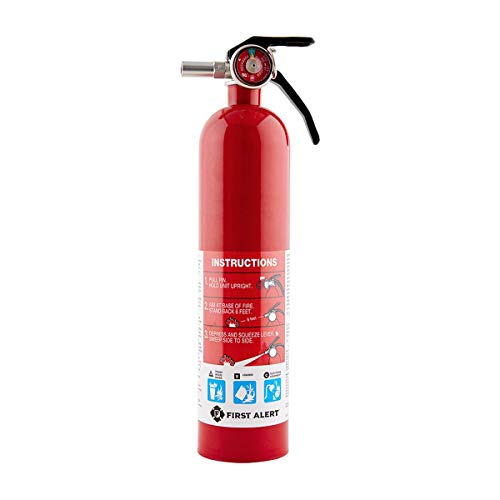
Best for: households that want a rechargeable unit with a long warranty. Skip it if: you want the lightest thing on the shelf.
At 4.5 lb and 15 x 4.25 x 4 in, this is the heaviest of the small units here, and the extra weight comes from an all-metal build with a commercial-grade metal valve and trigger. First Alert calls out a metal pull pin with a safety seal to prevent accidental discharge, and the label is waterproof so a garage or basement mounting will not fade the instructions. The listing states the unit is U.S. Coast Guard approved for marine use, which is unusual at this size.
Two things put it second rather than first. It is a step up in price position from the Kidde for the same UL rating, and its 4.5 lb body is noticeably heavier in the hand for a spouse or a teenager who has never used one. What you get for the money is longevity: the 10-year limited warranty is the longest in this comparison by four years, and the rechargeable design means a certified pro can bring it back to charge after a small kitchen incident rather than sending it to landfill.
Pros:
- 10-year limited warranty, longest in this set
- Rechargeable after use by a certified professional
- Commercial-grade metal valve and trigger
- U.S. Coast Guard approved per the listing
- Waterproof label survives basement mounting
Cons:
- 4.5 lb is the heaviest in this comparison
- Costs more than the Kidde for the same UL rating
- Still leaves dry chemical residue after discharge
3. Kidde Auto 10 Fire Extinguisher for Cars and Trucks — Best for heavy use
The Auto 10 is the small fire extinguisher I would strap under a car seat, because Kidde publishes hard performance numbers most vehicle-sized units skip.

Best for: a dedicated extinguisher in a car, truck, or boat. Skip it if: you need Class A coverage for wood or paper fires.
Kidde publishes three numbers for the Auto 10 that the other picks do not: a discharge time of 8 to 12 seconds, a discharge range of 6 to 8 feet, and an operating pressure of 100 PSI. That matters in a vehicle scenario where you may be aiming from outside the door at a small engine bay fire. The 4 lb body is 14.3 x 3.25 x 3.25 in, narrower than the Basic 110 and shipped with a UL-approved plastic strap bracket for mounting to a seat rail or firewall.
The catch is in the rating. The Auto 10 is a 10-B:C unit, meaning it is tested against flammable liquids and electrical fires only. It is not rated for Class A, so a burning upholstery fire is not what this canister is for. For a vehicle, that trade-off usually makes sense: fuel and wiring are the realistic risks. For a house, it is the wrong tool. Everything else about the design, from the metal valve to the pressure indicator, is lifted from the Basic 110 playbook.
Pros:
- Published 6 to 8 ft discharge range
- Discharge time of 8 to 12 seconds
- UL-approved strap bracket included
- Narrow 3.25 in body fits vehicle mounts
- Rust and impact-resistant handle
Cons:
- No Class A rating for wood or upholstery
- White finish is less visible than red in a footwell
- 6-year warranty rather than 10
4. AmzBoom Fire Extinguisher 3-Pack — Best premium
Three matching aerosol canisters buy you kitchen, car, and garage coverage from a single order, with mounting brackets in the box.

Best for: covering three rooms at once with matching aerosol canisters. Skip it if: you want a traditional pressurised extinguisher with a gauge.
This is the most expensive pick here, and the price position covers three units rather than one. Each canister is 10 x 2.6 x 2.6 in and 3.46 lb, small enough to sit inside a kitchen cabinet or a car door pocket. AmzBoom says the water-based solution handles kitchen grease, wood, gasoline, and lithium-ion battery fires and leaves no residue, which is the clearest practical difference from the dry chemical Kiddes.
Two caveats to weigh. The listing lists A, B, C, and K coverage but does not publish a UL rating number, so treat those classes as the manufacturer's description rather than a UL-tested figure. And the aerosol format has no pressure gauge on the outside, so you check status by the printed expiry date on the can rather than a needle. The bracket set is the reason to buy this over three single cans: you get three matching mounts, so a kitchen cabinet, a car boot, and a workshop wall all end up looking the same, which makes people remember where they live.
Pros:
- Three canisters cover multiple rooms at once
- Lithium-ion battery fires listed on the label
- Water-based solution leaves no powder residue
- Mounting brackets included for all three
- Compact 10 in body fits inside cabinets
Cons:
- Class ratings are manufacturer claims, not UL numbers
- No external pressure gauge to check monthly
- Highest price position in this set
- Water-based agent is not for deep-fat fires alone
5. AmzBoom Fire Extinguisher 1-Pack — Best budget pick
A 1 lb aerosol canister that is genuinely small enough for a glovebox or a nightstand drawer, and the cheapest pick in this comparison.

Best for: a glovebox or drawer where a full-size unit will not fit. Skip it if: you want one canister that protects a whole floor.
This is the pick that actually earns the word "small". At 1 lb and a listing dimension of 2 x 2 x 2 in, it sits in the palm of a hand. AmzBoom describes it as handling wood, grease, gasoline, and lithium-ion battery fires with a water-based, non-toxic agent, and the six-year manufacturer warranty matches the rest of the AmzBoom range. As a spare for a car, a boat, or a workshop drawer, it fills a gap the pressurised Kiddes cannot.
The trade-offs are the reason it is the budget pick rather than the winner. A 1 lb canister discharges quickly, and a small aerosol will not knock down a fire that has jumped a countertop. The class coverage is again the manufacturer's own claim, without a UL rating in the listing. Treat this as a supplementary can that gets you thirty extra seconds to leave the room, not a primary defence. Paired with the Kidde Basic 110 on the wall, it is a sensible layer.
Pros:
- Cheapest in this comparison
- Genuinely pocket-sized at 1 lb
- Lithium-ion battery fires listed on the label
- Non-toxic, residue-free agent
- 6-year manufacturer warranty
Cons:
- Class ratings are not UL-published
- Small charge means very short discharge time
- Not a primary extinguisher for a whole room
- No external pressure gauge
How I cut the field down to five
The five picks here map to five buyer profiles, not five specifications. That was the filter.
- Whole-home primary. A UL-rated 1-A:10-B:C unit that covers wood, liquids, and electrical in one canister. The Kidde Basic 110 fits.
- Long-warranty family option. Same rating, rechargeable body, longer warranty. The First Alert HOME1.
- Vehicle-specific. A narrower body with a mounting bracket and published discharge figures. The Kidde Auto 10.
- Multi-room aerosol kit. Three matching canisters with brackets, one purchase. The AmzBoom 3-Pack.
- Genuine glovebox size. Something that fits where a Kidde will not. The AmzBoom 1-Pack.
Listings that mixed marketing claims with no UL rating and no warranty term were cut early. Every unit here publishes a warranty, and three publish a UL rating. The two aerosols keep their spots because they fill a use case the pressurised units cannot: fitting inside a cabinet or a glovebox.
What the UL rating on the label actually means
The rating string, like 1-A:10-B:C, is a shorthand for tested performance:
- 1-A means the extinguisher put out a Class A test fire (wood cribs) at rating factor one.
- 10-B means it put out a Class B liquid fire covering ten square feet.
- C confirms the agent is non-conductive against energised electrical equipment. C has no number.
- K covers cooking oil fires, common in commercial kitchens but rarely on domestic canisters.
Two things follow from that. First, a 10-B:C unit is not a substitute for a 1-A:10-B:C one at home, because it is not tested against wood or paper. Second, a listing that names classes without a UL number is telling you what the agent is intended to handle, not what a testing body has verified. Both can be useful. They are not the same.
The best small fire extinguisher for a primary spot on the wall is one that publishes the string. The best small fire extinguisher for a supplementary spot in a drawer can be an aerosol, as long as you know it is a top-up, not a base layer.
Dry chemical or water-based: which belongs where?
The Kiddes and the First Alert use a dry chemical agent. The two AmzBoom picks use a water-based agent. Both work. They differ on residue and on where you want each one.
Dry chemical smothers a fire with a fine powder that coats every surface it lands on. In a kitchen, that means the cooker, the countertops, and often the adjoining wall need a proper clean afterwards. In a garage, it is a fair trade for a 1-A:10-B:C rating in a 3.9 lb body.
Water-based aerosols leave the surface wet rather than powdered. That is the practical case for keeping one near electronics, a nursery, or a bedroom where you do not want a dry chemical cloud settling on a mattress. The trade is that the class ratings on these particular AmzBoom listings are manufacturer descriptions rather than UL-tested figures, so pair them with something UL-rated for your primary spot.
Where should you actually mount one?
Small fire extinguishers work only if someone can reach them in the first ten seconds of a fire. That means mounting them at the exit side of the room, not next to the stove.
- Kitchen: on the wall near the doorway, roughly 4 to 5 ft off the floor. Never behind the cooker.
- Garage: on the wall next to the door back into the house, at head height.
- Car: on the passenger footwell mount or under the driver's seat with the strap bracket the Kidde Auto 10 includes.
- Bedroom: a supplementary aerosol in a nightstand drawer, not a full unit on the wall.
The Kidde Basic 110 and the First Alert both ship with the bracket you need. The Auto 10 includes a UL-approved plastic strap for vehicles. The AmzBoom sets include mounting hardware for each canister. Take the ten minutes to actually screw them in. An extinguisher on the floor of a cupboard behind a vacuum is one you will not reach in time.
How long does a small extinguisher last on the wall?
The warranty is not the service life. Warranties on this set run from 6 years (Kidde and AmzBoom) to 10 years (First Alert), and they cover manufacturing defects. The extinguisher itself is designed to hold pressure and be usable for the length of the warranty, which is why you check the gauge monthly.
Two habits worth building. First, glance at the gauge or the expiry date on the first of every month. The Kidde and First Alert units have a colour-coded pressure indicator; the aerosols use a printed date. Second, log the install date on the bracket with a strip of masking tape. When the tape hits the warranty year, replace or (for the First Alert) recharge through a certified professional.
Dry chemical units also benefit from being turned upside down and given a firm tap once or twice a year to keep the powder from settling. It is a thirty-second job that meaningfully improves discharge if you ever need it.
The verdict
The Kidde Basic 110 is the best small fire extinguisher for most homes, because its 1-A:10-B:C UL rating covers the three fires a house actually has, its 3.9 lb aluminium body is light enough for anyone in the family to lift, and it is the second-cheapest pick here. That combination is the reason it is the one buyers in this set reach for most often.
Two conditions flip the recommendation. If you want a rechargeable unit and a 10-year limited warranty rather than a 6-year one, the First Alert HOME1 is the better buy, and the extra 0.6 lb in the hand is a fair trade. If the canister is going in a car or a truck, the Kidde Auto 10 is the right pick, because its 10-B:C rating is calibrated for liquids and electrical fires and its strap bracket is designed for a vehicle mount. Add an AmzBoom 1-Pack in the glovebox or a bedroom drawer if you want a residue-free top-up that fills a gap the pressurised units cannot. The AmzBoom 3-Pack makes sense as a single purchase that covers three rooms with matching brackets.
FAQ
Is a small fire extinguisher enough for a whole kitchen?
A small fire extinguisher is enough for a kitchen if it is UL-rated 1-A:10-B:C and mounted at the exit side of the room. The Kidde Basic 110 and the First Alert HOME1 both carry that rating in a body under 5 lb. What you cannot do is rely on a 10-B:C vehicle canister or an aerosol without a UL rating as your only line of defence in a kitchen.
Is it worth paying more for a rechargeable extinguisher?
It is worth paying more for a rechargeable extinguisher if you expect to keep it for a decade. The First Alert HOME1 in this set is rechargeable by a certified professional and carries a 10-year limited warranty, four years longer than the Kidde Basic 110. If a small kitchen fire uses part of the charge, a rechargeable body gets serviced rather than replaced.
What does the 1-A:10-B:C rating on the Kidde Basic 110 actually cover?
The 1-A:10-B:C rating means the Kidde Basic 110 has been UL-tested against a Class A wood or paper fire at rating factor 1, a Class B liquid fire of ten square feet, and a Class C electrical hazard confirming the dry chemical agent is non-conductive. That is the standard three-class coverage most home shoppers actually need in a single canister.
Kidde Basic 110 or First Alert HOME1 for a family home?
The Kidde Basic 110 wins on weight and price position: 3.9 lb versus 4.5 lb, and the second-cheapest pick here. The First Alert HOME1 wins on longevity: a 10-year limited warranty against the Kidde's 6 years, and a rechargeable body. Same UL rating. For a first extinguisher in a starter home, the Kidde. For a long-term family fixture, the First Alert.
What is the biggest mistake buyers make with small fire extinguishers?
The biggest mistake buyers make is treating "small" as the deciding feature and ignoring the UL rating on the label. A 1 lb aerosol with an unpublished class rating is not a substitute for a UL-tested 1-A:10-B:C unit, even though both fit the compact category. Buy the rated unit for the primary spot and use aerosols as a supplementary layer in drawers and gloveboxes.
If you only add one canister to the house this month, make it the Kidde Basic 110 and mount it on the wall by the kitchen doorway, not behind the cooker. That single move takes a household from unprotected to genuinely covered against the three fire classes a home is realistically going to see. Once that primary unit is up, a Kidde Auto 10 in the car and an AmzBoom aerosol in a bedroom drawer round out the layers cheaply. Every small fire extinguisher in the world is useless on the floor of a cupboard. Ten minutes with a bracket and a drill is the difference.
Last updated: September 7, 2026. Product availability re-checked.
This page contains affiliate links. As an Amazon Associate we earn from qualifying purchases, at no extra cost to you.