Best Hammer Cordless Drill for Home Projects by Torque
A ranked shortlist of five drills that can handle home projects, with the deciding specifications spelled out and the trade-offs named honestly.

By Taylor DavidsonUpdated 14 min read
On this page
- Best hammer cordless drill for home projects at a glance
- Who this is not for
- How I screened the shortlist
- What actually decides a hammer drill for home projects
- 1. Skil HD182002 — Best overall
- 2. Sundpey Brushless Cordless Drill Set — Best upgrade
- 3. DEWALT DCK240C2 Combo — Best premium
- 4. AVID POWER 20V Cordless Drill Set — Best budget pick
- 5. BLACK+DECKER 12V MAX Drill & Home Tool Kit — Best minimal setup
- Corded or cordless: which suits your project list?
- How many torque settings do you really need?
- What the listings do not tell you
- The verdict
- FAQ
The best hammer cordless drill for home projects is the Skil HD182002, a 7.5 Amp corded hammer drill with a 1/2-in keyed chuck that Skil positions for wood, metal and concrete on the same tool. The Sundpey brushless kit takes the runner-up spot for anyone who genuinely needs cordless hammer mode, with a claimed 620 in-lbs of torque, 19,000 BPM and two 2.0Ah batteries in the box.
A quick note on the search itself. Amazon's results for the best hammer cordless drill for home projects mix true hammer drills with plain drill drivers, because the retailer treats "hammer" as a loose filter. Only two picks below actually run a hammer mode. I have flagged which is which.
Best hammer cordless drill for home projects at a glance
| Pick | Hammer mode? | Key spec | Price |
|---|---|---|---|
Best overall Skil HD182002 |
Yes, corded | 7.5 Amp, 1/2-in keyed chuck | Check Price |
Best upgrade Sundpey Brushless Drill Set |
Yes, cordless | 620 in-lbs claim, 19,000 BPM claim | Check Price |
Best premium DEWALT DCK240C2 Combo |
No | 20V drill + impact driver, 3.6 lb kit | Check Price |
Best budget pick AVID POWER 20V Drill |
No | 280 in-lbs claim, 15+1 torque | Check Price |
Best minimal setup BLACK+DECKER BDCDD12PK |
No | 12V drill, 60-piece kit | Check Price |



Who this is not for
If your project list is "hang two pictures and tighten a loose cabinet hinge", a hammer drill is overkill. Any of the smaller drivers below will do the job, and you will never use the hammer mode. Read the budget or minimal-setup sections and stop there.
If your project list is the opposite direction, driving 1/2-in holes into poured concrete foundations, cinder-block walls or dense brick every weekend, none of these is enough. That work belongs to a rotary hammer with SDS-Plus chuck, and a hammer drill treated as a rotary hammer will overheat. This roundup covers the middle ground: home projects where masonry work is occasional and wood or metal drilling is the daily use.
How I screened the shortlist
I started with the Amazon listings that show up under the best hammer cordless drill for home projects search, then applied three cuts based only on what the listings publish.
- Cut for missing hammer mode where hammer mode was the point. The DEWALT combo and the AVID POWER kit do not run a hammer setting. I kept them for readers who already realise they do not need masonry drilling, and I said so in their sections.
- Cut for missing published torque, chuck size or motor rating. A drill listing that hides its own specifications cannot be compared to one that publishes them.
- Cut for kits where the drill is a side item. A 60-piece home-tool kit that includes a drill is not the same purchase as a drill that includes bits. Only one such kit made the list, at the entry point for a new homeowner.
Five picks survived. Two run a hammer mode, three do not. Each earns its slot for a different buyer.
What actually decides a hammer drill for home projects
Most guides compare drills on voltage. Voltage is a proxy for battery size, not a measure of hammer performance, and it lets a poorly built 20V drill look stronger than a well-built 12V one. The specification that actually decides a hammer drill for a home projects list is the combination of three figures: torque in inch-pounds, blows per minute in hammer mode, and chuck size.
Torque tells you how hard the drill twists a bit under load. The Sundpey kit publishes a 620 in-lbs claim; the AVID POWER kit publishes a 280 in-lbs claim. Twice the torque is a real gap, and it maps directly to whether the drill stalls in a 1/2-in wood bit or pushes through.
Blows per minute matters only in hammer mode. Sundpey claims 19,000 BPM; the Skil publishes an amperage rather than a BPM figure, which is a limit of the listing. Chuck size sets the largest bit you can hold. A 1/2-in chuck like the Skil's takes bigger masonry bits than a 3/8-in chuck like the Sundpey's.
Everything else, LED lights, magnetic bit holders, colour, is comfort. Nice, not decisive.
1. Skil HD182002 — Best overall
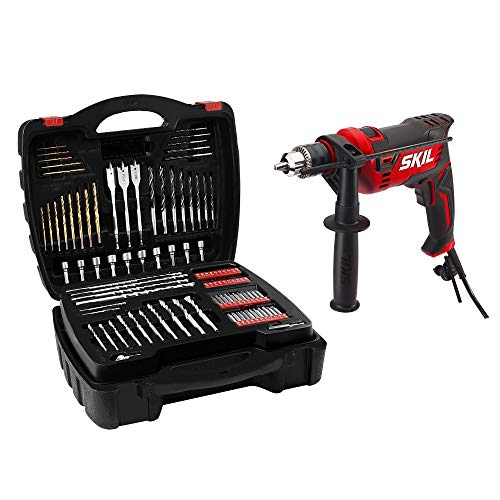
A 7.5 Amp corded hammer drill with a genuine 1/2-in keyed chuck, sold with a 100-piece bit set for the kind of home projects list where you drill wood on Saturday and masonry on Sunday.
Best for: occasional masonry work on a home renovation list Skip it if: you need to drill more than a few feet from an outlet
This is the pick that does what the search actually asks for, with one honest caveat: it is corded, not cordless. Amazon's filter treats it as a hammer drill anyway, and for home projects the reach of an extension cord usually beats the runtime anxiety of a battery. The 7.5 Amp motor and 1/2-in heavy-duty keyed chuck give it a bigger operating envelope than the two cordless picks below, and Skil lists wood, metal and concrete on the same tool. The 2-finger variable speed trigger and lock-on button suggest Skil designed it for longer holes rather than a quick screw.
Weight is 12.9 lb for the shipped package, and dimensions run 13.4 x 14.6 x 5.31 in. Skil publishes a 1-year limited warranty. That is shorter than the DEWALT's 3-year coverage, which is the clearest trade-off this pick makes against the premium option: more drilling authority, less warranty runway.
Pros:
- 7.5 Amp motor rated for wood, metal and concrete
- 1/2-in keyed chuck holds larger bits than the cordless picks
- 100-piece bit set included with the drill
- 2-finger variable speed trigger and lock-on button
- The only true hammer drill in the set with published amperage
Cons:
- Corded, so runtime and reach depend on outlets
- 12.9 lb package is heavier than any cordless pick here
- 1-year warranty trails the DEWALT combo's coverage
2. Sundpey Brushless Cordless Drill Set — Best upgrade
A brushless cordless drill that publishes a 620 in-lbs torque claim and a 19,000 BPM hammer-mode claim, sold with two 2.0Ah batteries and a 3/8-in metal keyless chuck.

Best for: DIYers wanting hammer mode without the cord Skip it if: you need a name-brand battery platform
This is the pick if you read the keyword literally: cordless, hammer, home projects. Sundpey publishes three drilling modes, screwdriving, drilling and hammer drilling, on the same tool, along with a 23+3 torque collar and a two-speed gearbox running 0-400 RPM on low and up to 1,800 RPM on high. The brushless motor is meaningful: brushless motors typically run cooler and last longer than brushed alternatives at the same claimed torque.
Two 2.0Ah batteries in the box is a rare inclusion for the entry price position. Sundpey also lists multi-layer battery protection: overcurrent at 60A, overload and over-temperature cutoffs.
The trade-offs against the Skil are the ones you would expect. Chuck size is 3/8-in rather than 1/2-in, so the largest masonry bit you can hold is smaller. Torque and BPM are manufacturer claims rather than independently measured figures. And Sundpey is not a battery platform you can build a shed of tools around. Buy it as a standalone drill, not as the start of a system.
Pros:
- Brushless motor at the entry price position
- Sundpey claims 620 in-lbs of torque and 19,000 BPM
- Two 2.0Ah batteries included in the box
- 23+3 torque settings and two-speed gearbox
- Three modes including hammer, on a cordless tool
Cons:
- 3/8-in chuck limits masonry bit size
- Torque and BPM figures are manufacturer claims, not measured
- Not a mainstream battery platform for future tools
3. DEWALT DCK240C2 Combo — Best premium
A 20V MAX drill-driver paired with a 1/4-in hex impact driver, two batteries, charger and bag, from a battery platform that fits a wide range of DEWALT tools.

Best for: shoppers building a long-term cordless kit Skip it if: you specifically need hammer-drill mode
The DEWALT is the highest price position here and it does not offer a hammer mode. That reads odd for a best hammer cordless drill for home projects roundup, but it earns its place for a specific buyer: someone who has looked at their project list and realised they mostly drive screws, drill pilot holes and assemble furniture. An impact driver does that faster than a hammer drill, and DEWALT's 20V MAX platform is one of the largest battery families on the market, so tomorrow's circular saw, jigsaw or leaf blower can share these two batteries.
Combined kit weight is 3.6 lb according to the listing, and dimensions run 9.88 x 15.1 x 6.38 in. The drill uses a 1/2-in single-sleeve ratcheting chuck, the impact driver uses a 1/4-in hex chuck with one-handed loading, and both tools carry LED work lights with a 20-second delay. DEWALT publishes a 3-year limited warranty, the longest in this set.
The trade-off is direct. If you need to drill into brick or concrete, the Skil or the Sundpey wins outright. If you never will, the DEWALT is a stronger long-term buy.
Pros:
- 20V MAX platform with wide tool compatibility
- 3-year limited warranty, the longest here
- Drill plus impact driver in one box
- 1/2-in ratcheting chuck on the drill
- Compact 3.6 lb kit with bag included
Cons:
- No hammer mode on either tool
- Highest price position in the set
- Batteries in-kit are typically small compact packs
4. AVID POWER 20V Cordless Drill Set — Best budget pick
A 20V lithium-ion drill with a real-time battery level display, a 3/8-in keyless chuck and 22 accessories, positioned at the cheapest of the six.

Best for: first-time DIYers hanging shelves and assembling furniture Skip it if: you plan to drill into concrete or brick
AVID POWER's listing is refreshingly honest: it markets this drill for "home DIY and beginner projects", not for professional builds. The specifications back that framing. Torque is a 280 in-lbs claim, variable speed runs 0-550 RPM, and there are 15+1 torque settings. Weight is 3.65 lb for the package, and the tool itself is described as a 2.5 lb build with a rubberised grip.
The kit includes 22 accessories: 10 drill bits, 10 driver bits, a flexible shaft and an extension bar. That is enough to hang curtain rods, assemble a bed frame, and put together the flat-pack desk in the same afternoon. The real-time battery level display is a small touch that shoppers usually notice only after they own a drill without one and run out mid-hole.
What it does not do is hammer drilling. Nothing in the listing suggests masonry capacity, and 280 in-lbs is well below what a hammer mode would demand. Treat it as a first drill for a first home, not a hammer drill. The trade-off against the Sundpey is stark: less than half the torque claim, and no hammer mode, at a similar price position.
Pros:
- Cheapest price position in the set
- 22 accessories included with the drill
- Real-time battery level display
- 15+1 torque settings for delicate driving
- Compact 2.5 lb tool weight
Cons:
- No hammer mode
- 280 in-lbs torque claim is the lowest here
- Not a mainstream battery platform
- 3/8-in chuck limits bit size
5. BLACK+DECKER 12V MAX Drill & Home Tool Kit — Best minimal setup
A 12V drill bundled with 59 hand tools and accessories, aimed at a new homeowner who owns nothing yet and wants a drill inside a general kit.

Best for: a new homeowner who owns no tools yet Skip it if: you already own a hand-tool kit
This is the pick that answers a slightly different question. If you have just moved into a first house, own a single screwdriver, and need a drill plus a hammer plus a tape measure plus pliers, the BLACK+DECKER 60-piece bundle is a sensible starting point. The drill is a 12V MAX lithium-ion model, which BLACK+DECKER describes as 35% more compact than the previous NiCad generation, with a mid-handle design and an LED work light. The lithium-ion pack holds a charge for up to 18 months on the shelf, per the listing.
Dimensions of the case are 13.8 x 17.7 x 5.02 in. Warranty is 2 years limited, longer than the Skil's coverage though shorter than the DEWALT's. The 59 accompanying items are hand tools, not drill accessories, which is the important distinction: this is a home-starter box that happens to include a drill.
It has no hammer mode. It also has less drilling authority than the Sundpey or Skil at 12V. The trade-off is that you get an entire tool drawer's worth of gear in one purchase. If you already own a claw hammer and a tape measure, buy a proper drill instead.
Pros:
- 60-piece kit covers a first tool drawer
- 12V lithium-ion pack holds charge up to 18 months
- 2-year limited warranty
- Compact mid-handle drill design with LED
- Mid price position for the total contents
Cons:
- No hammer mode on the drill
- 12V drill is the lowest voltage here
- Value depends on whether you need the hand tools
Corded or cordless: which suits your project list?
The Skil is the only corded pick, and the search assumes cordless. That gap is worth thinking about honestly. Cordless drills win on convenience: no cord to trip over, no need to be near an outlet, no extension cord snaking through a hallway. Corded drills win on sustained power and on never running out mid-hole.
For a home projects list that includes masonry, corded is usually the right call. Hammer drilling into concrete draws high current continuously, and a small battery pack will fade quickly. A 7.5 Amp corded motor like the Skil's holds its output as long as the outlet does.
For a list that is mostly wood and screws, cordless wins comfortably. The DEWALT combo, the Sundpey kit and the AVID POWER drill will all handle furniture assembly, shelf mounting and general repair without an outlet in sight. Match the tool to the drilling you actually do, not the drilling you imagine doing once a year.
How many torque settings do you really need?
Torque settings, sometimes called the clutch collar, let the drill slip before it over-drives a screw. Below is what each pick publishes:
- Sundpey: 23+3 settings
- AVID POWER: 15+1 settings
- DEWALT drill driver: not published on the listing
- BLACK+DECKER: not published on the listing
- Skil: not applicable, this is a hammer drill
Twenty-plus settings look impressive on a spec sheet, but most home projects use three or four of them. Setting one for cabinet hinges, a middle setting for drywall screws into studs, a higher setting for deck screws into softwood, and drill mode for holes. If a drill offers 23 positions, you will still cycle through the same handful. Treat torque-setting counts as a rough proxy for build care rather than a decisive spec, and give more weight to the maximum torque figure and the number of speeds.
What the listings do not tell you
Every listing here publishes what it wants to. Three details typically go missing:
- Battery cell chemistry and cell count. "2.0Ah" tells you capacity, not the cells inside. Reputable brands publish cell suppliers; entry-level brands rarely do.
- How long the warranty covers the battery, versus the tool. The Skil, DEWALT and BLACK+DECKER publish warranty lengths, but batteries and chargers often carry shorter coverage. Check the fine print before you buy.
- Noise levels in hammer mode. No listing here publishes a decibel figure. Hammer drilling in a shared apartment is loud enough to bother neighbours; if noise matters, plan on ear protection either way.
None of this is a reason to avoid a specific pick. It is a reminder that the listing is a marketing document, and the specifications on it are the ones the brand chose to publish.
The verdict
The Skil HD182002 is the right default for a shopper searching the best hammer cordless drill for home projects, even though it is corded, because it is the only pick with a genuine 1/2-in chuck, a published 7.5 Amp motor, and a listing that names concrete alongside wood and metal. For a home projects list that includes any masonry work, that combination wins.
The cutoff is what you drill into. If you drill wood, plastic, drywall and the occasional metal bracket, and never concrete or brick, the DEWALT DCK240C2 is a stronger long-term buy. Its 20V MAX platform, 3-year warranty and included impact driver will serve years of home projects, and you will not miss a hammer mode you were never going to use.
The Sundpey earns its spot for a narrower profile: shoppers who genuinely need cordless hammer mode and are comfortable buying outside the mainstream battery families. The AVID POWER and BLACK+DECKER picks are for shoppers whose real question is "what is my first drill?" rather than "what is my best hammer drill?".
FAQ
Is a hammer drill worth it for home projects?
A hammer drill is worth it for home projects if your list includes drilling into concrete, brick or masonry more than once a year. Anchors for shelves in a concrete basement wall, mounting a TV bracket in brick, or fixing a curtain rod into a stucco surface all benefit. If your list is entirely wood, drywall and metal, a standard drill driver like the DEWALT combo is a better fit.
Can the Skil HD182002 replace a rotary hammer?
The Skil HD182002 can drill into concrete for occasional home projects, but it cannot replace a rotary hammer for sustained masonry work. A rotary hammer uses an SDS-Plus chuck and a piston mechanism that hits harder, and it is the right tool for daily concrete drilling. The Skil's 7.5 Amp motor and 1/2-in chuck cover anchor holes and light masonry, not foundation work or full renovations.
DEWALT DCK240C2 vs Sundpey brushless drill: which wins?
DEWALT DCK240C2 vs Sundpey comes down to platform versus feature. The DEWALT wins if you plan to buy more cordless tools, because the 20V MAX battery fits saws, sanders and lights, and it carries a 3-year warranty. The Sundpey wins if you specifically need cordless hammer mode, since the DEWALT combo does not offer one. Sundpey publishes 620 in-lbs of torque and 19,000 BPM as claims.
What torque rating do I need for a home DIY drill?
Torque rating requirements for a home DIY drill depend on the fasteners you drive. Around 250 to 350 in-lbs handles furniture assembly, drywall screws and cabinet work; the AVID POWER's 280 in-lbs claim sits in that band. Above 500 in-lbs handles deck screws, lag bolts and thicker lumber; the Sundpey's 620 in-lbs claim covers those. For occasional masonry, the Skil's 7.5 Amp corded motor is a different measure entirely.
Should I buy a drill kit or a drill on its own?
Drill kits make sense when you need the bits, batteries or hand tools bundled. The BLACK+DECKER 60-piece bundle suits a new homeowner with an empty toolbox. The Skil's 100-piece bit set matters if you do not own drill bits. Buy the drill alone when you already own compatible batteries on the same platform, or when you have a bit set from a previous tool and only need the drill itself.
The right next step is a five-minute audit of what you actually plan to drill in the next twelve months. Count the masonry jobs first, then the wood jobs, then the pure screwdriving. If masonry lands above three, the Skil earns its lead by covering work the cordless picks cannot. If masonry lands at zero, the DEWALT combo is a smarter twelve-month investment, and hammer mode is a spec you are paying for and never using. The Sundpey sits between those two answers, and it is the honest cordless choice when the search phrase is taken literally rather than loosely.