Best Heavy Duty Portable Generator by Watts and Fuel

Six 10,000-plus watt generators lined up by wattage, fuel flexibility and frame weight. Which one belongs in your garage depends on three specific questions.

By Taylor DavidsonUpdated 16 min read
On this page
- Best heavy duty portable generator at a glance
- How I narrowed six heavy generators from a much longer list
- What actually decides a heavy duty portable generator?
- 1. Westinghouse WGen9500DF — Best overall
- 2. DuroStar DS13000MX — Best budget pick
- 3. DuroMax XP13000EH — Runner-up
- 4. Westinghouse iGen12000DFc — Best premium
- 5. Generac 8061 Tri-Fuel — Best for beginners
- 6. A-iPower AP10700E — Best for heavy use
- Dual fuel or tri-fuel: which one earns the price gap?
- How much generator does a whole house really need?
- What the listings do not tell you about moving 220 lb
- The verdict
- FAQ
The best heavy duty portable generator is the Westinghouse WGen9500DF, a 210 lb dual-fuel unit that delivers 12,500 peak watts and 9,500 running watts on gasoline and arrives transfer-switch ready with a 3-year limited warranty. If your priority is pure sine wave power for a house full of sensitive electronics, the Westinghouse iGen12000DFc inverter takes the crown instead, at 187.4 lb and up to 19 hours of runtime at 25% load.
Best heavy duty portable generator at a glance
| Pick | Peak watts | Fuel | Weight | Price |
|---|---|---|---|---|
Best overall Westinghouse WGen9500DF |
12,500 W (gas) 11,200 W (LP) |
Dual fuel | 210 lb | Check Price |
Best budget pick DuroStar DS13000MX |
13,000 W claim | Dual fuel | 220 lb | Check Price |
Runner-up DuroMax XP13000EH |
13,000 W claim | Dual fuel | 234 lb | Check Price |
Best premium Westinghouse iGen12000DFc |
12,000 W (inverter) ≤3% THD claim |
Dual fuel | 187.4 lb | Check Price |
Best for beginners Generac 8061 Tri-Fuel |
12,500 W (gas) 9,500 running |
Gas, LP, NG | 227 lb | Check Price |
Best for heavy use A-iPower AP10700E |
10,700 W (gas) 8,500 running |
Gasoline only | 212.1 lb | Check Price |


How I narrowed six heavy generators from a much longer list
Every unit in this roundup starts above 10,000 peak watts, carries a wheel kit-sized frame, and lists a 50-amp outlet. That is the threshold where "portable" stops meaning something you lift and starts meaning something you roll. Below it, you cannot realistically run a central AC blower, a well pump, and a fridge at the same time.
Three disqualifiers cut the longer list down to these six:
- No 50-amp transfer-switch-ready outlet. A heavy duty portable generator that cannot connect to a whole-home transfer switch is a very expensive extension cord, so anything missing the 14-50R output was cut.
- No electric start. Pulling a recoil cord on a 220 lb generator with a 457cc engine is not a plan.
- Under 10,000 peak watts. Below that line, the buyer profile changes to RV and tailgate use, which is a different article.
What survived is a set that clusters tightly on frame size and weight, and splits sharply on fuel type, wattage rating, and whether the unit uses inverter or conventional generator technology. Those three splits do the work of ranking the field.
What actually decides a heavy duty portable generator?
Most guides compare peak watts and stop there. Peak watts is the surge figure a generator holds for a second or two while a motor starts. It is not the number that decides whether the unit can back up your house.
Running watts is the real deciding figure. That is the continuous load the engine sustains for hours. The Westinghouse WGen9500DF delivers 9,500 running watts on gasoline. The Generac 8061 also delivers 9,500 running watts on gasoline, drops to 8,550 on propane, and 7,000 on natural gas per the listing. The A-iPower AP10700E delivers 8,500 running watts. The two 13,000-watt units in this set do not publish a running-watts figure in the data I have, which is worth noting before you assume higher.
The second decider is fuel flexibility. Five of these six are dual fuel: gasoline plus liquid propane. Only the Generac 8061 adds natural gas as a third option, which is what earns it the beginner pick when a home already has a gas line at the meter. The A-iPower AP10700E is the lone gasoline-only unit, and it wins on a different criterion entirely.
The third decider is power quality. Only the Westinghouse iGen12000DFc is an inverter generator with a stated ≤3% THD claim, and that matters if you plan to plug in a modern furnace board, a variable-speed pool pump, or a home office full of computers.
1. Westinghouse WGen9500DF — Best overall
The WGen9500DF wins because it hits the running-watts figure a whole-home transfer switch needs, at the lightest weight and second-lowest price in this set.
Best for: homeowners wiring a transfer switch for whole-house backup Skip it if: you need pure sine wave power for sensitive electronics
Within this set, the WGen9500DF is the only unit that pairs a published 9,500 running watts on gasoline with a frame weight of 210 lb. Every other picked generator either weighs more or does not publish its running-watts figure. The listing pegs peak output at 12,500 watts on gasoline and 11,200 watts on propane, driven by a 457cc Westinghouse 4-stroke OHV engine with a cast iron sleeve. Westinghouse says the unit runs up to 12 hours on a tank, includes a remote start key fob, and ships with oil, a funnel, a battery charger and a tool kit.
The outlet layout is what earns the top slot: two 120V 5–20R household receptacles, a 120V L14-30R twist lock, and the 120/240V 14–50R 50-amp outlet that a transfer switch or interlock kit plugs into directly. The 3-year limited warranty matches the best in this set. The trade-off is that this is a conventional generator, not an inverter, so it does not carry the low-THD label the iGen12000DFc does.
Pros:
- 9,500 running watts on gasoline, published clearly
- Lightest at 210 lb among the transfer-switch-ready picks
- Remote start key fob included in the box
- 3-year limited warranty
- Full outlet set including 50-amp 14-50R
Cons:
- Conventional generator, no published THD figure
- Louder than the iGen12000DFc inverter at comparable load
- No carbon monoxide sensor listed in the specifications
2. DuroStar DS13000MX — Best budget pick
The DS13000MX takes the budget slot because it is the cheapest in this set while still claiming 13,000 watts and a 50-amp outlet.

Best for: buyers who want the highest wattage for the lowest price here Skip it if: you need inverter-clean power or a longer warranty
The DS13000MX sits at the cheapest price position in this roundup and pairs it with the highest headline wattage claim: 13,000 watts, driven by a 500cc engine according to the listing. At 220 lb it is only 10 lb heavier than the Westinghouse WGen9500DF, and its 25.8 x 29.8 x 27.5 in footprint is broadly in line with the rest. DuroStar states dual fuel with a front-mounted selector, push-button electric start, a CO alert that shuts the unit down automatically, and a 50-amp outlet feeding a transfer switch.
The reason this is the budget pick rather than the overall winner is what the listing does not state: there is no published running-watts figure in the data, and no explicit inverter or THD label. The 3-year limited factory warranty matches the top picks. Against the WGen9500DF, you are trading a published running-watts number and a longer track record for a lower price and a stated CO shutdown. That is a genuine trade-off, not a free win.
Pros:
- Cheapest of the six
- 13,000-watt headline claim on the listing
- CO alert with automatic shutdown claim
- 3-year limited factory warranty
- Push-button start with fuel-selector dial
Cons:
- No published running-watts figure in the data
- 220 lb is heavy for a single person to move
- Not an inverter, no low-THD claim
3. DuroMax XP13000EH — Runner-up
The XP13000EH earns runner-up on frame build and category familiarity, at a mid-range price for this set.

Best for: buyers who prefer an all-metal frame and no plastic panel Skip it if: weight matters more than build feel
The XP13000EH is the heaviest generator in this comparison at 234 lb, on a 26 x 30 x 29 in footprint. DuroMax's listing highlights an all-metal frame and power panel with no plastic parts, a push-button start, a front-facing fuel selector, and a transfer-switch-ready outlet set. Peak wattage is stated as 13,000 watts on gasoline, and the unit runs on either gasoline or propane. Warranty is 3 years.
Where this pick lands against the two Westinghouse units is on feel rather than figures. It is the slowest seller of the six in this set, and it does not publish a running-watts figure or a THD claim in the data. What it does publish is a build description that emphasizes steel over plastic, which matters for a heavy duty portable generator that lives on a job site or in a garage that gets bumped. The extra 24 lb over the WGen9500DF is real, though: this is not a solo lift, and the wheel kit becomes non-negotiable rather than optional.
Pros:
- All-metal frame and panel per the listing
- 13,000-watt headline claim
- Dual fuel with front-panel selector
- 3-year warranty
- Transfer-switch-ready outlet set
Cons:
- Heaviest at 234 lb
- No published running-watts figure in the data
- Mid-range price without a clear spec advantage over cheaper picks
- No inverter, no THD claim
4. Westinghouse iGen12000DFc — Best premium
The iGen12000DFc is the only inverter in this roundup, and it wins the premium slot for a house full of sensitive electronics.

Best for: backing up a modern home full of sensitive electronics Skip it if: you refuse to pay the premium tier for THD under 3 percent
The iGen12000DFc is the most expensive pick here and it earns the premium tier on three specific counts. Westinghouse states peak output at 12,000 watts with a ≤3% THD claim, meaning the waveform is clean enough for sensitive electronics without a separate power conditioner. The 457cc engine and 7.5-gallon tank support a stated runtime of up to 19 hours at 25% load, which is the longest continuous run figure in this set. And at 187.4 lb, it is the lightest generator in the roundup by a clear margin.
Outlets include a 120/240V 14–50R 50A and a 120V/240V L14-30R 30A twist lock, both transfer-switch or interlock-kit ready. Westinghouse also notes an Eco Mode targeting as low as 64 dBA at partial load, a digital display for fuel and runtime, and a remote start key fob in the box. The trade-off is straightforward: you pay the premium band price to gain THD-clean power and lighter weight. If your loads are big motors rather than electronics, the WGen9500DF does the same core job for less.
Pros:
- Inverter generator with ≤3% THD claim
- Lightest pick at 187.4 lb
- Up to 19 hours claimed at 25% load
- Digital display for fuel, runtime and voltage
- Parallel-capable per the listing
Cons:
- Most expensive pick here
- 12,000 W peak is below the two 13,000 W claims in this set
- No natural gas option
5. Generac 8061 Tri-Fuel — Best for beginners
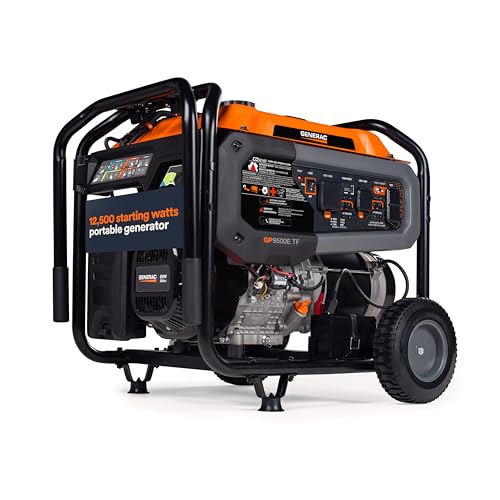
The Generac 8061 wins the beginner slot because a single dial switches between gas, propane and natural gas without shutting the unit down.
Best for: first-time owners who want gas, propane and natural gas on one dial Skip it if: you have no natural gas line and no plan to add one
Generac lists 9,500 running watts and 12,500 starting watts on gasoline, dropping to 8,550 running on propane and 7,000 running on natural gas. That third fuel is what separates this pick from every other unit in the roundup. If your home already has a natural gas meter, the 8061 lets you back up during long outages without hauling propane tanks or storing stabilized gasoline. The listed 6 hours at 25% load on a 20-pound LP tank sets expectations honestly: propane is for convenience, not week-long outages.
At 227 lb on a 27 x 27.2 x 26.9 in footprint, the frame is compact for its wattage. Generac's listing notes rocker-switch electric start with recoil backup, Cosense CO detection with automatic shutdown, and up to 14 hours at 25% load on a 7.5-gallon gasoline tank. The 3-year limited residential warranty matches most of this set. Two trade-offs: this is the second-most-expensive pick, and the running-watts figure on gasoline exactly matches the cheaper WGen9500DF. You are paying for the natural gas hookup capability, so it is only worth it if you will actually use it.
Pros:
- Only pick with three fuel types
- 9,500 running watts on gasoline, published clearly
- Cosense CO detection with auto-shutdown
- Electric start with recoil backup
- Named brand with wide dealer network
Cons:
- Second-most-expensive pick here
- Running-watts on gasoline match the cheaper WGen9500DF
- Natural gas requires a plumbed line, not included
6. A-iPower AP10700E — Best for heavy use
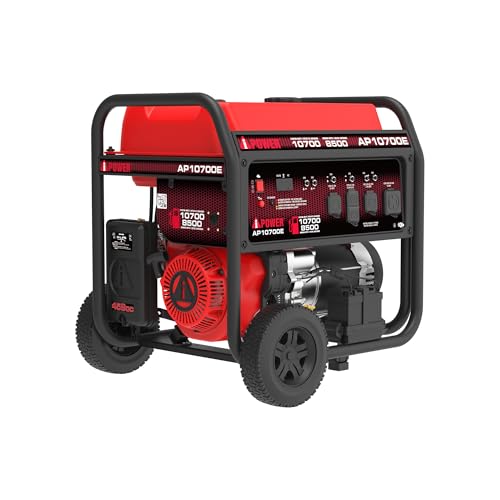
The AP10700E is the pick for a crew that runs the unit hard on gasoline every day and does not care about propane.
Best for: job-site crews running tools all day on gasoline only Skip it if: you want dual fuel or a three-year warranty
The AP10700E is the newest generator in this set, listed as released in 2025. A-iPower states 10,700 starting watts and 8,500 running watts on gasoline, driven by a 459cc OHV engine with a cast iron sleeve. Frame weight is 212.1 lb, within a few pounds of the Westinghouse WGen9500DF, and the 29.1 x 28 x 27.4 in footprint is close to the DuroMax. Outlets include two 5-20R GFCI receptacles, an L5-30R, and CO sensor monitoring on the control panel.
Two facts explain the ranking. First, this is the only gasoline-only unit in the roundup, so it forfeits the dual-fuel flexibility every other pick offers. Second, the warranty is 2 years rather than 3, the only pick under 3 years in this set. What you get in exchange is a large-displacement engine tuned for continuous duty, a lower peak wattage figure that avoids stretching a smaller engine, and a mid-band price. For a contractor who fills a jerry can weekly and runs the same tools for 10 hours a day, that is a coherent trade. For a homeowner planning around week-long outages, it is not.
Pros:
- 8,500 running watts on gasoline, published clearly
- Large 459cc engine with cast iron sleeve
- CO sensor with digital data center
- Newest release date in the set
- Mid-band price for a large-frame unit
Cons:
- Gasoline only, no propane fallback
- 2-year warranty, shortest in this set
- Slowest seller of the six
- Peak wattage is the lowest here
Dual fuel or tri-fuel: which one earns the price gap?
Five of these six generators run on gasoline plus propane. Only the Generac 8061 adds natural gas as a third option. The question is whether that third fuel is worth the step up from entry to premium pricing.
Natural gas has one big advantage: it comes out of a pipe rather than a tank. In a multi-day outage, a gas line at your meter keeps running while propane suppliers get overwhelmed and gasoline stations lose power. That is the exact scenario a heavy duty portable generator exists for.
Natural gas has two limits. First, the Generac listing shows 7,000 running watts on natural gas, compared with 9,500 running watts on gasoline. You lose about a quarter of the running capacity when you switch to the pipe. Second, you need a licensed plumber to run a gas quick-connect to the generator pad, which is a real project.
The math works like this: if your home has natural gas at the meter today, the 8061 earns the premium. If you would need to install a new gas line to use it, the money goes further on a dual-fuel unit with a spare propane tank in the garage.
How much generator does a whole house really need?
Whole-house backup is a phrase the listings use freely. What it actually means depends on your loads. Here is the running-watts math for a typical single-family home in an outage:
- Central AC blower or heat pump air handler: 1,500 to 3,500 W
- Well pump: 1,000 to 2,500 W at start
- Refrigerator plus deep freezer: 1,200 W combined
- Sump pump: 800 to 1,500 W
- Lights, outlets and small electronics: 1,000 to 1,500 W
That totals roughly 5,500 to 10,000 running watts before you add an electric range or an electric water heater. In this set:
- The Westinghouse WGen9500DF and the Generac 8061 both publish 9,500 running watts on gasoline, which comfortably covers the profile above.
- The Westinghouse iGen12000DFc is rated for 12,000 W peak with inverter output, targeted at homes that need clean waveform for the same loads.
- The A-iPower AP10700E publishes 8,500 running watts on gasoline, which handles the profile if you stage loads carefully.
- The DuroStar DS13000MX and DuroMax XP13000EH claim 13,000-watt peaks but do not publish a running-watts figure in the data, so plan around the peak-to-running ratio typical of conventional generators.
For most homes, 8,500 to 9,500 running watts is the sweet spot. Above that, you are paying for capacity you will not use.
What the listings do not tell you about moving 220 lb
Every generator in this roundup weighs between 187.4 lb and 234 lb. The listings all mention wheel kits or heavy-duty frames. What they do not tell you:
- A 210 lb generator with pneumatic tires is a two-person lift onto a truck bed. One person can roll it across a smooth garage floor. Nobody lifts it alone.
- Wheel-kit tires go flat sitting in a garage for a year. Check pressure before an outage, not during one.
- The 50-amp cord to a transfer switch is thick and short. Plan the generator location before you install the inlet box on the house.
- The tank capacity determines how often you refill in the middle of the night. The iGen12000DFc's 19-hour figure at 25% load is the outlier here; a heavier load cuts that runtime roughly in half.
- Propane hoses are not included. Every dual-fuel unit needs a regulator-terminated hose you buy separately.
None of these facts change the ranking. All of them change your first weekend with the generator.
The verdict
The Westinghouse WGen9500DF is the best heavy duty portable generator for most buyers because it publishes the running-watts figure a whole-home transfer switch needs, on the lightest transfer-switch-ready frame in this comparison, at the second-lowest price. 9,500 running watts on gasoline, 210 lb, a 3-year limited warranty, and a complete outlet set including the 14-50R 50-amp receptacle add up to a coherent whole-home backup package.
Two conditions flip the recommendation. First, if your home is full of variable-speed motors, modern furnace boards and computers, the Westinghouse iGen12000DFc's inverter output with a ≤3% THD claim is worth the premium tier price and buys you the lightest frame here at 187.4 lb along with up to 19 hours of stated runtime. Second, if you already have a natural gas line at your meter, the Generac 8061 tri-fuel earns its price with the ability to keep running when propane suppliers and gas stations are both offline.
The DuroStar DS13000MX is the answer if price is the only variable that matters. The AP10700E is the answer if you run one on gasoline daily.
FAQ
Is a heavy duty portable generator worth it for occasional outages?
A heavy duty portable generator is worth it when outages last more than 12 hours and cover freezers, sump pumps or medical equipment. Below that threshold, a smaller inverter unit or a battery station handles a few lights and a fridge more cheaply and more quietly. The 210 lb frames in this roundup earn their weight when a storm knocks power out for two or three days.
What is the difference between the Westinghouse WGen9500DF and the iGen12000DFc?
The difference between the Westinghouse WGen9500DF and the iGen12000DFc is inverter output. The WGen9500DF is a conventional dual-fuel generator with 9,500 running watts on gasoline. The iGen12000DFc is an inverter with a stated ≤3% THD claim, is lighter at 187.4 lb, and claims up to 19 hours at 25% load. The iGen sits in the premium band; the WGen sits in the entry band.
How long will a heavy duty portable generator run on one tank?
How long will one tank run depends on load. Westinghouse states up to 12 hours for the WGen9500DF and up to 19 hours at 25% load for the iGen12000DFc on a 7.5-gallon tank. Generac states up to 14 hours for the 8061 at 25% load. Running at 50 to 75 percent load roughly halves those figures, so plan refills around your actual draw rather than the headline number.
Can these generators back up a whole house?
Yes, these generators can back up a whole house when connected to a transfer switch through the 50-amp 14-50R outlet each unit provides. The practical cap is your running-watts figure, not the peak. 9,500 running watts on the WGen9500DF or Generac 8061 handles a typical single-family load profile with central AC, a well pump, a fridge and lights, provided you stage large-motor startups rather than hitting them simultaneously.
Do heavy duty portable generators need special maintenance?
Heavy duty portable generators need oil changes at the interval the manual states, fresh gasoline with stabilizer if the unit sits, and a monthly test run under load. The 457cc and 500cc engines in this set are car-scale, not lawnmower-scale, so treat them accordingly. Battery-start units need the battery kept on a maintainer. Propane runs cleaner than gasoline and extends time between oil changes, which is one quiet argument for dual fuel.
Once you know your running-watts number and your fuel situation, the choice among these six narrows fast. Write down the three biggest loads you want to run at once, add their nameplate wattage, and match that number to the running-watts column above rather than the peak. That single step separates buyers who end up happy from buyers who end up wishing they had bought the next size up. The Westinghouse WGen9500DF is the default answer because it hits the number most homes actually need at a weight one person can still roll, and that combination is rarer in this category than the wattage claims suggest.