Best Quiet Generators for Homeowners by Decibel

Seven inverter generators compared on published decibel figures, running watts and carry weight, with the Oxseryn 2800W leading on the numbers that matter for a suburban backyard.

By Taylor DavidsonUpdated 17 min read
On this page
- Best quiet generator for homeowners at a glance
- How I cut a long list down to seven
- 1. Oxseryn 2800-Watts Portable Inverter Generator — Best overall
- 2. AIVOLT 1600W Super Quiet Inverter Generator — Best budget pick
- 3. Oxseryn 4400-Watts Inverter Generator — Best for families
- 4. PowerSmart 3600 Watt Portable Inverter Generator — Most versatile
- 5. Pulsar PGD40ISCO 4000W Inverter Generator — Best for quiet operation
- 6. ERAYAK 4500W Portable Inverter Generator — Best upgrade
- 7. WEN 6800-Watt Dual Fuel Inverter Generator — Best premium
- Why decibel figures alone do not decide it
- What running watts actually cover in a house
- How much does a quiet generator weigh to move?
- What the listings do not tell you about noise
- Which pick fits which homeowner?
- The verdict
- FAQ
The best quiet generator for homeowners is the Oxseryn 2800-Watts Portable Inverter Generator, because its 58 dBA claim at 23 feet lands at the low end of this set while the 40 lb frame stays easy to roll out of a shed. The AIVOLT 1600W is the pick if your outage load is small and the lightest 28 lb carry matters more than headroom.
Most homeowners compare peak wattage first and quickly buy too much generator for the appliances they actually run. Peak numbers are surge figures that last a second. Running watts and the published decibel figure are the pair that decides whether a generator earns a spot on the back patio.
Best quiet generator for homeowners at a glance
| Pick | Noise (claim) | Running watts | Price |
|---|---|---|---|
Best overall Oxseryn 2800-Watts Portable Inverter Generator |
58 dBA at 23 ft | 2,000 W | Check Price |
Best budget pick AIVOLT 1600W Super Quiet Inverter Generator |
57 dBA at 23 ft | 1,400 W | Check Price |
Best for families Oxseryn 4400-Watts Inverter Generator |
not listed | 3,400 W | Check Price |
Most versatile PowerSmart 3600 Watt Portable Inverter Generator |
59 dBA at 23 ft | 3,200 W | Check Price |
Best for quiet operation Pulsar PGD40ISCO 4000W Inverter Generator |
59 dB claim | 3,200 W | Check Price |
Best upgrade ERAYAK 4500W Portable Inverter Generator |
60.5 dBA claim | 3,500 W | Check Price |
Best premium WEN 6800W Dual Fuel Inverter Generator |
not listed | 5,100 W (gas) | Check Price |





How I cut a long list down to seven
Three filters did most of the cutting. First, inverter design only, because open-frame contractor generators run louder than any suburban neighbour will tolerate. Second, a published decibel figure on the listing, or a manufacturer statement close enough to compare. Third, a weight low enough that one adult can move the unit without a hand truck, with the WEN as the one intentional exception at 99.2 lb.
Everything about the best quiet generator for homeowners depends on the buyer running the numbers against their own house. The word "homeowners" is broad. A townhouse fridge and a laptop is a very different job from a well pump and a window AC. So the picks span 1,400 running watts up to 5,100, on gas, across three price tiers.
A few practical notes on the screening:
- Every pick claims THD under 3%, so sensitive electronics like laptops and CPAP machines are covered on paper.
- Every pick is a single-fuel gasoline design except the WEN, which adds propane.
- Two of the seven publish a warranty of two years or longer, which is the cluster I would push most homeowners toward.
1. Oxseryn 2800-Watts Portable Inverter Generator — Best overall
A small, light inverter with a 58 dBA claim and enough headroom for the loads most homeowners actually run in an outage.
Best for: a suburban homeowner running a fridge, a router and a few lamps through an outage Skip it if: you need to power a well pump or a central AC
Within this set, the Oxseryn 2800 hits the sweet spot on the two numbers that decide a quiet generator for a house: the manufacturer states under 58 dBA at 23 feet, and the unit weighs 40 lb with a 19.2 x 18.6 x 11.2 in footprint. The 2,000 running watts, 2,800 peak spec covers a typical fridge, a router, a few lamps, a laptop and a small window fan at the same time. Oxseryn says the engine is a 79.8cc 4-stroke OHV with a 1.1 gallon tank, and the panel carries 2x 120V AC, 12V DC, USB-A and USB-C.
The trade-off is fuel range. That 1.1 gallon tank is small for a night of steady load, and the warranty runs only one year, half of what the AIVOLT and PowerSmart list. On price it sits third-cheapest here, so you are paying a small premium over the AIVOLT to get roughly 600 more running watts.
Pros:
- 58 dBA claim at 23 ft, low end of this set
- 40 lb frame with a built-in handle
- USB-A and USB-C alongside two 120V outlets
- Under 3% THD claim for laptops and small electronics
- Eco mode listed on the panel
Cons:
- 1.1 gallon tank limits runtime at higher loads
- 1-year warranty is the shortest of the picks that publish one
- No RV outlet, unlike three others in this set
2. AIVOLT 1600W Super Quiet Inverter Generator — Best budget pick
The lightest and cheapest pick here, with a two-year warranty and a 57 dBA claim.
Best for: a first-time buyer who wants the lightest carry and a two-year warranty Skip it if: your outage load runs past a small fridge and a laptop
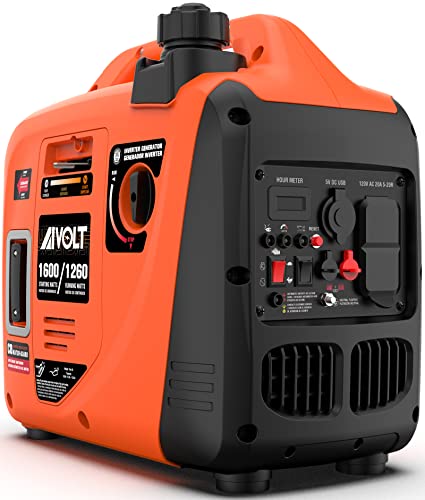
The AIVOLT is the cheapest of the six inverter picks and the lightest at 28 lb, with a 15.8 x 16.9 x 9.92 in body. AIVOLT states 57 dBA at 23 ft, which is the lowest published figure in this set, and the 60cc engine is rated for 8 hours at 25% load. Running watts are 1,400, so this is a companion to a modest outage kit, not a substitute for a bigger unit. The panel carries 2x 120V outlets, USB-A and USB-C, and AIVOLT lists parallel capability if you later buy a second unit to double the output.
The obvious weakness is capacity. A 1,400 watt ceiling covers a fridge, phones and a laptop, but a microwave or a portable AC will push it past the rated line. AIVOLT also claims a built-in CO shutdown sensor, which matches the WEN's Watchdog feature and is worth having on any generator that might get placed too close to a door.
Pros:
- Cheapest of the six inverter picks
- 28 lb, the lightest carry in this set
- 57 dBA at 23 ft, the lowest published figure here
- 2-year manufacturer warranty
- Claimed CO shutdown sensor
Cons:
- 1,400 running watts caps the appliance list
- No 30A RV outlet
- Small tank limits full-load runtime
3. Oxseryn 4400-Watts Inverter Generator — Best for families
More running watts and a 30A RV outlet, with an open-frame body that trades some noise for capacity.

Best for: a family that needs an RV outlet and longer runtime at partial load Skip it if: you want the quietest published figure in this set
The 4400 is the step up in the Oxseryn line, at 3,400 running watts and 4,400 peak, with a 2 gallon tank and a claimed 14 hour runtime at 25% load. That runtime figure is the longest in this set on paper, and it comes with a 30A RV outlet on the panel. Weight climbs to 57 lb across a 19.2 x 19.4 x 15.2 in open-frame body, and Oxseryn lists ECO mode, low-oil shutdown, overload protection and cold-start technology.
The catch is the noise figure. Oxseryn does not publish a decibel number for this open-frame model, which is a real gap in a "quiet generator" shortlist. Open-frame inverters tend to run a few dB louder than their enclosed siblings, so treat this pick as the wattage-and-runtime choice rather than the noise choice. Warranty is one year, same as the smaller Oxseryn.
Pros:
- 3,400 running watts covers larger appliances
- 30A RV outlet on the panel
- 14 hour runtime at 25% load, per Oxseryn
- ECO mode and low-oil shutdown listed
- Second-cheapest of this set
Cons:
- No published decibel figure
- Open frame typically runs louder than enclosed picks
- 57 lb is heavier than the small-frame options
- 1-year warranty
4. PowerSmart 3600 Watt Portable Inverter Generator — Most versatile
A twist-lock outlet, a duplex household outlet and a two-year warranty in one enclosed body.

Best for: a homeowner who wants a twist-lock outlet and a two-year warranty Skip it if: you plan to carry the generator far from a storage spot
The PowerSmart 3600 is the versatile middle of this set. On the panel PowerSmart lists a 120V 30A L5-30R twist-lock outlet, a 120V 20A 5-20R duplex household outlet, a 12V 8A DC port and dual 5V 2.1A USB ports. That mix covers a transfer-switch inlet, everyday extension cords and phone charging without an adapter. PowerSmart states 59 dBA at 23 feet at 25% load, 3,200 running watts and up to 8 hours of runtime from the 1.3 gallon tank at that load. Weight is 50.7 lb over a 19.5 x 21.9 x 13.4 in body.
Where it costs you is portability at longer distances. At 50.7 lb this is a two-hand carry, and the frame does not list built-in wheels. On price it sits mid-range in this set, which reads fair once you factor the 2-year warranty and the L5-30R outlet against the two Oxseryn picks below it. Parallel capability is listed if you later want to double output.
Pros:
- 30A twist-lock outlet plus duplex household outlet
- 3,200 running watts
- 59 dBA at 23 ft at 25% load, per PowerSmart
- 2-year manufacturer warranty
- Under 3% THD claim
Cons:
- 50.7 lb without built-in wheels listed
- Mid-tier price for entry-tier size
- Small tank compared with the Oxseryn 4400
5. Pulsar PGD40ISCO 4000W Inverter Generator — Best for quiet operation
A compact 4,000 peak watt inverter with the longest warranty in this shortlist.

Best for: someone who wants a three-year warranty and a compact footprint Skip it if: you need long runtime from a single tank
Pulsar publishes 4,000 peak watts and 3,200 rated watts, at a claimed 59 dB, in a 17.3 x 18.9 x 11.4 in body that is the smallest footprint of any pick above 3,000 running watts here. Weight is 47.3 lb, so it lands between the small inverters and the family-size picks. Pulsar lists a 3 year limited warranty, the longest published in this set, and calls out compatibility with AC units up to 13,500 BTU, which covers most window and RV rooftop units.
The runtime is the honest weakness. Pulsar states 4 hours at half load from a 1 gallon tank, which is short compared to the 8 hour figure PowerSmart claims at 25% load. If you expect to run through a full night without refuelling, you will be up to top it off. On price this sits fifth of seven, so you are paying for the warranty length and the compact shell more than for raw wattage.
Pros:
- 3-year limited warranty, longest here
- 3,200 running watts in a compact body
- 47.3 lb, manageable for one adult
- Rated for AC units up to 13,500 BTU per the listing
- Under 3% THD claim
Cons:
- 4 hour runtime at half load is short
- 1 gallon tank means more refuelling
- Warranty is limited rather than full
6. ERAYAK 4500W Portable Inverter Generator — Best upgrade
3,500 running watts and an RV outlet in a 54 lb frame, at a claimed 60.5 dBA.

Best for: a homeowner who wants 3,500 running watts in a portable frame Skip it if: the published noise figure is your top filter
The ERAYAK 4500 is the highest-output enclosed inverter in this shortlist, at 4,500 peak and 3,500 running watts, in a 54 lb body measuring 19.3 x 20 x 11.7 in. ERAYAK states 60.5 dBA, which is the highest published number in this set, though still in inverter territory rather than open-frame territory. The panel adds a 30A L5-30R (TT-30R) outlet plus two 120V AC outlets, and the unit is 50A parallel-ready if you later add a second.
The listing does not publish a warranty term, which is the gap that keeps this from beating the Pulsar for a homeowner who wants a paper safety net. On price it is the second most expensive here, sitting in premium tier alongside the Pulsar and the WEN. What you get for that spend is 300 more running watts than the Pulsar and a 30A outlet the Pulsar's listed spec sheet does not call out.
Pros:
- 3,500 running watts, highest here below the WEN
- 30A RV outlet plus two 120V outlets
- 50A parallel capability listed
- 54 lb, still a one-adult carry
- ECO mode called out on the panel
Cons:
- 60.5 dBA is the highest claim in this set
- No warranty term listed
- Premium price for a single-fuel design
7. WEN 6800-Watt Dual Fuel Inverter Generator — Best premium
Dual fuel, 240V and 5,100 running watts on gas, in the only pick built around whole-home backup.

Best for: a whole-home backup buyer with an EV and a propane tank on hand Skip it if: you need something one adult can lift alone
The WEN DF680iX is a different animal. WEN lists a 224cc dual-fuel engine that runs on gasoline (6,800 surge, 5,100 rated) or propane (6,000 surge, 4,500 rated), a bonded-neutral 240V configuration described as suitable for Level 2 EV charging at low power, and a receptacle set that includes L14-30R 240V, two 120V three-prong outlets and a TT-30R RV outlet. Electric start, the Watchdog CO shutdown sensor and fuel shutoff are all on the spec sheet, along with onboard wheels and a telescoping pull handle. Warranty runs three years limited.
The price you pay for that capability is weight and noise. At 99.2 lb, this is not a one-person lift, and the listing does not publish a decibel figure. Read this pick as the compromise a homeowner makes when the backup job outgrows a small inverter: it will be a little louder, it will be much heavier, and it will run the fridge, the well pump and the microwave together on gas.
Pros:
- 5,100 running watts on gasoline
- Dual fuel with propane option
- 240V L14-30R outlet plus TT-30R RV outlet
- Electric start, onboard wheels, telescoping handle
- 3-year limited warranty and CO shutdown sensor
Cons:
- 99.2 lb, not a one-person carry
- No published noise figure
- Most expensive pick in this shortlist
Why decibel figures alone do not decide it
The published dBA number is measured at 23 feet, usually at 25% load. That is a specific test condition, not the number your ear picks up on a porch. Move closer, add load, or drop the generator on concrete instead of grass and the perceived loudness climbs.
Two picks in this set do not publish a decibel figure at all: the Oxseryn 4400 and the WEN 6800. That is not the same as claiming they are noisy. It means the buyer has to reason from body style and engine size. Open-frame designs like the Oxseryn 4400 usually run 3 to 8 dB louder than enclosed inverters of the same wattage, and a 224cc engine like the WEN's will produce more sound energy than a 60cc engine like the AIVOLT's, no matter how well it is enclosed.
The best quiet generator for homeowners is the one whose published figure lands at a load close to yours. If a 58 dBA claim is measured at 25% and you plan to run at 70%, expect a few extra decibels in real use. Distance helps most: doubling the distance from the generator drops perceived level by roughly 6 dB, which is a bigger swing than the entire gap across this shortlist.
What running watts actually cover in a house
Homeowners overbuy on peak watts and underbuy on running watts. Peak is the surge a generator can deliver for a second or two when a compressor kicks in. Running watts are what it sustains hour after hour, and that is what your loads add up against.
A rough load stack for a typical outage:
- Fridge: 100 to 200 running watts, 800 to 1,200 to start.
- Wi-Fi router and modem: 20 to 30 watts.
- Two LED lamps and a laptop: under 200 watts combined.
- Phone chargers: under 50 watts.
- Gas furnace blower: 400 to 800 watts.
Total running load, without the furnace: under 500 watts. With the furnace: often under 1,500 watts. That is why the 2,000 running watt Oxseryn 2800 covers the case the best quiet generator for homeowners usually has to cover.
Where you need to jump up the ladder:
- Window AC or portable AC over 8,000 BTU: 3,200 running watts or more.
- Well pump on a 240V circuit: the WEN's 240V configuration is the only pick here that supports it.
- Electric range or dryer: outside the range of every pick here.
How much does a quiet generator weigh to move?
Carry weight matters more than most listings admit. A generator that lives in a shed is only useful if one adult can move it to the deck when the power drops. Across this set the spread is wide.
- AIVOLT 1600W: 28 lb.
- Oxseryn 2800: 40 lb.
- Pulsar PGD40ISCO: 47.3 lb.
- PowerSmart 3600: 50.7 lb.
- ERAYAK 4500: 54 lb.
- Oxseryn 4400: 57 lb.
- WEN DF680iX: 99.2 lb, with onboard wheels and a telescoping handle listed.
The 40 to 55 lb band is where most single-carry inverters land. Below 40 lb you are usually giving up running watts. Above 60 lb you want wheels and a pull handle, which only the WEN lists in this shortlist. If you have stairs between the storage spot and the deploy spot, weigh that seriously against the wattage headroom.
What the listings do not tell you about noise
A few things quietly matter that no product page addresses head on. First, placement surface. Concrete reflects sound; grass and soil absorb it. The same generator can measure differently depending on where you set it down. Second, wind direction. Homeowners underestimate how much a gentle breeze carries engine noise across a fence.
Third, load state. Every published decibel figure in this set that specifies a load points to 25%. At half load or full load, expect a rise of a few dB. Eco mode, which several picks list, dials the engine speed down when demand is light and drops the perceived noise further. It also stretches runtime.
Finally, resonance. A generator on a wooden deck can drum through the boards. A rubber mat under the frame is worth the small spend on any of these picks.
Which pick fits which homeowner?
Not every reader has the same house or the same outage risk. Match the pick to the constraint, not to the biggest number on the spec sheet.
- Small home, short outages, one adult moves everything: AIVOLT 1600W.
- Typical suburban home, fridge plus electronics plus a lamp or two: Oxseryn 2800.
- Family that also uses the generator for RV trips: Oxseryn 4400 or ERAYAK 4500.
- Homeowner planning a transfer-switch inlet: PowerSmart 3600, for the L5-30R outlet.
- Buyer who values warranty length: Pulsar PGD40ISCO at three years limited.
- Whole-home backup, well pump, EV low-level charge: WEN DF680iX.
- Loudest published dBA claim you should accept for a suburban lot: around 60 dBA.
The verdict
The Oxseryn 2800 is the best quiet generator for homeowners because it does the two things that matter for a house: it stays under 58 dBA at 23 feet on the listing, and it stays inside the 40 lb one-person carry line. Two thousand running watts is enough for the outage load most homeowners actually have.
If your outage kit is smaller and you want to spend less, the AIVOLT 1600W wins on 57 dBA, 28 lb and a two-year warranty. The cutoff is honest load: below about 1,300 running watts of appliances, the AIVOLT is the right buy. Above that line, the Oxseryn 2800 earns its position.
If your outage load includes a big window AC, a well pump or a wired-in transfer switch, the picture flips again. The PowerSmart 3600 is the mid-tier answer for the transfer switch buyer. The WEN DF680iX is the premium answer for the whole-home job, and the WEN is the only pick here with a 240V outlet.
FAQ
How quiet is quiet enough for a suburban backyard?
Quiet enough for a suburban backyard means about 60 dBA or lower at 23 feet, which is the range every inverter in this shortlist claims. Sixty dBA sits near normal conversation. Local noise ordinances often set a lower ceiling at night, so check yours. Placement helps more than shopping: doubling the distance drops perceived level by roughly 6 dB, which is bigger than the entire spread across these picks.
Is a quiet generator worth it for occasional outages?
A quiet generator is worth it for occasional outages when you share a fence line with neighbours or run the unit near sleeping windows. Inverter designs like the Oxseryn 2800 and the AIVOLT 1600W stay in conversation territory at 25% load. Open-frame contractor generators cost less but run 10 dB louder or more, which is the difference between tolerable and unwelcome after 10 pm.
What running watts do I need for a fridge, router and a few lamps?
The running watts you need for a fridge, a router and a few lamps land under 500 watts on a typical day. Fridges pull 100 to 200 running watts once the compressor stabilises, with a short surge on startup. A router and modem add 30. Two LED lamps and a laptop stay under 200. The Oxseryn 2800 at 2,000 running watts leaves plenty of headroom.
Oxseryn 2800 vs AIVOLT 1600W: which one for a homeowner?
Oxseryn 2800 vs AIVOLT 1600W comes down to load headroom against price and weight. The Oxseryn delivers 2,000 running watts at 40 lb and a 58 dBA claim. The AIVOLT delivers 1,400 running watts at 28 lb, a 57 dBA claim and a two-year warranty. Pick the AIVOLT if your outage load is a fridge and small electronics. Pick the Oxseryn if you want room for a furnace blower.
What is the biggest mistake homeowners make buying a quiet generator?
The biggest mistake homeowners make buying a quiet generator is chasing peak watts and ignoring dBA and running watts. Peak numbers describe a one-second surge. What you live with is the sustained running wattage against your appliance stack, and the noise your neighbours actually hear. A 6,800 peak watt unit that runs at 65 dBA is not the quiet neighbour a 2,000 watt inverter at 58 dBA is.
The right next step is to add up your outage load with a plug-in watt meter over a normal evening, then match that number to the running watts column in the table above. Most homeowners will land inside the Oxseryn 2800's envelope, which is why it wins this shortlist on the numbers that decide a purchase: a 58 dBA claim, 2,000 running watts, 40 lb of carry weight and a footprint that fits on a bottom shelf in the garage. The louder, heavier picks earn their place only when the load stack pushes past a small inverter, and that is a decision you can make with a receipt in hand rather than a guess.