Best Insulation for Garage Door: Reach Barrier Wins
Six garage door insulation kits compared by thickness, coverage and finish, with a clear winner for single doors and a full-perimeter upgrade for double.
The best insulation for garage door panels here is the Reach Barrier Garage Door Insulation Kit, an 8-panel bubble kit sized for a single 8x8 door with 5/32-inch reflective panels and pre-cut 24x48-inch sheets. For a double door that also needs perimeter sealing, the BEEST FULLSTOP Platinum bundles 16 panels with a threshold strip and 34.5 feet of top and side stripping in one box.
Note: none of these kits publish an independent acoustic rating, and garage insulation kits are sold primarily as thermal products, not soundproofing. Treat any noise reduction as a side benefit rather than the point.
Best insulation for garage door at a glance
| Pick | Panel core | Coverage | Price |
|---|---|---|---|
| Best overall Reach Barrier Garage Door Insulation Kit |
5/32 in bubble, foil both sides | 8x8 single door | Check Price |
| Best upgrade SmartGARAGE Reflective Kit |
5 mm closed-cell foam, foil + white film | Single-car door | Check Price |
| Most versatile MYFAMIREA 16P 6MM Panels |
6 mm bubble, aluminium foil face | 16x8 double door, 16 panels | Check Price |
| Best for families NASA TECH Foam Core Kit |
Foam core, white/foil face | 18 ft W x 8 ft H rolls | Check Price |
| Best minimal setup Xenjum Foil + EPE + Foil Kit |
6 mm EPE foam, foil both sides | 16x8 or 16x7 door, 16 panels | Check Price |
| Best premium BEEST FULLSTOP Platinum Kit |
Closed-cell foam, white vinyl face | 16x8 door + 34.5 ft seals | Check Price |
How I screened the field down to six
I started with the crowded weatherproofing category and pulled every kit sold specifically as insulation for garage door panels. Then I cut hard.
Kits without published panel dimensions went first. If a listing cannot tell you the thickness of what you are sticking to your door, comparing it to another kit is guesswork. That eliminated a surprising number of no-name rolls.
Next I dropped listings that repeat the same manufacturer photo but change the brand name and specifications. Where two products showed identical dimensions and different R-value claims, I kept the one with a stated model number and consistent size data.
Three disqualifiers finished the shortlist:
- No stated coverage. A garage door insulation kit that does not specify single or double door coverage in the listing forces a return.
- No adhesive included. Panels without tape or foam pads assume you own something the listing never names.
- Rolls under 2 feet wide. Standard garage door sections are close to 2 feet tall between struts, so narrower rolls need extra seams and extra tape.
Six kits survived. Two are bubble-based, three are closed-cell foam or EPE, and one is a full-perimeter bundle with threshold and side seals in the same box.
1. Reach Barrier Garage Door Insulation Kit — Best overall
A pre-cut bubble kit sized exactly for one 8-foot-wide single door, and the cheapest of the six.
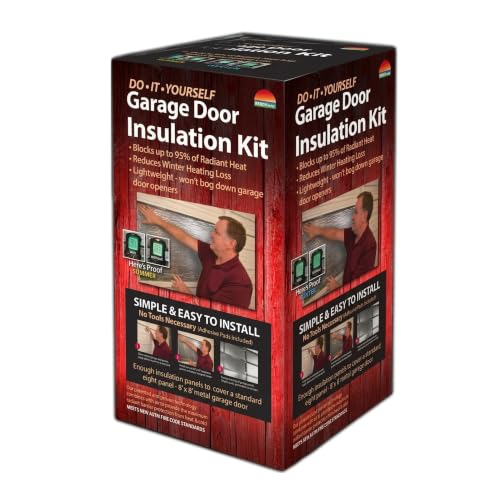
Best for: an 8x8 single door on a tight budget Skip it if: you have a double-wide door and want one box
Reach Barrier is the pick because it matches the most common home garage size without asking the installer to cut a roll. Eight pre-cut panels at 24x48 inches cover an 8x8 single door section by section. Each panel is 5/32 inch thick with reflective film on both sides and two bubble layers in between, and Reach Barrier includes 48 one-inch adhesive squares per panel in open-cell polyurethane foam with double-sided acrylic. That adhesive count matters more than the panel spec: it is what keeps the sheet on the door in July.
The whole kit weighs 3.3 lb and ships in a 13.2 x 25 x 13.4 in carton, which means it moves through a standard front door without a shipping crate. It is also the cheapest of the six here and sells faster than the rest of this set. The trade-off is coverage: for a two-car door you buy two boxes, and the silver-foil finish is more industrial than the white-faced upgrades further down.
Pros:
- Eight pre-cut 24x48 in panels, no rolls to slice
- 5/32 in thickness with foil on both sides
- 48 adhesive squares per panel included
- Cheapest of the six here
- Trims with scissors or a box knife
Cons:
- Silver-only interior finish
- One kit covers a single door, not a double
- No perimeter or threshold seals included
2. SmartGARAGE Reflective Garage Door Insulation Kit — Best upgrade
A closed-cell foam kit with a white interior face, one step up from bubble.
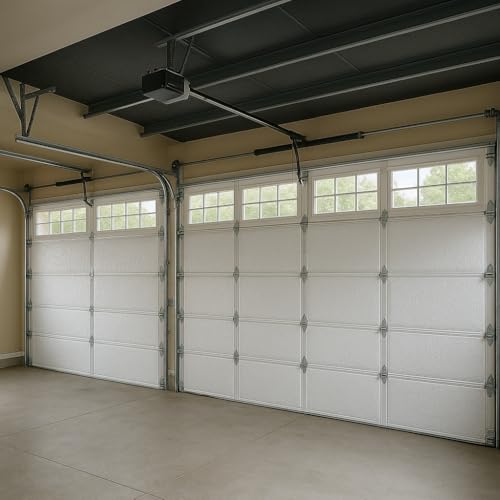
Best for: a single-car door where finish matters Skip it if: you need bottom or side seals in the same kit
The SmartGARAGE kit swaps bubble for 5 mm closed-cell polyethylene foam sandwiched between engineered foil on one side and a white film on the other. Insulation Marketplace claims an R-8 value and 95% reflection of radiant heat. Take those numbers as manufacturer claims rather than measured lab results, because the listing does not name the test standard used, but the physical construction is genuinely a step up from bubble. Closed-cell foam holds its thickness under pressure; bubble compresses where the door meets the frame.
Coverage sits at one single-car door per kit, same as the Reach Barrier, and the listed roll length runs to 440 inches. That is enough to trim around hinges and brackets with material to spare. The included tape is double-sided and rated for hot and cold climates.
What you pay more for here is the white interior face and the foam core, not extra square footage. If the garage doubles as a workshop and you look at the door every day, the finished look earns the price gap. If it is purely a car park, the Reach Barrier does the same job for less.
Pros:
- 5 mm closed-cell foam, not bubble
- White interior film for a clean finish
- Heavy-duty double-sided tape included
- Trims with a razor knife
- Non-toxic construction per the listing
Cons:
- Single-car coverage only
- R-8 claim is a listing figure, not third-party
- No included threshold or perimeter seals
3. MYFAMIREA 16P Garage Door Insulation Kit — Most versatile
A 16-panel double-door kit at an entry price, with material left over for a shed or attic hatch.

Best for: a 16x8 door plus leftover panels for a shed Skip it if: you want a white interior instead of silver
MYFAMIREA is the second-cheapest of the six and the least expensive way to cover a full 16x8 double door with pre-cut sheets. The kit includes 16 panels at 24x48 inches and 120 tape strips, with a 6 mm bubble core faced in aluminium foil. MYFAMIREA says the panels are age and fire resistant, and lists garage doors, attics, warehouses, roofs and car flaps as suitable applications. That range is what earns the versatile label: an average double door needs eight panels per side of the strut line, which leaves several sheets for other jobs.
The core is bubble rather than closed-cell foam, so it sits behind the SmartGARAGE and BEEST kits on thickness under load. The listed 6 mm thickness is nominal, and the panel dimension of 0.04 x 48 x 24 in in the technical spec undersells what you get by feel. It is also silver on both sides, which reads as industrial from inside the garage.
Against the rest of the set, this is the kit for the buyer who wants pre-cut panels, a double-door count, and material to spare, without paying for perimeter extras.
Pros:
- 16 pre-cut 24x48 in panels
- 120 tape strips included
- Second-cheapest of the six
- Fits standard 16x8 double doors
- Panels reusable on sheds and attics
Cons:
- Silver-only finish, both sides
- Bubble core rather than closed-cell foam
- No perimeter or threshold seals
4. US Energy Products NASA TECH Foam Core Kit — Best for families
Four 2x18 ft rolls that fit an 18-foot-wide door, the widest coverage in this set.

Best for: an 18-foot-wide double door with an odd size Skip it if: you prefer pre-cut panels over rolls
The NASA TECH kit is the only one here that ships as rolls instead of panels. Four rolls at 2 ft by 18 ft cover an 18 ft wide by 8 ft high door, and the listing confirms it also fits an 18x7 opening. That extra 2 feet of width matters: a genuine three-car door often lands at 18 feet, not 16, and standard 16-foot kits leave a strip of bare metal at each end. US Energy Products lists the kit as R-8 with a vapour barrier and radiant barrier claim, made in the USA and meeting fire codes. Those are listing claims, not independent test results, but the construction is a foam core with white and foil facing.
The kit ships with a razor, a squeegee and heavy-duty double-sided tape. That tooling matters because rolls are less forgiving than pre-cut panels: one bad measurement wastes 24 inches of material rather than a single sheet. The included squeegee is the tell. It exists because the tape needs to be pressed rather than laid.
Against the rest, this is the kit for the wide double door that Reach Barrier and the 16x8 pre-cut kits cannot reach.
Pros:
- Fits 18-foot-wide doors, not just 16
- Foam core with white interior facing
- Razor, squeegee and tape included
- Works on 18x7 or 18x8 openings
- Replacement offered for damaged rolls
Cons:
- Rolls require careful measuring
- Only one seller lists it
- R-8 figure is a listing claim
5. Xenjum Garage Door Insulation Kit — Best minimal setup
A 16-panel EPE foam kit that ships with a scraper, aimed at first-time installers.

Best for: a first-time installer who wants a scraper included Skip it if: you already own a squeegee and tape measure
Xenjum's kit uses a foil + EPE + foil construction, 6 mm thick, in 16 pre-cut 24x48 in panels sized to fit a standard 16x8 or 16x7 door. EPE is a closed-cell polyethylene foam, so this sits with the SmartGARAGE and BEEST kits on core material rather than with the bubble panels. Xenjum claims panels can keep a garage up to 20°F cooler in summer, which is a listing figure rather than a lab result, and the listed applications extend to sheds, attics, warehouses, metal buildings, RVs and pet houses.
What sets this kit apart in the set is the included tape and scraper. It is the only pick besides NASA TECH that ships an install tool in the box, and the trade-off is price: it lands in the premium band despite the same 16-panel count as MYFAMIREA at the entry price. If this is a first garage insulation job and the toolbox is thin, the scraper earns its keep. If not, MYFAMIREA covers the same door for less.
Against the rest, Xenjum is the choice when the install itself is the barrier, not the panel spec.
Pros:
- Foil + EPE + foil three-layer core
- 16 pre-cut 24x48 in panels
- Scraper and tape included
- Fits 16x8 and 16x7 doors
- Silver reflective finish on both faces
Cons:
- Premium price for a 16-panel kit
- Only one seller lists it
- 20°F cooling figure is a listing claim
6. BEEST FULLSTOP Platinum Garage Door Insulation Kit — Best premium
A double-door kit that bundles 16 panels with a threshold strip, side seals and window films in one box.

Best for: a double door that also needs perimeter and threshold seals Skip it if: the door already has good weather stripping
The BEEST FULLSTOP Platinum kit is the only pick in the set that treats the garage door as a whole assembly rather than just the panels. In the box: 16 pre-cut 24x48 in closed-cell foam panels with a white vinyl face, a bottom threshold seal strip with silicone adhesive, 34.5 ft of top and side weather stripping with 40 screws, four window insulation film sheets, and two entry draft stoppers. BEEST claims a 10 to 15°F improvement at the door surface and 95% radiant heat reflection, both listing figures rather than certified results.
The value question turns on the perimeter. Small gaps at the top, sides and floor let out more air than an uninsulated panel does, so a kit that seals the frame as well as the sections addresses the whole draft path. If the existing top and side stripping is already tight, the bundle is more than you need. If the door whistles in winter or lets leaves slide underneath, the threshold strip and side seals close the actual loss points.
Against the rest, this is the most expensive pick and the only one that ships perimeter material. That is what the price buys.
Pros:
- 16 pre-cut 24x48 in foam panels
- Bottom threshold seal with silicone adhesive
- 34.5 ft of top and side stripping, 40 screws
- Four window insulation films included
- White vinyl interior face
Cons:
- Most expensive pick here
- Only one seller lists it
- Trimming around hinges is on the installer
Bubble, foam or foil-faced EPE: which core actually holds heat?
Most guides to the best insulation for garage door installs compare R-values printed on the listing. That is not what decides it. Panel core and thickness under pressure are what decide it, because the R-value claim is a marketing figure and the core is a physical fact.
Three core types run through this set:
- Bubble with foil facing. Reach Barrier at 5/32 in and MYFAMIREA at 6 mm. Light, cheap, easy to cut. Compresses at pressure points, so a metal door that flexes will thin the bubble over time.
- Closed-cell polyethylene foam. SmartGARAGE at 5 mm and BEEST FULLSTOP. Holds its thickness. Handles the door's flex cycles better than bubble. Costs more per square foot.
- EPE foam sandwich. Xenjum at 6 mm with foil on both faces. A middle path: foam core rigidity with reflective faces on both sides.
The pattern in this set is simple. Bubble is fine for the panels that live in the middle of a door section and see no compression. Where the door bends over the rollers or where the strut presses the panel, closed-cell foam or EPE lasts longer. Kits that publish a thickness in millimetres alongside a named material are the ones you can compare against each other. Kits that only publish an R-number are asking for trust the listing does not earn.
Single door or double: sizing the kit to the opening
Coverage is the specification that most often causes returns, and it is the one that is easiest to verify before ordering. Measure the door in feet, width by height, from the outer edge of one vertical rail to the other, and from the floor line to the top of the top section.
The picks here map to three door sizes:
- 8 ft wide by 8 ft high single door. Reach Barrier is sized for this exactly. Eight panels at 24x48 in cover the door section by section.
- 16 ft wide by 8 ft high or 16 ft by 7 ft double door. MYFAMIREA, Xenjum and BEEST FULLSTOP all ship 16 panels sized for this range. SmartGARAGE covers a single-car door per kit, so a 16-foot door needs two kits.
- 18 ft wide by 7 or 8 ft high extended double door. NASA TECH is the only pick in this set that fits an 18-foot width in a single box. A 16-foot pre-cut kit leaves 12 inches of bare metal at each end.
If the door is between sizes, buy the next kit up and trim, rather than the one below and stretch. A 16-foot kit on an 18-foot door leaves two full-height strips uninsulated at the edges, and those edges are where the panels meet the vertical rails, which is where drafts start.
What the listings do not tell you about R-value claims
Every kit here that publishes an R-value publishes it as a listing figure, not a certified test result. That includes the R-8 claims on NASA TECH and SmartGARAGE. There is nothing dishonest about the number, but there is no third-party rating on the listing either, so treat R-8 as the manufacturer's calculation of the panel's insulating value under ideal conditions.
Two things the listings do not tell you, and both matter more than the R-number:
- The installed R-value is lower than the panel R-value. Every tape seam, every uncovered strut, every gap around a hinge is a thermal bridge. A well-installed R-6 kit outperforms a badly installed R-8 kit.
- The R-value of the panel does not include the door itself. A single-skin steel door is close to R-0 on its own. Adding an R-8 panel gets you closer to R-8 total, not to R-16.
If the goal is a warmer garage in winter and a cooler garage in summer, the actual return comes from the combination of the panel, the top and side seals, the threshold strip and the section joints. That is why the BEEST FULLSTOP kit exists in a category otherwise dominated by panel-only boxes.
Head-to-head: Reach Barrier vs SmartGARAGE
Both cover a single-car door. Neither includes perimeter seals. Choosing between them comes down to core material, finish and price position.
Reach Barrier is a 5/32 in bubble panel with foil on both sides, pre-cut to 24x48 in, and it is the cheapest of the six. SmartGARAGE is 5 mm closed-cell foam with foil on one side and white film on the other, and it sits in the mid price band. The Reach Barrier ships as eight discrete panels sized for an 8x8 door; SmartGARAGE ships as a 440-inch length that is cut to fit a single-car door.
Pick Reach Barrier if the door is exactly 8x8, the finish does not matter, and the budget is tight. Pick SmartGARAGE if the door is a larger single-car opening, the interior is visible from inside the house, or the door flexes enough that bubble compression is a concern. The cutoff is genuinely visual and structural: bubble on a low-traffic 8x8, foam on anything larger or nicer.
Prep, tape and the one step most installers skip
Every kit in this set relies on adhesive to hold panels against metal. Every kit's listing tells you to clean the surface first. Most installers skip that step.
Here is the trick with garage door insulation. Steel doors carry a thin film of manufacturing oil, road grit and hand oils from installation, and the double-sided tape or foam pad squares that ship with these kits do not bite through it. A panel that seems stuck in November peels in July when the metal reaches surface temperatures that soften the adhesive.
In practice, three prep steps do the work:
- Wipe every panel section with isopropyl alcohol on a clean cloth. Let it flash off.
- For tape-based kits, peel the liner and let the tape tack up for the time the instructions specify. Skipping this cuts adhesion.
- Press each panel firmly along every tape line, using the included squeegee or scraper where the kit ships one.
Xenjum and NASA TECH ship an install tool. Reach Barrier ships pre-applied adhesive squares that need firm hand pressure at each pad. BEEST FULLSTOP includes silicone adhesive for the threshold strip, which needs a full cure before the door is used. Skip the prep and the panels come off. Do the prep and even the entry-band kits stay put.
The verdict
The best insulation for garage door installs across most homes is the Reach Barrier Garage Door Insulation Kit. It is the cheapest of the six, it is pre-cut to the most common single-door size at 8x8, and its 5/32 in bubble panels with foil on both sides handle the job a single-car garage actually needs. Eight panels, 48 adhesive squares each, and scissors are all the install requires.
Two conditions flip the pick. If the door is a 16x8 or 16x7 double, buy the BEEST FULLSTOP Platinum Kit instead. It ships 16 pre-cut panels plus a threshold seal, 34.5 ft of top and side stripping, and window films, so the whole draft path closes in one order rather than three. If the door is an 18-foot-wide extended double, only the NASA TECH kit fits without leaving bare metal at each end.
For a single-car door where the interior finish shows, SmartGARAGE at 5 mm closed-cell foam with a white face is the honest upgrade. MYFAMIREA and Xenjum sit between those anchors, one on price and one on included tooling.
FAQ
Does a garage door insulation kit actually make the garage warmer?
Does a garage door kit make the garage warmer? Yes, but the size of the change depends on the whole assembly, not just the panels. BEEST claims a 10 to 15°F surface-temperature improvement and Xenjum claims up to 20°F cooler in summer, both listing figures. Expect a real improvement when the panels are combined with tight top, side and bottom seals.
Is a garage door insulation kit worth it for an attached garage?
Is a garage door insulation kit worth installing on an attached garage? Usually yes, because the shared wall with the house sees heat move both ways through the garage air. Sealing the door section reduces the load on the shared wall. On a detached garage used only for parking, the payback is slower. If the garage is a workshop or a gym, the case gets stronger.
What R-value do these garage door insulation kits actually deliver?
The R-value claims on these kits, including the R-8 figures on NASA TECH and SmartGARAGE, are listing numbers rather than third-party ratings. The installed R-value is always lower than the panel R-value because tape seams and uncovered struts create thermal bridges. Compare the core material and thickness in millimetres, and treat any single R-number in the listing as a directional figure.
Reach Barrier or BEEST FULLSTOP for a two-car garage door?
Reach Barrier or BEEST FULLSTOP depends on the door size and whether the perimeter needs work. Two Reach Barrier kits cover a 16x8 double door with bubble panels, and cost less. One BEEST FULLSTOP covers the same door with foam panels plus a threshold strip, 34.5 ft of top and side seals, and window films. Buy Reach Barrier for panels only; buy BEEST for the full perimeter.
Can these kits be installed on a wooden garage door?
Can these kits be installed on a wooden garage door? Yes, though the adhesive behaves differently on wood than on steel. The double-sided tapes in these kits are designed for smooth metal surfaces. On raw wood, adhesion is weaker and the panels may need mechanical fasteners. On painted wood, clean the surface with isopropyl alcohol first, press firmly along every tape line, and check the panels after the first hot month.
Once the door is measured and the core material chosen, the rest of the decision is inventory. Reach Barrier ships in a small carton and moves through a normal door without a crate, which matters when the delivery driver leaves the box on a porch. BEEST FULLSTOP arrives heavier and larger because it carries the perimeter stripping and threshold seal in the same box. Start with the door size, work backwards to the kit that fits without stretching, and set aside a Saturday morning for prep and pressing. Panels stay on doors that were cleaned. Everything else follows from there.
Last updated: September 7, 2026. Product availability re-checked.
This page contains affiliate links. As an Amazon Associate we earn from qualifying purchases, at no extra cost to you.