Best DIY Garage Door Insulation: Reach Barrier Wins
Six garage door insulation kits, compared on panel thickness, coverage width and what the manufacturer actually publishes. The winner covers a single 8x8 door with eight pre-cut panels and 48 adhesive squares per panel.
The best diy garage door insulation for most single doors is the Reach Barrier Garage Door Insulation Kit, which covers an 8ft x 8ft door with eight pre-cut 24x48-inch panels at 5/32 inch thick. If your door is double-wide, the MYFAMIREA 16-pack is the better buy at 6mm thickness across 16 panels. Panel thickness is what actually separates these six kits. Everything else, from foil colour to tape quality, is secondary to whether the material has enough bulk to slow heat moving through a thin steel skin.
Best diy garage door insulation at a glance
| Pick | Panel thickness | Door coverage | Price |
|---|---|---|---|
| Best overall Reach Barrier Garage Door Insulation Kit |
5/32 in bubble | 8ft x 8ft single | Check Price |
| Best for pros MYFAMIREA 16P Garage Door Insulation Kit Panels |
6mm bubble | 16ft x 8ft double | Check Price |
| Runner-up INSULATION MARKETPLACE SmartGARAGE |
5mm closed-cell foam | one single-car door | Check Price |
| Best for heavy use US Energy Products NASA TECH Foam Core |
foam core rolls | 18ft x 8ft two-car | Check Price |
| Best for beginners Xenjum Garage Door Insulation Kit |
6mm EPE foam | 16x8 and 16x7 | Check Price |
| Best premium Generic Garage Door Insulation Kit |
1.25 in EPS claim | one-car garage | Check Price |
How the six kits were scored, and on what
I weighted four things, in this order.
- Published panel thickness, at 40%. It is the single figure that separates a token reflective sheet from real material. Three of these six state it plainly: 5/32 inch, 6mm and 5mm. That earns them trust.
- Coverage stated as door dimensions, at 25%. A kit that says "8ft x 8ft single door" or "16ft x 8ft double" tells you whether one box finishes the job. A kit that says "one-car garage" leaves you guessing at panel count.
- What comes in the box, at 20%. Adhesive squares, double-sided tape, a razor, a squeegee. These are the parts people forget to buy and then improvise badly.
- How much the manufacturer publishes at all, at 15%. Two kits here list a colour, a count and a model number and almost nothing else. That is a real mark against them in a category where thickness decides the outcome.
Why those weights? Because garage doors are thin sheet steel with hollow sections behind them, and every kit in this set is a surface-applied barrier rather than a cavity fill. The variable you control is how much material you stick to that steel. The variable you cannot control is the door itself.
Nothing here was cut for being cheap. The two entry-priced kits finished first and second.
Does a printed R-value mean anything here?
Two of these listings print an R-value. SmartGARAGE says R-8. NASA TECH says R Value 8.0. The Generic EPS kit claims around 5.25. Those numbers are the manufacturer's, and the way to read them is with a raised eyebrow.
Here is the problem. An R-value describes a material in a controlled assembly, measured a specific way. A reflective foil or bubble product depends heavily on having an air gap next to it, and a garage door panel does not always give you one. Stick foil flat against steel and the radiant performance drops. Leave it facing the enclosed section behind the panel and it does better.
So the R-8 claims on two kits and the 5.25 claim on a third are not directly comparable to each other, and none of them is comparable to the R-value printed on a batt of fibreglass. Treat them as an ordering hint, not a measurement.
What I would compare instead:
- Stated thickness in millimetres or inches, which three kits give you
- Core material, which four kits name
- Whether the reflective layer is on one face or both
Reach Barrier says reflective film on both sides with two bubble layers between. MYFAMIREA says aluminised film outside, polyethylene bubble in the middle. Those descriptions tell you more about the best diy garage door insulation for your door than any single printed number.
1. Reach Barrier Garage Door Insulation Kit — Best overall
The clearest specification sheet in this set, and the cheapest of the six.
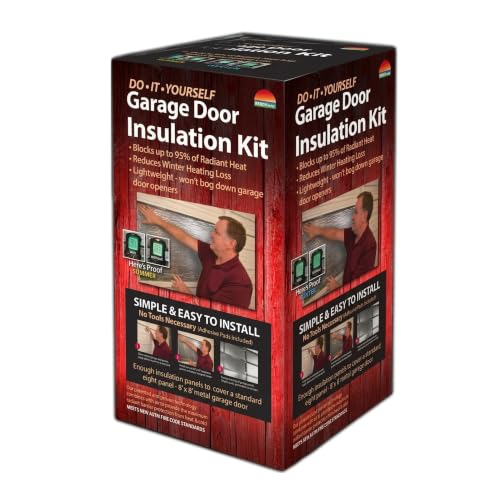
Best for: a single 8x8 sectional door and a first-time installer Skip it if: you have a double-wide door and want one box
This is the kit that tells you the most before you buy. Eight panels, each 24 by 48 inches, each 5/32 inch thick, each carrying 48 one-inch adhesive squares. Reflective film sits on both faces with two bubble layers sandwiched between. The whole kit weighs 3.3 lb and ships in a 13.2 x 25 x 13.4 in box, so it is not a shipping ordeal.
The adhesive is the part I keep coming back to. Reach Barrier describes open-cell polyurethane foam pads, 1/8 inch thick, with double-sided acrylic adhesive. That foam thickness matters on a garage door, because the steel face is rarely flat and a rigid adhesive dot will only touch the high spots. A conforming pad grabs more surface.
It sells faster than every other kit here, and three sellers list it. Released in 2018, model 3009. Installation needs no special tools and panels trim with scissors or a box knife.
The trade-off is coverage. This box does one 8ft x 8ft door and Reach Barrier says so plainly. A two-car door means two boxes, which puts you above the MYFAMIREA 16-pack on total spend for the same wall of steel.
Pros:
- Cheapest of the six
- Panel thickness published at 5/32 in
- 48 adhesive squares per panel included
- Reflective film on both faces
- Sells faster than the rest of this set
Cons:
- One box covers only a single 8x8 door
- Two boxes needed for a double door, at higher combined cost
- No published R-value to compare against rivals
- Bubble core is thinner than the 6mm options here
2. MYFAMIREA 16P Garage Door Insulation Kit Panels 6MM 16x8FT — Best for pros
Sixteen 6mm panels and 120 tape pieces for a full double door, at the second-cheapest position in this set.

Best for: a double 16x8 door where 6mm thickness matters Skip it if: you want a white finish facing the garage
If your garage has one wide door rather than two narrow ones, this is where the arithmetic lands. Sixteen pre-cut panels at 24 by 48 inches, 6mm thick, covering a stated 16ft x 8ft double door, with 120 tape pieces in the box. Panel dimensions come in at 0.04 x 48 x 24 in.
MYFAMIREA makes a direct comparison in its own copy: 6mm sheets versus a 3mm roll, arguing the thicker sheet blocks more. I would not treat that as a lab result, but 6mm against Reach Barrier's 5/32 inch is a real difference in bulk, and the listing states it. Construction is aluminised film outside with polyethylene bubble between. The brand also claims the panels resist ageing and fire, and points at attics, warehouses and roofs as secondary uses.
Two sellers list it, and it moves quickly for a kit this size.
Where it loses to the winner is finish and adhesive detail. Both faces are silver, so the side you look at every day stays foil rather than white. The tape is described only as complimentary tape, with no thickness or temperature range given, which is thinner information than Reach Barrier's foam-pad spec.
Pros:
- 6mm panels, the thickest bubble spec here
- 16 panels cover a stated 16x8 double door
- 120 tape pieces supplied
- Second-cheapest of the six
Cons:
- Silver on both faces, no white option
- Tape described without thickness or temperature rating
- No published R-value
- Foil finish shows fingerprints and creases readily
3. INSULATION MARKETPLACE SmartGARAGE — Runner-up
Closed-cell foam rather than bubble, with a white face and a heavy-duty tape rated for extreme temperatures.
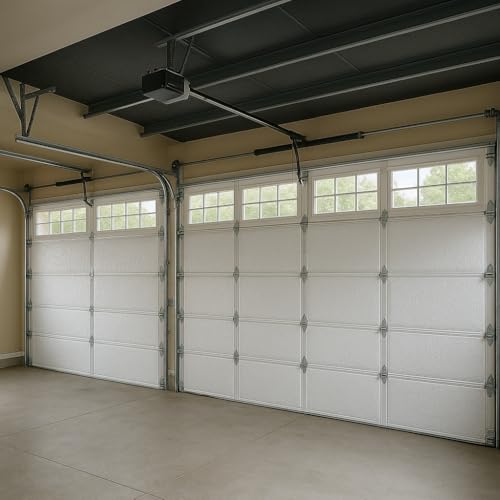
Best for: a single door where a clean white face matters Skip it if: you would rather trim panels than a long roll
This one changes the core material. Instead of bubble, SmartGARAGE uses 5mm closed-cell polyethylene foam, sandwiched between engineered foil on one side and white film on the other. Closed-cell foam does not rely on intact bubbles to keep its thickness, which is a quiet advantage on a door that flexes every time it opens.
The white face is the visible win. Foil-faced panels make a garage look like a grow room. White film reads as a finished ceiling, and INSULATION MARKETPLACE calls out a clean, finished look along with non-toxic material. The brand claims 95% radiant heat reflection and an R-8 value, and the tape is described as heavy-duty double-sided, usable in extreme hot and cold climates. Three sellers stock it, and it sits roughly mid-range for this set on price.
Format is the catch. The listed dimensions are 0.1 x 440 x 21 in, meaning you are working with long material about 21 inches wide rather than discrete pre-cut panels. Coverage is one single-car door, so a two-car garage needs two kits and a three-car garage needs three, exactly as the listing states.
Pros:
- 5mm closed-cell foam core, not bubble
- White film face for a finished look
- Tape rated for extreme hot and cold
- Three sellers list it
Cons:
- Long roll format means more measuring and cutting
- One kit covers a single-car door only
- R-8 figure is the manufacturer's claim, not standardised
- Costs more than both bubble kits above it
4. US Energy Products NASA TECH White Reflective Foam Core — Best for heavy use
The only kit here sized for an 18-foot-wide door, and the only one that ships a razor and a squeegee.

Best for: an 18-foot-wide two-car door with an installer who likes rolls Skip it if: your door is a standard 16 feet wide
Door width is where this pick earns its place. NASA TECH states 18'W x 8'H, and adds that it also fits 18x7. Every other double-door kit in this set targets 16 feet. If you measured 18 and came up short with a 16-foot kit, that is a wasted afternoon and a return label.
The box contains four rolls of 2ft x 18ft white and foil foam core, heavy-duty double-sided tape, a razor, a squeegee and instructions. That tool list is unique here. A squeegee is exactly what you want for pressing foil-faced material onto steel without trapping air, and nobody else supplies one. Shipping dimensions are 17 x 24 x 18 in.
US Energy Products claims R8, describes the product as vapour barrier and radiant barrier in one, says it is made in the USA and meets US and international fire codes, and offers to replace damaged rolls. It also flags a technique point in the instructions: peel the liner and let the tape tack up before you press.
Only one seller lists it, and it is the slower half of this set on sales. Rolls also mean measuring, marking and cutting every piece yourself.
Pros:
- Only kit sized for an 18-foot-wide door
- Razor and squeegee included
- White and foil faces on the foam core
- Damaged rolls replaced by the brand
Cons:
- Roll format needs full measuring and cutting
- Single seller, so no listing competition
- Panel thickness not published in millimetres or inches
- Tape needs a tack-up wait before application
5. Xenjum Garage Door Insulation Kit — Best for beginners
Sixteen pre-cut 6mm EPE panels with tape and a scraper, sized for both 16x8 and 16x7 doors.

Best for: 16x8 and 16x7 doors with a tool-free install Skip it if: you want a published thickness you can verify
Xenjum aims squarely at the person who has never done this before. Sixteen panels at 24 by 48 inches, pre-cut, plus tape and a scraper in the box. The listing says the panels fit standard 16ft x 8ft and 16ft x 7ft doors and can be trimmed for a custom fit. That second door height is a genuinely useful detail, because plenty of houses have 7-foot openings and most kits only quote 8.
Construction is described as foil, EPE foam, foil: a closed-cell polyethylene foam core with reflective facing on both sides, listed at 6MM in the title. EPE behaves more like the SmartGARAGE foam than like bubble film, holding its thickness under compression from a door that cycles daily. Xenjum claims up to 20°F cooler in summer, and lists sheds, attics, warehouses, metal buildings, RVs and pet houses as other uses. Panel dimensions are 0.1 x 48 x 24 in.
The scraper matters more than it sounds. Pressing panels flat is where amateur installs fail, and a scraper does that job.
Against the picks above it, this is the second-most expensive kit in the set, one seller lists it, and the specification table is thin: colour, count, dimensions and a model name. The 6mm figure lives in the title rather than the spec list.
Pros:
- 16 pre-cut panels, no measuring on a standard door
- Fits both 16x8 and 16x7 door heights
- EPE closed-cell core with foil on both faces
- Scraper and tape supplied
Cons:
- Second-highest price in this set
- Only one seller lists it
- Thickness appears in the title, not the published specs
- Cooling claim of 20°F is the brand's own figure
6. Generic Garage Door Insulation Kit — Best premium
Rigid EPS foam panels at a claimed 1.25 inches thick, the only rigid-board option in this comparison.

Best for: rigid panel fans who want thickness over flexibility Skip it if: your door panels are not close to 20 by 54 inches
Everything else here is flexible sheet material. This is rigid expanded polystyrene, and the title states 1.25 by 20 by 54 inches across an 8-pack, laminated and high density. If you have seen factory-insulated garage doors, that thick white board is what sits inside them, and this kit is the closest match in the set to that construction.
The listing claims roughly 5.25 R-value, foil and film lamination for radiant reflection and moisture control, noise reduction from the sound-absorbing foam, and manufacture in the USA from EPS. It states an 8-pack for a one-car garage, with panels cut to fit your door.
Two things hold it back, and both are about information. The published dimensions in the specification list read 0.1 x 54 x 20 in, which does not match the 1.25-inch thickness in the title, so you cannot verify the figure that justifies the price. And it is the most expensive pick here while publishing the least: a colour, a count, a model number of Gdi-8pk, and nothing more.
It is also the slowest seller of the six, and only one seller lists it. Rigid board is genuinely less forgiving than sheet material. Panels have to land inside the door's stiles and rails or they interfere with the door folding.
Pros:
- Only rigid EPS board option in this set
- Claimed 1.25 in thickness, the thickest here
- Foil and film lamination stated for radiant and moisture control
- Panel size of 20 by 54 in suits many door sections
Cons:
- Most expensive pick here with the fewest published specifications
- Listed dimensions contradict the title thickness
- Slowest seller of the six, single seller only
- Rigid panels must clear stiles and rails to let the door fold
Measure your door before you buy anything
The most common way this project fails is buying coverage for the wrong door. Take five minutes with a tape measure first.
- Width, outside edge to outside edge. 8 feet, 9 feet, 16 feet and 18 feet are all common. Reach Barrier covers 8 feet, MYFAMIREA and Xenjum cover 16, NASA TECH covers 18.
- Height. 7 feet and 8 feet are both standard. Xenjum states both. Most others quote 8 feet only.
- Section height. Individual panels on a sectional door are usually 18 to 24 inches tall. Compare that to the 24-inch panel height on three of these kits and the 20-inch width of the Generic EPS boards.
- Recess depth inside each section. This decides whether rigid board fits at all, and whether flexible sheet sits flush or bulges.
- Stile and rail positions. Material must not cross the hinge lines, or the door will not fold.
Write those five numbers down before you open a listing. Then check what each kit says it covers. This is the whole reason coverage got 25% of the weighting.
Foam core or bubble film: which belongs on your door?
Three of these kits use bubble, three use foam. They fail differently.
Bubble film is two reflective faces with air pockets between. Reach Barrier layers two sheets of bubble at 5/32 inch. MYFAMIREA runs 6mm. It is light, it trims with scissors, and it costs less: the two cheapest kits here are both bubble. The weakness is that bubble depends on intact pockets. Crush it against a stile, or let a lawnmower handle press it for two years, and that section loses its thickness.
Foam core holds its shape. SmartGARAGE uses 5mm closed-cell polyethylene, Xenjum uses EPE, and NASA TECH uses a white and foil foam core. Closed-cell foam under compression springs back rather than deflating. Both foam-core kits with a white face also look better from inside.
Rigid EPS is the third case, and only the Generic kit uses it. Thickest claimed material in the set, least tolerant of an imperfect fit.
My rule: bubble for a door in a tidy garage that mostly sees temperature swings, foam core for a garage that doubles as a workshop or a storage crush. If you cannot walk past your door without something touching it, foam.
What the listings do not tell you
Four gaps show up across all six.
Weight, mostly. Only Reach Barrier states a usable figure at 3.3 lb. This matters more than it sounds. A garage door opener is balanced by springs, and adding mass to the door can push it out of balance. None of these kits tells you the total added weight, and NASA TECH's weight field reads 0 g, which is a placeholder rather than data.
Warranty. Not one of the six publishes one. NASA TECH offers to replace damaged rolls, which is a shipping-damage promise, not a warranty on performance.
Adhesive service life. Reach Barrier describes acrylic adhesive on foam pads. SmartGARAGE and NASA TECH describe heavy-duty double-sided tape. MYFAMIREA supplies 120 tape pieces. Nobody states how long any of it holds on a door that cycles twice a day through summer heat.
Fire performance detail. MYFAMIREA says fire resistant. NASA TECH says it meets US and international fire codes. Neither names a standard or a class, so you cannot compare them.
None of this rules any kit out. It does mean the specifications you can compare, thickness and coverage, deserve the weight I gave them.
When a different kit wins
Six if-then flips, with the threshold that triggers each.
- Door wider than 16 feet. Go NASA TECH. It is the only kit stating 18 feet.
- Door height of 7 feet rather than 8. Xenjum states 16x7 explicitly, which removes the guesswork.
- You want white facing the garage. SmartGARAGE and NASA TECH both have a white film face. Reach Barrier and MYFAMIREA are silver on both sides.
- Garage doubles as a workshop with clutter against the door. Choose foam core over bubble, so SmartGARAGE or Xenjum.
- You want a rigid board like a factory-insulated door. The Generic EPS kit is the only one in this set.
- Cost is the whole decision. Reach Barrier for a single door, MYFAMIREA for a double. Those are the two cheapest here.
One note on the search term itself. Every kit in this comparison is sold as a do-it-yourself product, and every listing says panels or rolls trim without special tools. What none of them can promise is that your particular door, its section depth and its spring balance suit a surface-applied kit. That part is your call, and a five-minute measure-up is how you make it.
The verdict
If you have a single 8x8 door, buy the Reach Barrier Garage Door Insulation Kit. It is the cheapest of the six, it publishes the most usable numbers, and eight pre-cut 24x48-inch panels with 48 adhesive squares each turn the job into one afternoon with a box knife. The 1/8-inch foam adhesive pads are the detail that separates it: they conform to a steel face that is never as flat as it looks.
If you have a double 16x8 door, buy the MYFAMIREA 16-pack instead. Sixteen 6mm panels and 120 tape pieces cover the full opening from one box, and 6mm is more bulk than the winner's 5/32 inch. Buying two Reach Barrier kits costs more than one MYFAMIREA kit for the same wall of steel.
The cutoff is door width. At 8 feet, Reach Barrier. At 16 feet, MYFAMIREA. At 18 feet, NASA TECH is the only kit here that states it fits.
The runner-up's specific advantage is material. SmartGARAGE swaps bubble for 5mm closed-cell polyethylene foam with a white film face, so it holds its thickness under pressure and looks finished from inside. If your garage is a working space rather than a parking space, pay the difference.
FAQ
Is the best diy garage door insulation worth installing yourself?
Installing garage door insulation yourself is worth it when the kit is pre-cut to your door size. Reach Barrier supplies eight 24x48-inch panels with adhesive squares attached and states no special tools are needed. Rolls like the NASA TECH kit demand more measuring and cutting. The work is straightforward either way, but pre-cut panels remove the step where mistakes happen.
How much value do you get from the cheapest kit here?
The cheapest kit here, Reach Barrier, publishes more verifiable detail than the most expensive one. It states 5/32-inch thickness, 8ft x 8ft coverage, 48 adhesive squares per panel and a 3.3 lb weight. The Generic EPS kit at the top of the range lists only a colour, a count and a model number. Low cost does not mean thin information in this category.
What thickness should garage door insulation panels be?
Panels in this set run from 5/32 inch of bubble up to a claimed 1.25 inches of rigid EPS. The 6mm options, MYFAMIREA and Xenjum, sit in the middle and represent a good balance of bulk and flexibility. What matters more than the number is that the manufacturer publishes it at all. Three of these six do.
Reach Barrier or MYFAMIREA: which fits my garage door?
Reach Barrier or MYFAMIREA comes down to door width. Reach Barrier covers a single 8ft x 8ft door with eight panels at 5/32 inch. MYFAMIREA covers a 16ft x 8ft double door with sixteen 6mm panels and 120 tape pieces. Measure your opening edge to edge, then match the number. Two single kits cost more than one double kit.
What mistake do first-time buyers make with garage door insulation?
The mistake first-time buyers make with garage door insulation is ignoring door balance. Adding material adds weight, and a sectional door is counterbalanced by springs sized for the bare door. None of these six kits publishes total added weight. After installing, check that your door holds position halfway open. If it drifts, the springs need adjusting by someone qualified.
Start with the tape measure, not the shopping cart. Write down your door's width, height, section height and recess depth, then pick the kit whose stated coverage matches those four numbers. For most single doors that ends at Reach Barrier, and the reason is simple: it is the only kit here that tells you the thickness, the coverage, the panel count, the adhesive spec and the weight before you spend a cent. In a category where three of six listings hide the one number that decides performance, that transparency is worth more than any printed R-value.
Last updated: September 7, 2026. Product availability re-checked.
This page contains affiliate links. As an Amazon Associate we earn from qualifying purchases, at no extra cost to you.