Best Lightweight Wood Planer: WEN 6530 Leads
A 6.5 lb corded planer, a 0.55 lb block plane and a 102 lb benchtop machine all show up under the same search term. Here's which one your project actually needs, and where the weight number stops mattering.

By Taylor DavidsonUpdated 19 min read
On this page
- Best lightweight wood planer at a glance
- How I ranked these seven planers
- Handheld, benchtop or block plane: which do you need?
- 1. WEN 6530 6-Amp Electric Hand Planer — Best overall
- 2. WEN 6528 3.8-Amp Electric Hand Planer — Most versatile
- 3. DEWALT 20V MAX Planer — Best warranty
- 4. Amazon Basics Woodworking Hand Planer — Best upgrade
- 5. JORGENSEN NO.60-1/2 6-1/4" Wood Planer — Best minimal setup
- 6. JORGENSEN No.101 Mini Wood Planer — Best budget pick
- 7. DEWALT Thickness Planer — Best premium
- Does a lighter planer actually cut better?
- Depth stops, and why the number matters more than the range
- What a lightweight wood planer can't do
- The verdict
- FAQ
The best lightweight wood planer is the WEN 6530, a 6.5 lb corded hand planer with 16 depth stops running from 0 to 1/8 inch. If you'd rather carry a tool with no cord at all, the DEWALT DCP580B is the pick, though at 7.4 lb it weighs more than the WEN and ships as a bare tool. Get the weight call wrong and you feel it fast. A planer that's too heavy for overhead trim work leaves you shaking after four feet of door edge, and one that's too light to hold a cut chatters across the grain and leaves ripples you then have to sand out.
Best lightweight wood planer at a glance
| Pick | Weight | Depth control | Price |
|---|---|---|---|
Best overall WEN 6530 6-Amp Electric Hand Planer |
6.5 lb | 16 stops, 0 to 1/8 in | Check Price |
Most versatile WEN 6528 3.8-Amp Electric Hand Planer |
4.3 lb | 9 stops, 0 to 1/16 in | Check Price |
Best warranty DEWALT 20V MAX Planer |
7.4 lb | Knob to 1/256 in, 2 mm max | Check Price |
Best upgrade Amazon Basics Woodworking Hand Planer |
2.66 lb | Adjustable mouth and depth gauge | Check Price |
Best minimal setup JORGENSEN NO.60-1/2 6-1/4" Wood Planer |
1.48 lb | Knob-adjusted blade depth | Check Price |
Best budget pick JORGENSEN No.101 Mini Wood Planer |
0.55 lb | Knob-adjusted blade depth | Check Price |
Best premium DEWALT Thickness Planer |
102 lb | Two speeds, 96 or 179 CPI | Check Price |



How I ranked these seven planers
I set three criteria before opening a single listing, weighted in this order.
- Published weight, at 50%. This is the search term's whole premise, and it's the one number every listing states. Weights here run from 0.55 lb to 102 lb, a spread of nearly 200 to 1.
- Depth control, at 30%. A planer you can't set precisely is a planer that ruins stock. I counted positive stops where the listing gives them and noted the adjustment method where it doesn't.
- What's in the box, at 20%. A dust bag, a fence bracket or a kickstand changes what you can do on day one. A bare tool means a battery purchase before you cut anything.
Those weights follow from the failure modes. Weight leads because fatigue is what actually stops a planing job, not motor amps. Depth control comes second because it's the difference between one clean pass and three corrective ones. Contents come last but they're not trivial: two of the seven need something else bought before they work.
I also had to be honest about the search term itself. "Lightweight" is doing very little filtering here. A 102 lb benchtop machine sits in the same result set as a plane that fits in a shirt pocket, so I've kept it in and told you plainly what it is rather than pretending it qualifies.
Handheld, benchtop or block plane: which do you need?
These seven tools split into three groups that don't compete with each other, and picking from the wrong group is the most expensive mistake in this category.
Powered handheld planers ride on the workpiece and remove material by the pass. The WEN 6530, WEN 6528 and DEWALT DCP580B are all this type. They handle door edges, sticking joists, oversized shelves and rough stock that's already installed. Three of the seven fall here.
Bench and block planes are hand tools with no motor. The Amazon Basics No.4, JORGENSEN NO.60-1/2 and JORGENSEN No.101 are all manual, and they're the four lightest tools in the set by a wide margin. Their job is the final shaving, the chamfer, the end grain, the fitted joint. They will not thickness a board in any reasonable time.
Benchtop thickness planers take a board in one end and spit it out flatter and thinner. The DEWALT DW735X is the only one here. Its 102 lb frame is the whole point: mass keeps the cut steady.
The quick test is where the tool goes. If the tool moves and the wood stays still, you want the first two groups. If the wood moves and the tool stays bolted down, you want the third. A lightweight wood planer only exists in the first two.
1. WEN 6530 6-Amp Electric Hand Planer — Best overall
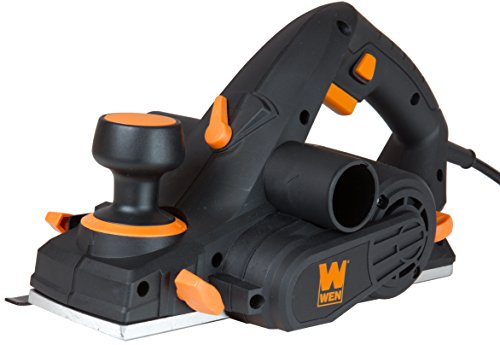
The best combination of controllable depth and manageable weight in this set, and the only powered pick that arrives ready to work.
Best for: door edges, joists and stock prep where a corded tool is fine Skip it if: you need a cord-free tool for site work
At 6.5 lb, this is not the lightest tool here. It's the lightest tool here that can take real material off a 3-1/4 inch cut width, and that combination is what earns it the top spot. WEN lists 16 positive stops covering 0 to 1/8 inch, double the stop count of its own 6528 and covering twice the depth range. That matters when you're shaving 1/16 inch off a swollen door and want the same setting on the return pass.
WEN says the 6-amp motor reaches 34,000 cuts per minute, the highest claimed figure of the three powered picks. The listing also describes a 5/16 inch rabbeting guide for rabbets up to 1 inch, so edge joinery is on the table without a router.
The box is the quiet advantage. WEN lists a dust bag, kickstand, parallel fence bracket and a 2-year warranty, so nothing else needs buying. The DEWALT cordless model ships bare.
The trade-off is the cord. Against the DCP580B you give up cord-free reach and 0.9 lb of saved weight, and against the two WEN siblings you're mid-priced rather than cheap.
Pros:
- 16 positive stops, the finest stop count among the powered picks
- Depth range to 1/8 in, double the 6528's
- 3-1/4 in cut width, widest handheld here
- Dust bag, kickstand and fence bracket included
- 2-year warranty stated on the listing
Cons:
- Corded, so an outlet or extension is mandatory
- 6.5 lb is heavier than every hand plane in this set
- Only one seller lists it
- Sells more slowly than the cheap JORGENSEN block plane
2. WEN 6528 3.8-Amp Electric Hand Planer — Most versatile
The lightest powered planer here at 4.3 lb, which makes it the one you can actually hold above your head.

Best for: overhead trim work and long sessions on narrow stock Skip it if: you plane 3-inch-wide boards regularly
Weight is the entire argument. This planer weighs 4.3 lb, which is 2.2 lb less than the WEN 6530 and 3.1 lb less than the DEWALT cordless. Over an afternoon of trimming door bottoms or dressing stair treads, that difference decides whether you finish the job or stop early. Its footprint is smaller too, 6.5 x 9 x 6.25 in against the 6530's 7 x 12 x 7 in, so it fits into corners the bigger tool won't.
WEN puts the motor at 3.8 amps and 32,000 cuts per minute, close to the 6530's claimed rate from a smaller motor. The narrower 2-3/8 inch cut width is the reason: less width to drive. Depth control is 9 positive stops from 0 to 1/16 inch, which is genuinely fine control, just over a shorter range.
You also get a two-year warranty and an onboard slot for the blade wrench, plus a kickstand to keep the blade off your work.
Against the 6530 you lose the rabbeting guide, the dust bag, the fence bracket and half the depth range. Against a hand plane you gain speed and lose finesse.
Pros:
- 4.3 lb, lightest powered planer in this set
- Compact 6.5 x 9 x 6.25 in body for tight corners
- 9 depth stops for controlled shaving cuts
- Two-year warranty and onboard wrench storage
Cons:
- 2-3/8 in cut width, narrowest of the powered picks
- Depth stops top out at 1/16 in, half the 6530's range
- No dust bag or fence bracket listed
- The slowest-selling powered pick of the three
3. DEWALT 20V MAX Planer — Best warranty
A cordless brushless planer with the longest stated warranty in the set and depth adjustment calibrated to 1/256 inch.

Best for: anyone already holding 20V MAX batteries Skip it if: you don't own the battery platform
Three years of limited warranty is the longest coverage published on any of these seven listings, and the only one longer than WEN's two years. Combined with a brushless motor, that's the durability case for anyone using a planer weekly rather than twice a year.
The depth knob is where this tool separates itself. DEWALT calibrates it to 1/256 inch, roughly 0.01 mm, against a maximum cut depth of 5/64 inch (2 mm). Nobody's hitting 1/256 inch by feel on a stop-based dial. If you're fitting a door into a frame that's out of square, that resolution earns its keep. DEWALT also lists 30,000 cuts per minute and precision-machined aluminium front and back shoes for parallelism.
Now the weight. At 7.4 lb this is the heaviest handheld here, 0.9 lb over the WEN 6530 and 3.1 lb over the WEN 6528. That's the price of the battery mount and the metal shoes.
It's also sold as a bare tool. No battery, no charger, and it's a premium-priced pick before you add either. If you're not already on 20V MAX, the total outlay is much higher than the listing suggests.
Pros:
- 3-year limited warranty, longest published here
- Depth knob calibrated to 1/256 in
- Brushless motor and 30,000 cuts per minute claimed
- Machined aluminium shoes for parallel cuts
- Cord-free, so no extension lead on site
Cons:
- 7.4 lb, heaviest handheld in this set
- Bare tool, so battery and charger cost extra
- Maximum cut depth of 2 mm is shallower than the WEN 6530's 1/8 in
- Premium price position with no dust bag listed
4. Amazon Basics Woodworking Hand Planer — Best upgrade
A 2.66 lb cast-iron No.4 bench plane with two handles, which is the right tool for the pass a power planer can't make.

Best for: final smoothing passes and tear-out repair Skip it if: you need to remove more than a shaving at a time
A No.4 smoother is the plane most woodworkers reach for last, after the machine work is done. This one weighs 2.66 lb and measures 9.8 in along the sole, long enough to bridge small hollows a shorter block plane would follow straight into.
Amazon lists a 2-inch (51 mm) steel blade with both an adjustable mouth and a depth gauge. The adjustable mouth is the feature worth paying attention to and the reason this ranks above the two JORGENSEN block planes for smoothing work: closing the mouth down supports the fibres ahead of the cut and reduces tear-out on figured grain. Neither JORGENSEN listing mentions a mouth adjustment.
The body is described as cast iron, which the listing credits for stability and reduced vibration. Front and rear handles give you two-handed control, unlike the one-handed block planes here.
It's also the only pick with more than one seller besides the NO.60-1/2, and it sits low in the price order. The catch is effort. This is a muscle-powered tool, and flattening a warped board with it takes hours the DW735X does in minutes.
Pros:
- 2.66 lb with a 9.8 in sole for bridging hollows
- Adjustable mouth, unique among the hand planes here
- 2-inch steel blade with depth gauge
- Two handles for controlled two-handed passes
Cons:
- No stated warranty on the listing
- Manual only, so material removal is slow
- Bench planes typically need sole flattening and honing before first use
- Heavier than both JORGENSEN planes if you want pocket portability
5. JORGENSEN NO.60-1/2 6-1/4" Wood Planer — Best minimal setup
A 1.48 lb ductile-iron low-angle block plane, the one-handed tool for end grain and chamfers.

Best for: end grain, chamfers and one-handed trimming Skip it if: you're flattening a table top
The 60-1/2 pattern exists for a reason: at 6-1/4 inches long and 1.48 lb, it fits one hand and reaches places a No.4 can't. That's less than half the weight of the Amazon Basics bench plane and a third of the WEN 6528. If your work is fitting rather than dimensioning, this is the shape you want.
JORGENSEN specifies O1 tool steel for the blade, which is a carbon steel that takes a keen edge and is straightforward to resharpen. The body is ductile iron and the listing says it's drop-tested, which is a fair claim to make about a tool that lives in a tool belt. Depth is set with a knob rather than positive stops.
It's the priciest of the four hand tools here, sitting in the same price band as the two DEWALTs despite being the second-lightest tool in the whole set. Two sellers list it.
That price is the honest sticking point. You're paying premium money for a block plane with no published warranty and no mouth adjustment mentioned, when the Amazon Basics No.4 costs less and offers both a longer sole and an adjustable mouth. Buy this for its size and one-handed balance, not because it does more.
Pros:
- 1.48 lb, second-lightest tool in this set
- 6-1/4 in body suits one-handed work
- O1 tool steel blade, easy to resharpen
- Ductile iron body, drop-tested per the listing
- Two sellers stock it
Cons:
- Premium price position for a manual tool
- No warranty stated on the listing
- No adjustable mouth mentioned, unlike the Amazon Basics No.4
- Depth set by knob rather than repeatable stops
6. JORGENSEN No.101 Mini Wood Planer — Best budget pick
At 0.55 lb and under two inches wide, this is the lightest and cheapest tool here, and it fits in a pocket.

Best for: deburring, tiny chamfers and pocket carry Skip it if: your hands are large or the work is long
Nothing else here comes close on weight. The No.101 is 0.55 lb, roughly a third of the NO.60-1/2 and about one-twelfth of the WEN 6530. Its footprint is 1.97 x 3.54 x 1.26 in, which is genuinely pocket-sized. It's also the cheapest of the seven and the one buyers choose most often in this group.
JORGENSEN gives it the same materials story as its larger sibling: an O1 tool steel blade and a ductile iron body described as drop-tested. Depth is knob-adjusted. The listing points it at trimming, deburring, polishing and small chamfers, which is exactly the right scope for a plane this size.
Where it fits into a real workflow is the fiddly stuff. Knocking the sharp arris off a cut edge, easing a drawer that binds by a hair, cleaning up a dowel. Tasks where reaching for a 6.5 lb power tool is absurd.
The limits are structural, not fixable. A sole under 4 inches long follows every dip in a board rather than bridging it, so it cannot flatten anything. There's no front knob or rear tote, so extended use is uncomfortable, and there's no published warranty. This is a supplement to another plane, not a replacement.
Pros:
- 0.55 lb, lightest tool in this comparison
- Cheapest of the seven picks
- Pocketable at 1.97 x 3.54 x 1.26 in
- O1 tool steel blade, same as the larger JORGENSEN
Cons:
- Sole too short to flatten or true a surface
- No handles, so long sessions are uncomfortable
- No stated warranty on the listing
- Only one seller lists it
7. DEWALT Thickness Planer — Best premium
A 102 lb benchtop thickness planer that does a job none of the other six can, at a weight that disqualifies it from this search term.

Best for: a fixed shop where boards get milled to thickness Skip it if: the tool has to move or you plane in place
I'm including this because Amazon returns it for this search, and being straight with you is more useful than pretending it isn't there. At 102 lb, the DW735X is roughly 185 times the weight of the JORGENSEN No.101. It is not a lightweight wood planer by any reading of the phrase.
What it is, is the only tool here that takes a rough board to a consistent thickness across a 13-inch width. DEWALT lists a 15-amp motor at 20,000 rpm with a 10,000 rpm cutterhead, a three-knife cutter head credited with 30% longer knife life, and a two-speed gearbox switching between 96 and 179 cuts per inch. That second speed is the finish pass. Fan-assisted chip ejection pulls shavings clear of the head rather than letting them recirculate and dent the surface.
The 19-3/4 in cast aluminium base is described as twice as rigid as a standard 10 in base, and mass is why: a light thickness planer would snipe and chatter.
The trade-offs are obvious and total. It's the most expensive pick here, the slowest seller of the group, no warranty is stated, and it's stationary. It also can't touch a door that's already hung.
Pros:
- Only pick that mills boards to a set thickness
- 13-inch cut width, widest here by far
- Two feed speeds, 96 or 179 CPI
- Three-knife head claimed to last 30% longer
- Fan-assisted chip ejection keeps the cutterhead clear
Cons:
- 102 lb, so it is not portable in any practical sense
- Most expensive pick in this set
- No warranty stated on the listing
- Cannot work on installed or fixed workpieces
- Slowest-selling of the seven
Does a lighter planer actually cut better?
No, and this is where the search term misleads people. Weight does two opposite things at once.
For a powered handheld planer, lower weight means less fatigue and better control overhead or on a vertical edge. The WEN 6528 at 4.3 lb wins this comparison outright, and if you're trimming door bottoms all day it's the tool that lets you finish.
For a hand plane, mass is a feature. A heavier plane carries momentum through a cut, which is why the 2.66 lb Amazon Basics No.4 will smooth a panel more evenly than the 0.55 lb JORGENSEN No.101 no matter how sharp the little one is.
For a thickness planer, mass is the entire mechanism. The DW735X's 102 lb and its cast aluminium base exist to stop the cutterhead moving relative to the board.
So the honest guidance runs like this:
- Lighter is better only when you carry the tool through the cut
- Heavier is better when the tool needs to resist the cut
- Sole length matters more than weight for flatness, which is why a 9.8 in No.4 beats a 3.54 in mini plane
- Cut width sets how many passes you make, and passes cost more time than weight costs energy
The number to actually check first isn't weight at all. It's whether the tool moves or the wood does.
Depth stops, and why the number matters more than the range
Two of these planers publish stop counts, and the comparison is instructive. The WEN 6530 gives 16 stops across 0 to 1/8 inch. The WEN 6528 gives 9 stops across 0 to 1/16 inch.
Run the arithmetic on the intervals rather than the headline range. The 6530 spreads 16 stops over 1/8 inch. The 6528 spreads 9 over 1/16 inch. Both land at roughly comparable increments, which means the 6530's advantage is reach, not resolution: it can take a deeper bite when you need one and still dial back to a whisper.
The DEWALT DCP580B does something different again. Rather than discrete clicks, it uses a knob calibrated to 1/256 inch with a 2 mm ceiling. Finer than either WEN, shallower than the 6530.
Why does this matter for a lightweight wood planer specifically? Because a light tool takes light bites well and heavy bites badly. Push a 4.3 lb planer at maximum depth into hardwood and it will skip. A tool with a lot of shallow settings suits its own weight class. A tool with a deep range that you never use is range you paid for.
The hand planes here don't quote stops at all. Both JORGENSENs use a knob, and the Amazon Basics No.4 pairs a depth gauge with an adjustable mouth. That's normal for hand tools, where the setting is by eye and shaving thickness, but it does mean you can't return to a known number.
What a lightweight wood planer can't do
Every lightweight wood planer in this comparison shares the same four limits, and knowing them stops you buying the wrong tool twice.
- It won't make a board flat. A handheld planer rides the surface it's cutting, so it follows a cup or twist rather than removing it. Flattening needs a long sole or a machine bed.
- It won't hold a consistent thickness. Only the DW735X references a set thickness across a 13-inch width. A hand-held pass is as parallel as your hands are.
- It won't manage dust on its own. The WEN 6530 is the only pick here whose listing includes a dust bag. Everything else sends chips wherever they fall.
- It won't cut wide in one pass. The widest handheld here is 3-1/4 inches. A 10-inch board needs overlapping passes, and overlapping passes leave ridges.
A realistic setup for most home workshops is two tools, not one. A powered handheld for stock removal and fitting, plus a hand plane for the final surface. The WEN 6530 and the Amazon Basics No.4 cover that pair between them and neither is expensive.
One more thing the listings won't tell you: every blade here dulls. The O1 steel on both JORGENSENs resharpens well with a stone. Powered planer blades are usually replaced rather than honed. Budget for that from the start.
The verdict
Three tiers, three different answers.
At the entry level, the WEN 6528 is the pick. 4.3 lb, 9 depth stops to 1/16 inch, a two-year warranty and the lightest powered body here. If your work is trimming doors, easing shelves and dressing edges in place, this does it with the least arm strain of any motorised option in this set. The Amazon Basics No.4 sits in the same tier and complements it rather than competing: 2.66 lb, a 9.8 in sole and an adjustable mouth for the finishing pass.
In the middle tier sits the winner. The WEN 6530 is the best lightweight wood planer overall because 6.5 lb is still one-handed weight while 16 stops and a 1/8 inch range give you depth control the 6528 can't reach, and because it's the only powered pick that arrives with a dust bag, kickstand and fence bracket rather than needing extras.
At the premium end, the DEWALT DCP580B is the buy if you already own 20V MAX batteries. Its 3-year limited warranty is the longest published here and its 1/256 inch depth calibration is the finest, but it's 7.4 lb and it ships bare. The DW735X occupies the same tier and answers a different question entirely, milling boards to thickness at 102 lb. Buy it as a second tool, never as a lightweight one.
FAQ
Is a lightweight wood planer worth it over a hand plane?
A lightweight wood planer is worth it when you have material to remove rather than a surface to perfect. The WEN 6530 claims 34,000 cuts per minute, which no hand plane matches on volume. But a 2.66 lb No.4 bench plane with an adjustable mouth leaves a cleaner final surface than any powered pass. Most workshops end up owning both, and that's the right answer.
How much should I spend on a wood planer?
How much you should spend follows the job, not the brand. The two cheapest picks here, the JORGENSEN No.101 at 0.55 lb and the Amazon Basics No.4 at 2.66 lb, cover trimming and smoothing for very little. Powered work costs more. The DEWALT DCP580B sits at the premium end and ships as a bare tool, so factor a battery and charger into your total before comparing it against the corded WEN 6530.
WEN 6530 or WEN 6528: which should I buy?
Between the WEN 6530 and the 6528, depth range decides it. The 6530 offers 16 stops to 1/8 inch, a 3-1/4 inch cut width, a rabbeting guide for rabbets to 1 inch, plus a dust bag and fence bracket. The 6528 offers 9 stops to 1/16 inch and a 2-3/8 inch width, but weighs 4.3 lb against 6.5 lb. Choose the 6528 only if overhead work dominates.
What cut depth do I actually need?
The cut depth you need is usually far less than the maximum. Fitting a sticking door takes 1/32 inch or less per pass. The WEN 6530 reaches 1/8 inch, the WEN 6528 reaches 1/16 inch, and the DEWALT DCP580B tops out at 2 mm while adjusting in 1/256 inch steps. Deep settings on a light tool cause skipping, so shallow passes beat one aggressive cut.
Can a handheld planer flatten a warped board?
A handheld planer cannot flatten a warped board reliably, because the tool rides on the surface it's cutting and follows the existing cup or twist. Flattening needs either a long-soled hand plane worked across the grain or a machine bed. Of these seven picks only the 102 lb DEWALT DW735X mills to a set thickness, across a 13-inch width, and it can't touch installed wood.
Start by answering one question: does the wood come to the tool, or does the tool go to the wood? Answer that and five of these seven picks eliminate themselves in a second. For anyone whose planing happens on doors, shelves, joists and edges already in place, the WEN 6530 is the sensible default, because 6.5 lb with 16 depth stops and a fence bracket in the box handles the widest slice of that work without a follow-up purchase. Add the Amazon Basics No.4 when you want the surface to look finished rather than merely flat.