Best Professional Fire Extinguisher for Beginners at Home
Five extinguishers compared for someone buying their first one. A 3.9 lb Kidde leads, a 9.6 lb First Alert waits in the wings, and a wet-chemical unit covers the stove.
The best professional fire extinguisher for beginners is the Kidde Basic 110 (FA110G), a 3.9 lb 1-A:10-B:C unit that stops trash, wood, liquid, gas and electrical fires from one canister. Step up to the First Alert HOME2PRO if your home has a garage or workshop: it is UL rated 2-A:10-B:C, weighs 9.6 lb, and carries a 12-year limited warranty. Neither will handle a serious grease fire on the range, which is why a Class K unit belongs in the kitchen alongside your general-purpose pick.
Most first-time buyers compare canisters by size and price. That is not what decides it. What decides it is the rating stamped on the label, because that letter and number tell you what the extinguisher is actually certified to put out and how much of it. A 5 lb unit with no printed UL rating is a worse buy than a 3.9 lb unit that says 1-A:10-B:C in black and white. Read the label first, then the weight.
Best professional fire extinguisher for beginners at a glance
| Pick | Rating | Weight | Price |
|---|---|---|---|
| Best overall Kidde Basic 110 (FA110G) |
1-A:10-B:C | 3.9 lb | Check Price |
| Best large-capacity First Alert HOME2PRO |
UL 2-A:10-B:C | 9.6 lb | Check Price |
| Best for beginners Ougist ABC FF2KG |
2-A:10-B:C claim | 5 lb agent claim | Check Price |
| Runner-up Ougist Class K KF01 |
1-A:K | 4.4 oz | Check Price |
| Best premium Strike First SF-6LK |
1-A:K claim | 22 lb claim | Check Price |
How I narrowed a crowded category to five
Fire extinguishers on Amazon fall into three buckets: tiny aerosol cans meant for a single flare-up, ABC dry-chemical units meant for general use, and Class K wet-chemical units meant for cooking oil. A shortlist that serves a beginner has to include at least one of each, because no single canister covers every household risk. I built the weighting from the ground up rather than from a fixed template.
Here is the order I weighted things:
- Published rating. The letter and number on the label is the single most important field. A unit with a written UL rating outranks one that only claims capability in marketing text.
- Weight against capability. A canister you cannot lift one-handed is a canister you will not use. Anything above 10 lb needs a strong reason.
- Warranty length as a proxy for build. The Kidde publishes a 6-year warranty; the First Alert publishes 12; the Ougist KF01 publishes 6. Longer generally means metal you can rely on for a decade.
- Coverage fit. The five picks together cover general-purpose fires, high-capacity defence, kitchen grease, and a compact stove-side option.
What I cut: single-shot aerosol cans that give you one squeeze and no gauge, no-name canisters with no visible pressure indicator, and anything with a stated capacity but no published fire rating at all. That still left more than five candidates. The final five are the ones a beginner can actually pair together into a coherent home setup.
1. Kidde Basic 110 (FA110G) — Best overall
A 3.9 lb 1-A:10-B:C canister that covers the four fires a beginner is most likely to face, at the most accessible price position in this set.

Best for: a first-time buyer who wants one unit covering kitchen, garage and living areas Skip it if: your priority is fighting a full-pan grease fire on the stove
This is the pick I keep coming back to for one reason: the label prints a full 1-A:10-B:C rating, which means it is certified against ordinary combustibles, flammable liquids and live electrical equipment. At 3.9 lb and 15.5 x 4.81 x 3.88 in, it is the smallest and lightest full-rated unit in this set, and it is the cheapest of the five. Kidde publishes a 6-year warranty on the FA110G, and the listing describes all-metal construction with an easy-pull safety pin and a pressure gauge that reads green when the canister is charged.
The trade-off is capacity. The 1-A number is roughly half of what the First Alert publishes, which means less agent and a shorter discharge for the same class of fire. For a small apartment, a hallway, or a bedroom near the mains panel, that is fine. For a two-car garage full of gasoline, oil rags and a workbench, it is not enough on its own.
Pros:
- Full 1-A:10-B:C rating printed on the listing
- 3.9 lb makes one-handed use realistic
- 6-year warranty from a name-brand fire safety maker
- Compact 15.5 in body fits under a sink or in a pantry
- The cheapest option in this set
Cons:
- Half the A rating of the First Alert
- Not a Class K unit, so it is not the right tool for burning cooking oil
- Single canister only, no wall bracket described in the listing
2. First Alert HOME2PRO — Best large-capacity
A UL rated 2-A:10-B:C canister with a 12-year limited warranty, built for anyone whose home includes a garage, workshop or shed.
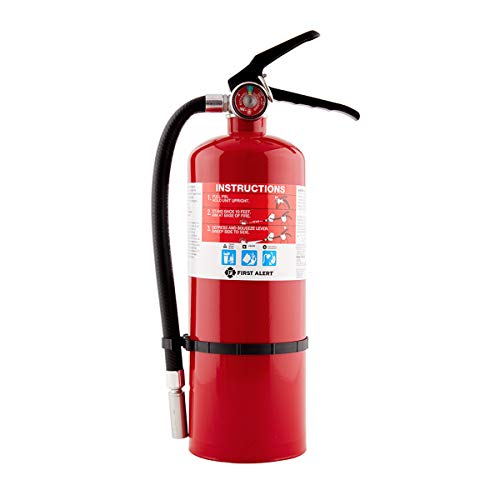
Best for: a homeowner with a garage, workshop or larger square footage to defend Skip it if: you cannot comfortably lift and aim 9.6 lb under stress
The First Alert is the one to buy when the Kidde is not enough. It carries a UL rating of 2-A:10-B:C, which means twice the A-class capability of the Kidde against ordinary combustibles like wood and paper, and the same rating against flammable liquids and electrical fires. At 9.6 lb and 17 x 5.75 x 6 in, it is heavier and taller. The listing calls out commercial-grade metal construction, a mono ammonium phosphate agent that is rechargeable by certified professionals after use, a color-coded corrosion-resistant pressure gauge, and a wall hook in the box. First Alert publishes a 12-year limited warranty, the longest in this set.
The trade-off is exactly what you would expect. Nearly ten pounds of canister is harder to bring to the flame quickly, especially for a smaller adult or a teenager pulling it off a wall hook. It is also the second-cheapest here, not the cheapest, though the price band is still entry-tier.
Pros:
- Printed UL 2-A:10-B:C rating
- 12-year limited warranty, longest in this set
- Rechargeable rather than disposable
- Wall hook included in the box
- Commercial-grade metal construction described in the listing
Cons:
- 9.6 lb is a real handling difference from the Kidde
- Recharging needs a certified professional, not a DIY refill
- Overkill for a studio apartment or a single bedroom
3. Ougist ABC FF2KG — Best for beginners
A lighter ABC dry-chemical unit that leans on a patented easy-grip handle and quick release, aimed squarely at first-time users.

Best for: renters or first-time buyers who want a lighter ABC unit and a shorter learning curve Skip it if: you need a published UL rating printed on the label
The Ougist FF2KG earns its award label on ergonomics. The listing describes a patented handle designed to activate with less grip strength than a traditional lever, a claim aimed at grandparents, teenagers or anyone who has never squeezed an extinguisher trigger under stress. Ougist calls it a 2-A:10-B:C rated unit with a 5 lb agent load, and describes a discharge distance of up to fifteen feet. That is a claim on the listing, not a printed UL certification in the specifications table, and it is the reason it sits at number three rather than number one.
The rest of the value here is fit and finish for the price. It sits in the middle price band of the five, so it is a step up from the Kidge Basic 110 without reaching the Strike First. If you are stocking a rental where you cannot mount a heavy wall unit but still want ABC coverage, this is the sensible pick. The trade-off is transparency: the specifications table publishes size, colour and model, but not weight or dimensions, which the other ABC units both do.
Pros:
- Patented handle claimed to require less grip strength
- 15-foot discharge range claim gives you standoff distance
- Middle price position, not premium
- Marked with a production date per the listing
- Covered by a six-year quality program per Ougist
Cons:
- No UL rating printed in the specifications table
- Weight and dimensions not published in the listing
- 2-A:10-B:C is a manufacturer claim, not a certified figure here
4. Ougist Class K KF01 — Runner-up
A compact 34 fl oz wet-chemical unit built to live under the sink and handle a stovetop grease flare-up.

Best for: cooks who want a dedicated Class K aerosol under the sink Skip it if: you want one extinguisher for the whole house
Here is where an ABC unit shows its limit. Dry chemical on burning cooking oil can spread the fire rather than smother it, which is why Class K wet chemical exists. The Ougist KF01 is 1-A:K rated, 4.4 oz, and 3.35 x 14.2 x 5.51 in, which is small enough to keep in the cupboard under the sink or in the pantry within arm's reach of the stove. Ougist publishes a 6-year manufacturer warranty and describes a quick-release handle that follows the standard PASS technique: pull, aim, squeeze, sweep.
The reason this is a runner-up and not a top pick is that no one should own only this. It is a supplement to your general-purpose extinguisher, not a replacement for it. It will not do anything meaningful against a wood or paper fire, and its whole reason to exist is the class of fire the Kidde and the First Alert are not built for. Buy this one alongside a full-house unit.
Pros:
- 1-A:K rated for cooking oil fires
- 4.4 oz and 3.35 in wide, easy to store near the stove
- 6-year manufacturer warranty
- Stainless steel finish reads less industrial than red canisters
Cons:
- Not a whole-house solution
- Small footprint means small agent load
- Sales rank shows it is a slower seller than the ABC picks here
5. Strike First SF-6LK — Best premium
A 6-liter commercial-grade wet-chemical unit for a home chef with a serious cooking setup and the space to wall-mount it.

Best for: a home chef with a range hood, deep fryer or serious cooking setup Skip it if: you have never handled a 22 lb cylinder and want something a beginner can lift one-handed
This is the most expensive pick here and the biggest by a wide margin. Strike First describes a 6-liter wet-chemical agent, a mirror-polished stainless cylinder, a chrome-plated brass valve, a waterproof gauge, and a stainless handle. The listing states a UL/ULC 1-A:K rating, a 73-second discharge time, an 8 to 10 ft agent throw, and a total weight of 22 lb inside a 21.5 x 8.75 x 7.13 in footprint. A Class K wall hook is included and Strike First publishes a 5-year warranty.
The reason it is here for beginners at all is honest: if your kitchen has a real deep fryer, a wok burner, or you cook with more than a quart of oil on a regular basis, a 4.4 oz aerosol is not going to do the job. This will. The trade-off is bluntly stated in the specifications: at 22 lb, it is the heaviest unit in this set by more than a factor of two, and it needs a wall mount rather than a cupboard. It also sells more slowly than any other pick here, so treat it as a specialist buy rather than a default one.
Pros:
- Claimed UL/ULC 1-A:K rating in the listing
- 73-second discharge claim, longest in this set
- Stainless steel build with waterproof gauge
- Class K wall hook included
- 5-year warranty from a specialist maker
Cons:
- 22 lb is a lot of canister to bring to a fire
- The most expensive pick here
- The slowest seller in this set
- Overspecified for anyone without a serious cooking setup
What the A, B, C and K ratings actually mean
The letters on the side of an extinguisher are shorthand for the class of fire it is certified to fight. Learn them once and shopping gets simpler.
- Class A is ordinary combustibles: wood, paper, cloth, most plastics.
- Class B is flammable liquids: gasoline, oil, solvents.
- Class C is energised electrical equipment.
- Class K is cooking oils and fats at kitchen temperatures.
The numbers matter too. On the Kidde FA110G, "1-A:10-B:C" means one A unit of capability against ordinary combustibles and ten B units against flammable liquids, with C class electrical safety confirmed. The First Alert HOME2PRO is 2-A:10-B:C, so it carries twice the A capability at 9.6 lb versus 3.9 lb. If you see a listing that describes a fire class in the marketing text but does not print the rating in the specifications, treat it as a claim, not a certification. That is the single biggest habit that separates a confident buyer from an anxious one.
How much extinguisher do you actually need?
Most homes need two canisters, not one. Here is the shortcut I use when someone asks how to stock a place from scratch:
- One general-purpose ABC unit near the main exit, mounted where you would walk past it on the way out. The Kidde Basic 110 covers this for a small home; the First Alert HOME2PRO covers it for a larger one with a garage.
- One Class K unit near the stove, stored somewhere you can reach without crossing in front of the flame. The Ougist KF01 at 4.4 oz fits under the sink; the Strike First SF-6LK belongs on a wall bracket if you cook seriously.
- A third unit only if the layout demands it. A workshop, a detached garage, or a second floor with only one stairway are the usual reasons.
The threshold for stepping up from the 3.9 lb Kidde to the 9.6 lb First Alert is not square footage in the abstract, it is combustible load. A garage with gasoline, a workshop with sawdust, or a hobby room with paint thinners tips the scale toward the heavier canister every time.
Where should a beginner mount it?
Placement decides whether an extinguisher works. A canister in the back of the pantry behind cereal boxes is not an extinguisher, it is a paperweight. Mount your general-purpose unit on the wall between the kitchen and the primary exit, at shoulder height, on the escape route rather than the fire route. Never mount it above the stove, and never inside a cabinet next to the range: the moment you need it most is the moment you cannot reach it.
For the Class K unit near the stove, the rule flips. Store it low and to the side, so you can pull it out while ducking below rising heat. The Ougist KF01 fits under-sink; the Strike First SF-6LK needs its included wall hook and about two feet of clear wall next to the range. Check the pressure gauge once a month. Green is charged, anywhere else is not.
What the listings do not tell you
Three things the specifications will not tell you, that matter once the canister is in your hand.
Recharging. The First Alert listing calls out that it is rechargeable by certified professionals after use. Most home extinguishers under 5 lb are technically disposable, which means after a single use, you replace rather than refill. Factor that into the cost of ownership if you have children or animals that might pull a pin.
Discharge time. The Strike First publishes a 73-second discharge time. Most home ABC units in this size class run somewhere in the ten to twenty second range, but the number is not always printed. You have far less time than you think to aim, so practising the PASS technique once, out loud, is worth more than reading a manual.
Shelf life. Even an unused extinguisher does not last forever. The pressure gauge is not a full check. If the canister is more than about a decade old, the warranty has expired, or the gauge sits outside the green zone, replace it rather than hoping.
The verdict
For a beginner buying a first professional-grade extinguisher, the Kidde Basic 110 (FA110G) is the right default. It publishes a full 1-A:10-B:C rating, weighs 3.9 lb, comes with a 6-year warranty, and sits in the cheapest price position of the five picks here. It is the unit most first-time buyers will actually reach for in a panic, because it is the one they can lift one-handed.
Two picks flip the recommendation. If your home has a garage, workshop or serious combustible load, buy the First Alert HOME2PRO instead: UL 2-A:10-B:C, 9.6 lb, 12-year limited warranty. If you cook with real quantities of oil, add a Class K unit alongside your general-purpose canister rather than replacing it. The Ougist KF01 at 4.4 oz handles casual stove use; the Strike First SF-6LK at 22 lb handles a range with a deep fryer. The cutoff between them is honest: if you would not use the word "chef" for yourself, the Ougist is enough.
Whatever you buy, buy two extinguishers, not one, and mount the general-purpose unit on the escape route.
FAQ
Is a professional fire extinguisher for beginners worth the money over a cheap aerosol can?
A professional fire extinguisher for beginners is worth the money because it publishes a real fire rating and a real warranty, both of which an aerosol can lacks. The Kidde FA110G sits in the entry price band with a 1-A:10-B:C rating and a 6-year warranty, so the step up from a disposable spray is small in price and enormous in capability. Buy the rated canister.
What does 1-A:10-B:C actually mean on the Kidde FA110G label?
1-A:10-B:C on the Kidde FA110G means the unit is certified against one A unit of ordinary combustibles like wood and paper, ten B units of flammable liquids like gasoline and oil, and the C class certification for use on live electrical equipment. It is the minimum rating most safety guides recommend for a general-purpose home extinguisher, and it is printed on the specifications rather than only claimed.
Kidde FA110G vs First Alert HOME2PRO: which should a beginner buy?
Kidde FA110G vs First Alert HOME2PRO comes down to combustible load and body strength. Buy the 3.9 lb Kidde if your home is a small apartment or the canister is going in a hallway. Buy the 9.6 lb First Alert if you have a garage, workshop, or a two-story home with mixed hazards. The First Alert doubles the A rating and adds six years of warranty.
Do I really need a separate Class K extinguisher for the kitchen?
A separate Class K extinguisher for the kitchen is genuinely useful because dry chemical from an ABC unit can spread burning cooking oil rather than smother it. Wet chemical in a Class K unit cools and blankets the oil instead. The Ougist KF01 at 4.4 oz stores under the sink; the Strike First SF-6LK at 22 lb wall-mounts near a serious range. Buy one in addition to your ABC unit.
How often should a beginner check the pressure gauge on a home extinguisher?
The pressure gauge on a home extinguisher should be checked at least monthly, and the Kidde FA110G, First Alert HOME2PRO and Ougist KF01 all publish an easy-to-read gauge for exactly that reason. The arrow needs to sit inside the green zone; anywhere else means the canister has lost pressure and needs recharging or replacement. Make it part of the same routine as changing smoke alarm batteries.
Stock two canisters, not one, and buy them today rather than after a scare. The Kidde Basic 110 covers the general case for less than most people spend on a coffee run, and it will sit charged on a wall hook for years without asking anything of you. If your home warrants the heavier First Alert HOME2PRO, buy that one instead of the Kidde rather than in addition. Then add a Class K unit for the kitchen based on how you actually cook. The best professional fire extinguisher for beginners is the one hanging where you can reach it before the fire spreads, so pick, mount, and check the gauge every month.
Last updated: September 7, 2026. Product availability re-checked.
This page contains affiliate links. As an Amazon Associate we earn from qualifying purchases, at no extra cost to you.