Best Powerful Smart Carbon Monoxide Detector: Kidde Wins
Five smart CO detectors compared on app alerts, power source, warranty and interconnection. One winner, one runner-up, and the conditions that flip the choice.
The best powerful smart carbon monoxide detector is the Kidde Smart Smoke & CO Detector with Ring, a 5 in combination alarm that runs on two AA batteries and pushes real-time alerts through the Ring app with no subscription. If your house already has hardwired alarm loops in the ceiling, the First Alert SC5 (model SMCO600NV-AC) is the better buy, since it interconnects with Nest Protect and every other compatible alarm on the same line.
Most guides on smart CO detectors compare decibel numbers. Every current alarm hits the same 85 dB floor, so that number does not decide the purchase. Power source, app ecosystem and how the unit warns you when the sensor itself is dying do.
Best powerful smart carbon monoxide detector at a glance
| Pick | Power | Alerts | Price |
|---|---|---|---|
| Best overall Kidde Smart Smoke & CO with Ring |
2x AA batteries | Ring app, no subscription | Check Price |
| Best premium First Alert SC5 Hardwire Smart |
Hardwired + battery backup | First Alert app, Nest Protect compatible | Check Price |
| Best upgrade Kidde Smart CO Detector |
Plug-in + 2x AA backup | Kidde app over 2.4 GHz Wi-Fi | Check Price |
| Best minimal setup Heiman 3-Pack + Gateway |
Battery, included | Heiman app via gateway hub | Check Price |
| Best budget pick First Alert CO400 (2-Pack) |
Battery only | Local 85 dB alarm, no app | Check Price |
How I cut the shortlist to five
I started with the criteria a shopper searching for a best powerful smart carbon monoxide detector actually cares about, and weighted them in this order.
- App notifications without a mandatory subscription. A smart alarm that goes quiet the moment you cancel a monthly plan is not smart. Four of the five picks push alerts free of charge; one is deliberately non-smart to hold the price down.
- Power source that matches real homes. Battery, plug-in and hardwired each solve a different problem, so the list has to cover all three.
- Sensor and warranty length. A 10-year limited warranty signals a sealed sensor lifespan, which matters because CO sensors drift.
- Interconnection. In a two-storey home, one alarm sounding in the basement is useless if it cannot wake anyone upstairs.
- A published set of specifications. Listings that skip dimensions, weight and warranty went to the bottom.
Cut from the list: any CO-only alarm with no app whatsoever (except one budget pick kept as a reference), anything that required a paid plan to send a push, and combination units that lumped in features unrelated to CO detection.
What actually decides a smart CO detector?
The deciding criterion is how the alarm reaches you when you are not in the room. Every unit here sounds the same 85 dB tone at close range. What separates them is whether that tone becomes a phone notification, whether that notification costs money each month, and whether one alarm can trigger the others.
Sensor type matters second. Electrochemical sensors, which four of these five listings describe, are the current standard for residential CO detection. The Heiman listing names the specific sensor: a Japan-made FIGARO TGS5141. That level of detail is unusual and worth noting, though it is still a manufacturer claim rather than an independent measurement.
Third comes end-of-life behaviour. The First Alert CO400 listing states it chirps at the end of the sensor's life so you know when to replace the unit. The Kidde combination alarm carries a 10-year limited warranty, matching the industry expectation for sealed sensors. Anything shorter is a compromise.
Ignore comparisons that lead with decibel figures alone. That number is a UL requirement, not a differentiator.
1. Kidde Smart Smoke & CO Detector with Ring — Best overall
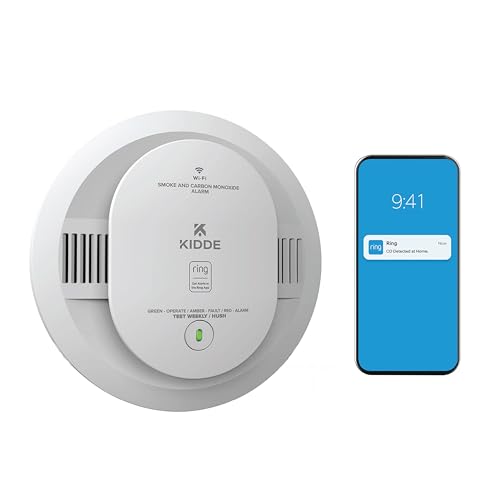
The Kidde RGCUDR-RW is the pick most homes should buy first because it covers both smoke and CO on two AA batteries and pushes free alerts through Ring.
Best for: renters and owners who want app alerts without rewiring anything Skip it if: you already own Nest Protect and want everything on one app
This is the only pick in the set that handles both smoke and carbon monoxide in one 5 in unit while running purely on batteries. Dimensions are 5 x 2 x 5 in, colour is white, and Kidde publishes a 10-year limited warranty on the alarm. The listing states real-time Ring app notifications for smoke, CO and low-battery events cost nothing, with an optional 24/7 monitored plan at five dollars a month for anyone who wants professional response. Kidde also claims over 25% faster smoke detection based on internal testing against a leading competitor, which you should read as a manufacturer claim rather than an independent benchmark. Compared with the plug-in Kidde model, this one goes anywhere a screw hole will reach: hallway ceilings, bedrooms, stairwell landings. The trade-off is that a set of AAs eventually runs down, and a hardwired loop with battery backup does not.
Pros:
- Both smoke and CO in one 5 in body
- Ring app alerts with no subscription required
- 10-year limited warranty on the alarm
- Runs on two AA batteries, no wiring
- Optional monitoring at five dollars a month
Cons:
- Ties you to the Ring ecosystem
- Battery-only means periodic AA swaps
- "25% faster" figure is Kidde's own internal test
2. First Alert SC5 Hardwire Smart Smoke & Carbon Monoxide Alarm — Best premium
The First Alert SC5 is the right choice when you already have hardwired alarm loops in the ceiling and want Nest Protect compatibility on top.

Best for: homes with existing hardwired alarm loops and Nest Protect gear Skip it if: you cannot access AC wiring in the ceiling
This is the most expensive pick here and the only one built for retrofit into an existing hardwired system. Dimensions are 5.75 x 5.75 x 1.6 in, and the model number is SMCO600NV-AC. The listing states compatibility with Google's Nest Protect alarm, sends push notifications through the First Alert app when smoke or CO is detected, and interconnects so that one triggered alarm sounds every compatible alarm on the loop. Battery backup covers power outages. Voice alerts announce the type and location of the danger, which is a real advantage in a large home where a chirp gives you no direction. Two sellers list it. The trade-off against the Kidde winner is installation: you need an AC connection in a standard alarm box, and if you have neither the wiring nor the appetite to add it, this pick is out of reach. First Alert does not publish a warranty length on the listing.
Pros:
- Interconnects with existing hardwired alarms
- Compatible with Google Nest Protect
- Voice alerts name the danger type and location
- Battery backup covers outages
- App notifications for smoke and CO
Cons:
- Highest price position in the set
- Requires access to AC wiring
- No warranty length stated on the listing
- Larger 5.75 in footprint than the Kidde combo
3. Kidde Smart Carbon Monoxide Detector — Best upgrade
The Kidde COPDW plug-in makes sense next to a bedroom outlet, especially when you want a CO-only unit rather than a combination alarm.

Best for: outlets near sleeping areas where a plug-in with battery backup makes sense Skip it if: you need coverage in a room without a spare wall outlet
The COPDW is CO-only, plugs into a standard 120V outlet, and carries two AA backup batteries for power outages. It weighs 6.88 oz, measures 5.47 x 1.52 x 2.9 in, and the rotating plug fits vertical or horizontal receptacles. Kidde publishes a 10-year limited warranty. The listing states the alarm sounds at 85 dB when CO is detected, connects over 2.4 GHz Wi-Fi, and pushes free notifications through the Kidde app with no subscription required. UL 2034, 5th Edition testing and ETL listing are both stated on the page. Against the combination Kidde winner, this one sacrifices smoke detection and portable placement in exchange for continuous mains power and a place low on the wall, which is where CO tends to distribute in a room. The main constraint is straightforward: no outlet, no unit.
Pros:
- Plug-in with two AA batteries for outage backup
- Free Kidde app notifications, no subscription
- Rotating plug fits either outlet orientation
- 10-year limited warranty on the alarm
- Wall placement puts the sensor low in the room
Cons:
- CO only, no smoke detection
- Requires a spare 120V outlet in the right spot
- Requires 2.4 GHz Wi-Fi, not 5 GHz
- Blocks one plug in a two-outlet receptacle
4. Heiman Smart Carbon Monoxide Detectors 3-Pack — Best minimal setup
The Heiman 3-pack with gateway suits larger homes that want three linked CO alarms out of one box.

Best for: larger homes that want linked alarms across three rooms Skip it if: you do not want a separate hub sitting on your network
This pick ships as three CO detectors plus a gateway hub. Each detector measures 2.75 x 2.75 x 1.45 in, which is the smallest footprint here, and the model number is C1-R. Two sellers list it. Heiman states that when one alarm detects CO, every linked alarm sounds within 200 m/656 ft, and the gateway pushes alerts to the Heiman app. The listing also names the sensor: a Japan-made FIGARO TGS5141 electrochemical unit, described as resistant to humidity and temperature interference. Installation uses screws or magnetic pads, and the detectors are battery-powered with the battery included, so a wiring cut does not knock them out. The trade-offs are real. The Heiman listing does not publish weight, warranty length, colour or decibel rating, and the interconnect depends on a proprietary gateway that adds another device to your Wi-Fi. If you only need one unit, this is not the right buy.
Pros:
- Three linked alarms in one purchase
- Gateway pushes app alerts across the set
- Smallest 2.75 in footprint in the set
- Named FIGARO TGS5141 sensor on the listing
- Screw or magnetic mounting options
Cons:
- Highest price band position of the CO-only picks
- Requires a separate gateway hub
- No published warranty on the listing
- No published weight or decibel rating
5. First Alert Battery Carbon Monoxide Alarm (CO400 2-Pack) — Best budget pick
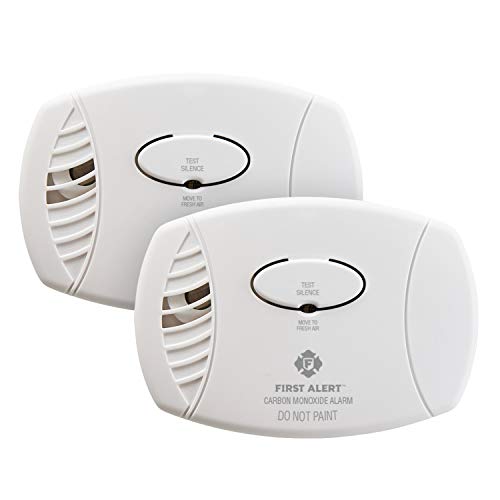
The First Alert CO400 2-pack is the cheapest here and the right pick when you need coverage without an app.
Best for: second homes, cabins or rentals that need coverage without an app Skip it if: you want notifications on your phone when you are away
This is the cheapest of the six and the one buyers choose most often here, though it is worth being clear that it is not a smart detector: it has no app, no Wi-Fi and no phone alerts. It ships as a pack of 2, weighs 0.8 lb per unit, measures 4 x 9 x 6 in on the box, and the model number is CO400. First Alert publishes a 5-year warranty, and the listing states an 85 dB alarm at dangerous CO levels, an electrochemical sensor, and an end-of-life chirp so you know when to replace the unit. Two sellers list it. Include this one only if the question is where to add local CO coverage without a network, or as backup on a floor where the smart alarms have not reached yet. Against every other pick here, the compromise is the point: no app, shorter warranty, but two units for the price of one entry-band smart alarm.
Pros:
- Cheapest of the six
- Ships as a pack of 2 for two rooms
- Electrochemical sensor on the listing
- End-of-life chirp warns of replacement
- No Wi-Fi or hub required
Cons:
- No app or phone alerts at all
- 5-year warranty, half the length of the Kidde picks
- Not a smart detector despite meeting the search intent
- CO only, no smoke coverage
Battery, plug-in or hardwired: which power source fits your home?
Every alarm here uses one of three power schemes, and the right one depends on your building, not the listing.
- Battery only. The Kidde combination winner and the Heiman 3-pack both run on batteries. Best for renters, older houses without ceiling wiring, and any spot where an outlet is far from where the alarm should sit. The trade is periodic battery replacement.
- Plug-in with battery backup. The Kidde COPDW plugs into a 120V outlet and adds two AA cells for outages. Best when the room you care about has a spare outlet near the floor, since CO distributes evenly and low placement is fine for a plug-in unit.
- Hardwired with battery backup. The First Alert SC5 slots into an existing alarm loop and inherits interconnect and outage coverage automatically. Best in newer builds that already have the wiring in place. Retrofitting a hardwired loop just to install this alarm rarely pays off.
If your house has no wiring and no consistent outlet placement, the battery combination unit is the least fussy default. It goes where a smoke alarm would.
How loud is 85 dB, and where should the unit go?
85 dB is roughly the loudness of a running food processor at arm's length. Three of the listings here state that figure explicitly: the two First Alert units and the Kidde plug-in. UL 2034 sets 85 dB at 10 ft as the minimum for a residential CO alarm, so any current-generation unit will hit it. The number is a floor, not a feature.
Placement matters more than volume. CO mixes evenly through indoor air, so a detector works whether it sits on a ceiling, high on a wall, or near an outlet. First Alert says on the CO400 listing to place one on each level of the home and one in each bedroom. That is the right template for every pick here. In a two-storey home with a basement, that means three alarms at minimum, which is exactly why the Heiman 3-pack exists.
Keep alarms out of the kitchen, out of bathrooms, and away from the immediate vicinity of fuel-burning appliances, where transient CO spikes can cause nuisance alarms.
What the listings do not tell you
Two things worth knowing before you buy any smart CO detector:
- Wi-Fi band. The Kidde plug-in explicitly states 2.4 GHz Wi-Fi. Most smart home devices use 2.4 GHz because it reaches further through walls, but a router set to 5 GHz only will not pair. Check your router before you install.
- App accounts. Ring, Kidde and First Alert each require an account, and the Heiman gateway routes through the Heiman app. If you already run one of those ecosystems for cameras or doorbells, prefer the matching alarm. If you want everything on Google Home through Nest Protect, the First Alert SC5 is the only pick that lists that compatibility.
Also worth flagging: not every listing publishes a warranty length. The two Kidde units state 10 years, the First Alert CO400 states 5 years, and the Heiman and First Alert SC5 listings do not state a length at all. That gap is not proof of a shorter warranty, but it is a real information gap when you are comparing at the same price band.
The verdict
The Kidde Smart Smoke & CO Detector with Ring is the right default. It covers both smoke and CO in a single 5 in unit, runs on two AA batteries, sits on any ceiling that will take a screw, and pushes real-time alerts to the Ring app without a monthly plan. The 10-year limited warranty matches the sensor's expected lifespan, and the option to add a five-dollar monitoring plan is there if you want professional response without changing hardware.
Two conditions flip the choice. First, if the house already has hardwired alarm loops and you own Nest Protect gear, the First Alert SC5 is the better buy: it interconnects with the existing loop and adds voice alerts naming the type and location of danger. Second, if a bedroom outlet sits low on the wall and you want a CO-only detector with mains power plus battery backup, the Kidde COPDW plug-in is the closer fit than the combination unit. For everyone else, the battery combination Kidde is the shorter path to coverage.
FAQ
Is a smart carbon monoxide detector worth it over a basic alarm?
A smart carbon monoxide detector is worth it when the house is empty for stretches: at work, on a trip, or overnight in a separate bedroom from where the CO source lives. The app push wakes you or reaches you when the 85 dB tone would not. If someone is always home in earshot, the basic First Alert CO400 covers the safety requirement for less money.
What is the difference between the two Kidde picks here?
The difference between the two Kidde picks is scope and power source. The RGCUDR-RW combination unit detects smoke and CO on two AA batteries and sends alerts through Ring. The COPDW plug-in detects only CO, plugs into a 120V outlet with AA backup, and uses the Kidde app over 2.4 GHz Wi-Fi. Pick the combination for whole-room coverage, the plug-in for CO-only near a specific outlet.
Does the First Alert SC5 work with Google Nest Protect?
The First Alert SC5 lists compatibility with Google's Nest Protect alarm on its product page, and it interconnects so that one triggered alarm sounds every compatible alarm in the home. That is the reason to pick it over the Kidde combination unit. The trade-off is installation: the SC5 model SMCO600NV-AC needs an AC connection in a standard hardwired alarm box.
How long does a carbon monoxide sensor last?
A carbon monoxide sensor typically lasts as long as its published warranty. Both Kidde picks here carry 10-year limited warranties, matching the industry standard for sealed sensors. The First Alert CO400 carries a 5-year warranty, and the CO400 listing notes an end-of-life chirp so you know when to replace it. The Heiman and First Alert SC5 listings do not publish a warranty length.
Can one detector cover a whole two-storey house?
One detector cannot cover a whole two-storey house safely. First Alert's own guidance on the CO400 listing is to place one alarm on each level and one in each bedroom. That is why the Heiman 3-pack ships as three linked units with a gateway hub, and why the First Alert SC5 exists as an interconnected hardwired alarm. For a two-storey home with a basement, three alarms is the practical minimum.
If you are buying the first smart CO detector for a home that has never had one, start with the Kidde combination unit and put it on the ceiling of the hallway between the bedrooms. That single placement covers the highest-risk hours, the sleeping ones, and the Ring app pushes free alerts if CO rises while you are out. Add a second alarm on the floor where the furnace or garage lives, and pick the plug-in Kidde or the CO400 pack depending on whether you want app alerts there too. The winner earns its spot because it does the thing every other pick asks you to compromise on: smoke and CO, no wiring, no subscription, on a warranty that matches the sensor.
Last updated: September 7, 2026. Product availability re-checked.
This page contains affiliate links. As an Amazon Associate we earn from qualifying purchases, at no extra cost to you.