Best Smart Carbon Monoxide Detector for Seniors
A comparison of five smart and connected CO alarms with the alert thresholds, mounting styles and warranty terms that matter most in an older adult's home.
The best smart carbon monoxide detector for seniors is the Kidde Smart CO Detector + Indoor Air Quality (COPDLQW), because it alerts at 30-70ppm rather than waiting for the standard 70ppm threshold, plugs into a wall outlet at eye level, and pushes alarms to a family member's phone through the Kidde app with no subscription. If a combined smoke and CO alarm on the ceiling would suit the house better, the Kidde Smart Smoke & CO with Ring (RGCUDR-RW) is the pick, especially inside a Ring household.
How the picks compare at a glance
| Pick | Mounting | Alert path | Warranty | Price |
|---|---|---|---|---|
| Best overall Kidde Smart CO + IAQ |
Plug-in, AA backup | 85dB alarm + Kidde app, no subscription | 10-year limited | Check Price |
| Best upgrade Kidde Smart Smoke & CO with Ring |
2 AA batteries, ceiling | Ring app, no subscription required | 10-year limited | Check Price |
| Best premium First Alert SC5 Smart Smoke & CO |
Battery, ceiling | First Alert app + voice location alerts | Not listed | Check Price |
| Best minimal setup Heiman Smart CO 3-Pack + Gateway |
Battery, screw or magnet | Heiman app via gateway, 656 ft interconnect claim | Not listed | Check Price |
| Best budget pick First Alert CO605 Plug-in |
Plug-in, battery backup | 85dB alarm only, no app | 7-year limited | Check Price |
How I screened this shortlist
I started with the connected CO alarms Amazon lists inside Fire Safety > Carbon Monoxide Detectors and the combination smoke and CO subcategory. The criteria, in weighted order:
- A published alert path a caregiver can see from another home. That ruled out standalone alarms with no app entirely, with one exception kept in as the budget benchmark.
- A mounting style that suits an older adult. Plug-in at outlet height is easier to hear and easier to service than a ceiling unit reached from a step-stool.
- A published warranty, or a clear sensor lifetime. A ten-year warranty is the ceiling in this category, and two of the five picks reach it.
- A stated low-level CO behaviour. The industry alarm point is 70ppm; earlier alerts matter more when the person in the room is 75 or 80.
The word "seniors" is not indexed by Amazon in this category, so no listing here is designed only for older adults. I have treated it as a use-case filter, not a product claim, and picked for the things that actually help: outlet-height mounting, loud alarms, app relays for a family member, and long warranties.
1. Kidde Smart CO Detector + Indoor Air Quality — Best overall
A plug-in smart CO alarm with a 30-70ppm early-warning band, a 10-year warranty, and no subscription for phone alerts, all at a mid-set price.

Best for: an older adult who wants early low-level CO alerts and app notifications a family member can see Skip it if: the outlet is behind furniture or the Wi-Fi is 5 GHz only
Inside this set, the COPDLQW is the only pick that both plugs into a wall outlet and speaks to a phone app. That combination matters for an older adult: the alarm sits at knee-to-waist height instead of on a ceiling, the 85dB horn is close to the room rather than nine feet up, and a family member across town gets the same alert on their phone. Kidde says the early-warning band starts at 30ppm with a distinct light and sound pattern, and the standard alarm pattern begins at 70ppm, which is the level a conventional CO alarm waits for. That earlier window is the single most useful spec in this shortlist for a household with a resident over 70. The unit weighs 6.88 oz, measures 5.47 x 1.52 x 2.9 in, and the plug rotates for vertical or horizontal outlets. The Kidde app runs on 2.4 GHz Wi-Fi and does not require a subscription for CO alerts; an optional Advanced Home Health plan adds air-quality trend analysis. The trade-off against the ceiling-mounted picks is that it does not detect smoke.
Pros:
- Alerts at 30-70ppm, earlier than the standard 70ppm point
- Plug-in mounting at outlet height, with AA battery backup
- Phone alerts through Kidde app with no subscription
- 10-year limited warranty, the ceiling in this set
- Rotating plug fits vertical or horizontal outlets
Cons:
- Detects CO only, not smoke
- Needs a 2.4 GHz Wi-Fi network
- Advanced air-quality insights sit behind a paid tier
2. Kidde Smart Smoke & CO Detector with Ring — Best upgrade
A combined smoke and CO alarm that pipes both alerts into the Ring app on batteries alone, with the fastest sales record in this shortlist.
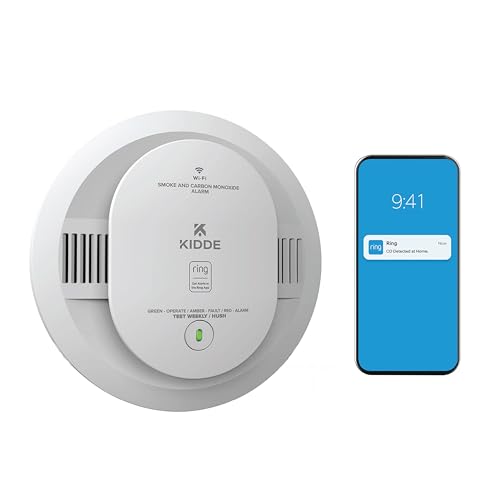
Best for: a household already inside the Ring ecosystem that wants smoke and CO on one device Skip it if: you do not want a ceiling-mounted alarm to change batteries
If the person you are protecting already has a Ring doorbell or camera, this is the alarm to add. It runs on two AA alkaline batteries, so it needs no electrician and no outlet, and it appears in the same Ring app the household already opens for the front door. Kidde claims over 25 percent faster smoke detection than an unnamed leading competitor, based on the brand's internal testing, so treat that figure as a manufacturer number rather than a measured comparison. The device is 5 x 2 x 5 in with a 10-year limited warranty and a 2026 release date, and Ring's optional 24/7 professional monitoring is a separate paid add-on. Sales rank in this set is 614, the fastest here, which usually correlates with easier ordering and stock. The compromise against the plug-in Kidde is height: a ceiling alarm is harder for an older adult to hush or service, so pair it with a caregiver phone on the same Ring account.
Pros:
- Smoke and CO in one alarm, no wiring
- Runs on two AA batteries, included
- Real-time alerts through the Ring app, no subscription required
- 10-year limited warranty
- Fastest seller of the five picks in this set
Cons:
- Ceiling mounting is harder for an older adult to reach
- "25% faster" figure is Kidde's own internal test
- Adds another app if the household is not already on Ring
3. First Alert SC5 Battery Smart Smoke & Carbon Monoxide Alarm — Best premium
The only pick in this set that announces the type and location of the danger by voice, and the only one that talks to Google's Nest Protect.

Best for: a multi-floor home where every alarm should sound together and announce the danger by voice Skip it if: you are not willing to pay the highest price in this set
The SC5 sits at price rank 5, the most expensive pick here, and it earns that position on two features an older adult actually benefits from. First Alert says its Heads-Up voice alerts announce both the type of hazard, smoke or CO, and the location, so a resident who wakes disoriented hears "carbon monoxide, basement" rather than a horn of unknown origin. The listing also states compatibility with Google's Nest Protect and an interconnect that sounds every linked alarm when one triggers, which is the right behaviour in a two-story home where the bedroom is upstairs from the furnace. The unit weighs 1 lb and measures 5.75 x 5.75 x 1.6 in, so it is chunkier than the Kidde ceiling model. It also notifies through the First Alert app when batteries are low, which the listing says prevents late-night chirps, a small quality-of-life detail that matters more with age. The trade-off: no warranty is published for this listing, and it is the priciest of the five.
Pros:
- Voice alerts name the hazard type and location
- Compatible with Google Nest Protect for interconnect
- Low-battery notifications, no late-night chirp
- Phone alerts through First Alert app
- Whole-home interconnect when paired with compatible alarms
Cons:
- The most expensive pick in this set
- No warranty listed on the product page
- Ceiling mount, harder for an older adult to service
4. Heiman Smart Carbon Monoxide Detectors 3-Pack with Gateway — Best minimal setup
Three interconnected CO alarms and a Wi-Fi gateway in one box, so a single evening covers a bedroom, a hallway and a utility area.

Best for: a single-story home or apartment where three linked alarms cover every sleeping area Skip it if: you want a US-brand app with a long track record
Heiman's three-pack is the odd shape in this shortlist, and useful because of it. Instead of one alarm you scale up, you get three CO detectors plus a gateway that bridges them to the Heiman app, so a caregiver sees which unit tripped. Heiman claims wireless interconnect within 200 m or 656 ft between units, which is more than enough for any single-family home, and lists a Figaro TGS5141 electrochemical sensor made in Japan. Each alarm is 2.75 x 2.75 x 1.45 in and mounts with screws or magnetic pads, so it can move from a stud wall to the side of a fridge without tools. It runs on batteries, included, so a power outage does not disable it. Sales rank in this set is 51499, the slowest here, and no warranty is published, so this is the pick that leans on set composition rather than track record. The Heiman app is the least familiar of the four apps in this comparison.
Pros:
- Three CO alarms plus gateway in one box
- Wireless interconnect up to a claimed 656 ft
- Screws or magnetic pads for tool-free relocation
- Battery-powered, unaffected by outages
- Figaro TGS5141 sensor cited on the listing
Cons:
- Slowest seller of the five picks here
- No warranty published on the product page
- Heiman app is less established than Kidde, Ring or First Alert
5. First Alert CO605 Plug-in Carbon Monoxide Detector — Best budget pick
The cheapest of the five, a plug-in CO alarm with battery backup and no app, for a parent who will not touch a smartphone.
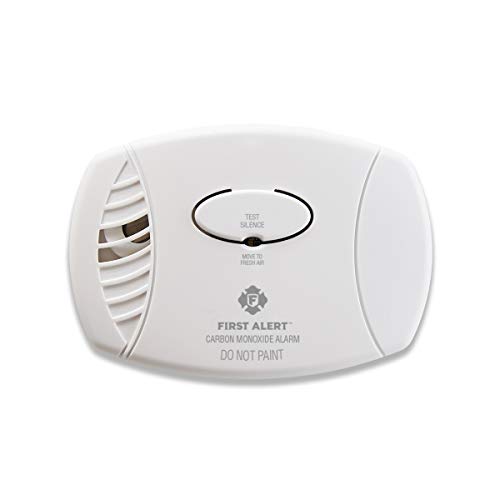
Best for: a caregiver buying one alarm per outlet for a parent who will not use an app Skip it if: you want phone alerts when you are not in the house
Not every senior wants a smart alarm, and not every caregiver needs one. The CO605 is the cheapest of this set and the fastest seller of the five, at sales rank 84 in this comparison. It plugs into a standard outlet, keeps monitoring during a power cut on its battery backup, and sounds an 85dB horn when CO reaches dangerous levels. First Alert lists a single test and silence button, which is the right control count for a resident with reduced dexterity or vision. The alarm is 5 x 3.4 x 1.38 in, weighs 4.2 oz and carries a 7-year limited warranty, shorter than the Kidde smart pair but the only warranty published in this trio of standalone-style picks. The listing also mentions an end-of-life chirp so the device tells you when it needs replacing. What you give up is obvious and it is the whole point of this article: no smart alerts, so a family member in another zip code will never know the alarm has sounded. Pair it with a phone call plan.
Pros:
- The cheapest pick in this set
- Fastest seller of the five here
- Plug-in with battery backup for outages
- Single test-and-silence button
- 7-year limited warranty with end-of-life chirp
Cons:
- No smart features, no phone alerts
- Alarm is heard only inside the home
- Older listing, released in 2007
What actually decides a CO alarm for an older adult
Most guides in this category compare decibels and battery type. Those matter, but they do not decide the buy. Two other things do.
The first is the alarm threshold. UL-listed CO alarms typically wait until 70ppm before they sound. An older adult, a resident with COPD, or someone on cardiac medication can feel the effects lower and longer than a healthy adult. Kidde's COPDLQW is the only pick here that publishes an earlier alert band at 30-70ppm, and that is the single most defensible reason to prefer it for a senior.
The second is the alert path off-property. A CO alarm at 3am helps only the person who hears it. A smart alarm that sends a push notification to an adult child ten miles away turns the same event into a phone call to 911. Four of the five picks here send app alerts without a subscription: the Kidde COPDLQW, the Kidde with Ring, the First Alert SC5 and the Heiman three-pack. The CO605 does not.
Everything else, mounting style, warranty length, whether it also detects smoke, is a tie-breaker after those two.
A note on the word smart in this category
Every pick except the budget CO605 sends app notifications, but "smart" varies more than the badge suggests. The Kidde COPDLQW and the Kidde with Ring both use their own manufacturer apps and both state that CO alerts are free of any subscription. The First Alert SC5 uses the First Alert app and also interoperates with Google Nest Protect for interconnect, which is a different kind of smart than a push notification. The Heiman three-pack uses a bridge gateway and its own app, and the interconnect it advertises is between its own alarms rather than a broader ecosystem.
Practical implication: pick the app the caregiver will actually open. If the household already opens Ring for the doorbell, the Kidde with Ring reduces app fatigue. If nobody in the family uses Ring, the plug-in Kidde COPDLQW is the cleaner install because it is one app on one phone tied to one alarm.
None of these picks include cellular backup. All of them assume the home has working Wi-Fi. If the internet drops, the local horn still sounds; the notification does not go out.
Where should a CO detector be placed in a senior's home?
Where should a CO detector be placed matters more than which model sits inside the box. Three rules apply, and they hold across every pick in this shortlist:
- One alarm on every level of the home, including the basement.
- One alarm inside or immediately outside every sleeping area.
- Not directly above a fuel-burning appliance, and not in a garage or bathroom.
For an older adult specifically, the plug-in Kidde COPDLQW and the plug-in First Alert CO605 sit at outlet height, roughly waist to knee, which puts the horn closer to the ear and the status LEDs in the line of sight of a seated resident. Ceiling alarms, the Kidde with Ring and the First Alert SC5, are correct for smoke because smoke rises, and CO mixes with room air so height is less critical. In a bedroom used by someone who cannot easily reach a ceiling, a plug-in CO-only alarm on the wall plus a ceiling smoke alarm elsewhere is often the better split than a single combination unit overhead.
How long does a smart CO detector actually last?
CO sensors are consumables. Electrochemical sensors, which every pick in this set uses or is described as using, degrade over roughly 7 to 10 years, and the warranty length on each listing is a useful proxy. Both Kidde picks, the COPDLQW and the Ring model, carry a 10-year limited warranty. The First Alert CO605 carries a 7-year limited warranty and includes an end-of-life chirp so the resident knows when to replace it. The First Alert SC5 and the Heiman three-pack do not publish a warranty on their product pages, which does not mean they lack one, only that the number is not there to compare.
Practically, that means budgeting for a replacement inside a decade for every one of these picks, regardless of brand. Write the install date on the back of the alarm with a marker the day you mount it. That single habit is worth more than any spec.
The verdict
The Kidde Smart CO Detector + Indoor Air Quality (COPDLQW) wins the best smart carbon monoxide detector for seniors on three grounds that hold up inside this set. Its 30-70ppm early-warning band is the earliest CO alert published on any listing here, its plug-in mounting keeps the alarm at outlet height for a resident who should not be on a step-stool, and its Kidde app sends notifications without a subscription so a family member on another network sees the same alarm the resident hears.
Two conditions flip the pick. If the household is already inside the Ring ecosystem, or the resident prefers one combined smoke and CO alarm on the ceiling, the Kidde Smart Smoke & CO with Ring (RGCUDR-RW) is the better buy: same brand, same 10-year limited warranty, one app the family already uses. If voice announcements of the hazard and its location would help a resident who wakes disoriented, the First Alert SC5 is the pick, at the highest price in this shortlist. For a parent who will never open an app, the plug-in First Alert CO605 is honest budget hardware with a 7-year warranty and no smart pretence.
What to check before you hit buy
Before you order, walk the home and confirm five things. Two are about the house, three are about the person.
- Is there a free 120V outlet within eyeline of the bedroom and the furnace? If yes, a plug-in alarm is on the table.
- Is the Wi-Fi 2.4 GHz and does the caregiver have the router password? The Kidde app needs both.
- Can the resident reach a ceiling alarm safely? If not, either mount it for them and commit to changing the batteries yourself, or choose a plug-in unit.
- Is there already a smart app the household opens weekly? Match the alarm to that app, not the other way round.
- Are there existing CO alarms in the home? Note their install date. If any is older than seven years, replace it now regardless of what the horn does.
FAQ
Is a smart carbon monoxide detector worth it for a senior living alone?
Is a smart carbon monoxide detector worth it for a senior living alone comes down to who else needs to know. A local horn wakes the resident. A smart alarm sends the same alert to an adult child or caregiver's phone, so a 3am CO event triggers a phone call to 911 even if the resident is confused or unresponsive. For a senior alone, that off-property alert path is the case for spending more than a basic plug-in.
How is the Kidde COPDLQW different from the Kidde Smart Smoke & CO with Ring?
The Kidde COPDLQW is a plug-in CO-only alarm that runs on 120V with AA backup and reports through the Kidde app, alerting at 30-70ppm as well as the standard 70ppm point. The Kidde Smart Smoke & CO with Ring is a battery-powered ceiling combination alarm that reports smoke and CO through the Ring app. Pick the plug-in for outlet-height mounting; pick the Ring model to consolidate smoke and CO in one app.
What alarm volume do these smart carbon monoxide detectors actually reach?
What alarm volume these smart carbon monoxide detectors actually reach is 85dB for the two picks that state a figure, the Kidde COPDLQW and the First Alert CO605. That is the standard for the category and loud enough to wake a sleeping adult in the same room. Hearing loss is common with age, so pair the local horn with a phone-based alert for anyone who wears hearing aids only during the day.
Do I need a subscription to get phone alerts from any of these picks?
Do I need a subscription to get phone alerts is a fair question because pricing in smart home is opaque. On the picks here, no. Kidde states no subscription is required for CO alerts through its app on the COPDLQW, and the same is true of the Kidde with Ring for its smoke and CO alerts. Optional paid tiers exist for extra features: Kidde's Advanced Home Health at 1.99 a month, Ring at 5 a month for professional monitoring.
Can one smart carbon monoxide detector cover a whole house?
Can one smart carbon monoxide detector cover a whole house is the wrong question, because code and manufacturer guidance both call for one alarm per level and one inside or beside every sleeping area. The Heiman three-pack answers this directly by shipping three alarms plus a gateway, and both Kidde smart alarms plus the First Alert SC5 can be paired up in multiples through their apps. Plan for two to four alarms in a typical single-family home.
A last practical note. A CO alarm is not a device you upgrade every year; it is a device you install once and forget for close to a decade, and the person it protects will not think about it again until it sounds. That is why the pick matters. The Kidde COPDLQW earns the top spot here because it makes the two decisions that matter most, an earlier alert threshold and an off-property notification, without asking a senior to learn anything new. Plug it in, hand a caregiver the app, write the install date on the back with a marker, and move on. That is what a good buy in this category looks like.
Last updated: September 7, 2026. Product availability re-checked.
This page contains affiliate links. As an Amazon Associate we earn from qualifying purchases, at no extra cost to you.