Best Cordless Smart Smoke Detector by Battery Type
A close read of five listings, with the winner named, the runner-up's advantage spelled out, and the trade-offs each pick makes.
The best cordless smart smoke detector is the Kidde Smart Smoke & CO Detector with Ring, model RGCUDR-RW, a 5 x 2 x 5 in unit that runs on two AA batteries and pushes real-time smoke and CO alerts to the Ring app with no subscription attached. If you need whole-home coverage instead of a single room, the Heiman S1-R kit ships six wireless interconnected detectors plus a gateway, backed by a 10-year limited warranty. Both dodge hardwiring entirely.
Best cordless smart smoke detector at a glance
| Pick | Smoke + CO? | Power | Price |
|---|---|---|---|
| Best overall Kidde Smart Smoke & CO Detector with Ring |
Yes | 2 AA batteries | Check Price |
| Best premium Heiman Smart Wireless Interconnected Smoke Detector |
Smoke only | 10-year battery claim | Check Price |
| Best minimal setup First Alert SC5 Battery Smart Smoke & CO Alarm |
Yes | Battery (unspecified) | Check Price |
| Best budget pick First Alert Battery Smoke Alarm |
Smoke only | Battery, front access | Check Price |
| Best for pros Kidde Hardwired App-Enabled Smart Alarm |
Yes | Hardwired + AA backup | Check Price |
How I screened the listings down to five
I started with the phrase in the search bar and worked backwards. A best cordless smart smoke detector needs to run without mains wiring, connect to a phone in some way, and be sold as a smoke alarm rather than a bundled bit of home-automation kit. Amazon's own results loosened that filter, so the shortlist includes one hardwired unit that earns its slot as a comparison point.
I ranked what remained on three criteria, weighted in this order:
- Whether the listing publishes concrete specifications you can compare across the set.
- Whether the alarm covers carbon monoxide as well as smoke.
- Whether the app path is described, and whether it demands a subscription.
Three listings were cut before the final five. Two carried no warranty and no dimensions, which made honest comparison impossible. One was a smart bulb marketed as an alarm accessory, not an alarm. What survived splits neatly into three battery-only smart units, one battery-only dumb alarm as a budget yardstick, and one hardwired smart unit that shows what more money buys when you have wiring in place.
1. Kidde Smart Smoke & CO Detector with Ring — Best overall
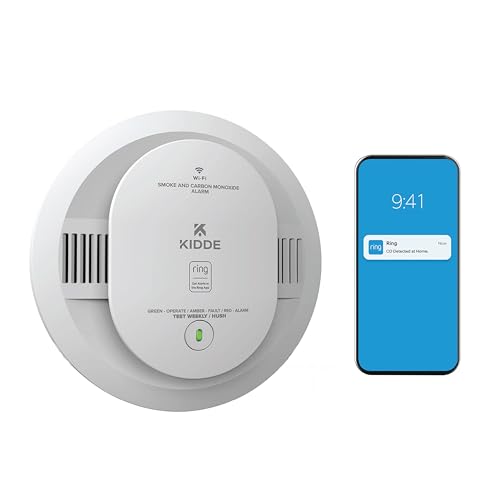
A 5 x 2 x 5 in dual-threat alarm on two AA batteries, with Ring app alerts and no subscription needed for the basic notifications.
Best for: renters and single-floor homes wanting Ring app alerts without hardwiring Skip it if: you need to cover a large multi-floor house with linked alarms
Nothing else in this set combines four things at once: no wiring, real-time app alerts, both smoke and carbon monoxide sensing, and a published 10-year limited warranty. That combination is what a best cordless smart smoke detector actually needs to deliver, and the RGCUDR-RW is the only listing here that ticks every box. The 5 x 2 x 5 in body is compact for a combo alarm, and the 2-AA cell design means you can install it in a hallway ceiling with a screwdriver and nothing else. Kidde says the Ring app pushes smoke, CO and low-battery warnings whether you are home or away, with no subscription required for those alerts. An optional Ring plan adds 24/7 monitoring for a flat monthly fee. Kidde also claims the sensor is over 25% faster than a leading competitor, based on internal testing. Read that as a manufacturer claim, not an independent figure. The trade-off against the Heiman kit is coverage: you get one alarm here, not seven, and there is no wireless interconnect between multiple units.
Pros:
- Only cordless pick here with published smoke and CO sensing
- 10-year limited warranty on the listing
- Real-time Ring app alerts without a paid subscription
- Compact 5 x 2 x 5 in footprint on 2 AA cells
- Second-cheapest of the five
Cons:
- Single unit only, no linked-alarm option
- Speed claim is manufacturer's internal test
- AA cells still need replacing on a schedule
2. Heiman Smart Wireless Interconnected Smoke Detector — Best premium
A seven-piece kit with six wireless detectors and one gateway, sold as a whole-home upgrade with a 10-year limited warranty.

Best for: whole-home coverage with wireless interconnect across six rooms Skip it if: you only need one alarm or want carbon monoxide detection
This is the most expensive pick here, and the reason is set size. You get six 3.52 oz detectors plus one gateway, each unit a 1.45 x 2.75 x 2.75 in disc, all working as a single mesh. Heiman calls it "One Starts, All Sounds": trip one alarm in the basement and every unit upstairs sounds too. That is the single feature the best cordless smart smoke detector for a multi-storey home has to deliver, and no other listing in this roundup delivers it out of the box. The gateway routes alerts to a smartphone or email once an alarm fires. Heiman claims a 10-year battery life, which if accurate wipes out the annual AA swap the Kidde needs. The listing cites UL 217 10th Edition certification and a dual-beam photoelectric sensor pitched at cutting kitchen false alarms. The catch is real: this is smoke only, no carbon monoxide. Pair it with a separate CO alarm if you burn gas anywhere in the house.
Pros:
- Six wireless interconnected units in one box
- 10-year limited warranty on the listing
- 10-year battery claim removes annual swaps
- Gateway sends smartphone and email alerts
- UL 217 10th Edition certification cited
Cons:
- No carbon monoxide sensing
- Most expensive pick in the set
- Slowest seller of the five
- 10-year battery figure is a manufacturer claim
3. First Alert SC5 Battery Smart Smoke & Carbon Monoxide Alarm — Best minimal setup
A 1 lb battery combo alarm that plugs into the Nest Protect ecosystem instead of running its own hub.

Best for: households already in the Google Nest Protect ecosystem Skip it if: you do not want to depend on Nest Protect compatibility
The SC5 is the pick for anyone who already has a Nest Protect on the ceiling. The listing states compatibility with Google's Nest Protect, which means this alarm can join an existing wireless mesh rather than asking you to buy a separate gateway. When one alarm sounds, all compatible alarms in the home sound. That is genuine interconnect without wiring or a Heiman-style hub. Alerts still push through the First Alert app when smoke or CO is detected. The unit weighs 1 lb and measures 5.75 x 5.75 x 1.6 in, so it is thicker than the Heiman disc but still a clean ceiling install. Voice alerts spell out the type and location of the threat, which matters at 3 a.m. The listing does not publish a warranty length or a battery-life figure, which is why it sits behind the Kidde overall rather than ahead. If you are starting fresh with no Nest Protect on the ceiling already, the Kidde is the simpler buy.
Pros:
- Combined smoke and CO sensing
- Works with Google's Nest Protect mesh
- App alerts and voice location warnings
- Low-battery notice ahead of chirp
- Two sellers list it
Cons:
- No warranty length in the listing
- No battery-life figure published
- Depends on Nest Protect for interconnect
4. First Alert Battery Smoke Alarm — Best budget pick
A 0.7 lb dumb smoke-only alarm at the cheapest position here, kept in the shortlist as a value yardstick.

Best for: closet, hallway and utility-room spots where app alerts are overkill Skip it if: you want any smart features at all
This one is not smart, and the listing makes no pretence otherwise. It earns its slot because a best cordless smart smoke detector shortlist is incomplete without the honest cheap benchmark, and because this is the one buyers here choose most often by a wide margin. The SMI100 is 1.9 x 5.4 x 5.4 in, weighs 0.7 lb, and runs on a single battery through a front-access door. First Alert cites its Precision Detection sensing as compliant with new standards aimed at cutting kitchen nuisance alarms. There is an end-of-life warning and a combined test/silence button, which is the entire feature list. You can buy several of these for the price position of one smart unit, which makes it a rational pick for utility rooms, closets and second bedrooms where you already have a smart alarm on the same floor. Skip it as your primary alarm, though. There is no app path, no CO sensing and no interconnect at all.
Pros:
- Cheapest of the five
- Front-access battery door
- End-of-life warning included
- Compliant with the newer nuisance-alarm standard
- The one buyers choose most often here
Cons:
- No smart features whatsoever
- Smoke only, no CO sensing
- No warranty length listed
- Cannot link to other alarms
5. Kidde Hardwired App-Enabled Smart Alarm — Best for pros
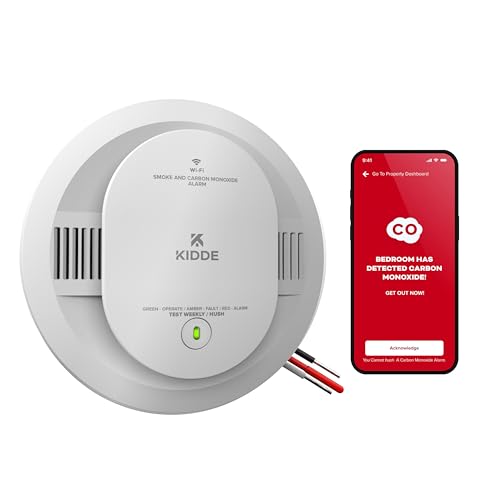
A 1.31 lb hardwired combo alarm with AA backup and app alerts, priced mid-range and pitched at existing 120V ceiling boxes.
Best for: homeowners with existing 120V wiring who want one smart hub alarm Skip it if: you want a fully battery-only install with no wiring
This is not a cordless unit and that is the point of including it. If you already have hardwired alarms in the ceiling, the 30CUAR-W is the way to add smart alerts without ripping the wiring out. Kidde's angle is that a single smart alarm on the circuit acts as the gateway: add one 30CUAR-W and every hardwired alarm in the home sends mobile alerts through the Kidde app. That is a cleaner upgrade path than replacing five ceiling units. The alarm covers smoke and CO, keeps an AA backup for outages, and adds a phone-side hush for false alarms triggered by cooking. At 5 x 2 x 5 in and 1.31 lb, the unit is close in footprint to the cordless Kidde but heavier because of the wiring harness. If you rent, or your ceiling boxes are not there, this pick is not for you. If you own and the wires exist, this is where the money is best spent.
Pros:
- Smart alerts extend to all hardwired alarms
- Combined smoke and CO sensing
- AA backup for power outages
- Phone-side hush for false alarms
- Released 2025, newest in this set aside from the winner
Cons:
- Requires 120V ceiling wiring to install
- No cordless install option
- Mid-range price with an install cost on top
What the word cordless actually means here
Cordless in this category means one thing: the alarm runs on internal batteries and does not need a 120V line dropped into the ceiling. It does not mean wireless in every sense. Every unit still uses radio to reach a phone or a hub, and interconnect between units is either wireless (Heiman, Nest-compatible SC5) or absent (single Kidde, budget First Alert).
Read the listings with that split in mind. A best cordless smart smoke detector is a battery-powered alarm with an app path. That is the useful definition. If a listing offers hardwired install as an option, as the Kidde 30CUAR-W does, it fails the cordless test even if the smart features are otherwise identical.
The reason it matters is install effort. A cordless unit goes up with two screws. A hardwired unit needs a ceiling box, a neutral, a load conductor and, in most jurisdictions, a permit if you are adding a new location. That is a very different Saturday.
Smoke-only or smoke plus CO: which do you need?
Three of the five listings cover both smoke and carbon monoxide. Two cover smoke only. The split matters because CO comes from combustion appliances: gas furnaces, gas water heaters, gas ranges, wood stoves, attached garages with running vehicles. A house with none of those needs a smoke-only alarm and can save the money.
- All-electric home, no attached garage: smoke-only is enough. The Heiman kit or the budget First Alert covers it.
- Any gas appliance, or a wood stove: buy a combo. The Kidde RGCUDR-RW is the cleanest cordless answer.
- Attached garage regardless of fuel: buy a combo, and put one CO-capable alarm within earshot of the sleeping area.
The one trap to avoid is buying a smoke-only Heiman kit and assuming the wireless mesh handles CO too. It does not. CO needs its own sensor in every unit that claims to detect it, and Heiman's listing does not claim it.
How the app tie-ins compare
Four of the five picks are smart, and each takes a different route to your phone. That route is the second-biggest decision after cordless-or-not, because it dictates whether your alarm will still talk to you in five years.
- Ring app, no subscription required for alerts — Kidde RGCUDR-RW. Optional paid plan adds 24/7 monitoring.
- Kidde app via one smart alarm acting as a bridge — Kidde 30CUAR-W. Requires hardwired install.
- Nest Protect mesh — First Alert SC5. Depends on you having Nest Protect already.
- Heiman gateway — Heiman S1-R. Self-contained, ships in the box.
Any of these can be discontinued by the manufacturer. The Ring and Nest paths ride on the largest ecosystems and are the safer long-term bets. Heiman's gateway is bundled, so you are not depending on a third party at all, which cuts a different way: nobody else can turn it off.
What the listings do not tell you
Three things worth knowing that no product page here calls out.
- UL certification is not universal in this set. Only Heiman explicitly cites UL 217 10th Edition. The others may still be certified, but the listings do not say so. If certification matters to your insurer, ask before buying.
- Battery-life claims are manufacturer figures. Heiman's 10-year figure and Kidde's 25% speed advantage both come from internal testing, not independent labs. Weight them accordingly.
- A smart alarm is only as reliable as its cloud. If the manufacturer's server goes down, the alarm still sounds locally, but the app alerts do not fire. Keep at least one hardwired or interconnected local alarm in play regardless of what the app promises.
The verdict
The best cordless smart smoke detector for most homes is the Kidde Smart Smoke & CO Detector with Ring, the RGCUDR-RW. It is the only battery-only pick in this set that covers both smoke and carbon monoxide, publishes a 10-year limited warranty, and pushes app alerts without asking for a monthly fee. It installs with two screws and two AA cells. That is what a cordless smart alarm should be.
The cutoff is house size. If you have one or two floors and a single sleeping level, the Kidde is the right single-alarm pick, and adding a second on the other floor solves the coverage gap. If you have three floors, multiple sleeping levels, or a layout where a bedroom alarm cannot be heard from the kitchen, the Heiman S1-R is the better buy. Six interconnected detectors and a gateway in one box is a whole different kind of coverage, and no combination of Kidde units matches it without hardwiring.
The First Alert SC5 wins only if you already own a Nest Protect. The 30CUAR-W wins only if you already own 120V ceiling wiring. The budget SMI100 wins only for secondary rooms.
FAQ
Is a cordless smart smoke detector worth it over a hardwired one?
A cordless smart smoke detector is worth it when you rent, when your ceiling has no wiring box, or when you want an alarm in a spot the electrician never planned for. The Kidde RGCUDR-RW installs on two AA batteries and pushes Ring app alerts with no subscription. If you already own hardwired alarms, the Kidde 30CUAR-W is the cheaper upgrade path.
What is the difference between the Kidde RGCUDR-RW and the Heiman S1-R kit?
The difference between the Kidde and the Heiman comes down to coverage and sensing. Kidde ships one 5 x 2 x 5 in unit that detects smoke and carbon monoxide and talks to the Ring app. Heiman ships six wireless interconnected detectors plus a gateway, but the detectors sense smoke only, no CO. Choose Kidde for a single sleeping level, Heiman for a full multi-storey house.
Does the Kidde Ring detector need a paid subscription to send alerts?
The Kidde Ring detector does not need a paid subscription to send smoke, CO or low-battery alerts to the Ring app. Kidde's listing states that basic notifications work without a plan. The optional Ring plan adds 24/7 professional monitoring for a flat monthly fee. If you only want phone alerts, the free path covers it, and you can skip the plan entirely.
Can a cordless smart smoke detector really last 10 years on one battery?
Can a cordless smart smoke detector last that long? Heiman's S1-R listing claims a 10-year battery life for its wireless detectors, eliminating annual battery swaps for the life of the alarm. Treat that figure as the manufacturer's spec, not an independent lab result. The Kidde RGCUDR-RW uses two replaceable AA cells instead, which is a more conservative design and easier to service.
Do I need carbon monoxide detection or just smoke?
You need carbon monoxide detection if you have any gas appliance, a wood stove, or an attached garage where a vehicle idles. All-electric homes with detached garages can run smoke-only alarms. The Kidde RGCUDR-RW, First Alert SC5 and Kidde 30CUAR-W all cover both. The Heiman S1-R and First Alert SMI100 cover smoke only, so pair them with a separate CO alarm.
Pick the Kidde RGCUDR-RW, put one in the hallway outside the bedrooms, add a second on any other floor, and you have a working smart alarm layout in an afternoon. That is the shortest path from an empty ceiling to a phone that will wake you before the fire does. The reason it wins is boring and important: it is the only cordless unit in this shortlist that covers smoke and CO, publishes a warranty, and skips the subscription tax on basic alerts. Every other pick is a specialist. This one is the default.
Last updated: September 7, 2026. Product availability re-checked.
This page contains affiliate links. As an Amazon Associate we earn from qualifying purchases, at no extra cost to you.