Best Lightweight Fire Extinguisher for DIY Enthusiasts
A workshop fire moves faster than you can find your phone. Seven picks compared on weight, rating and reach, with the First Alert HOME1 leading on warranty and grip.
The best lightweight fire extinguisher for DIY enthusiasts is the Kidde Basic 110 FA110G, a 1-A:10-B:C aluminium unit that ships as a 2-pack at 7.5 lb per canister with a 6-year warranty. If you only need one bottle and want the longest warranty in this set, the First Alert HOME1 at 4.5 lb with a 10-year limited warranty is the better single-can buy. Both are UL-rated multipurpose extinguishers built for the mixed hazards of a home workshop.
Best lightweight fire extinguisher for DIY enthusiasts at a glance
| Pick | Weight | UL rating | Price |
|---|---|---|---|
| Best overall Kidde Basic 110 FA110G |
7.5 lb | 1-A:10-B:C | Check Price |
| Best for beginners First Alert HOME1 FE1A10GR |
4.5 lb | 1-A:10-B:C (claim) | Check Price |
| Best premium Jasvelly 5 lb ABC Dry Chemical |
5 lb charge | 2A:10B:C (claim) | Check Price |
| Best for heavy use Joyfast 5 lb ABC with Wall Mount |
9 lb | 2A:10B:C (claim) | Check Price |
| Best for families Ougist 620 ml Spray, 2-pack |
4 lb (pair) | Water-based aerosol | Check Price |
| Most versatile Jasvelly Water-Based A/B/C/K |
1.37 lb (claim) | A/B/C/K (claim) | Check Price |
| Best budget pick First Alert EZ Fire Spray AF400 |
Aerosol can | 32-second discharge (claim) | Check Price |
How I narrowed seven listings to a working shortlist
A workshop is not a kitchen. Sawdust, solvent-soaked rags, a battery charger left running, an angle grinder throwing sparks near a paint tin: the risks stack up in ways a single small aerosol cannot answer. So I started by cutting listings that only claimed suitability for a specific room, and kept the ones rated for the mixed hazards a DIY bench actually produces.
Three disqualifiers ran the cut. First, no clear indication of the fire classes covered. A workshop needs Class A for wood and paper, Class B for flammable liquids and Class C for energised electrical equipment. Second, no way to check whether the canister was charged. A pressure gauge or an equivalent indicator is the difference between a device you trust and a paperweight. Third, size and weight that ruled out one-handed use from a shelf. Anything a smaller adult could not lift and aim comfortably came off the list.
What survived splits into three camps: two traditional dry chemical cylinders with UL-style ratings, one heavier 5 lb dry chemical unit with a wall bracket, two water-based aerosol sprays and two multipurpose water-based cans. Every product in this roundup targets the "grab it off the pegboard" use case, not the fixed-installation, commercial-code role that a 10 lb cabinet-mounted extinguisher fills.
A note on the "lightweight" qualifier. The listings in this set report weights from a claimed 1.37 lb up to 9 lb, and not every canister here is what a professional installer would call lightweight. I have flagged the true featherweights and the heavier picks in the sections below so you can match the choice to your reach and grip, rather than trusting the keyword alone.
What actually decides a workshop-friendly extinguisher
Most guides to a lightweight fire extinguisher for DIY enthusiasts lead with weight. Weight matters, but it is not the deciding number. The deciding number is the UL rating, which tells you how big a fire the device can actually stop and which types of fuel it works on.
A 1-A:10-B:C rating, which the Kidde Basic 110 and First Alert HOME1 both carry, means the extinguisher has been tested against a Class A fire equivalent to 1 unit of wood cribbing and a Class B fire equivalent to 10 square feet of flammable liquid, with the C indicating it is safe on live electrical equipment. A 2A:10B:C claim, like the two 5 lb dry chemical picks here, doubles the tested Class A capacity. An aerosol spray or a water-based mini extinguisher may list the same fire classes, but the numerical rating is either absent or manufacturer-stated rather than UL-certified.
That is the trap. A 1.37 lb can that claims A, B, C and K coverage is not equivalent to a 4.5 lb UL 1-A:10-B:C cylinder, however similar the label reads. The lightweight can is a first-strike device. The rated cylinder is what puts out the fire.
For a DIY bench, the practical answer is usually both: a rated cylinder mounted where you can reach it in three seconds, and a small can somewhere else in the room as a backup or for the tight corner the cylinder cannot cover. Read the fire class letters, read the numbers in front of them, and treat any listing that skips the numbers as a supplement rather than a primary tool.
1. Kidde Basic 110 FA110G — Best overall
A UL 1-A:10-B:C aluminium cylinder sold as a matched pair, which is exactly how a home workshop should be covered.

Best for: a two-storey home where one unit sits in the shop and one in the kitchen Skip it if: you only need a single canister and hate paying for a pair
The Kidde FA110G is the pick that solves the real problem, which is that one extinguisher in one room is not enough coverage. Buying a 2-pack at 7.5 lb per canister means you can put one at the workbench and one near the door, or split them between the garage and the utility room. Kidde specifies the 1-A:10-B:C UL rating for solids, flammable liquids and live electrical equipment, and the all-metal construction is what you want in a device that lives on a wall bracket for years between uses.
The listing calls out an easy-pull safety pin and a pressure indicator with a green zone that tells you at a glance whether the canister is charged. Kidde publishes a 6-year warranty here, longer than most in this set. The trade-off is price position: this is the second-most-expensive listing in the group, and the 7.5 lb per bottle puts it heavier than the single-cylinder First Alert. What you buy is redundancy in metal, from a brand whose fire safety catalogue is deep.
Pros:
- Two matched cylinders in one purchase
- UL 1-A:10-B:C rated for mixed workshop hazards
- All-metal aluminium body with easy-read pressure indicator
- 6-year warranty stated on the listing
- Rated for Class C live electrical fires
Cons:
- Sits in the premium price band of this set
- Heavier than the 4.5 lb single-cylinder alternative
- Not rechargeable per the listing wording
2. First Alert HOME1 FE1A10GR — Best for beginners
The lightest UL-style rated metal cylinder in this group and the one with the longest published warranty.
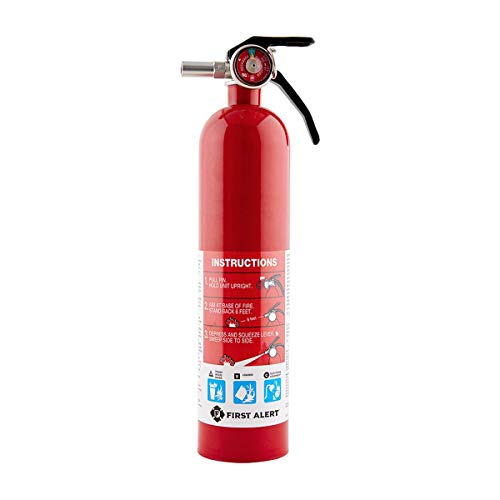
Best for: a first-time buyer who wants a rechargeable metal unit with a long warranty Skip it if: you want a two-pack out of the box
If you are new to owning an extinguisher, the HOME1 is the easiest recommendation. It weighs 4.5 lb, measures 15 x 4.25 x 4 in and, according to First Alert, is UL-rated 1-A:10-B:C for wood, paper, trash, plastics, gasoline, oil and electrical-equipment fires. The listing states the unit is rechargeable by a certified professional after use, which changes the maths: instead of buying a new canister after every discharge or expiry, you refill.
First Alert publishes a 10-year limited warranty here, the longest in the set, and calls out a metal pull pin with a safety seal to prevent accidental discharge. The construction is described as durable all-metal with a commercial-grade metal valve and trigger. First Alert also notes U.S. Coast Guard approval for marine use, which is a useful proxy for build quality even if you never take it near water.
The trade-off against the Kidde is coverage rather than quality. You get one cylinder, not two, and 4.5 lb of unit means slightly less agent on board. For a small workshop or a single-room use case, that is a fair deal for the longer warranty.
Pros:
- 4.5 lb, the lightest metal cylinder here
- 10-year limited warranty from First Alert
- Rechargeable by a certified professional
- Metal pull pin with tamper seal
- USCG-approved per the listing
Cons:
- Ships as a single unit, not a pair
- Priced in the entry band but only marginally cheaper than the Kidde 2-pack per canister
- Recharging requires finding a certified service
3. Jasvelly 5 lb ABC Dry Chemical — Best premium
A 5 lb dry chemical charge with a claimed 2A:10B:C rating and a quick-release handle.
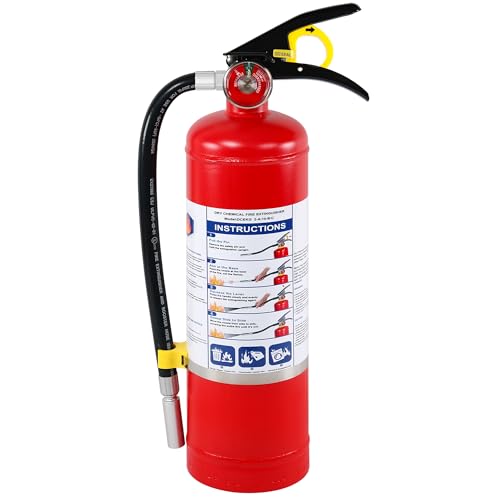
Best for: a heavier-duty pick when a 5 lb dry chemical charge matters more than portability Skip it if: you need something a smaller person can grab off a shelf one-handed
The Jasvelly ABC Dry Chemical is the most expensive pick here, and what you buy is a bigger charge and a claimed 2A:10B:C rating. Jasvelly describes coverage for Class A wood and paper, Class B grease and gasoline and Class C electrical fires. The listing calls out a quick-release handle for one-handed activation and a compact form intended to slip under a kitchen sink or into a car trunk.
For a DIY bench where the biggest fire risks are flammable liquids and energised equipment, doubling the Class A rating from 1A to 2A gives you a wider working margin against a fire that is still small enough to fight. The trade-off is straightforward: this is the top price position in the set, weight is higher than the true lightweights, and the brand does not carry the depth of catalogue that Kidde or First Alert do. Jasvelly does not publish a warranty figure on this listing, which is a real gap when both established brands here quote multi-year cover.
Pros:
- 5 lb dry chemical charge, larger than the First Alert HOME1
- Claimed 2A:10B:C rating covering solids, liquids and electrical
- Quick-release handle described for one-handed operation
- Compact enough to mount under a bench
Cons:
- Highest price position in this set
- No warranty figure on the listing
- Sells more slowly than the First Alert and Kidde picks
- Ships as a single unit only
4. Joyfast 5 lb ABC Dry Chemical with Wall Mount — Best for heavy use
A 9 lb wall-mounted dry chemical unit for the workshop that needs commercial-style coverage.

Best for: a garage or detached workshop that wants a wall-mounted 5 lb dry chemical unit Skip it if: you want the lightest thing that will still stop a real fire
The Joyfast is the heaviest listing in this set at 9 lb, and it is the only one that ships with a heavy-duty wall bracket in the same box. That combination matters when the extinguisher lives in a detached garage or a basement shop, because a bracket is what stops the cylinder ending up behind a stack of lumber a month after you unpack it. Joyfast lists a claimed 2A:10B:C rating and describes a discharge range of up to 15 feet, which lets you keep back from a burning solvent tray while still hitting the base of the flame.
The listing also cites a working temperature range of -22°F to 140°F, useful if your shop is unheated in winter or bakes in summer. Joyfast publishes a 6-year warranty and describes an all-metal build. It sells more slowly than any other pick here, and the brand is less familiar than Kidde or First Alert, so you are trusting the listing's specifications rather than a long track record. If the fire risk in your space is real and mixed, the extra weight buys you the biggest tested Class A capacity in the group and the only bracket included as standard.
Pros:
- Wall bracket included and described as heavy-duty
- Claimed 2A:10B:C rating with up to 15 ft discharge
- Working range of -22°F to 140°F per the listing
- 6-year warranty stated
Cons:
- Heaviest pick at 9 lb, not truly lightweight
- Slowest seller of the seven
- Premium price position
- Brand less established than Kidde or First Alert
5. Ougist 620 ml Fire Extinguisher Spray — Best for families
A matched pair of water-based aerosol cans for the kitchen and the car.

Best for: a household that wants two matching cans, one for the car and one for the kitchen Skip it if: you want a UL-rated metal cylinder
The Ougist is the pick to pair with a bigger extinguisher, not to replace one. Two 620 ml cans arrive together, each roughly 11.7 in tall and 3.3 in wide, and Ougist describes the formula as non-toxic, biodegradable and water-based, with a maximum spray distance of 13 feet. The cans are small enough to sit in a car door pocket, on a kitchen shelf or in a tool tote, which is the case a family typically forgets to plan for.
The listing emphasises anti-reignition and residue-free cleanup, both real advantages when the fire is a stovetop flare-up or a small electrical incident and you would rather not repaint the cabinets. What Ougist does not publish is a UL fire-class rating with numbers in front of the letters, which is why this belongs in the "backup" tier of a workshop plan rather than the primary one. The warranty description on the listing is a manufacturer-and-seller combination with no fixed year figure, which is a weaker guarantee than either First Alert brand carries.
Pros:
- Ships as two matching cans
- Water-based, non-toxic formula per the listing
- Compact 11.7 in height fits in a car door
- Anti-reignition claim and residue-free wipe
Cons:
- No UL rating with tested numbers on the listing
- Warranty terms are vague
- Not a primary extinguisher for larger fires
- Aerosol format has a finite shelf life
6. Jasvelly Water-Based A/B/C/K — Most versatile
A 1.37 lb water-based can that claims coverage across four fire classes.

Best for: a mixed-use spot where grease, electrical and solid-fuel risks all sit near each other Skip it if: you want a proven brand with a long warranty
At a claimed 1.37 lb, the Jasvelly water-based extinguisher is the lightest listing in the set by a wide margin. Jasvelly describes a spray distance of up to 13 feet and coverage across Class A solids, Class B liquids, Class C electrical and Class K cooking oils, along with a stated ability to remain effective down to -4°F. That combination is unusual in a can this small, and it is why the Class K claim matters: most compact aerosols skip Class K entirely, which leaves a real gap over a hotplate or a deep pan.
The cleanup story is the other reason to consider it. Water-based agents wipe off surfaces where dry chemical powder leaves a residue you will still be scrubbing out of a tool chest six months later. That said, this listing has the highest price rank in the entry band and does not publish a warranty figure or a UL fire-class number. It sells more slowly than every other pick here. Treat it as a supplement to a rated cylinder, not a substitute.
Pros:
- Claimed 1.37 lb, lightest here
- Claimed coverage across A, B, C and K classes
- Low-temperature effectiveness down to -4°F per the listing
- Water-based, residue-light cleanup
Cons:
- No UL numerical rating on the listing
- No warranty figure stated
- Slowest seller among the entry-band picks
- Newer brand with a thinner catalogue
7. First Alert EZ Fire Spray AF400 — Best budget pick
The cheapest pick here and the one to keep in every place a real cylinder does not fit.
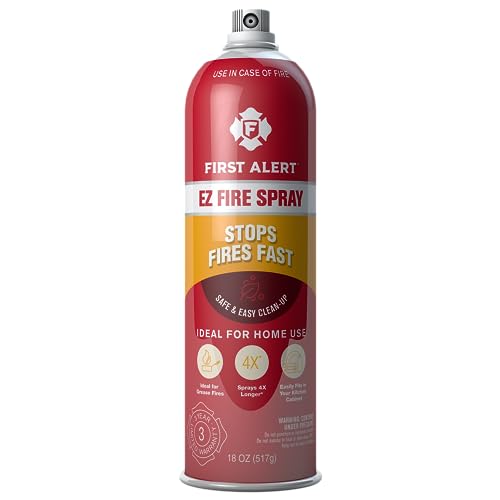
Best for: keeping a second line of defence in the glovebox, tool bag or under the workbench Skip it if: this is your only fire safety device in the house
The EZ Fire Spray is the cheapest of the seven and, at 9.37 x 2.6 x 2.6 in, small enough to live in places a 4.5 lb cylinder never will. First Alert claims 32 seconds of discharge, which the listing describes as four times longer than a traditional fire extinguisher, and covers paper, fabric, wood, grease and electrical fires. The formula is described as biodegradable, non-toxic and easy to wipe up, and First Alert publishes a 3-year limited warranty with an ETL rating.
The reason it is number seven rather than higher is scope. This is an aerosol can, not a rated cylinder, and it is the right tool for a small, contained ignition you catch in the first few seconds. For a workshop, the honest recommendation is to buy one of these plus a UL-rated cylinder, not to buy this alone. Kept in a car, a boat, a dorm room or a workbench drawer, it earns its place. First Alert's brand track record means the shelf-life expectations are clear, which is not true of every aerosol here.
Pros:
- Cheapest listing in the set
- 32-second discharge claim, longer than typical aerosols
- 3-year limited warranty with ETL rating
- Small enough for a glovebox or tool bag
Cons:
- Aerosol format, not a UL-rated cylinder
- No numerical fire-class rating
- Single can per purchase
- Best used as a backup rather than a primary tool
Dry chemical, water-based or aerosol: which suits a DIY bench?
The three chemistries in this roundup do different jobs, and the DIY case usually calls for more than one. Understand what each is really for before you buy.
- Dry chemical (Kidde FA110G, First Alert HOME1, Jasvelly 5 lb, Joyfast 5 lb). ABC dry chemical is the workshop default. It smothers Class A solids, Class B flammable liquids and Class C electrical fires, and the rated cylinders here carry tested fire-class numbers. The downside is the mess: the powder gets into every crevice of a tool chest and is hard to clean off electronics after use. Live with the cleanup, because the coverage is what stops a fire.
- Water-based cans (Ougist 2-pack, Jasvelly water-based). Water-based formulas wipe off surfaces and often claim non-toxic status. Both listings here describe biodegradable agents. They are good in a kitchen and reasonable at a bench, but the UL numerical ratings that dry chemical carries are missing from these listings, so treat them as supplementary.
- Aerosol (First Alert EZ Fire Spray). An aerosol is a first-strike device: quick to grab, easy to aim, and time-limited by the 32-second discharge First Alert claims. It handles a stovetop flare-up or a small solvent ignition. It is not a substitute for a rated cylinder.
The workshop-friendly combination for most readers is one dry chemical cylinder mounted where you work, plus one aerosol or water-based can somewhere the cylinder cannot reach.
How many extinguishers does a home workshop really need?
One is not enough. Two is usually the right answer for a single-storey home with a small shop. Three makes sense the moment you add a detached garage or a basement bench.
- The primary. A UL-rated ABC dry chemical cylinder, mounted on a wall bracket at the exit from your work area. Not behind the bench, because you need to be able to reach it without walking toward the fire.
- The backup. An aerosol or water-based can in the workshop itself, within one step of the bench. This is what you grab if the fire is small and you catch it early.
- The kitchen unit. A separate rated cylinder or two aerosol cans dedicated to the kitchen, because grease fires behave differently and the workshop bracket is often too far away in a real emergency.
The Kidde 2-pack solves items one and three in a single purchase, which is a large part of why it takes the top spot here. A First Alert HOME1 plus a First Alert EZ Fire Spray covers items one and two for a single workspace. For a fuller plan, add the Ougist 2-pack or one Jasvelly water-based can for the kitchen and the car.
Check the pressure gauge on any rated cylinder every month. Aerosol cans have a manufacturer-specified shelf life; write the purchase date on the base with a marker so you know when to replace.
What the listings do not tell you
Product listings on any marketplace are marketing copy, and there are gaps in the seven descriptions here that a careful buyer should fill before purchase.
- Refill and recharge. Only the First Alert HOME1 explicitly states it is rechargeable by a certified professional. The Kidde and both Jasvelly cylinders do not describe a recharge path on the listing. Treat any cylinder without a stated recharge option as a one-time-use device you replace after discharge or on expiry.
- Shelf life. None of these listings publishes a specific expiry date or refill interval. Rated cylinders typically carry an inspection tag or a manufacturer-stamped date; you will need to check the physical unit when it arrives.
- Mounting hardware. Only the Joyfast lists an included wall bracket. If you plan to hang the Kidde or First Alert, you will need to buy a bracket separately or use a shelf.
- Certification detail. UL 1-A:10-B:C is the standard the Kidde and First Alert HOME1 listings reference. The other cylinders here describe claimed 2A:10B:C ratings without naming the testing body. The distinction matters if you care about insurance or local code compliance.
Read the listing, then read the label on the unit when it arrives, and cross-check against your local fire code before you rely on it.
The verdict
For a DIY workshop, the Kidde Basic 110 FA110G is the winner because it solves the coverage problem, not just the single-unit problem. Two 7.5 lb UL 1-A:10-B:C aluminium cylinders in one box means you can put one at the bench and one at the kitchen or the door, which is the setup a home actually needs. Kidde's 6-year warranty and easy-read pressure indicator make routine checks straightforward.
If you only need one cylinder, or you specifically want a rechargeable unit with the longest published warranty in this set, the First Alert HOME1 FE1A10GR is the pick. At 4.5 lb it is the lightest rated metal cylinder here, First Alert publishes a 10-year limited warranty, and the listing describes recharge by a certified professional after use.
For anyone whose shop risks skew toward flammable liquids or an unheated detached garage, the Joyfast 5 lb ABC with wall mount is the more serious tool, at the cost of extra weight and a less familiar brand. And for everyone, whichever cylinder you choose, add the First Alert EZ Fire Spray or the Ougist 2-pack as a backup. One extinguisher in one room is not a plan.
FAQ
Is a lightweight fire extinguisher powerful enough for a workshop?
A lightweight fire extinguisher is powerful enough for a workshop only if the fire is caught early and the extinguisher carries a real UL fire-class rating. The First Alert HOME1 at 4.5 lb is UL 1-A:10-B:C per the listing, which covers wood, paper, gasoline, oil and electrical equipment. Aerosol cans and unrated water-based sprays should serve as backups, not primary tools.
What is the best lightweight fire extinguisher for DIY enthusiasts on a budget?
The best lightweight fire extinguisher for DIY enthusiasts on a budget depends on whether you want a rated cylinder or an aerosol. The First Alert EZ Fire Spray AF400 is the cheapest listing here, with a claimed 32-second discharge and a 3-year limited warranty. For a rated metal cylinder at an entry price, the First Alert HOME1 FE1A10GR is the stronger buy at 4.5 lb.
How does the Kidde FA110G compare with the First Alert HOME1?
The Kidde FA110G ships as a 2-pack at 7.5 lb per canister with a 6-year warranty and a UL 1-A:10-B:C rating, giving you two cylinders for whole-home coverage. The First Alert HOME1 is a single 4.5 lb cylinder with the same UL rating claim, a 10-year limited warranty and a rechargeable design. Choose Kidde for coverage across two rooms, First Alert for the longer warranty on one unit.
Is a water-based fire extinguisher worth it for a DIY bench?
A water-based fire extinguisher is worth it as a supplement, not a replacement. The Jasvelly water-based can claims A, B, C and K coverage at 1.37 lb, and the Ougist 620 ml pair is described as non-toxic and residue-light. Neither listing publishes a UL numerical rating, so keep one near the bench for quick response and rely on a rated dry chemical cylinder for anything larger.
What common mistake do first-time buyers make with fire extinguishers?
The common mistake first-time buyers make is buying one small can and calling the job done. A single aerosol will not stop a solvent fire that has taken hold, and one cylinder in the wrong room is worse than none. Buy a UL-rated cylinder mounted near the exit from your workshop, add an aerosol or water-based can within one step of the bench, and check the pressure gauge every month.
The right lightweight fire extinguisher for a DIY workshop is the one you can reach in three seconds, aim without thinking and trust to be charged. The Kidde Basic 110 FA110G wins because it solves the layout problem: two matched UL 1-A:10-B:C cylinders let you cover the bench and the kitchen from a single purchase, and the pressure indicator makes monthly checks a glance rather than a chore. Pair it with a First Alert EZ Fire Spray for the drawer or glovebox, mark the purchase date on the base of every can, and put the brackets on the wall the day the boxes arrive.
Last updated: September 7, 2026. Product availability re-checked.
This page contains affiliate links. As an Amazon Associate we earn from qualifying purchases, at no extra cost to you.