Best Carbon Monoxide Detector for Large Rooms by Spec
A single detector cannot cover a large room the way a speaker fills it. Here is how the five listings compare, and which one earns the default pick.
The best carbon monoxide detector for large rooms is the Kidde KN-COB-DP2, a plug-in unit with a 2-AA backup and an 85 dB alarm loud enough to carry across an open-plan space. If a free outlet is not where the detector belongs, the battery-only First Alert CO400 pack of 2 covers the same room from the ceiling instead. Neither is rated for square footage: coverage in a large room comes from where you mount it, not how big the sensor is.
Best carbon monoxide detector for large rooms at a glance
| Pick | Power | Alarm | Price |
|---|---|---|---|
| Best overall Kidde KN-COB-DP2 |
Plug-in + 2-AA backup | 85 dB | Check Price |
| Best budget pick First Alert CO605 |
Plug-in + battery backup | 85 dB | Check Price |
| Best minimal setup Kidde KN-COEG-3 |
Plug-in + 9V backup | 85 dB (CO + gas) | Check Price |
| Best premium TOPTES CT-580 |
Rechargeable, portable | Audible + vibrate | Check Price |
| Best for pros First Alert CO400 pack of 2 |
Battery only | 85 dB | Check Price |
How I cut a wider field down to five
I lined up every carbon monoxide detector in the input by the criteria that decide a large-room install, then weighted them.
- Alarm output. Every fixed alarm here is rated at 85 dB. That level is the UL benchmark, and it is what the manufacturers publish. Anything below it would have been cut.
- Power redundancy. A large room usually sits between two circuits. Plug-in units with battery backup ride out a breaker trip without going silent. That put three plug-in units on the list.
- Placement flexibility. Battery-only units go where outlets do not, which matters in older rooms with sparse wiring. That kept the First Alert CO400 in.
- A spot-check option. For garages, boat cabins and rented spaces, a portable meter reads what a fixed alarm cannot. The TOPTES CT-580 filled that slot.
What lost out: alarms with no battery backup at all, and combination smoke-plus-CO units where the CO sensor is a secondary feature rather than the point of the device. None of the surviving picks is advertised with a square-foot rating, because none of these devices carries one. That absence is the story of this category, and the next section is about why.
Why room size is the wrong question
Carbon monoxide detectors are not sold by coverage area the way smoke alarms often are. There is a reason. CO is close in density to air and mixes through a room within minutes, so a working detector anywhere in the room reads the same concentration as one on the far wall. What a large room actually changes is two things: how far the alarm has to carry, and how many corners the sound has to turn.
That is why 85 dB matters more than sensor sensitivity. Every fixed unit here hits that number, measured at 10 ft per the standard. In a 400 sq ft open-plan room with soft furnishings, that reading drops noticeably at the far wall, and drops further through a closed door. The fix is not a bigger detector. It is either a second unit or a placement that puts the alarm between the source and the sleeping area.
A large room is also more likely to contain the source: a fireplace, a gas range, an attached garage door. The best carbon monoxide detector for large rooms is the one you can mount close enough to catch a rising plume without sitting directly above the appliance, where drafts and heat throw off the reading.
1. Kidde KN-COB-DP2 — Best overall
The newest plug-in on this list, with dual-AA backup and the placement flexibility a large room usually needs.
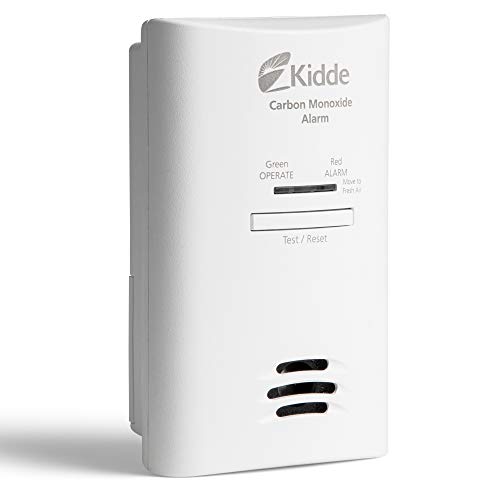
Best for: a large bedroom or living area near an outlet Skip it if: you have no free wall outlet where the detector belongs
At 4.72 x 2.32 x 2.83 in and 0.68 lb, the KN-COB-DP2 is the second-cheapest fixed alarm in this set and the newest, with a 2025 release. It plugs into a standard 120V outlet and Kidde says the 2-AA cells keep it live through a power cut. In a large room that draws heavily on one circuit, that redundancy is the difference between an alarm that sounds and one that does not.
The 85 dB siren is the same figure every fixed unit here publishes, so the deciding factors are elsewhere: peak level memory, which Kidde says records the last CO event, and a test-hush button for silencing false alarms without pulling the unit off the wall. LED status lights sit on the face, so a glance across the room confirms it is armed.
The trade-off is outlet dependence. If the wall you want it on has no socket at chest height, this is the wrong pick, and the CO400 further down is the answer. It is also the newest model in the set, which means less field history than the seven-year-old First Alert.
Pros:
- Newest release on the list, 2025
- Plug-in with 2-AA backup for outage cover
- 85 dB alarm and peak level memory
- Test-hush button for false triggers
- Compact 0.68 lb body
Cons:
- Requires a free wall outlet at the right height
- No published warranty term in the listing
- Only one seller lists it
2. First Alert CO605 — Best budget pick
The cheapest fixed alarm in the set and the one buyers here choose most often, with a published seven-year warranty behind it.
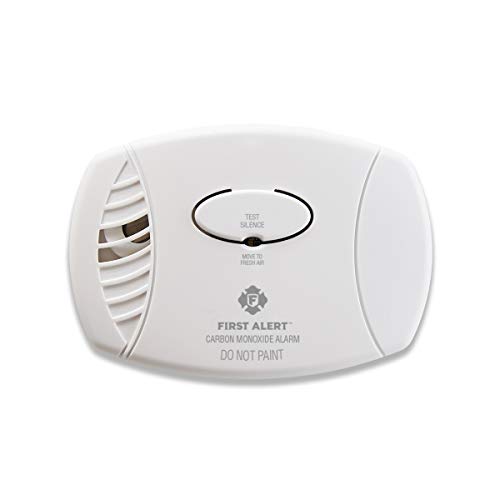
Best for: buyers fitting several rooms at once on a tight budget Skip it if: you want the newest sensor generation
The CO605 is the price leader here and also the strongest seller of the fixed alarms on offer, sitting well ahead of the two 2025 Kiddes in category rank. It measures 5 x 3.4 x 1.38 in and weighs 4.2 oz, so it barely projects from the wall, which matters in a large room where a sofa or headboard often sits against the outlet.
First Alert says the electrochemical sensor reads accurately regardless of where in the room the unit sits, and the 85 dB horn matches the rest of the set. The single test-and-silence button keeps operation simple: one press to check, one press to quiet a nuisance trigger. The published seven-year limited warranty is the longest term in this set and the only one long enough to cover a full sensor lifetime.
The catch is age. This model was released in 2007, and while the sensor technology has not fundamentally changed, the housing and electronics predate every other pick. If you want the newest platform, the Kidde is a small step up in price. If you are fitting a large room plus every bedroom on one level, the CO605's cost position wins.
Pros:
- Cheapest fixed alarm in this set
- Seven-year limited warranty, the longest here
- Slim 1.38 in depth clears furniture
- Sells faster than the rest of this set
- Single-button test and silence
Cons:
- Released in 2007, oldest platform here
- Backup battery type is not specified in the listing
- Only two sellers list it
3. Kidde KN-COEG-3 — Best minimal setup
A single plug-in that covers both carbon monoxide and explosive gas, so a large kitchen only needs one device on the wall.
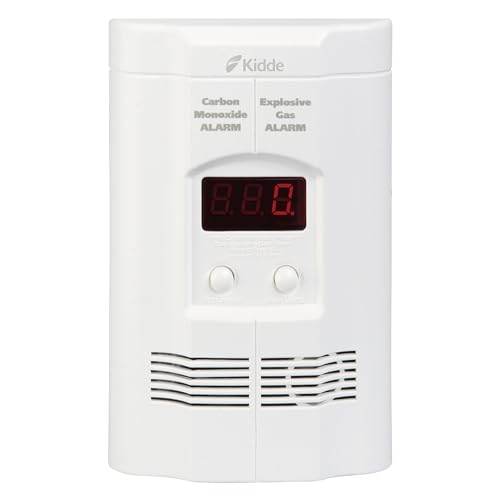
Best for: a large kitchen or utility room with a gas line Skip it if: you only need carbon monoxide coverage
The KN-COEG-3 is the most expensive pick here and the reason is a second sensor. Kidde says it detects both CO and explosive gas, meaning natural gas and propane, and the digital LED display shows either a CO concentration or the word "GAS" when a hydrocarbon leak is present. In a large kitchen with a gas range and possibly a nearby water heater, that combined coverage is the point.
At 6.1 x 2.48 x 3.82 in it is the tallest fixed unit in the set, which is worth checking against your outlet clearance. A 9V battery handles the backup role. The 85 dB horn is the same as the rest of the fixed picks. Peak level memory records the last event, so a returning homeowner can see whether the alarm tripped while they were out.
The trade-off is scope. If the room has no gas appliance and no shared wall with a garage, the gas sensor is idle capacity you paid for. For a bedroom or living room, the CO605 or the KN-COB-DP2 do the same CO job for less. In a kitchen, though, one device on one outlet replaces two, and that is the case for it.
Pros:
- Dual CO and explosive gas coverage
- Digital LED shows live CO level
- 9V battery backup
- Peak level memory
- 2025 release, newest combination unit here
Cons:
- The most expensive pick here
- Tallest fixed body at 6.1 in
- No published warranty term in the listing
- Gas sensor is wasted in a room without gas appliances
4. TOPTES CT-580 — Best premium
A rechargeable handheld that turns any room into a spot-check, useful where a fixed alarm cannot go.

Best for: trades, RV owners and anyone spot-checking rooms Skip it if: you want a fixed detector for a bedroom wall
The CT-580 is the outlier of the group, and deliberately so. It is a portable meter with a 0 to 1000 ppm range and a TFT colour display, aimed at people who need to know a reading rather than wait for an alarm. TOPTES says it uses a DDS sensor with a fast response and offers three alert modes: indicator light, audible tone and vibration. That vibration mode is the reason to consider it for anywhere loud, where an 85 dB horn might not carry through hearing protection or a running engine.
Because it is rechargeable, it goes where a wall outlet does not. In a large workshop, a boat cabin or a rental cabin with a wood stove, that portability is the whole case. Two sellers list it and it sells slower than the fixed alarms, which is expected: a handheld meter serves a narrower buyer.
The trade-off is that this is not a substitute for a fixed alarm on a bedroom wall. A portable that sits on a workbench will not wake a sleeping family at 3 am. For most homes, this is a second device rather than the first, and it earns the premium slot because it fills a gap the others physically cannot.
Pros:
- Portable and rechargeable, goes anywhere
- Three alert modes including vibration
- 0 to 1000 ppm live reading
- Colour display for numeric checks
- Works out of the box for spot inspections
Cons:
- Not a fixed alarm for sleeping areas
- Fewer published specifications than the fixed picks
- Slowest seller in this set
- No stated warranty term
5. First Alert CO400 pack of 2 — Best for pros
Battery-only pair that mounts anywhere on the wall, ideal for a large room with no outlet where the detector belongs.
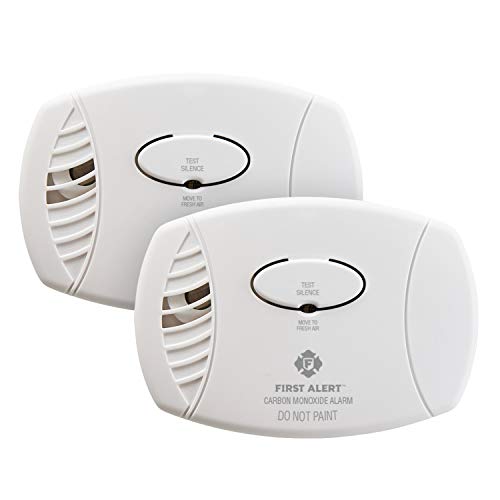
Best for: large rooms without a convenient wall outlet Skip it if: you dislike swapping batteries on a schedule
The CO400 comes as a pack of 2, weighs 0.8 lb per unit, and runs on batteries alone. First Alert says the same electrochemical sensor sits inside as the CO605, and the alarm rings at 85 dB. What changes is placement freedom. With no cord and no plug, this mounts high on a wall or on a ceiling near an appliance, which is where a large room's alarm should sit when the nearest outlet is 15 ft away at knee height.
The pack format is the second reason for its slot here. Large homes rarely need one detector. First Alert recommends one on every level and in every bedroom, so a pair covers a great room and an adjoining hallway with one purchase. The five-year limited warranty is shorter than the CO605's seven, but longer than the two Kiddes list.
The trade-off is upkeep. A battery-only alarm depends on you replacing the cells on schedule, and the end-of-life chirp will start after several years whether the batteries are fresh or not. Plug-in owners get outage protection almost as a bonus. Battery owners have to think about it.
Pros:
- Two units in the pack
- Battery-only mounting anywhere on a wall or ceiling
- Five-year limited warranty
- End-of-life chirp built in
- Same 85 dB alarm as the plug-in picks
Cons:
- Requires scheduled battery changes
- Bulkier body at 4 x 9 x 6 in
- Two sellers only
Plug-in, battery or portable: which suits a large room?
The three power types are not interchangeable, and the size of the room amplifies the differences.
- Plug-in with battery backup. The default for a bedroom or living room. It sits at outlet height, roughly 12 to 18 in off the floor, which is fine for CO because the gas mixes evenly. The backup handles outages. Choose this unless the wall you want has no socket.
- Battery only. The answer when placement wins over convenience. High mounting on a wall near a fireplace or gas appliance, or on a ceiling in an open-plan great room where no outlet is close. The pack of 2 also splits neatly between two rooms.
- Portable rechargeable. Not a replacement for either of the above. This is a diagnostic tool for garages, workshops, RVs and rooms you visit rather than sleep in. In a large room, use it to walk-test a fixed alarm's placement by taking a reading at different points.
The mistake to avoid is assuming a portable's numeric display beats a fixed alarm's simple horn. It does not, because you have to be holding it and looking at it. A fixed alarm wakes you.
What the listings do not tell you about coverage
Four things the product pages will not spell out, and all of them matter more in a large room than a small one:
- Ceiling height changes the read. CO mixes evenly at steady state, but a plume from a fireplace or a running car in an attached garage stratifies briefly. A high ceiling gives the plume room to rise and dilute before it reaches an outlet-height detector.
- Airflow direction matters near HVAC returns. A detector placed within a few feet of a return grille reads the whole house average, which sounds ideal until you realise it also delays the alarm during a local event.
- Interior walls block sound more than they block gas. A closed bedroom door drops an 85 dB alarm noticeably. A large room with a sleeping alcove behind a partition needs the detector on the alcove side, or a second unit inside it.
- End-of-life chirps come from the unit, not the sensor. CO sensors have a fixed lifespan, generally around seven to ten years depending on the manufacturer. The chirp fires on a clock, not because the sensor failed a test. Two of these picks publish a warranty; three do not.
How many detectors does one large room actually need?
First Alert's own guidance, which appears in both its listings here, is one detector on each level of the home and one in each bedroom. That does not scale with room size, but it does scale with function. A great room that combines kitchen, dining and living into a single 500 to 800 sq ft footprint is doing the work of three rooms and should carry two detectors: one near the gas appliances and one near the seating area, ideally 15 to 20 ft apart.
The best carbon monoxide detector for large rooms in that setup is a plug-in for the seating end, where an outlet is usually available, and a battery unit near the range hood or fireplace, where cables would look wrong. A single unit on one wall of a large room will still detect CO, but the alarm's audibility drops sharply across the space, and that is what the second device fixes.
The verdict
The Kidde KN-COB-DP2 is the best carbon monoxide detector for large rooms as a single-purchase default. It is the newest fixed unit in the set, its 2-AA backup covers outages that a battery-only alarm does not, and its 85 dB horn matches every other fixed pick here. Pair it with the First Alert CO400 pack of 2 if the room is genuinely large, above roughly 400 sq ft, or if there is no outlet near the appliance that concerns you.
Two conditions flip the recommendation. If the room contains a gas range, a gas water heater or an attached garage door, the Kidde KN-COEG-3 replaces both a CO alarm and a gas leak alarm with one plug-in device, and the price premium starts to make sense. If cost is the deciding factor and you need to fit several rooms at once, the First Alert CO605 is the cheapest fixed alarm here, sells faster than the rest, and carries the only seven-year warranty in the set. The TOPTES CT-580 is not a substitute for any of them: it is the second device that lets you check readings in places where a fixed alarm cannot go.
FAQ
Does a large room need more than one carbon monoxide detector?
More than one detector is often the right answer for a large room, but not because CO fails to mix. It mixes fine. The reason is that an 85 dB alarm loses audibility across 500 sq ft, especially through soft furnishings and partition walls. Two units placed 15 to 20 ft apart, one near appliances and one near seating, solve the audibility problem without changing the sensing story.
Is the best carbon monoxide detector for large rooms plug-in or battery?
The best carbon monoxide detector for large rooms is a plug-in with battery backup when an outlet sits where the alarm belongs, and battery-only when it does not. Plug-in units like the Kidde KN-COB-DP2 handle power outages through their AA cells. Battery units like the First Alert CO400 mount anywhere on a wall or ceiling, which matters when the appliance you want to monitor is far from wiring.
Is a portable CO meter worth it alongside a fixed alarm?
A portable meter is worth it if you have places a fixed alarm cannot cover: a workshop, an RV, a boat cabin, a rented room. The TOPTES CT-580 gives a live parts-per-million reading and a vibration alert that carries where an 85 dB horn cannot. It is not a substitute for a wall-mounted alarm in a bedroom, because you are not holding it while you sleep.
How does the Kidde KN-COB-DP2 compare to the First Alert CO605?
Compare the Kidde KN-COB-DP2 to the First Alert CO605 and two things separate them. The Kidde is newer, released in 2025, and uses a 2-AA backup Kidde publishes clearly. The First Alert is older, released in 2007, but carries a seven-year limited warranty and sits at the lowest price position in this set. Both ring at 85 dB. Choose the Kidde for the newer platform, the First Alert for cost.
Where should a carbon monoxide detector go in a large open-plan room?
A carbon monoxide detector in a large open-plan room should sit between the likely source and the sleeping or seating area, at outlet height for plug-in units or high on a wall for battery units. Keep it at least 15 ft from cooking appliances to avoid nuisance alarms and away from HVAC return grilles, which pull room-average readings and can slow the response to a local plume.
CO is invisible and the alarm is your only warning, so the single decision that matters is not which brand you buy but where you put it, and how many you put up. Start with a plug-in Kidde KN-COB-DP2 in the room where you spend the most waking hours, add a battery First Alert CO400 near any fuel-burning appliance, and keep a TOPTES CT-580 in the toolbox if you own a garage, an RV or a boat. That layered approach beats any single device shopping for the best carbon monoxide detector for large rooms, because a large room is really several risks in one footprint.
Last updated: September 7, 2026. Product availability re-checked.
This page contains affiliate links. As an Amazon Associate we earn from qualifying purchases, at no extra cost to you.