Best Variable Speed Drills: AVID POWER Leads
A ranked look at six variable speed drills, corded and cordless, judged on published RPM ranges, clutch settings, chuck size and weight rather than marketing copy.
The best variable speed cordless drill is the AVID POWER 20V Cordless Drill Set, because its 0-550 RPM trigger and 15+1 clutch settings give you fine control at 3.65 lb. If you already own 20V DEWALT batteries or want a two-range gearbox that reaches 1,500 rpm, the DEWALT DCD771C2 is the better buy. Most shoppers compare peak RPM and stop there. That number decides almost nothing about screw driving, and it is the reason so many first drills strip heads and snap bits within a month.
Best variable speed cordless drill at a glance
| Pick | Speed range | Chuck & clutch | Price |
|---|---|---|---|
| Best overall AVID POWER 20V Cordless Drill Set |
0-550 RPM claim | 3/8" keyless 15+1 clutch |
Check Price |
| Best premium DEWALT 20V Max Cordless Drill Driver Set |
0-450 & 1,500 rpm claim | 1/2" ratcheting 2-speed gearbox |
Check Price |
| Best budget pick COMOWARE Cordless Drill |
2 speed ranges claimed | 3/8" keyless metal 25+1 clutch |
Check Price |
| Best for heavy use Hammerhead 7.5-Amp Hammer Drill |
Variable trigger, preset selector | 1/2" keyless metal no clutch |
Check Price |
| Best for beginners DEWALT Drill, 8.0-Amp Corded |
0-2,500 rpm claim | 3/8" all-metal ratcheting no clutch |
Check Price |
| Runner-up Genesis 4.2 Amp Corded Drill |
0-3,000 RPM claim | 3/8" keyless no clutch |
Check Price |
How I screened this field, and what the criteria were
I weighted four things, in this order.
- Published speed control. A stated RPM range or a stated number of speed settings. Vague "variable speed" wording with no figure attached scored nothing.
- Clutch settings. The number of torque positions, because that is what stops a screw sinking through a cabinet back.
- Chuck size and type. 3/8-inch versus 1/2-inch, keyless versus ratcheting, metal versus not.
- Weight and published dimensions. Overhead work and one-handed work punish every extra ounce.
Those weights come from how a drill fails. Nobody returns a drill because it topped out at 2,500 rpm instead of 3,000. People return drills because the head of the screw is mangled, because the bit walked off the mark, or because their wrist gave out before the deck did.
Worth saying plainly: the keyword asks for a cordless tool, and Amazon's own results for it mix corded and cordless. Three of the six here run on a cord. I have not pretended otherwise, and I have not claimed a cord-fed drill is cordless. Each pick's section says which it is, and the section further down on corded versus cordless tells you which side you belong on. If a battery is non-negotiable for you, your shortlist is three tools long: AVID POWER, DEWALT DCD771C2 and COMOWARE.
What does variable speed actually control?
Variable speed is the trigger, not the motor's top number. Squeeze a little and the chuck turns slowly. Squeeze fully and it runs at whatever the tool's ceiling is. That slow end is the part that matters.
Here is why. Starting a screw at low speed lets the tip bite instead of skating. Starting a hole at low speed keeps a twist bit from wandering across the grain. Everything difficult happens in the first second, at low RPM, and that is a skill the trigger hands you rather than a spec sheet.
The best variable speed cordless drill for delicate work is therefore the one with a usable low range and a clutch to back it up. The AVID POWER lists 0-550 RPM. That looks slow next to the Genesis at 0-3,000 RPM. In practice the AVID POWER's whole range sits in the part of the dial where screws live, and the clutch stops the motor when the preset torque is reached.
- A clutch protects the screw head and the workpiece.
- A two-speed gearbox gives you low torque and high drilling speed.
- A high single-speed ceiling suits drilling, not driving.
- A lock-on button suits long continuous cuts, never fastening.
1. AVID POWER 20V Cordless Drill Set for Home DIY & Beginner — Best overall
The most complete first drill here: 15+1 clutch settings, a 0-550 RPM trigger, 22 bits and only 3.65 lb of kit to carry.

Best for: furniture assembly and light household drilling Skip it if: you need to drill masonry or bore large holes
This is the only pick in the set that pairs a battery, a published clutch count and a bit assortment in one box. AVID POWER lists 15+1 torque settings and 280 in-lbs, with the trigger covering 0-550 RPM. The chuck is 3/8-inch keyless. The listing puts the whole kit at 3.65 lb across 9.65 x 8.66 x 3.15 in, and describes the bare tool as a 2.5 lb build with a rubberised grip.
The accessory count is what separates it inside this group. AVID POWER says the 22 pieces include 10 drill bits, 10 driver bits, a flexible shaft and an extension bar. The flexible shaft is the piece that earns its keep, because it reaches the screw behind the drawer slide that the drill body cannot line up on. The battery pack is listed with a real-time charge display, so you find out you are low before the driver stalls mid-screw.
It also sells faster than every other cordless pick here, which tells you the DIY audience keeps landing on it. The trade-off is ceiling. Where the DEWALT DCD771C2 shifts up to a claimed 1,500 rpm and grips a 1/2-inch bit, this one stays at 550 RPM on a 3/8-inch chuck. For wide spade bits or long augers, that is the wrong tool.
Pros:
- 15+1 clutch settings, the second-highest count here
- 22 bits, flexible shaft and extension bar included
- Lightest cordless kit in this set at 3.65 lb
- Battery charge display listed on the pack
- 3/8" keyless chuck for fast bit swaps
Cons:
- 0-550 RPM ceiling is the lowest published figure here
- 3/8" chuck rules out larger shank bits
- No warranty stated on the listing
- Only one seller lists it
2. DEWALT 20V Max Cordless Drill Driver Set — Best premium
A two-range gearbox, a 1/2-inch ratcheting chuck and a 3 year limited warranty make this the most capable cordless tool in the group.
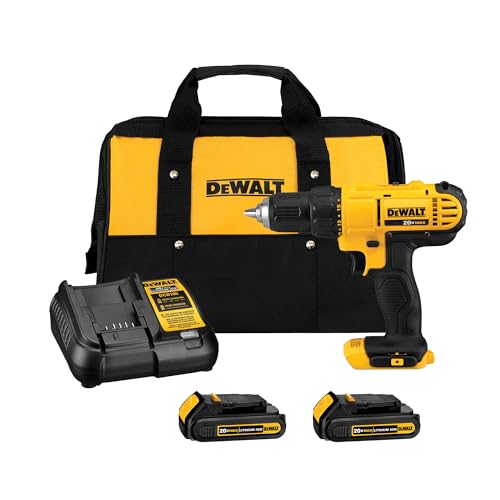
Best for: someone building a 20V battery platform Skip it if: you want bits included in the box
The gearbox is the reason to buy this one. DEWALT lists two speeds, 0-450 and 1,500 rpm, which means you get a genuinely slow driving range and a fast drilling range from the same trigger. Every other cordless pick here asks the trigger to do both jobs across one span. The chuck is listed at 1/2-inch single sleeve ratcheting, the widest opening in this set, and DEWALT claims 300 unit watts out from the motor.
It ships with two 1.3Ah XR batteries, a charger and a contractor bag. Two packs matter more than raw capacity for a weekend job, because one charges while the other works. The listed weight is 3.64 lb, marginally under the AVID POWER kit, across 4.25 x 13.9 x 9.88 in. It carries a 3 year limited warranty, the longest published here.
DEWALT is also unusually direct about limits in its own copy: suitable for home repairs, DIY, light construction, wood, plastic and light metal, not suitable for concrete or masonry or heavy industrial use. Take that at face value. This is the most expensive pick here and it arrives without a single drill bit, so budget for a bit set on top. Read that against the AVID POWER, which hands you 22 pieces for less.
Pros:
- Two speed ranges, 0-450 and 1,500 rpm claimed
- 1/2" ratcheting chuck, widest in this set
- 3 year limited warranty, longest published here
- Two batteries and a charger in the box
- Compact 3.64 lb body
Cons:
- Most expensive pick in this set
- No drill or driver bits included
- 1.3Ah packs are small capacity for long sessions
- Manufacturer excludes concrete and masonry work
3. COMOWARE Cordless Drill — Best budget pick
The cheapest of the six and still the highest clutch count, with 25+1 positions and 23 accessories in a storage case.

Best for: a first drill on the tightest budget Skip it if: you care about the lightest kit
COMOWARE lists 25+1 clutch positions and 266 in-lbs max torque, plus two variable speed ranges on a 20V platform. That clutch count is the highest in this group, which gives you finer steps between "barely turning" and "sinking the screw". The chuck is 3/8-inch keyless metal, and the listing adds an LED work light, which the AVID POWER does not mention.
The kit is generous for the cheapest pick here. COMOWARE says the 23 accessories include 3 HSS twist bits, 3 brad point bits and 16 screwdriver bits, in a compact storage case. Brad point bits are the ones you want in furniture-grade plywood, because the centre spur stops the wander. The battery is listed at 20V 1500mAh with a charge indicator and a 60-minute fast charger, so a flat pack is back before lunch.
Weight is where it loses. The listing puts this kit at 5.2 lb, the heaviest cordless option here and roughly 1.5 lb over the AVID POWER. Most of that is case and accessories rather than tool, but it is still the box you lug up the ladder. It also ships with a single battery, so a long afternoon means an hour of waiting.
Pros:
- Cheapest of the six
- 25+1 clutch positions, highest count here
- 23 accessories including brad point bits and case
- LED work light and battery charge indicator
- 60-minute fast charger claimed
Cons:
- Heaviest cordless kit at 5.2 lb
- One battery only, so charging stops the job
- No warranty stated on the listing
- 1500mAh is a small pack for sustained drilling
4. Hammerhead 7.5-Amp 1/2 Inch Variable Speed Hammer Drill — Best for heavy use
The only hammer function here, on a 7.5-amp corded motor with a 1/2-inch metal chuck and a 2 year limited warranty.

Best for: long stretches of drilling into brick or block Skip it if: you work away from outlets
Every other pick is a drill driver. This one is listed in the hammer drill category and has a 2-in-1 function switch, so it can pound while it turns. That is the difference between drilling brick and staring at brick. Hammerhead states a 7.5-amp motor, a keyless 1/2-inch metal chuck, a variable speed trigger with a preset selector and a lock-on, and a soft grip handle. Six bits are included, and there is a 2 year limited warranty.
Read the caveat in Hammerhead's own copy: it says the drill cannot be used in reinforced concrete walls. So this is a brick, block and mortar tool, not a slab tool. The preset selector is the feature I would use most, because it caps the top speed so a full trigger pull cannot run away from you on a hole you have already started.
It is the second-heaviest pick at 5.18 lb, and the cord is doing the work a battery does elsewhere. There is no clutch, which means no torque cutoff when driving screws. Use it for holes, and drive fasteners with something else. Against the DEWALT DCD771C2, you trade portability and a clutch for hammer action and a bigger corded motor.
Pros:
- Only pick with hammer function for masonry
- 7.5-amp corded motor, no runtime limit
- 1/2" keyless metal chuck accepts larger bits
- Preset speed selector plus lock-on trigger
- 2 year limited warranty and 6 bits included
Cons:
- No clutch, so screw driving is unprotected
- Corded, so an outlet dictates where you work
- 5.18 lb, second heaviest here
- Manufacturer rules out reinforced concrete
5. DEWALT Drill, 8.0-Amp — Best for beginners
The biggest motor in the group at 8.0 amps, with a 0-2,500 rpm trigger and an all-metal ratcheting chuck that never needs a charge.

Best for: someone who never wants to think about charging Skip it if: you need a clutch to protect screw heads
The reason this is the beginner pick has nothing to do with power. It is that there is nothing to learn. Plug it in, squeeze the trigger, and the tool behaves the same at hour four as it did at minute one. No pack to charge, no capacity to misjudge, no dead battery halfway through hanging a shelf. DEWALT lists an 8-amp motor, 0-2,500 rpm with a VSR trigger, and a 3/8-inch all-metal ratcheting keyless chuck for better bit retention.
The mid-handle grip is the detail worth understanding. Your hand sits behind the bit rather than under the back of the tool, which makes it easier to push straight and keep the hole square. DEWALT also cites all ball bearing construction. Listed dimensions are 3.44 x 13.1 x 12.8 in.
Two gaps, though. No clutch, so nothing stops the motor when a screw bottoms out, and no weight figure is published, which is a real omission on a corded tool you will hold above your head. It also sits in the premium price positions here without offering the battery freedom of the DEWALT DCD771C2 or the hammer function of the Hammerhead. Buy it for drilling, not for assembly.
Pros:
- 8-amp motor, largest published here
- 0-2,500 rpm variable speed trigger
- All-metal ratcheting chuck for bit retention
- Mid-handle grip aids straight, square holes
- Corded, so no runtime ceiling
Cons:
- No clutch for controlled screw driving
- No weight published on the listing
- Premium price position without a battery
- No warranty stated on the listing
6. Genesis 4.2 Amp Corded Drill Variable Speed Reversible — Runner-up
The highest published speed here at 0-3,000 RPM, the lightest tool at 2.14 lb, and a 2 year warranty with US-based support.
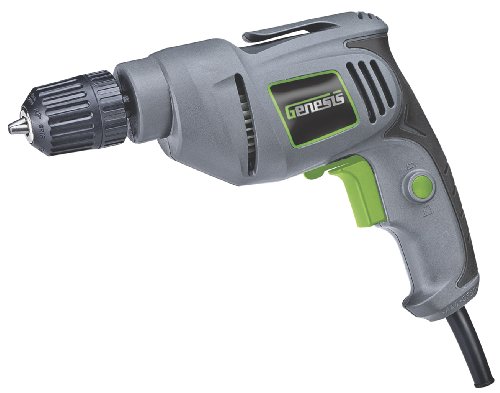
Best for: high-speed drilling in wood and plastic Skip it if: you drive a lot of screws
Two numbers make this one interesting. It lists 0-3,000 RPM, the highest ceiling in the set, and 2.14 lb, the lightest weight. High RPM and low mass is exactly the combination you want for small-diameter holes in softwood, plywood and plastic, where speed gives a clean edge and light weight keeps your arm working. Genesis lists a 4.2-amp motor, a reversible direction, a 3/8-inch keyless chuck, a lock-on button, a rubberised non-slip grip and a belt clip, across 2.5 x 9 x 9.5 in.
The belt clip is a small thing that changes ladder work, because you stop setting the drill down on a rung. The 2 year manufacturer warranty with US-based customer support is published, which two of the entry picks here do not manage.
Why it is the runner-up rather than higher: no clutch, and the smallest motor in the group at 4.2 amps. A trigger alone gives you speed control without a torque cutoff, so driving screws depends entirely on your reflexes. Reversible helps with backing a screw out, but it does not stop you overdriving one. It is also corded, and next to the AVID POWER it swaps clutch control and a battery for raw RPM.
Pros:
- 0-3,000 RPM, highest published ceiling here
- Lightest tool in the set at 2.14 lb
- 2 year warranty with US-based support
- Belt clip and lock-on button
- Reversible motor for backing screws out
Cons:
- No clutch, so screws are easy to overdrive
- 4.2-amp motor, smallest in this group
- Corded and slowest seller of the six
- No bits included in the box
Two speeds or one trigger: which setup wins?
This is the split that decides most of the list. A single-range tool asks one trigger to cover everything. A two-range gearbox gives you a mechanical low gear and a mechanical high gear, and the trigger modulates inside each.
Look at what the picks publish:
- Single range, low: AVID POWER at 0-550 RPM. All driving, no speed.
- Single range, high: Genesis at 0-3,000 RPM and DEWALT DWD115K at 0-2,500 rpm. All drilling, no torque control.
- Two ranges: DEWALT DCD771C2 at 0-450 and 1,500 rpm claimed, and COMOWARE with two claimed speed ranges.
- Trigger plus preset cap: Hammerhead, where the selector limits the top of the trigger's travel.
If your work is mixed, the two-range tools are the safer default, and that is the case for the DEWALT DCD771C2 as the best variable speed cordless drill for someone who drills and drives in the same afternoon. If your work is almost all fastening, a low single range plus a good clutch beats a gearbox you never shift, and that is why the AVID POWER wins overall for household jobs.
Corded or cordless: which side of this list are you on?
Three of these run on batteries and three plug in. The honest test is not power, it is where you stand while you work.
Choose cordless if you work outdoors, on a ladder, in a crawlspace, or anywhere an extension cord becomes a trip hazard. The best variable speed cordless drill for that life is the AVID POWER, or the DEWALT DCD771C2 if you want the wider chuck. Cordless costs you runtime: the COMOWARE ships one 1500mAh pack, and the DEWALT arrives with two 1.3Ah packs, which is why two small batteries often beat one larger one.
Choose corded if you drill for an hour at a stretch in a garage or basement with an outlet in reach. The Hammerhead's 7.5-amp motor and DEWALT's 8-amp motor never fade, never need charging, and never age out of a battery platform. The Genesis at 2.14 lb is the lightest thing here precisely because there is no pack on the bottom.
The cord also buys you masonry. Only the Hammerhead has hammer action, and it is a corded tool. If there is brick in your plans, the choice is made for you.
What the listings leave out
Read what is absent, not just what is printed. Four gaps run through this set.
Weight, sometimes. The DEWALT DWD115K publishes no weight. On a corded drill you will hold overhead, that is the figure you most want.
Warranty, often. Three of six state one: DEWALT DCD771C2 at 3 years, Genesis and Hammerhead at 2 years each. The AVID POWER, COMOWARE and DEWALT DWD115K listings state none. Absence is not the same as none existing, but it is not a promise you can point to either.
Torque, unevenly. AVID POWER lists 280 in-lbs, COMOWARE lists 266 in-lbs, DEWALT cites 300 unit watts out. Those are three different measurements, so you cannot rank them against each other. Compare in-lbs to in-lbs and nothing else.
Kit contents. The AVID POWER lists 22 accessories, COMOWARE 23, Hammerhead 6, and the two DEWALTs and the Genesis list bits nowhere. Add a bit set to your basket for those three.
The verdict
If you assemble furniture, hang shelves, fix cabinet hinges and drill occasional holes in wood, buy the AVID POWER 20V Cordless Drill Set. Its 15+1 clutch and 0-550 RPM trigger are aimed squarely at fasteners, the 22-piece kit means you drill the same day it arrives, and 3.65 lb is easy on a stepladder.
If you drill as often as you drive, and larger bits are in your future, buy the DEWALT 20V Max DCD771C2 instead. Its exact advantage is the gearbox: two published ranges, 0-450 and 1,500 rpm, on a 1/2-inch ratcheting chuck, backed by a 3 year limited warranty and two batteries. You give up the included bits and pay the most in this set.
The cutoff is the chuck. If nothing you own or plan to buy has a shank wider than 3/8-inch, the AVID POWER covers you and saves money. The moment a 1/2-inch spade bit or hole saw enters the picture, the AVID POWER cannot hold it and the DEWALT can.
Two conditions flip both answers. Brick or block in the job means the Hammerhead, the only hammer drill here. No outlet anywhere near your work means cordless only, which cuts the DEWALT DWD115K, the Genesis and the Hammerhead from your list entirely.
FAQ
Is a variable speed cordless drill worth it over a single-speed model?
A variable speed cordless drill is worth it for one reason: control at the start of the cut. Single-speed tools jump straight to full RPM, which walks bits off the mark and mangles screw heads. Every pick here has a variable trigger, and the ones that pair it with a clutch, like the AVID POWER's 15+1 settings, protect your workpiece as well as the fastener.
What is the best variable speed cordless drill for a beginner's first purchase?
The best variable speed cordless drill for a first purchase is the AVID POWER 20V set, because it arrives ready to work. You get 15+1 clutch positions, a 0-550 RPM trigger, a 3/8" keyless chuck and 22 accessories including 10 drill bits and 10 driver bits. On the tightest budget, the COMOWARE offers 25+1 clutch positions and 23 accessories for less.
Does more amps or higher RPM mean a better drill?
More amps and higher RPM describe capacity, not capability. The Genesis reaches a claimed 0-3,000 RPM from a 4.2-amp motor, yet it has no clutch, so overdriving screws is easy. The DEWALT DWD115K's 8-amp motor is the largest here and also has no clutch. Match the specification to the job: RPM for holes, clutch settings for fasteners.
AVID POWER or DEWALT DCD771C2: which should I buy?
Between the AVID POWER and the DEWALT DCD771C2, the deciding factor is chuck size and gearing. AVID POWER gives you a 3/8" chuck, one 0-550 RPM range, 15+1 clutch settings and 22 bits. DEWALT gives you a 1/2" ratcheting chuck, claimed 0-450 and 1,500 rpm ranges, two batteries and a 3 year limited warranty, with no bits at all.
Can these drills handle concrete or masonry?
These drills handle masonry only in one case. The Hammerhead 7.5-amp is the sole hammer drill here, with a 2-in-1 function switch and a 1/2" metal chuck, though Hammerhead states it cannot be used in reinforced concrete walls. DEWALT explicitly lists the DCD771C2 as not suitable for concrete or masonry. The others are wood, plastic and light metal tools.
Start with the chuck and the clutch, in that order, and the rest of the decision falls out on its own. The AVID POWER is the right default for household work because the jobs most people actually face are fastening jobs, and a 15+1 clutch on a 0-550 RPM trigger is built for exactly that, with 22 bits so the first project starts the day the box lands. Widen the scope to 1/2-inch bits or add masonry, and the DEWALT DCD771C2 or the Hammerhead takes over. Check the chuck on the bits you already own before you order anything.
Last updated: September 7, 2026. Product availability re-checked.
This page contains affiliate links. As an Amazon Associate we earn from qualifying purchases, at no extra cost to you.